2026 Current Application, Conditions, Reasons for Refusal, and Extension Guide
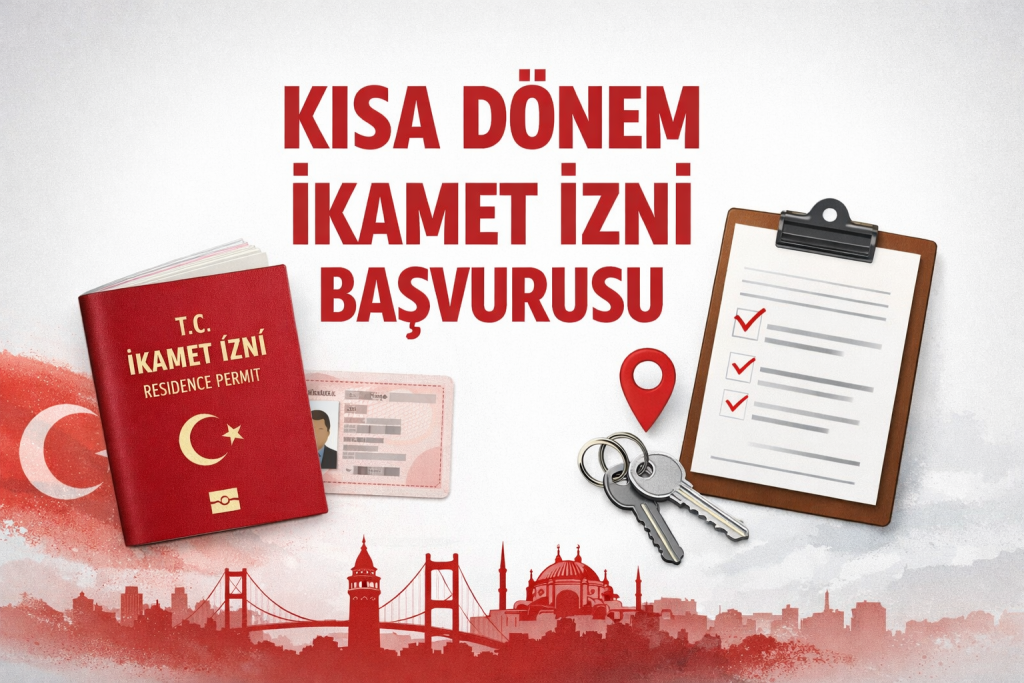
Short-term residence permit is the most common type of residence permit that allows foreigners staying in Turkey for temporary purposes to reside legally. Especially in districts with a high foreign population, such as Istanbul, Tuzla, Pendik, Kartal, and Maltepe, applications and refusal processes for this type of permit are quite frequently observed.
In this guide, you can find answers to all questions regarding short-term residence permits: who is eligible, what documents are required, why they are rejected, how to extend them, and what legal appeal options are available, all in one content.
1. What is a Short-Term Residence Permit?
Definition: Short-Term Residence Permit is a type of residence permit granted to foreigners staying in Turkey for temporary purposes for a specified period. The permit is generally issued for a maximum of two years. However, for some special cases, such as investors and TRNC citizens, the permit duration can extend up to five years. This residence permit is intended for foreigners who will stay for temporary purposes such as scientific research, business connections, tourist visits, education, and medical treatment. (Foreigners and International Protection Law No. 6458, Art. 31)
Application Place and Period: Applications made from within the country are submitted to governorships, while applications made from abroad are submitted to the relevant Turkish consulates. Applications made from within the country must be submitted before the foreigner’s legal stay period expires. Applications must be completed at least 60 days before the expiry of the residence period. (YUKK Implementation Regulation, Art. 21/1-5)
Duration: Normally granted for a maximum period of two years, this permit can be extended up to five years in some special cases (e.g., TRNC citizens and investors). Additionally, for those attending Turkish courses, a residence permit is granted for the duration of the course and can be extended a maximum of two times. (YUKK Implementation Regulation, art. 28/2, art. 28/13)
Legal Basis: This residence permit is regulated by Articles 31-33 of Law No. 6458 on Foreigners and International Protection and Articles 28 and 29 of the YUKK Implementation Regulation. (YUKK art. 31-33; Regulation art. 28-29)
Purpose: It aims to regulate the entry, stay, and residence rights of foreigners coming to Turkey for temporary purposes within a legal framework, and to support the integration process by protecting public order and security. (YUKK art. 31-33)
2. Persons Who Can Be Granted a Short-Term Residence Permit and Their Purposes
Scientific Research (YUKK art. 31/1-a; Implementation Regulation art. 28/2): Granted to foreigners who will conduct scientific research in Turkey. For research requiring permits, such as archaeological excavation works, a permit must be obtained from the Ministry of Culture and Tourism or relevant universities. For research not subject to a permit, submitting a declaration is sufficient.
Immovable Property Owners (YUKK art. 31/1-b; Implementation Regulation art. 28/3): Foreigners who own residential immovable property in Turkey can apply for a residence permit to use these properties. Family members can also apply for the same permit. It is a condition that the property must be suitable for use as a residence. This permit cannot be granted for properties that are not residential.
Commercial Link or Business Establishment (YUKK art. 31/1-c; Implementation Regulation art. 28/4): Granted to foreigners who come to Turkey with the aim of establishing a business or commercial connections. Applications must be made with documents such as invitation letters obtained from commercial partners. In case of a stay exceeding three months, it is mandatory to submit a business opening certificate.
In-Service Training (YUKK art. 31/1-ç; Implementation Regulation art. 28/5): Foreigners who will receive in-service training in an institution or organization in Turkey can obtain a residence permit valid for the duration of the training. Documents showing the content and duration of the training must be submitted.
Education or Exchange Programs (YUKK art. 31/1-d; Implementation Regulation art. 28/6): Foreigners participating in student exchange programs (e.g., Erasmus) in Turkey in accordance with international agreements can obtain a residence permit for the duration of their education. Health insurance is not required for students who have completed their insurance procedures.
Touristic Purposes (YUKK art. 31/1-e; Implementation Regulation art. 28/7): Foreigners coming to Turkey for touristic purposes can apply for a residence permit with documents detailing their duration of stay, accommodation plan, and other relevant information.
Medical Treatment (YUKK art. 31/1-f; Implementation Regulation art. 28/11): Granted to foreigners who will receive treatment in public or private hospitals. A residence permit valid for the duration of the treatment can be obtained. Health insurance is required from foreigners who cover their own treatment expenses.
Stay Subject to Judicial or Administrative Decision (YUKK art. 31/1-g; Implementation Regulation art. 28/12): Granted to foreigners who must stay in Turkey due to a judicial or administrative decision. The duration of stay is determined in accordance with the requirements of the judicial or administrative decision.
Other Purposes (Law on Foreigners and International Protection Art. 31/1-h-j; Implementation Regulation Art. 28/13-14): A short-term residence permit may also be granted to those who will participate in education, internship, or course programs through public institutions, those attending MEB-approved Turkish language courses, and graduates who have completed their higher education in Turkey.
3. Short-Term Residence Permit Application Requirements
Application and Documents (Law on Foreigners and International Protection Art. 32/1-a; Implementation Regulation Art. 28): Applications must primarily be made to the governorship or to consulates when made from abroad. The required documents are determined by the General Directorate, and the applicant must submit these documents completely. Applicants must prepare documents showing the duration of their stay and their accommodation for a valid residence permit application. (Regulation Art. 21/1)
Legal Status (Law on Foreigners and International Protection Art. 32/1-b): Foreigners must not threaten public order and security. A criminal record (certificate) must be submitted if requested. (Law on Foreigners and International Protection Art. 32/1-b; Regulation Art. 21/6)
Accommodation Requirement (Law on Foreigners and International Protection Art. 32/1-c): It is mandatory to provide accommodation that meets general health and safety conditions. Accommodation must be proven with documents such as hotel reservations, rental agreements, or title deeds. (Regulation Art. 22/7)
Address Declaration (Law on Foreigners and International Protection Art. 32/1-d): It is mandatory to declare the address of stay in Turkey, and after obtaining the residence permit, registration must be made to the address registration system. The foreigner must specify a fixed address or accommodation address. (Regulation Art. 22/8)
Health Insurance (Implementation Regulation Art. 28/10): It is required to have valid health insurance in Turkey. For those without health insurance in Turkey, a one-year private health insurance policy is required for renewal at year-end. (Regulation Art. 22/13-14)
4. Application Process and Required Documents
E-Residence and Application Period (Law on Foreigners and International Protection Implementation Regulation, Art. 21/1, 5): Applications made from within the country to governorates, and from abroad to consulates, are received through the e-residence system. The application period is also valid for foreigners who have overstayed their visa by up to 10 days. It is mandatory to submit the application at least 60 days before the expiration of the residence permit.
Documents to be Submitted with the Application: Documents such as an application form, a passport or a document in lieu of a passport, a biometric photograph, a declaration proving financial sufficiency, health insurance, and a document proving payment of the fee must be submitted. (Law on Foreigners and International Protection Art. 33; Implementation Regulation Art. 21/1-5)
5. Reasons for Refusal, Cancellation, and Non-Extension of Residence Permit
Reasons for Refusal (Law on Foreigners and International Protection Art. 32): If the required documents for the application are incomplete or the conditions are not met, the application will be refused. The permit is canceled in cases of use contrary to its purpose or a threat to public order. (Law on Foreigners and International Protection Art. 32/1)
Cases of Cancellation: If there is a deportation order or an entry ban to Turkey for the foreigner, the residence permit will be canceled. If there are diseases that threaten public health, an additional health report may be requested. (Regulation Art. 22/4-5)
Conditions for Non-Extension: Short-term residence permits are not extended in cases where the foreigner’s need to stay in the country ceases. Applications must be made at least 60 days before the expiry of the residence period. (YUKK art. 33/1; Regulation art. 21/6-8)
6. Short-Term Residence Permit Extension Process
Extension Period: The permit can be extended for up to two years at a time. Extension applications must be made at least 60 days in advance. For extensions, valid health insurance and documents proving financial sufficiency must be submitted. (YUKK art. 31/2; Regulation art. 21/6)
Required Documents: For extensions, previous application documents such as valid health insurance, address information, application form, and passport must be resubmitted. (Regulation art. 23)
7. Legal Rights in Case of Refusal and Cancellation
Right to Object and File a Lawsuit (YUKK art. 80-82): Foreigners whose residence permit is refused or cancelled can object to the Directorate General of Migration Management within 60 days. If the Directorate General of Migration Management issues a negative decision, a lawsuit can be filed in the administrative court.
Administrative Procedures: If there is any deficiency in the objection process, the foreigner is granted a 30-day period. The application is finalized within 90 days. (Regulation art. 22/1-2)
8. Refusal of Extension Applications and Legal Process
Reasons for Refusal (YUKK art. 33): Extension applications are refused for reasons such as missing required documents or not being submitted in accordance with the procedure. The Directorate General of Migration Management has the right to refuse. (YUKK art. 33/1)
Appeal and Lawsuit Process: In case of rejection, a lawsuit can be filed within 60 days. During the appeal process, the foreigner is allowed to stay in Turkey and wait until the application is finalized. (YUKK m. 80-82)
9. Transition from Short-Term Residence Permit to Other Residence Permit Types
Transition Conditions: The foreigner must meet the conditions required by the new type of residence permit they wish to transition to. Those transitioning to a family residence permit can apply based on marriage or a child. (YUKK m. 34; Yönetmelik m. 23/2-3)
Application and Submission of Documents: Applications are made through the e-residence system. Documents must be submitted to the Provincial Directorate of Migration Management. (Yönetmelik m. 23/1)
10. Short-Term Residence Permit Application and Extension Costs
Cost : Short-term residence permit application and extension procedures include fees, health insurance, and notary fees. The fees incurred during the application are determined according to the Fees Law No. 492. As of 2024, the total cost to be paid for short-term residence permit application and extension procedures for the applicant foreign national varies approximately between 10,000 TL and 12,000 TL. This cost consists of the residence permit card fee of 565.00 TL, the residence permit fee of 1,040 TL, the single entry visa fee of 5,476.00 TL, an average of 1,800 TL for notary and translation procedures, and health insurance amounts ranging from 1,000 TL to 4,000 TL. Additionally, a residence permit fee of 381.90 TL is applied daily for the first month, and this fee can be a minimum of 381.90 TL and a maximum of 1,962.60 TL for the first month. For months subsequent to the first month, calculations are made by considering fractions of a month as full months. These items are the fees determined during the application process and must be submitted to the Directorate General of Migration Management along with the requested documents.
Payment of Fees: The residence permit fee and card fee must be deposited in the banks specified during the application, and the receipt must be submitted along with the documents. (Regulation Article 21/9, Article 23/4)
Attorney Fee: If legal support is obtained during the application process, attorney fees may also be added to the total cost. An article suggestion.
Kısa Dönem İkamet İzni Kimler İçin Verilir?
Kısa dönem ikamet izni; Türkiye’ye kalıcı yerleşme amacı olmadan, ancak belirli ve geçici bir gerekçeyle gelen yabancılara verilir. En sık verilen durumlar şunlardır:
Turistik amaçlarla Türkiye’de kalmak isteyenler
Türkiye’de taşınmaz (konut) sahibi olan yabancılar
Ticari bağlantı kurmak veya iş geliştirmek isteyenler
Bilimsel araştırma, akademik çalışma yapanlar
Tedavi amacıyla Türkiye’de bulunanlar
Türkçe kursu, staj, hizmet içi eğitim programlarına katılanlar
Mahkeme veya idari karar nedeniyle Türkiye’de kalması gerekenler
Bu izin, genel kural olarak en fazla 2 yıl verilir. Yatırımcılar ve KKTC vatandaşları için bu süre 5 yıla kadar çıkabilir.
Kısa Dönem İkamet İzni Başvuru Şartları Nelerdir?
Başvurunun kabul edilmesi için yabancının:
Yasal giriş yapmış olması,
Geçerli pasaporta sahip olması,
Türkiye’de kalacağı adres ve konaklamayı belgelemesi,
Geçerli sağlık sigortası sunması,
Kamu düzeni ve güvenliğini tehdit etmemesi
gerekmektedir.
Başvurular e-ikamet sistemi üzerinden yapılır ve ikamet süresi bitmeden en az 60 gün önce tamamlanmalıdır. İstanbul’da başvurular İl Göç İdaresi tarafından değerlendirilir; Tuzla, Pendik, Kartal ve Maltepe ilçelerindeki dosyalar da İstanbul İl Göç İdaresi uygulamasına tabidir.
Kısa Dönem İkamet İzni Neden Reddedilir veya İptal Edilir?
Uygulamada en sık karşılaşılan red ve iptal nedenleri şunlardır:
Başvuru amacının inandırıcı bulunmaması
Konaklama veya adres bilgilerinin yetersiz olması
Sağlık sigortasının geçersiz olması
Önceki ikamet izninin amacına aykırı kullanılması
Hakkında sınır dışı kararı veya giriş yasağı bulunması
Dosyada eksik belge olması
Kısa Dönem İkamet İzni Uzatma İşlemi Nasıl Yapılır?

Kısa dönem ikamet izni süresi dolmadan önce uzatma başvurusu yapılabilir. Uzatma işlemleri de e-ikamet sistemi üzerinden yürütülür ve her uzatma en fazla 2 yıl için verilir.
Uzatmada yeniden:
Sağlık sigortası
Adres bilgisi
Mali yeterlilik
belgeleri sunulmalıdır.
Uzatma talebi reddedilirse, yabancının Türkiye’de kalış hakkı tehlikeye girebilir.
Kısa dönem ikamet izni turistik amaçla alınabilir mi?
Evet. Turistik amaçlarla Türkiye’de kalmak isteyen yabancılar kısa dönem ikamet iznine başvurabilir. Ancak son yıllarda turistik başvurular çok daha sıkı denetlenmektedir.
Kısa dönem ikamet izni reddedilirse Türkiye’den çıkmak zorunda mıyım?
Red kararına karşı 60 gün içinde itiraz veya idari dava açılabilir. Dava süresince yabancının Türkiye’de kalmasına çoğu zaman izin verilir.
Kısa dönem ikamet izni ile çalışabilir miyim?
Hayır. Bu izin çalışma hakkı vermez. Çalışmak isteyen yabancının ayrıca çalışma izni alması gerekir.
Kısa dönem ikamet izni aile ikametine çevrilebilir mi?
Evet. Gerekli şartlar sağlanıyorsa kısa dönem ikamet izninden aile ikamet iznine geçiş mümkündür.
Why is Expert Attorney Support Necessary During the Short-Term Residence Permit Process?
Short-term residence permit applications are not merely about document submission. Immigration Administration practices are particularly strict in the Istanbul, Tuzla, Pendik, Kartal, and Maltepe regions. Even the slightest error can lead to a foreigner facing residence rejection, or even deportation proceedings.
The support of an Istanbul foreign lawyer or a Tuzla foreign lawyer;
The correct initial structuring of the file,
The minimization of the risk of rejection,
The proper management of files with a history in a removal center,
And the execution of an effective litigation process against rejection and cancellation decisions
is ensured.
Especially in cases involving contact with the Tuzla Removal Center, the process being managed by an expert Tuzla lawyer is of vital importance. At this point, 2M Hukuk Law Office offers a preventive and strategic approach in the field of short-term residence permits, extensions, rejections, cancellation lawsuits, and foreigners’ law.