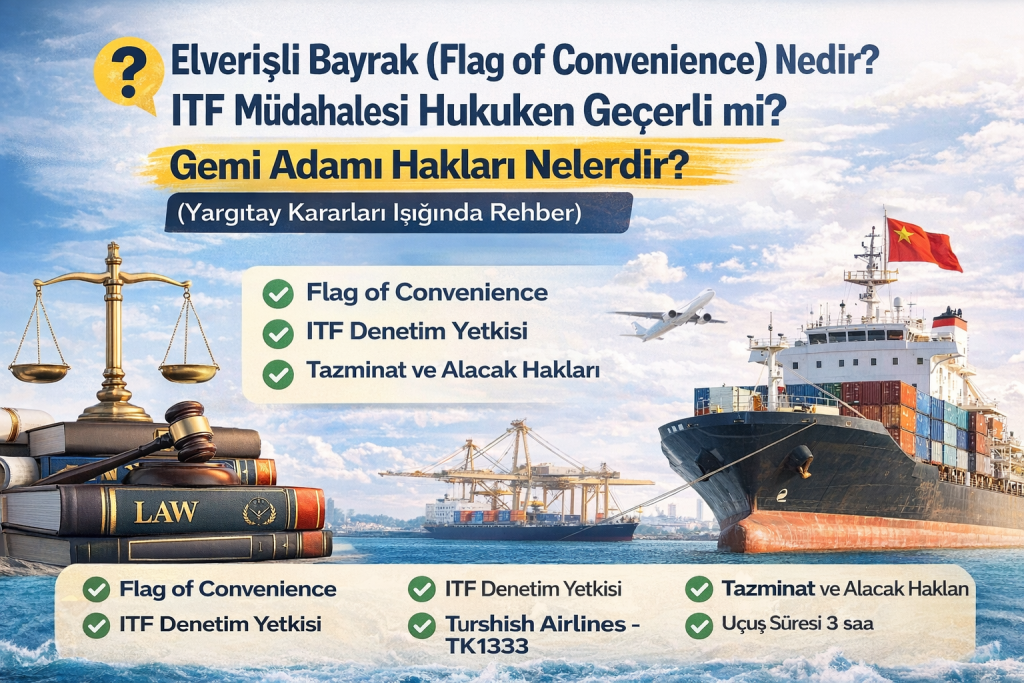
The right to benefit from international protection mechanisms and the legal nature of the International Transport Workers’ Federation’s (ITF) interventions on ships flying a “Flag of Convenience” have been examined below in light of Supreme Court decisions.
Concept of Flag of Convenience and the Role of ITF
According to Supreme Court decisions, “Flag of Convenience” is when a shipowner operates their vessel under the flag of another state. Ships flying the Maltese state flag have been explicitly accepted as flags of convenience in judicial decisions (Supreme Court 9th Civil Chamber, 02.06.2014, E. 2012/10899, K. 2014/17601 ; Supreme Court 13th Civil Chamber, 25.05.2015, E. 2014/21627, K. 2015/16727 ). The International Transport Workers’ Federation (ITF) is an organization that makes decisions regarding employment, working conditions, and occupational safety in the transport sector and protects the interests of transport workers. The ITF is responsible for the operational dimension of the “Flag of Convenience Campaign,” and ITF agreements are only applied to ships flying flags of convenience (Supreme Court 9th Civil Chamber, 17.02.2015, E. 2013/10307, K. 2015/6929 ).
ITF’s Authority for Representation and Supervision
Ships flying flags of convenience are subject to ITF supervision. Even if there is no ITF-affiliated trade union organization in the seafarer’s country, if the seafarer works on a vessel covered by an ITF agreement, the ITF has the authority to represent the seafarer in disputes with the employer (Supreme Court 11th Civil Chamber, 16.11.2015, E. 2015/9878, K. 2015/12047 ). The Supreme Court accepts that ITF officials have the right to intervene if, during inspections on ships in foreign ports (for example, the port of Kaskinen, Finland), they determine that wages and working conditions do not comply with international standards (Supreme Court 3rd Civil Chamber, 02.12.2015, E. 2015/11291, K. 2015/19459 ).
Legal Validity and Binding Nature of Signed Agreements
Following an ITF inspection, contracts (collective or individual employment contracts) signed between the ITF and the ship’s captain representing the shipowner, after the seizure of the vessel due to the wages and working conditions of the seafarers on board not complying with international agreements, are legally valid and binding on the parties. The Supreme Court has emphasized that these contracts are valid within the framework of the principle of freedom of contract (Turkish Code of Obligations Arts. 26-27) (Supreme Court 3rd Civil Chamber, 02.12.2015, E. 2015/11291, K. 2015/19459 ).
The right to benefit from international protection mechanisms and the legal nature of the interventions by the International Transport Workers’ Federation (ITF) on “Flag of Convenience” ships are examined below in light of Supreme Court decisions.
Claims by employers that they signed contracts under duress (coercion and threat) due to the threat of ship detention or boycott are rejected by the Court of Cassation. The decisions clearly state that it is legally not possible to consider actions taken in accordance with international legal rules as a vitiating factor affecting freedom of will (Court of Cassation, 11th Civil Chamber, 08.02.2016, E. 2015/14908, K. 2016/1153 ). Therefore, additional payments made to seafarers based on valid contracts do not constitute unjust enrichment, and employers cannot claim the return of the wages they paid (Court of Cassation, 9th Civil Chamber, 02.06.2014, E. 2012/10899, K. 2014/17601 ).
Additional Context and Evaluations Derived from Secondary Sources
The following information has been compiled from secondary judicial decisions that do not directly rule on the merits but provide indirect context to the issue:
Jurisdiction and Venue Disputes: In unjust enrichment lawsuits filed by employers, claiming that the ITF collected extra wages under coercion and violence with the threat of boycotting the ship, some Court of Cassation decisions focused solely on determining the competent court without delving into the merits. Procedural decisions were rendered stating that such disputes arise from service contracts, and therefore, Labor Courts or Maritime Specialized Courts are competent (Court of Cassation, 17th Civil Chamber, 30.10.2012, E. 2012/5591, K. 2012/11538 ; Court of Cassation, 11th Civil Chamber, 14.02.2011, E. 2009/8659, K. 2011/1504 ; Court of Cassation, 13th Civil Chamber, 14.11.2011, E. 2011/8398, K. 2011/16532 ).
Rejection of Payment Refund: In a lawsuit filed for the refund of payments made due to ITF’s intervention and boycott warning on a foreign-flagged vessel, the local court’s decision to dismiss the case was upheld by the Supreme Court. This decision provides an indirect precedent that ITF-related payments are legally considered non-refundable and indicates that the employer’s claim of coercion was not accepted (Supreme Court 11th Civil Chamber, 06.12.2012, E. 2011/12951, K. 2012/20086 ).
ITF as an Element of Pressure: In another dispute, it was alleged that the ship’s personnel threatened the employer “to report the ship to the ITF” to receive their wages, and the employer made the payment to avoid lengthy bureaucratic procedures. This situation demonstrates that even without an actual intervention by the ITF, international protection mechanisms are used by workers as a means of seeking rights and applying pressure (Supreme Court 13th Civil Chamber, 08.06.2020, E. 2017/8526, K. 2020/4275 ).
International Standards and Trade Union Rights: In other secondary decisions examined (e.g., Constitutional Court, 23.03.2023, Application No: 2016/5002 ; Council of State Administrative Litigation Chambers Board, 24.02.2020, E. 2020/1, K. 2020/35 ; Criminal General Assembly of the Court of Cassation, 17.09.2019, E. 2019/285, K. 2019/554 ), the general framework for trade union organization, collective bargaining, and the freedom to seek redress has been outlined within the scope of ILO Conventions (especially Conventions 87 and 98), the European Social Charter, and ECHR jurisprudence. Furthermore, the annulment of the exclusion of international navigation conditions in maritime transport from the scope of occupational health and safety as being unconstitutional (Constitutional Court, 14.05.2015, E. 2014/177, K. 2015/49 ) indirectly supports the necessity of compliance with international standards (ILO norms) in the maritime sector. However, these decisions do not contain a concrete provision directly related to “Flags of Convenience” vessels or specific interventions by the ITF.
Frequently Asked Questions
ITF’ye şikâyet tehdidiyle gemi personeline yapılan ödeme geri alınabilir mi?
Evet, ancak bu tür ödemelerin geri alınabilmesi için tehdidin (ikrahın) somut ve güçlü delillerle ispatlanması gerekir; aksi halde ödeme geçerli kabul edilir.
Yargıtay 13. Hukuk Dairesi’nin 08.06.2020 tarihli kararına konu olayda; gemi işvereni, personelin ITF’ye şikâyet edeceklerini söyleyerek baskı kurduğunu ve bu nedenle 12.666 USD ödeme yaptığını ileri sürmüştür. İlk derece mahkemesi bu talebi kabul etmiş, ancak Bölge Adliye Mahkemesi davayı reddetmiş ve Yargıtay da bu kararı onamıştır.
Bu kararın ortaya koyduğu temel ilkeler:
👉 ITF’ye şikâyet tehdidi tek başına hukuka aykırı baskı olarak kabul edilmeyebilir
👉 Ödemenin gerçekten tehdit (ikrah) altında yapıldığının açık ve kesin delillerle ispatlanması gerekir
👉 Tutanak, kaptan raporu gibi belgeler tek başına yeterli görülmeyebilir
👉 İspat edilemeyen durumlarda ödeme “haksız ödeme” sayılmaz ve geri alınamaz
📌 Sonuç olarak, Yargıtay bu kararıyla; denizcilik uygulamasında sıkça karşılaşılan ITF şikâyeti tehdidine dayalı ödeme iddialarında ispat standardının oldukça yüksek olduğunu açıkça ortaya koymuştur.
ITF denetimi sonrası gemi adamına ödenen maaş farkları geri istenebilir mi?
Kural olarak hayır. ITF (Uluslararası Taşımacılık İşçileri Federasyonu) denetimi sonrasında yapılan ödemelerin geri istenebilmesi için, bu ödemenin gerçekten hukuka aykırı bir baskı (ikrah) sonucu yapıldığının açık ve güçlü delillerle ispatlanması gerekir. Aksi halde, yapılan ödeme geçerli kabul edilir ve sonradan “sebepsiz zenginleşme” iddiasıyla geri talep edilmesi mümkün olmaz. Özellikle gemide uygulanan sözleşmelerin uluslararası standartlara uygun olmaması halinde yapılan ödemeler, bir eksikliğin giderilmesi olarak değerlendirilmektedir.
Yargıtay 11. Hukuk Dairesi’nin 06.12.2012 tarihli kararına konu olayda; gemi adamlarının ITF yetkililerini gemiye davet etmesi üzerine işveren, bu durumun baskı oluşturduğunu ileri sürerek yaptığı ödemenin iadesini talep etmiştir. Ancak yapılan incelemede, işverenin ITF standartlarına uygun sözleşmeleri ibraz edemediği ve bu nedenle gemi adamlarına maaş farkı ödediği anlaşılmıştır. Bu sebeple Yargıtay, yapılan ödemenin baskı sonucu değil, uluslararası standartlara uyum sağlama amacıyla gerçekleştirildiğini kabul etmiş ve iade talebini reddeden mahkeme kararını onamıştır.
Bu karar, deniz iş hukukunda önemli bir ilkeyi ortaya koymaktadır: ITF müdahalesi sonucunda yapılan ödemeler, gerçekten bir hakka veya eksikliğe dayanıyorsa geri istenemez. Dolayısıyla her ITF süreci baskı olarak değerlendirilmeyip, çoğu durumda işçi haklarının korunmasına yönelik meşru bir denetim mekanizması olarak kabul edilmektedir.
Why is Expert Legal Support Necessary?
International maritime labor law has a multi-layered and technical structure, differing from conventional labor law rules. Particularly, ITF agreements, flag of convenience practices, and disputes involving foreign elements require the joint assessment of both national and international legislation.
In such disputes:
The applicable law (Turkish law or foreign law?) must be correctly determined
The binding nature of the ITF agreement must be correctly analyzed
The jurisprudence of the Court of Cassation and international norms must be evaluated together
To avoid loss of rights, attention must be paid to deadlines and application procedures. A wrong legal strategy can lead to the seafarer completely losing their wages, compensation, and other rights. Therefore, it is of critical importance that the process is managed by a maritime labor law attorney specialized in the field.
Istanbul Seafarer Lawyer – Tuzla Seafarer Lawyer Support
In Istanbul, the center of the maritime sector, and especially in the Tuzla region, disputes faced by seafarers are quite common.
At this point, 2M Law Firm provides seafarers with support in;
ITF-related claims lawsuits
Wage and overtime claims
Contractual disputes
professional legal support on issues such as international maritime labor law problems. Especially for those seeking an Istanbul seafarer lawyer and a Tuzla seafarer lawyer, sectoral experience makes a big difference.