Introduction
What is a concordat? Who can apply for a concordat? This study, formed by the analysis of various first-instance, regional court of justice, and Supreme Court decisions, aims to provide a holistic overview of the definition, application conditions, competent court, process stages, and duration of a concordat.
In court decisions, a concordat is generally defined as an institution of collective enforcement law that allows an honest debtor, who cannot pay their debts when due or is at risk of not being able to pay them, to restructure their debts and continue their commercial activities according to an agreement made with their creditors and approved by the court. In a decision by the General Assembly of Civil Chambers of the Supreme Court, this situation was expressed as follows: “It is a form of collective enforcement substituted for harsh compulsory enforcement methods like seizure and bankruptcy, which occurs with the acceptance by creditors of all ordinary debts of an honest debtor within a certain time frame by the qualified majority specified in the law and with the approval of the competent authority (the court), enabling the debtor to be relieved of a portion of the debt and/or to change the payment method in favor of the debtor.”
1. Definition and Purpose of Concordat
Court decisions define concordat as a two-way mechanism that protects both the debtor and the creditor. The main objective is “to protect honest debtors whose financial situation has deteriorated due to reasons beyond their control.” This institution offers the debtor a legal remedy “to be able to pay their debts by granting maturity or making a reduction, or to avoid a potential bankruptcy.” The Court of Appeals has characterized concordat as “a mitigated enforcement procedure compared to bankruptcy” and “a collective enforcement institution aimed at the equal satisfaction of creditors.” Thus, while the aim is for the debtor to continue commercial activities, preserve employment, and contribute to the economy, it is also intended for creditors to collect more than they would in the event of the debtor’s bankruptcy.
2. Applicants and Competent/Authorized Court
The decisions emphasize that the scope of persons who can apply for concordat is broad. The phrase “any debtor” in Article 285 of the EBL covers “all real persons, regardless of whether they are legal entities or merchants.” The decisions also state that real persons who are joint and several guarantors for company debts can apply for concordat. Furthermore, in addition to the debtor, “any creditor who can file a bankruptcy petition may also request the initiation of concordat proceedings against the debtor with a reasoned petition.”
In applications, the competent and authorized court is clearly specified as the Commercial Court of First Instance . Regarding jurisdiction, the decisions make the following distinction:
For debtors subject to bankruptcy: With reference to Article 154 of the EBL, the Commercial Court of First Instance located at the debtor’s center of business operations.
For debtors not subject to bankruptcy: The Commercial Court of First Instance at the debtor’s domicile.
3. Conditions for Concordat Application and Approval
Judicial decisions require the existence of a series of conditions for the concordat process to commence and conclude successfully. These conditions differ for the application and approval stages.
Application Conditions:
Financial Situation: It is sufficient for the debtor to “be unable to pay their debts when due, or to be at risk of being unable to pay them when due.” The condition of over-indebtedness is not required.
Submission of Documents: It is mandatory to submit all documents listed in Article 286 of the EBL along with the application petition. These documents include a preliminary concordat project, detailed balance sheet, income statement, lists of creditors and debtors, and an independent audit report.
Realistic Project: The submitted preliminary project is expected to demonstrate “the chance of success of the concordat,” meaning it should create a reasonable conviction in the court that the debtor’s financial situation can improve.
Approval Conditions (EBL Art. 305): It is consistently emphasized in decisions that all of the following cumulative conditions must be met for the concordat to be approved by the court:
“The amount offered must be greater than the probable amount creditors would receive in case of the debtor’s bankruptcy.”
The proposed amount should be proportionate to the debtor’s resources.
The concordat project must have been accepted by the qualified majority stipulated in Article 302 of the EBL. This majority is defined as “a) a majority exceeding half of the registered creditors and claims, or b) a majority exceeding one-fourth of the registered creditors and two-thirds of the claims.”
The full payment of privileged claims and the fulfillment of debts arising during the moratorium period must be sufficiently secured.
The litigation costs and the confirmation fee must have been deposited by the debtor into the court’s treasury.
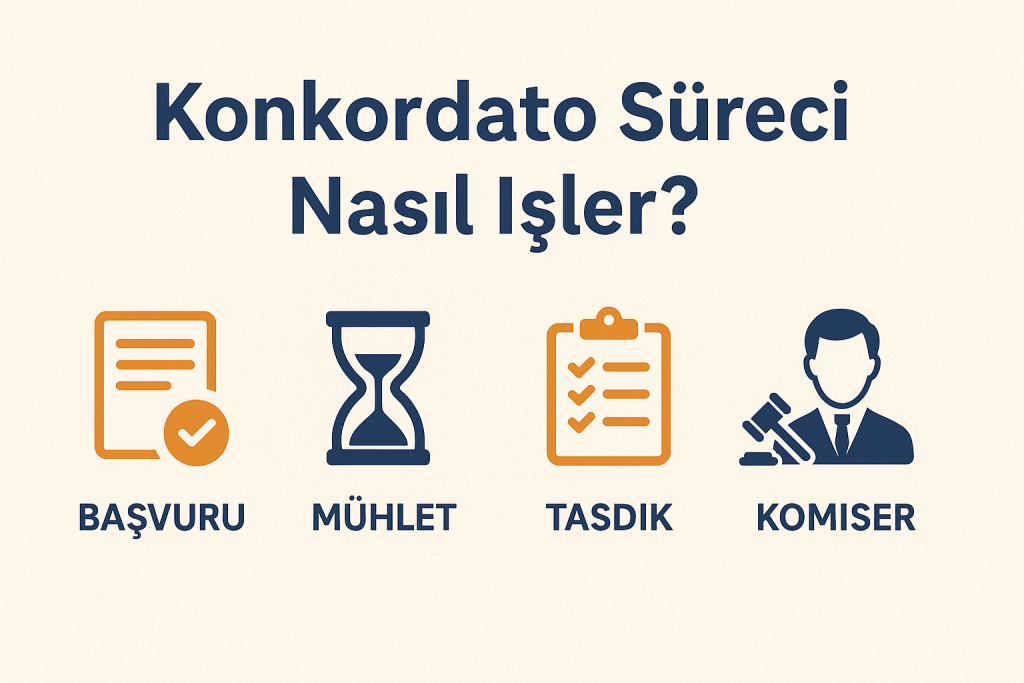
4. Stages of the Concordat Process
According to the decisions reviewed, the concordat process consists of the following main stages:
Application and Provisional Moratorium: The debtor or creditor applies to the Commercial Court of First Instance with the necessary documents. If the documents are complete, the court immediately grants a 3-month provisional moratorium and appoints a provisional commissioner committee of one or three persons.
Extension of Provisional Moratorium and Definitive Moratorium: The provisional moratorium can be extended for a maximum of 2 additional months upon the request of the debtor or the commissioner. During this period, the commissioner examines the debtor’s financial situation and submits their report. The court, “if the concordat is deemed likely to succeed, grants the debtor a one-year definitve moratorium.”
Definitive Moratorium and Creditors’ Meeting: During the definitive moratorium, the commissioner invites creditors to a meeting. At this meeting, the debtor’s project is discussed and put to a vote.
Confirmation Proceedings and Decision: If the project is accepted by the majority required by law, the commissioner submits the file to the court with a reasoned report. The court decides whether to confirm or reject the concordat by evaluating whether the conditions for confirmation have been met.
Supervision and Termination: Following the confirmation decision, a trustee may be appointed to oversee the implementation of the project. If the debtor fails to comply with the project, “any creditor whose claim has not been fulfilled according to the concordat project can apply to the court that confirmed the concordat and have the concordat terminated with respect to them.”
The decisions also drew attention to a special situation called “in-bankruptcy concordat.” In this type, since a concordat is requested after the bankruptcy decision is rendered, “neither a concordat grace period is granted nor a concordat commissioner is appointed.”
5. Concordat Period
The concordat period should be addressed under two different headings: the grace periods during the proceedings and the payment due date of the confirmed project:
Grace Periods: The law stipulates definite periods for the completion of the process within a reasonable time. The provisional grace period can last a maximum of 5 months (3+2), and the definite grace period can last a maximum of 1 year 6 months (1 year + 6 months). The Supreme Court stated that the legislator “stipulated very short and definite periods” and that its purpose was “to finalize the concordat process as soon as possible.”
Payment Plan Duration: The debt repayment term in the approved concordat project is completely independent of the grace periods. In the examined decisions, it is observed that debts are decided to be paid according to the approved projects as “in 36 equal installments”, “in 48 months”, “in 60 months”, or “within 60 months, including a 12-month non-payment period”. This period is determined according to the debtor’s financial structure and the content of the project.
Conclusion
In light of judicial decisions, concordat is a meticulously regulated legal institution that offers a vital lifeline for honest debtors on the verge of bankruptcy, and an opportunity for creditors to collect their receivables at a higher rate compared to bankruptcy. The success of the process depends on the debtor’s honesty, the realism of the proposed project, the approval of the qualified majority of creditors, and strict adherence to the procedures and principles specified in the Enforcement and Bankruptcy Law. Commercial Courts of First Instance assume a supervisory and regulatory role at every stage of the process, ensuring both the protection of the debtor’s assets and the safeguarding of creditors’ rights. While definite grace periods determined by law prevent the process from dragging on, flexible payment terms in approved projects allow for the creation of a solution suitable for the debtor’s financial structure. A article suggestion.
Why is Expert Lawyer Support Necessary?
The concordat process is not merely a debt restructuring method; it is a collective enforcement procedure subject to strict formal requirements in the Enforcement and Bankruptcy Law, requiring technical expertise and being prone to procedural errors. When court decisions are examined, the most common errors leading to the rejection of the concordat request or the failure of the process are: incorrectly prepared preliminary project, incomplete documents submitted, wrongly chosen competent court, failure to secure the qualified majority, erroneous management of the commissioner process, and incorrect classification of creditors.
Therefore, for businesses operating in areas with high commercial density such as Istanbul, Tuzla, Pendik, Kartal, Maltepe, Kadıköy, Ataşehir, Ümraniye, and Gebze, the management of the concordat process by an expert lawyer is of critical importance. Because a small legal error made at any stage of the process can lead to the debtor losing concordat protection, the lifting of the stay, and directly facing the risk of bankruptcy.
2M Hukuk Law Office provides professional legal support in matters such as preparing concordat applications, auditing the legal compliance of financial documents, developing strategies in line with commissioner reports, managing creditor meetings, preparing petitions and objections to be submitted to the court, conducting the approval stage, and monitoring the supervision process after concordat.
Expert lawyer support is mandatory for the following reasons:
The preliminary project must be prepared in accordance with Article 286 of the EBL and be economically viable.
Even minor errors in independent audit reports, balance sheets, and debt lists can lead to the rejection of the application.
Incorrect classification of creditors, failure to secure a qualified majority, and improperly drawn up meeting minutes make ratification impossible.
Incorrect determination of the distinction between secured, privileged, and unsecured debts invalidates the legal validity of the concordat project.
Failure to properly manage the commissioner’s process creates the risk of the moratorium being lifted.
In the court’s review, the inability to accurately present the debtor’s financial structure weakens the likelihood of ratification.
Concordat is an area of private law that requires technical knowledge, strategic planning, and financial analysis. Therefore, **working with a lawyer experienced in concordat law** from beginning to end of the process is of vital importance for the debtor to continue their commercial life.