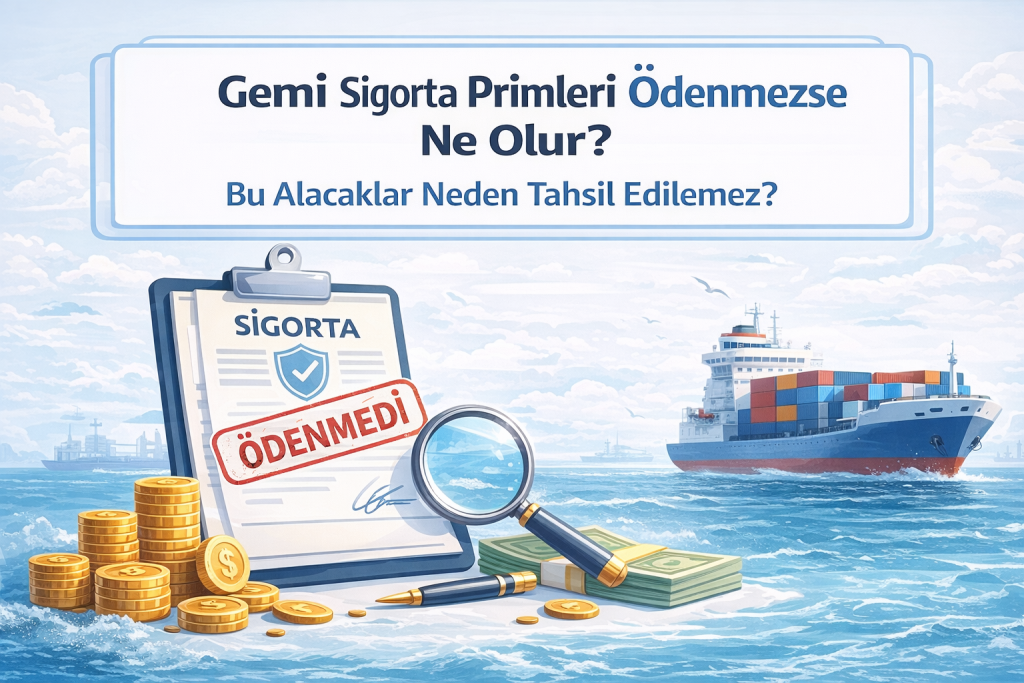
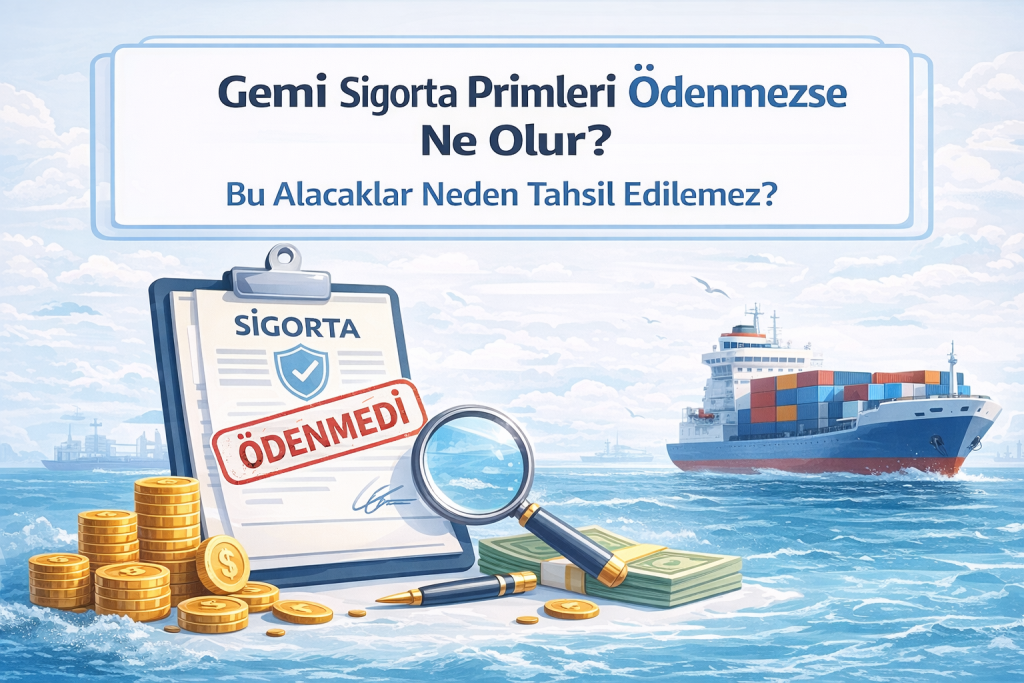
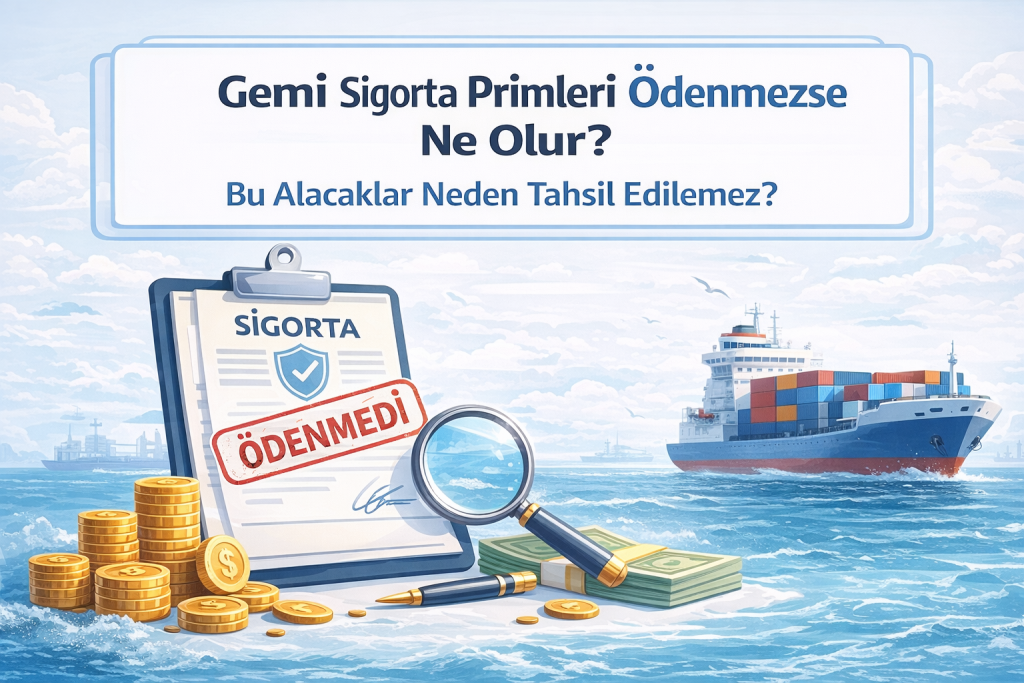
Hull insurance, P&I (Protection & Indemnity) and mutual insurance club contributions, despite being explicitly considered a maritime claim under the Turkish Commercial Code; in practice, a significant portion of these receivables is either collected late or cannot be collected at all. The main reason for this is the improper legal characterization of insurance premiums and targeting the wrong party.
Hull insurance, P&I (Protection & Indemnity) premiums, and mutual insurance club contributions are explicitly recognized as maritime claims under the Turkish Commercial Code. However, in practice, a significant portion of these receivables is either collected late or cannot be collected at all. The main reason for this is the improper legal characterization of insurance premiums and directing claims against the wrong party.
1. Legal Basis and Nature of Maritime Claim
In accordance with Article 1352/1-r of the Turkish Commercial Code No. 6102 (TCC), “insurance premiums, including mutual insurance contributions, payable by or on behalf of the owner of the ship” are explicitly defined as maritime claims. Court decisions consider this provision an indispensable financial obligation for the operation of the ship. Antalya 1st Commercial Court of First Instance (2017/611 E., 2019/818 K K.), has characterized the taking out of an insurance policy against accident risk during the operation of vessels at sea as “a mandatory expense” and “a prudent commercial necessity” . The Court ruled for the annulment of the objection by including the hull insurance costs paid in this context in the maritime claim calculation.
Pursuant to Article 1352/1-r of the Turkish Commercial Code No. 6102 (TCC), “insurance premiums, including mutual insurance contributions, payable by or on behalf of the shipowner” are explicitly defined as maritime claims. Judicial decisions consider this provision as an indispensable financial obligation for the operation of a vessel.
The Antalya 1st Commercial Court of First Instance (File No. 2017/611 E., Decision No. 2019/818 K.) characterized the procurement of insurance policies against accident risks during the maritime operation of vessels as a “mandatory expense” and a “prudent commercial necessity.” Within this scope, the court included the hull insurance premiums paid in the calculation of maritime claims and ruled for the annulment of the objection.
2. Commercial Necessity of Insurance Premiums and Operating Agreements
The 11th Civil Chamber of the Court of Appeals emphasized that insurance premiums are a “commercial necessity” for a vessel to put to sea and accept cargo (File No. 2012/7604 E., Decision No. 2012/12075 K K.). This necessity is also reflected in ship operating agreements. In a decision of the 11th Civil Chamber of the Court of Appeals (File No. 2014/9401 E., Decision No. 2014/17531 K K.), it was stated that if the ship operator fails to fulfill their obligation to pay insurance premiums, leading to the vessel losing its insurance coverage and sinking, the operator will be held liable for the resulting damage. In a similar case, the inability to receive insurance compensation due to a delay in premium payment led to the operator being found 50% at fault and served as a reason for the payment of compensation (File No. 2018/3642 E., Decision No. 2018/5710 K.).
The 11th Civil Chamber of the Court of Cassation has emphasized that insurance premiums constitute a “commercial necessity” for a vessel to put to sea and accept cargo (File No. 2012/7604 E., Decision No. 2012/12075 K.). This obligation is also reflected in ship management agreements.
In one of its decisions (File No. 2014/9401 E., Decision No. 2014/17531 K.), the 11th Civil Chamber of the Court of Cassation held that where a ship operator fails to fulfill the obligation to pay insurance premiums, resulting in the vessel being deprived of insurance coverage and subsequently sinking, the operator shall be held liable for the resulting damage.
In a similar case, the failure to obtain insurance compensation due to delayed payment of premiums was deemed to constitute 50% fault on the part of the operator, forming the basis for an award of damages (File No. 2018/3642 E., Decision No. 2018/5710 K.).
3. P&I (Protection and Indemnity) Insurances and Mutual Insurance Contributions
Another important item considered within the scope of a maritime claim is the contributions paid to mutual insurance clubs (P&I Clubs). The 11th Civil Chamber of the Court of Cassation (File No. 2016/10458 E., Decision No. 2018/2781 K), has confirmed that if the protection and indemnity insurance premiums undertaken by the ship operator are not paid, the insurance company can exercise its right of termination and claim the outstanding premium receivables through enforcement proceedings. P&I insurances operate according to mutual insurance principles to fund the shipowner’s financial liabilities (crew compensation, environmental pollution, third-party damages) (File No. 2013/4536 E., Decision No. 2013/21540 K).
4. Collection of Premium Receivables, Broker Authority and Statute of Limitations
The authority of brokers and agents in the collection of insurance premiums is frequently debated in legal proceedings. The Supreme Court states that for brokers to be able to collect premiums, there must be a clear assignment or authorization obtained from the insurance company (2016/2832 E., 2017/1694 K K.). In a dispute regarding the Trakya vessel, it was accepted that the broker could file a premium claim lawsuit based on the assignment agreement, but termination dates and premium revisions were taken into account in the calculation (2023/1538 E., 2024/1145 K K.). Furthermore, a 2-year statute of limitations period is stipulated for insurance premium receivables under Article 1268 of the Turkish Commercial Code (TTK) (2008/12607 E., 2010/3712 K.).
5. Contextual Information Obtained from Secondary Sources
The following matters have been evaluated based on secondary sources due to limited information in the decision texts:
Competent Court: In disputes arising from insurance premiums and marine insurance, Maritime Specialized Courts are competent according to TTK Article 1352 and Article 5/2. The Istanbul Regional Court of Justice 43rd Civil Chamber (2024/1636 E. ) and Istanbul 20th Commercial Court of First Instance (2022/129 E. K), have issued decisions of non-jurisdiction in marine insurance-related claims such as insurance compensation and wreck removal, sending the files to the specialized courts.
P&I Club Mechanism: In P&I club insurances, the “Pay To Be Paid” (Pay to be Paid) rule applies, and for a member (shipowner) to claim compensation, it is expected that they first cover the loss themselves or fulfill their contribution obligations (BAM 43. HD, 2024/1636).
Mortgagee’s Interest: Banks that are ship mortgagees, in order to protect their own interests if the shipowner does not take out insurance, can pay premiums in the capacity of “insured party” and these expenses are evaluated within the context of maritime commercial law (BAM 13. HD, 2024/859
Conditions for Precautionary Attachment: In claims for the recourse collection of deductible amounts under an insurance policy from the shipowner, requests for precautionary attachment may be rejected if the liquidity and maturity of the receivable cannot be fully proven (Yargıtay 11. HD, 2014/15126 Source).
Conclusion Court decisions, in accordance with Article 1352/1-r of the TCC, consider insurance premiums and mutual insurance contributions as essential costs for the operation of the vessel and accept these items as maritime claims. Non-payment of premiums is not only subject to a claim for debt, but also due to the loss of the vessel’s insurance coverage, can lead to severe compensation liabilities for the shipowner or operator.
Frequently Asked Questions
P&I kulübü aidatları gerçekten gemi alacağı sayılır mı?

Evet. Yargıtay içtihatlarına göre, karşılıklı sigorta kulüplerine (P&I Clubs) ödenen aidatlar geminin işletilmesi için zorunlu ve vazgeçilmez maliyetlerdir. Ancak P&I sisteminde geçerli olan “Pay to be Paid” (Öde ki Ödensin) kuralı nedeniyle, donatan aidatını ödemeden kulüpten tazminat talep edemez. Bu da prim ödenmediğinde hem sigorta korumasının hem de ticari faaliyetin durmasına yol açar
Sigorta brokeri prim alacağını doğrudan tahsil edebilir mi?
Hayır, her zaman değil. Yargıtay’a göre brokerin prim tahsil edebilmesi için sigorta şirketinden açık bir temlik veya yetki belgesi bulunmalıdır. Aksi halde broker tarafından açılan davalar husumet yokluğu nedeniyle reddedilir. Uygulamada birçok prim alacağının tahsil edilememesinin nedeni, brokerin yetkisinin dava dosyasında ispatlanamamasıdır.
Gemi sigorta primlerinde zamanaşımı ne kadar?
Sigorta prim alacakları için TTK m. 1268 uyarınca 2 yıllık zamanaşımı uygulanır. Bu süre, çoğu zaman yanlış hesaplanmakta veya fesih–revizyon tarihleri dikkate alınmadan dava açılmaktadır. Zamanaşımı süresinin kaçırılması, alacağın tamamen ortadan kalkmasına neden olur.
Why is Expert Legal Support Necessary?
Although insurance premiums and P&I contributions are theoretically among the “clearest maritime claims,” in practice, they are one of the items **most frequently lost in lawsuits**. The reason for this is;
Incorrect distinction between owner / operator
Inability to prove broker’s authority
Statute of limitations errors
Filing a lawsuit in the wrong competent court
such as inadequate preparation of conditions for preliminary attachment, these are **technical but fatal errors**.
Especially in port areas such as **Istanbul**, **Tuzla**, **Tuzla Shipyard**, **Ambarlı**, **Pendik**, **Aliağa**; ships can change hands quickly, operational structures change rapidly, and insurance debts turn into disputes in a chain reaction. Therefore, insurance premium receivables should not be pursued with **general enforcement logic**, but with reflexes specific to maritime commercial law.
At this point, **2M Law Firm**, which has extensive practical experience in maritime claims, ship arrest, and insurance premium disputes, is among the prominent law firms in the Istanbul and Tuzla port region for **quickly securing and collecting** such receivables.