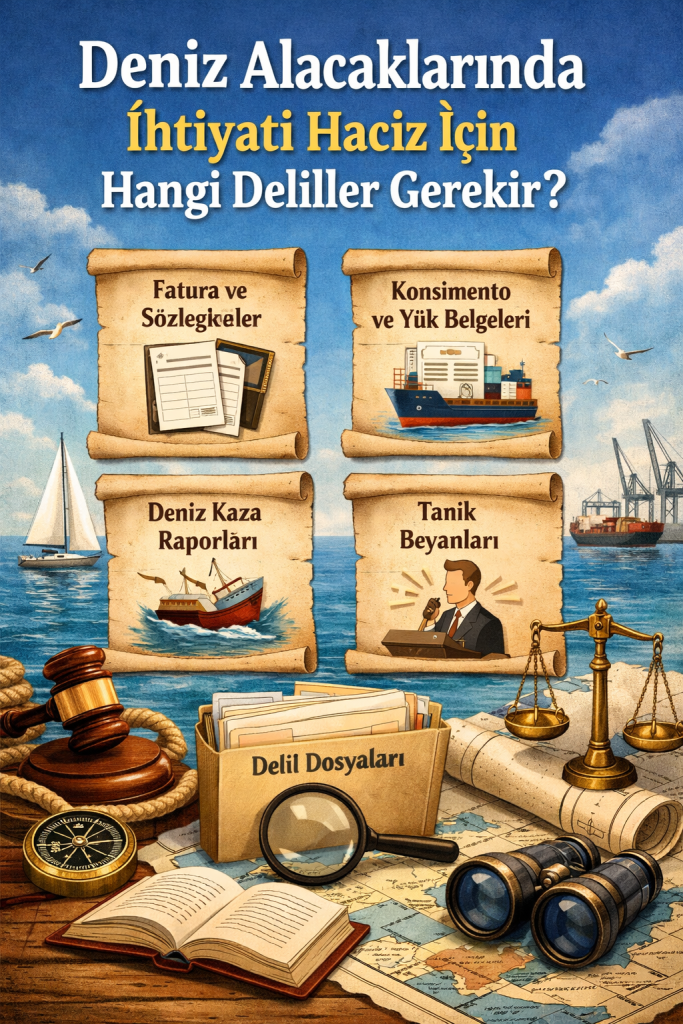
1. Legal Basis and Standard of Proof
Pursuant to Article 1362 of the Turkish Commercial Code (TCC) and Article 258 of the Enforcement and Bankruptcy Law (EBL), in requests for provisional attachment related to maritime claims, the creditor is obliged to present evidence that will convince the court regarding the existence and amount of the claim. In judicial decisions, this burden of proof is referred to as “approximate proof” (approximate proof); while full and definitive proof is not sought, it is considered sufficient to demonstrate the existence of the claim as “highly probable” or to present “strong convincing indications” (Court of Appeals 11th Civil Chamber-2014/13476 K, Regional Court of Appeals Istanbul 12th Civil Chamber-2023/987 K).
2. Analysis of Evidence Presented According to Types of Maritime Claims
Loss or Damage to Goods (TCC art. 1352/1-f, g, h):
Accepted Evidence: Bills of lading (especially those marked “Clean On Board”), invoices, survey reports, ship agency correspondence, expert reports, damage assessment reports, silver nitrate test photographs, and bank receipts have been deemed sufficient for prima facie evidence (Court of Cassation 11th Civil Chamber-2014/13476 D, Regional Court of Justice Istanbul 43rd Civil Chamber-2022/666 D).
Situations for Rejection: Claims may be rejected in cases where the amount of damage cannot be determined due to the notations “weight, quantity, and value unknown” (unknown) on the bill of lading, or if there is insufficient evidence indicating that the damage occurred during transportation (Regional Court of Justice Istanbul 12th Civil Chamber-2020/117 D). Furthermore, conflicting bills of lading and the uncertainty of the legitimate holder are also grounds for rejection (Regional Court of Justice Adana 9th Civil Chamber-2021/2071 D).
Seafarers’ Wages and Labor Claims (TCC art. 1352/1-o):
Accepted Evidence: Seafarer employment contracts (especially those bearing the ship’s seal), service documents, passport records, SGK (Social Security Institution) termination records, and claim confirmation documents issued by the captain have been deemed sufficient for prima facie evidence (Regional Court of Justice Istanbul 14th Civil Chamber-2021/2135 D, Regional Court of Justice Istanbul 13th Civil Chamber-2022/1202 D).
Rejected Cases: Provisional attachment requests are rejected if it cannot be determined whether the employment contract is still ongoing, or if the calculation of additional payments (claims other than the base salary) requires litigation (BAM Istanbul 12. HD-2021/1141 K, BAM Istanbul 12. HD-2021/62 K).
Fuel, Material, and Service Supply (Turkish Commercial Code art. 1352/1-l):
Accepted Evidence: Fuel invoices, fuel delivery receipts (bunker delivery receipts), dispatch notes, delivery records, fuel purchase ledger entries, and payment receipts constitute sufficient conviction in court (BAM Istanbul 13. HD-2019/253 K, BAM Antalya 11. HD-2017/561 K).
Rejected Cases: It has been accepted that the condition of prima facie evidence is not met when there is an ongoing “current account” relationship between the parties and the net amount of receivables can only be determined through litigation due to installment payments (BAM Istanbul 12. HD-2021/501 K).
Ship Repair, Maintenance, and Shipyard Services (Turkish Commercial Code art. 1352/1-m, n):
Accepted Evidence: Repair contracts, service reports, job delivery records, and invoices have been found sufficient to prove the nature and amount of maritime claims (BAM İstanbul 14. HD-2018/66 K, BAM Antalya 11. HD-2022/134 K).
Collision and Infrastructure Damages (Turkish Commercial Code Art. 1352/1-a, d):
Accepted Evidence: Captain’s reports, marine accident reports, survey and camera inspection reports, cost tables, and price quotes obtained from contractor companies constitute sufficient evidence for prima facie proof (BAM İstanbul 12. HD-2023/987 K, BAM İstanbul 12. HD-2020/751 K).
3. Courts’ Criteria for Evidence Assessment
Fact Requiring Litigation: If there are serious discrepancies among the documents submitted regarding the existence of the claim or if the claim is illiquid and requires complex calculations, courts reject the request on the grounds of “a situation necessitating litigation” (BAM İstanbul 13. HD-2021/38 K, BAM İstanbul 13. HD-2024/831 K).
Nature of Documents: Unilaterally issued invoices, if not supported by delivery notes, correspondence, or other collateral evidence (e.g., WhatsApp records or emails), may be deemed insufficient by courts for prima facie evidence (BAM İstanbul 13. Civil Chamber – 2019/899 Decision, BAM İstanbul 43. Civil Chamber – 2022/693 Decision).
Limit of Objections: Claims of “forgery” or “related to the merits of the debt” presented during the provisional attachment objection phase are generally not considered among the limited grounds for objection under EBL Art. 265 but are evaluated as the subject of the main lawsuit (BAM İstanbul 43. Civil Chamber – 2022/266 Decision).
4. Secondary Sources and Additional Context
The following points have been evaluated as secondary sources that do not directly rely on maritime receivables reports but shed light on general provisional attachment and evidence presentation principles:
Fee Procedure: In provisional attachment requests, the full payment of the application fee has been emphasized as a procedural prerequisite for a lawsuit, even before evidence regarding the existence of the receivable is presented (BAM Denizli 4. Civil Chamber – 2025/518 Decision).
Commercial Books and Records: It has been stated that in general commercial receivables, in addition to invoices and current account statements, BA/BS forms and unsigned reconciliation letters can also be used as supporting evidence for approximate proof (BAM Istanbul 12th Civil Chamber-2024/1221 Decision).
Logistics and Storage: It has been stated that in logistics services other than maritime trade, the sole submission of e-archive invoices may not be sufficient to form a “swift” opinion without collecting the opposing party’s evidence (BAM Istanbul 12th Civil Chamber-2023/1578 Decision).
Frequently Asked Questions
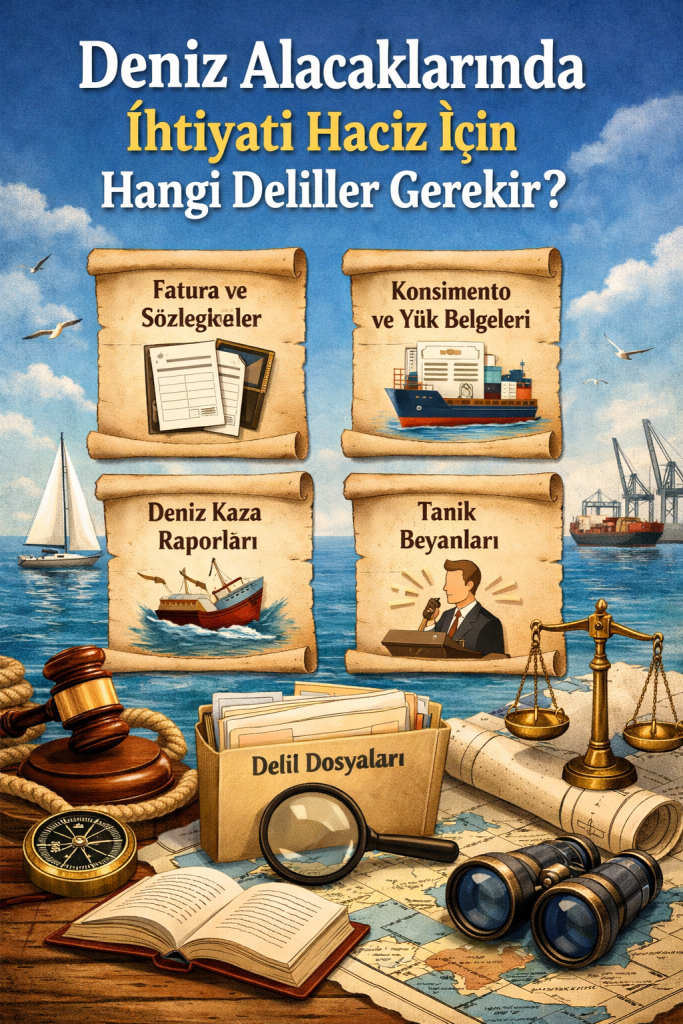
Conclusion: Pursuant to Article 1362 of the Turkish Commercial Code (TCC), for a preliminary attachment decision to be granted in maritime receivables, the creditor must “approximately” prove that the receivable falls within the scope of the list in Article 1352 of the TCC and its monetary value with concrete data such as an invoice, contract, survey report, or delivery document. If the evidence is contradictory or if the existence of the receivable requires an in-depth adjudication, the request is rejected.
Deniz alacağı için ihtiyati haciz alırken “yaklaşık ispat” ne demektir?

Deniz alacaklarında ihtiyati haciz talep eden alacaklıdan tam ve kesin ispat beklenmez. TTK m. 1362 ve İİK m. 258 uyarınca aranan ispat standardı **“yaklaşık ispat”**tır. Bu; alacağın gerçekten var olduğunun kuvvetle muhtemel olduğunu, mahkemede kanaat uyandıracak güçlü emarelerle göstermeyi ifade eder. Yani mahkeme, “bu alacak büyük ihtimalle vardır” sonucuna varabilmelidir. Ancak soyut iddialar veya tek başına fatura yeterli değildir.
Yük hasarı veya ziyaı varsa ihtiyati haciz için hangi belgeler yeterlidir?
Eşyanın zıyaı veya hasarına dayanan deniz alacaklarında mahkemeler özellikle şu belgelere önem verir:
Clean On Board konşimento
Sörvey (survey) raporları
Hasar tespit tutanakları
Gemi acentesi yazışmaları
Banka dekontları ve ticari faturalar
Fotoğraflar (örneğin korozyon, su teması, gümüş nitrat testi)
Buna karşılık; konşimentoda “unknown” (ağırlık/değer bilinmiyor) kaydı varsa veya hasarın taşıma sırasında oluştuğu net gösterilemiyorsa, yaklaşık ispat sağlanamadığı gerekçesiyle ihtiyati haciz reddedilebilmektedir.
Mürettebat ücretleri için ihtiyati haciz almak kolay mı?
Evet, doğru belgeler varsa mürettebat alacakları ihtiyati hacze en elverişli deniz alacakları arasındadır.
Yaklaşık ispat için genellikle yeterli görülen belgeler:
Gemi adamı iş sözleşmesi
Gemi kaptanı tarafından imzalanmış alacak teyitleri
Crew List (mürettebat listesi)
Pasaport ve giriş-çıkış kayıtları
SGK veya benzeri sosyal güvenlik belgeleri
Ancak; çalışılmayan dönem ücretleri, fazla mesai, ikramiye gibi hesaplama gerektiren kalemler söz konusuysa, mahkeme “yargılamayı gerektirir” diyerek ihtiyati haczi reddedebilir.
Yakıt, kumanya veya tersane faturası tek başına yeterli mi?
Çoğu durumda hayır. Mahkemeler tek taraflı düzenlenmiş faturaları, aşağıdaki belgelerle desteklenmediği sürece yetersiz görmektedir:
Teslim tutanakları
Bunker Delivery Receipt (BDR)
Sevk irsaliyeleri
E-posta / WhatsApp yazışmaları
Ödeme dekontları
Özellikle taraflar arasında cari hesap ilişkisi varsa ve net alacak miktarı açık değilse, ihtiyati haciz talebi “alacak yargılamayı gerektiriyor” gerekçesiyle reddedilir.
Çatma, rıhtım, iskele veya altyapı hasarında yaklaşık ispat için hangi deliller aranır?
Bu tür olaylarda mahkemeler şu belgelere ağırlık verir:
Kaptan raporları
Deniz kazası tespit raporları
Kamera kayıtları
Sörvey raporları
Onarım bedeline ilişkin fiyat teklifleri veya keşif raporları
Bu belgelerle zararın olayla illiyet bağı kurulabiliyorsa, yaklaşık ispat şartı sağlanmış kabul edilir.
Why is Expert Legal Support Necessary for Maritime Receivables?
The preliminary attachment process in maritime receivables is fundamentally different from classic commercial receivable cases. In practice, the most common problem faced by creditors is the rejection of preliminary attachment despite the actual existence of the receivable. The main reason for this is the incorrect or incomplete conceptualization of “approximate proof.”
The need for expertise particularly arises at the following points:
A rightful claim can be lost due to wrong evidence
In maritime claims, courts do not issue precautionary attachment orders based solely on an invoice, a unilateral report, or incomplete correspondence. Which document constitutes critical evidence for which type of claim has been shaped by the jurisprudence of the Supreme Court and Regional Courts of Justice. Applications made without this jurisprudential knowledge are often rejected on the grounds of “requiring a trial”.
Incorrect classification of a claim completely nullifies the attachment
Even if a claim genuinely exists;
– basing it on the wrong article of the TCC (Turkish Commercial Code),
– confusing a maritime claim with a ship creditor’s right,
– not correctly distinguishing between a current account and a singular claim
can result in the rejection of the precautionary attachment. These errors subsequently lead to irrecoverable loss of time.
The objection phase is a technical “battle of defense”
After a precautionary attachment is obtained, the debtor party usually immediately objects. A minor procedural error at this stage can lead to the lifting of the granted attachment. It is critically important to know at which stage issues such as forgery, the merits of the debt, and payment claims can be raised.
There is a risk of wrong court, wrong city, wrong timing
In maritime claims, the competent court, authorized port, the actual location of the vessel, and its flag status are of great importance. There are differences in practice in ports such as Istanbul, Tuzla, Ambarlı, Aliağa, and Mersin. An application made in the wrong place can lead to the vessel departing and the attachment becoming practically impossible.
Maritime claims are a “matter of speed”
While a ship is in port today, it might be in another country tomorrow. Therefore, an application for a precautionary attachment must be prepared and submitted correctly within hours. Incomplete or erroneous petitions lead to irreversible consequences.
For this reason, in maritime claims;
– proficient in Supreme Court and Regional Courts of Justice precedents,
– knowledgeable about port and shipyard practices,
– experienced in precautionary attachments
working with a maritime law attorney often becomes as important as the existence of the claim itself.
In this context, Istanbul-based 2M Hukuk Avukatlık Bürosu (2M Law Office), which has extensive experience particularly in the Tuzla Shipyards Region, port, and ship claims, is among the few offices that can provide expert support in precautionary attachment, ship arrest, and debt collection processes for maritime claims.