Introduction
This study examines the rights of relatives (spouse, child, mother, father, etc.) of individuals held under administrative detention in removal centers, how they can exercise these rights, and the steps they need to take in this process, in light of the analyses of judicial decisions provided. A significant portion of the documents reviewed does not directly focus on the rights of relatives of individuals held in Removal Centers (GGM). However, the legal regulations referenced in some decisions and the Constitutional Court’s jurisprudence regarding the family rights of detainees and convicts in penal institutions provide an important framework for the rights of relatives of individuals held in Removal Centers. This study aims to clarify the subject by bringing together direct and indirect findings.
Direct Legal Right: Article 59 of Law No. 6458 on Foreigners and International Protection clearly stipulates that foreigners held in Removal Centers (GGM) must be provided with the opportunity to meet with their relatives, notary, legal representative, and lawyer. This indicates that the right of relatives to visit has a legal basis.
Participation in Legal Processes: Relatives can play a critical role in initiating and following legal processes on behalf of the person held in the Removal Center (GGM). Especially for filing a lawsuit against the deportation decision and the administrative detention decision, securing a lawyer and not missing the legal deadlines (usually 7 days) is of vital importance.
Right to Respect for Family Life: In its decisions concerning detainees and convicts in penal institutions, the Constitutional Court is frequently observed to emphasize the “right to respect for family life” guaranteed by Article 20 of the Constitution and the state’s “positive obligation” to protect this bond. This principle also applies, mutatis mutandis, to individuals held in Removal Centers (GGM) and their families.
Best Interests of the Child: Especially if the person held in a Removal Center (GGM) has a child, the Constitutional Court’s jurisprudence regarding the need to “consider the best interests of the child” is an important point of reference. Administrative authorities and courts are obliged to consider this principle in maintaining family ties.
Problems in Practice: Judicial decisions show that the right to access information (such as a lawyer not being able to find out where their client is detained) and the right of family members to meet each other (such as being held in different rooms in the same center and not being allowed to meet) can be violated in practice.
1. Right to Visit and Communication
Among the reviewed documents, the clearest and most direct information is provided by references to Law No. 6458 on Foreigners and International Protection. Specifically, Article 59 of the Law, as referred to in the Constitutional Court’s (AYM) decisions dated 2/6/2020 and 6/10/2022, outlines the fundamental legal framework on this matter. According to the article, the following facilities must be provided to foreigners held in Removal Centers (GGM): “…the opportunity to access and meet with their relatives, a notary, a legal representative, and a lawyer must be provided.” This provision unequivocally demonstrates that the right of relatives to visit the person held in the Removal Center is under legal guarantee. Preventing or arbitrarily restricting this right will constitute a direct violation of the law.
2. The Role of Relatives in Legal Processes
Individuals held in Removal Centers (GGM) may not be able to effectively exercise their rights due to reasons such as language barriers, lack of legal knowledge, and restricted movement. At this point, the role of their relatives becomes critical.
Obtaining a Lawyer: Relatives must immediately initiate the legal support process by arranging for a lawyer. In the Constitutional Court’s (AYM) decision dated 3/12/2020, it is observed that even lawyers’ requests to meet with and obtain information from their clients can be delayed. Therefore, persistent legal follow-up is important.
Filing a Lawsuit: As stated in the Constitutional Court’s decision dated 15/5/2020, “A foreigner or their legal representative or lawyer may apply to the administrative court within seven days of the notification of the deportation decision.” This short period necessitates relatives to act quickly. Filing a lawsuit will automatically halt the deportation process until the case is concluded.
Compensation Lawsuits: The right to claim non-pecuniary damages due to unlawful detention or poor conditions in Removal Centres also exists. Decisions by the Court of Jurisdictional Disputes and the Council of State (e.g., the decision of the Court of Jurisdictional Disputes dated 23.11.2020) state that such cases can be heard in the judicial courts. Relatives can also provide support for initiating and pursuing these lawsuits.
3. Protection of Family Unity and Analogous Application
Although Repatriation Centers (GGMs) are special administrative detention facilities, the fundamental rights of individuals held there, particularly the right to respect for family life, are guaranteed by the Constitution. Many decisions rendered by the Constitutional Court (AYM) in the context of correctional institutions are guiding in this regard. The following statement from AYM’s decisions dated 10/5/2023 and 2/6/2020 clearly outlines the state’s obligation: “The state has a positive obligation to take measures to ensure that convicts and detainees maintain contact, especially with their close family members.” This positive obligation should apply, a fortiori, to individuals held in Repatriation Centers who have not yet been convicted of a crime. Specifically, the allegation mentioned in AYM’s decision dated 10/1/2024, concerning family members being held in separate rooms in the same center and not being allowed to meet, is a typical example of the violation of this positive obligation. Similarly, in the presence of children, as emphasized in AYM’s decision dated 19/10/2022, “it is a requirement of the state’s positive obligations to consider the best interests of the child and to act in a way that ensures the continuation of family relations.”
Conclusion
The rights of relatives of individuals held in repatriation centers and what they can do can be summarized as follows, based on the judicial decisions examined:
What Can They Do? Relatives have the right to meet and communicate with the individual held in the Repatriation Center (GGM). They must apply to the relevant GGM administration to exercise this right. Furthermore, through a lawyer, they can initiate and follow legal proceedings against administrative detention and deportation decisions. If there is ill-treatment or unfavorable conditions, they can report the situation to judicial and administrative authorities.
What Should They Do? Relatives should seek legal assistance from an expert lawyer without delay. Against the deportation decision, they must pay particular attention to critical deadlines such as the 7-day period for filing a lawsuit. Visits and communication requests should be made in writing, and they should be prepared to resort to legal remedies against possible refusal decisions.
What Are Their Rights? Their most fundamental rights are the right to visit and communicate, stemming from Law No. 6458. Furthermore, they have the right to demand the protection of the “right to respect for family life” in accordance with Article 20 of the Constitution and relevant Constitutional Court precedents. This right requires the state to take positive measures to maintain family ties and is particularly reinforced by the principle of the best interests of the child. A statement suggestion.
Geri gönderme merkezinde tutulan kişinin ailesi ziyaret edebilir mi?
Evet. 6458 sayılı Yabancılar ve Uluslararası Koruma Kanunu’nun 59. maddesi uyarınca, geri gönderme merkezinde tutulan yabancıya yakınlarıyla görüşme imkânı sağlanması zorunludur. Eş, çocuk, anne, baba gibi yakınların ziyaret ve iletişim hakkı yasal güvence altındadır. Bu hakkın keyfi şekilde engellenmesi veya kısıtlanması hukuka aykırıdır.
Geri gönderme merkezindeki kişi adına dava açmayı ailesi yapabilir mi?
Evet. GGM’de tutulan kişinin yasal temsilcisi veya avukatı aracılığıyla, yakınları süreci fiilen başlatabilir. Özellikle sınır dışı etme kararına ve idari gözetim kararına karşı 7 gün içinde dava açılması gerekir. Bu sürenin kaçırılması telafisi güç hak kayıplarına yol açabileceğinden, aile bireylerinin hızlı hareket etmesi hayati önem taşır.
Geri gönderme merkezinde aile hayatı ve çocuklarla görüşme hakkı var mı?
Evet. Anayasa Mahkemesi içtihatlarına göre, aile hayatına saygı hakkı yalnızca ceza infaz kurumları için değil, idari gözetim altındaki kişiler için de geçerlidir. Devletin, aile bağlarının sürdürülmesini sağlamak yönünde pozitif yükümlülüğü bulunmaktadır. Özellikle çocukların söz konusu olduğu durumlarda, çocuğun üstün yararı ilkesi gereği aile ilişkilerinin korunması zorunludur.
Why Is Expert Tuzla Lawyer Support Necessary?
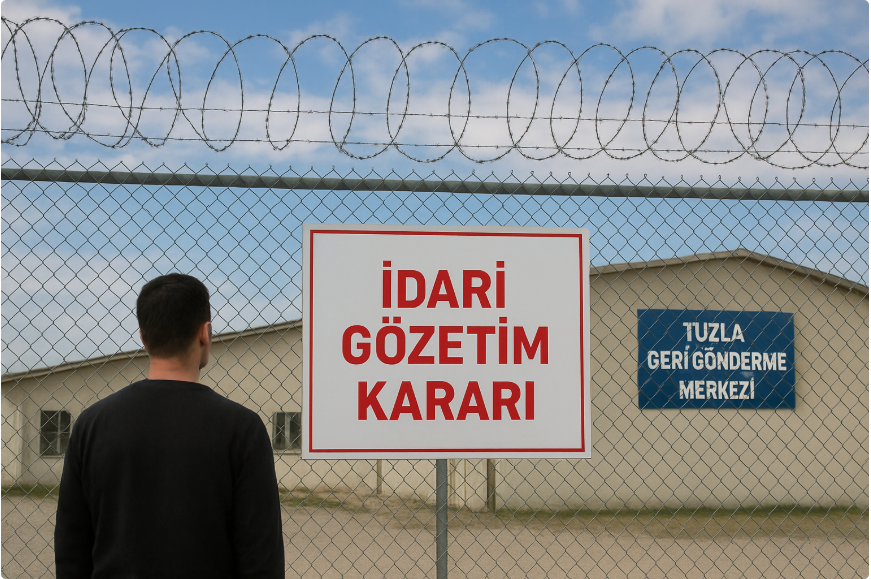
While the rights of relatives of individuals held in removal centers are often clear in theory, serious difficulties can be encountered in practice. Situations such as short seven-day litigation periods, the requirement for applications to be made in writing and in due form, arbitrary restrictions by administrative authorities, or their failure to provide information, can lead to loss of rights. For this reason, the support of a specialized Tuzla lawyer is of critical importance both for filing lawsuits against deportation and administrative detention decisions and for the effective exercise of visitation and communication rights. The lawyer closely monitors the legal process, protects the rights of relatives, prevents procedural errors, and makes necessary applications in cases of possible ill-treatment or rights violations.
Advantages of Tuzla Removal Center’s Location
The location of Tuzla Removal Center in the Tuzla district of Istanbul offers several advantages for relatives and lawyers. Firstly, access to the center is easier compared to removal centers in other provinces, thanks to Istanbul’s extensive transportation network. Furthermore, Tuzla is conveniently located with road and air connections for families coming from both the Anatolian side and outside the city. This enables relatives to exercise their right to visit more practically and lawyers to follow legal procedures more quickly. Due to its location in a metropolis, access to experienced immigration and foreigners’ law lawyers is also much easier compared to other regions.