
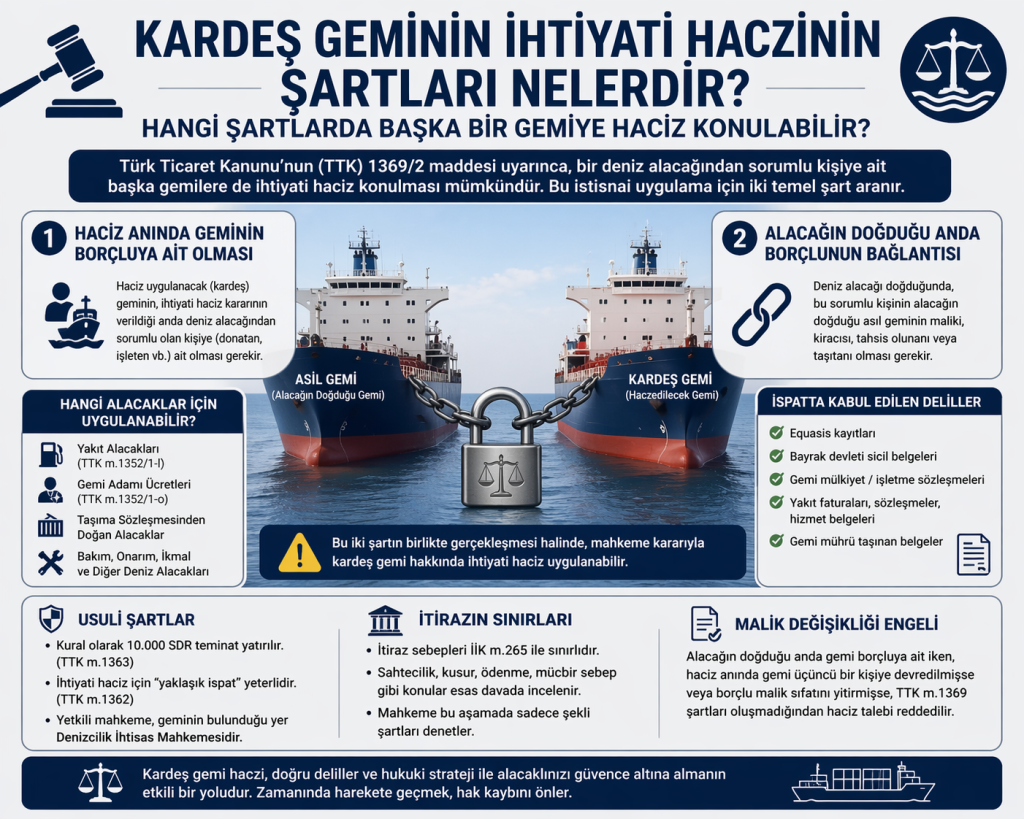
1. Legal basis and basic conditions for the sibling ship’s precautionary attachment
The precautionary attachment of sister ships (Sister Ships) in Turkish Law is regulated in the 2nd paragraph of Article 1369 of the Turkish Commercial Code (TTK) No. 6102. As a rule, although the precautionary lien is only possible for the ship in which the maritime receivable is born (TTK article 1369/1), other ships belonging to the debtor are also possible in the presence of certain conditions.
In the light of judicial decisions, there are two basic cumulative conditions of the foreclosure of the sister ship:
First condition: At the time of the lien, the ship to be seized must belong to a person responsible for this sea receivable.
Second condition: When the sea receivable is born, this responsible person; The original ship from which the receivable is born must be the owner, the tenant, the allocated or the carrier.
These conditions are Istanbul Regional Court of Justice 14th Civil Chamber dated 23.12.2021, 2021/2175 E. – 2021/1668 k. in the decision no. Sakarya Regional Court of Justice 7th Civil Chamber dated 28.11.2024, 2024/1712 E. – 2024/1726 k. It is clearly emphasized in the no.
2. Sea Receivables Qualification and Approximate Proof Condition
In order to decide on the seizure of sibling ships, the receivables are listed as limited in Article 1352 of the TCC. “From the Sea Receivables” It is necessary to be one. Pursuant to Article 1362 of the TCC, the creditor will be sent to the court about the asset and monetary value of the receivable.Evidence for convincing” It is sufficient to present it, and definitive proof is not sought; The “approximate proof” rule applies.
Concrete examples and accepted evidence:
Shipman Receivables: The labor receivables of the captain and personnel are sea receivables in accordance with TTK article 1352/1-(o).. Istanbul BAM 43rd Civil Chamber (03.03.2022, 2022/266 E. – 2022/256 k.)has deemed naval labor contracts, service documents and registry records carrying the ship’s seal sufficient for approximately proof.
Fuel Receivables: Fuel bills, delivery minutes and letters issued by the ship’s captain are accepted as evidence for fuel costs within the scope of TCC article 1352/1-(l).Istanbul BAM 13. HD, 09.05.2024, 2024/689 E. – 2024/801 k.).
Receivables arising from the contract of transport: Chartary Parties and Equasis records are based on receivables arising from missing cargo delivery or time charter contracts (Istanbul BAM 14. HD, 21.11.2024, 2024/1671 E. – 2024/1661 k).
3. DETERMINATION OF OWNERSHIP AND RESPONSIBILITY
The most critical element in the seizure of siblings is the proof of the ownership or operating bond between the ship to be seized and the ship in which the receivable is born. The courts are based on the following data:
Equasis Records and Flag State Registry Certificates: The fact that the registered owners, operators (ship manager) or addresses of the ships are the same is the basic evidence for the determination of the quality of the sister ship (Istanbul BAM 13. HD, 13.11.2025, 2025/2019 E. – 2025/1875 k.).
Naked ship lease agreements: In case the shipment of the receivable is operated by the same owner through leasing, the confiscated ship can also be applied to the sister ship.Istanbul BAM 14. HD, 03.03.2022, 2022/221 E. – 2022/252 k.).
Fleet insurance: The fact that the ships are covered by the same fleet liability insurance and the sameness of the authorities in the power of attorney constitute the right presumption for the acceptance of the sister ship (Istanbul BAM 14. HD, 20.09.2023, 2023/1512 E. – 2023/1397 k.).
4. Procedural Assurances and Limits of Objection
Guarantee: Pursuant to Article 1363 of the TCC, the creditor requesting a lien must, as a rule, deposit a collateral of 10,000 SDR (special withdrawal right).
Scope of appeal: Objections to the lien are limited in the framework of Article 265 of the EBL. False allegations, faults, or force majeure defenses on the merits are examined during the main case, not at the precautionary attachment stage (Istanbul BAM 43. HD, 16.03.2022, 2022/265 E. – 2022/281 k.).
Owner change barrier: If the person who is the tenant of the ship is born when the sea receiver is born, the lien request is rejected because the conditions of Article 1369 of the TCC are not met if the person who is the tenant of the ship is not the owner of the ship or the ship has been transferred to a third party (Supreme Court 11. HD, 01.07.2013, 2013/9731 E. – 2013/13860 k.).
5. Additional context acquired from secondary sources
Contractual Authority: In some cases, in contracts such as “payment guarantee letters” between the parties, if the debt is not paid, the creditor may be given the right to foreclosure or detention on sister ships. The courts may consider such contractual commitments as valid evidence.Bakırköy 4th ATM, 25.12.2023, 2023/1216 E. – 2023/1011 k. and Istanbul 17. ATM, 26.02.2019, 2016/225 E. – 2019/90 k.).
Organic vineyard and legal personality curtain: On ships that appear to be registered on different companies, the addressing of the Equasis records or the similarities in the partnership structure can be interpreted as “organic bonds” and can be considered sufficient for the approximate proof; However, the final determination of this situation is the subject of the main case (Istanbul BAM 12. HD, 17.06.2020, 2020/595 E. – 2020/592 k.).
The court in charge: Maritime Specialization Courts (or the Commercial Courts of First Instance) are responsible for the precautionary lien requests arising from maritime receivables; The issue of duty is from the public order and is observed ex officio (Bakırköy 4th ATM, 25.12.2023, 2023/1216 E. – 2023/1011 k.).
Result: The basis of the foreclosure of the sister ship is the legal and material continuity between the person responsible at the time of the receivable and the owner at the time of the lien. It is sufficient to prove this bond with Equasis records, registry documents and commercial contracts and to make a foreclosure decision.
Frequently asked questions
Under what conditions is the sister ship foreclosure possible?
For which receivables sister ship lien can be applied?
Is there a definitive proof for the foreclosure of the sister ship?
Why is expert lawyer support needed?
Sister ship foreclosure is one of the most complex and technical areas of maritime trade law. Especially Istanbul and Tuzla In regions where there is heavy ship traffic, the fast and accurate management of the process directly affects whether the receivable can be collected.
In this process;
between the donator (ship owner) and other ships Accurate determination of ownership and business link, ,
Equasis records, registration documents and commercial contracts Strong establishment of approximate proof, ,
Correct qualifying of sea receivables (fuel, craftsmanship, charter, etc.),
in the right port and in the right court Application for an immediate lien, ,
It is vital that the collateral, objection and execution processes are carried out completely.
The slightest mistake; It may cause the ship to leave the port, reject the seizure or the complete loss of the receivable. Therefore, the process maritime law expert It must be run by a team.
TUZLA CENTERED 2M LAW LAWYER OFFICE, in all shipyards and port regions, especially in Istanbul, it manages the foreclosure, lien and maritime receivable collection processes in a fast, strategic and result-oriented manner.
Time is a critical element in maritime trade. Getting expert support for the right legal steps to be taken in a timely manner is often the most important factor that ensures the collection of the receivables.