Inlet
This study examines the legal basis of the right of repatriation of the seafarer to his country, the situations in which this right arises and who will cover the expenses within the framework of the presented literature analysis answers. The analysis will be made from the perspective of both the National Legislation Maritime Labor Law (DİSK) and the International Labor Organization (ILO) Conventions to which Turkey is a party, and especially the 2006 Maritime Labor Convention (MLC 2006). The study elaborates on the order of responsibility of the expenses, the scope and the exceptional cases where the employer may request these expenses back from the shipman.
MAIN FINDINGS
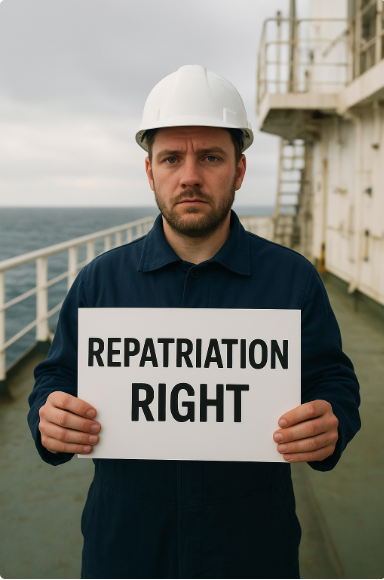
Repatriation right: The right of the seafarer to be returned to his country is a fundamental right guaranteed by both the Maritime Labor Law and international conventions. This right aims to prevent seafarers from being in need of help in foreign countries.
Responsible for expenses: The principal responsible for the reimbursement of the dormitory expenses is in the national legislation. “Employer or Employer’s Representative” and “Ship Owner” (Donatan) in international conventions determined as.
Responsibility hierarchy: In the event that the employer or the owner of the ship does not fulfill its obligations, international conventions envisage a multi-layered assurance mechanism. In order of responsibility; It belongs to the state on which the ship carries its flag, the port state to which the seafarer will be returned, or the state of its citizenship, and finally the “Financial Assurance System” established within the scope of MLC 2006.
Scope of expenses: Expenses by Dentistry”road, food and other essential expenses suitable for the situation” covers. In international conventions, these items are more detailed and transportation, food, accommodation, living expenses up to the day of departure and necessary medical care expenses may also contain.
Request for expenses (recruitment): The general rule is that the expenses cannot be charged to the shipman in any way. However, in both national legislation and international conventions, the right to demand (recourse) the expenses incurred by the employer/ship owner in exceptional cases is granted. This situation is usually the shipman’s “not seriously fulfilling its obligations arising from the working relationship” or in certain cases of termination specified in the Dink.
1. Situations in which the shipman’s right to return to the country is born
The shipman’s right to return home arises when certain conditions are realized. In the literature, these situations are summarized as follows:
Termination of employment contract: “In accordance with Article 21 of DİSK, in the event that the employment contract is terminated without notice according to Article 14 of DİSK during the expedition abroad, the employer or the employer’s representative has to return the ship’s employee to the mount of the ship, unless otherwise agreed in the contract.”
Disease or disability: “If the shipman catches a disease that prevents him from working on the ship for any reason, or if he becomes disabled, the right of the seafarer to return to the country will come to the fore after one of the parties terminates the employment contract.” In this case, the employer cannot demand the expenses incurred from the ship’s man.
Removal of the ship: “The ship for any reason More than thirty days Bin case of “removal from the expedition for a period of time” With the termination of the employment contract, the right to extradition arises.e Expenses belong to the employer.
Disease or injury (international contracts): “In the event of illness, injury or death of shipmen, the owner of the ship is required in Article 6 of the Convention on the responsibility of the shipowner, Every patient or injured person who has come to the land as a result of illness or injury during the journey is obliged to cover the expense of returns to the dormitory. It is regulated.” According to this contract, the owner of the ship is responsible, regardless of whether the seaman is at fault.
2. Expenses and Responsibility Mechanism
The most important element of the right to return to the country is who and how the expenses will be covered.
Main Responsible: Employer/Ship Owner According to the maritime labor law, the main responsible is the employer or representative: “According to the Maritime Labor Law, in the event that the seafarer has earned the right to return to the country, the employer or employer’s representative is also obliged to cover the return, subsistence and other essential expenses related to the return and appropriate situation.” In international conventions, this responsibility is attributed to the “Ship owner”.
Secondary liability and assurance mechanisms International law has provided a layered protection against the possibility that the owner of the ship cannot fulfill his obligations. This situation is called the “ordered liability regime”: “If the navy does not fulfill this responsibility, the country where the ship is registered, if the country where the ship is registered does not fulfill this responsibility, if it does not fulfill this responsibility, the country where it will be left or the country of its citizenship, “This mechanism aims to prevent the shipman from being abandoned in a foreign port. The state that covers the expenses may recourse this price to the state where the ship is registered, and that state to the owner of the ship.
Financial Assurance System (MLC 2006 amendment) The Financial Assurance System, which was added to MLC 2006 in 2014, further strengthened this protection: With this provision, as a rule, the way to apply to the institution that gives the financial security after the ownership has been opened.”
The role of the consul In cases where the employer does not fulfill its obligations, the consulates come into play: “The employer is also in charge of providing the return of the shipman that the employer did not return to the dormitory. exists.”
3. Exceptions where expenses may be requested back from the shipman
Although the general rule is that the expenses cannot be charged to the shipman, the employer/ship owner may claim back the expenses incurred in certain cases.
According to international conventions: The right of recourse arises when the seafarer does not “seriously fulfill his obligations”. “According to Standard A2.5.1 F.3, in case of detection of serious violations of the shipman in fulfilling his obligations, the owner of the ship will be able to demand the expenses incurred from the ship’s man for the return to the country. cannot be loaded.”
According to the Maritime Labor Law (criticized provisions): DİSK has regulated the employer’s right of recourse in a way that can be interpreted more broadly.” He will be able to demand the expenses he has made for the ship.” In addition, it is against the equity that the expenses can be demanded from him, even in cases such as the arrest of the seafarer without fault.
4. Sanction of Violation of Obligation
The employer’s failure to fulfill his obligation to return to the country is subject to a sanction within the scope of DİSK: “Article 24 of the Maritime Labor Law… In the event that the employer or employer’s representative does not comply with the obligation specified in Articles 21 and 23, the seafarer may demand compensation from the employer or employer’s representative for the appropriate route, subsistence and other expenses, as well as the 15-day wage, in accordance with the situation he has made to return to the country.
Result
The seaman’s right to repatriate the dormitory is one of the basic guarantees of maritime labor law. The main responsibility belongs to the employer or the owner of the ship, and the expenses cover the road, subsistence and other compulsory expenses. International conventions have created a multi-layered mechanism of liability, including the flag state, port state, and financial assurance system to protect the seafarer in case the employer violates this obligation.
Although the Maritime Labor Law regulates this right in Turkish Law, it is criticized that the provisions of the employer regarding the situations in which he may demand the expenses incurred from the shipman do not exactly coincide with the protective spirit of international conventions and may have consequences against equity. In addition, as stated in the literature, the lack of a regulation stating that the Turkish competent authorities will be held directly responsible if the employer does not fulfill its obligations is also a point mentioned by the ILO Committee of Experts. This situation points to the necessity of harmonization between national legislation and international standards. One article#atfp_close_translate_span# recommendation.

Why is expert lawyer support needed?
The right of seafarers to return to the country (repatriation), is a basic assurance protected by both the Maritime Labor Law and international conventions. However, in practice, many different scenarios such as termination of the employment contract, illness, removal of the ship from voyage or accidents come to the fore. In this process, who will cover the expenses, in which exceptions the employer will have the right to recourse, and how the international assurance mechanisms will be operated requires legal knowledge and experience.
Especially Istanbul Ports and Saline For seafarers operating in the region, incorrect or not made on time applications may lead to serious loss of rights. Multi-layered processes such as state liability, financial security system and consular interventions that come into effect in the event of the employer’s failure to fulfill its obligations are only possible in the field of maritime labor law. Expert#atfp_close_translate_span# a attorney can be managed correctly.
For this reason, both to protect the rights of seafarers and to prevent employers from possible disputes and compensation risks, Tuzla Shipyards And professional lawyer support is critical in all kinds of repatriation processes that may occur in other ports in Istanbul.