1. Legal Nature of the Incident and the Concept of “Maritime Claim”
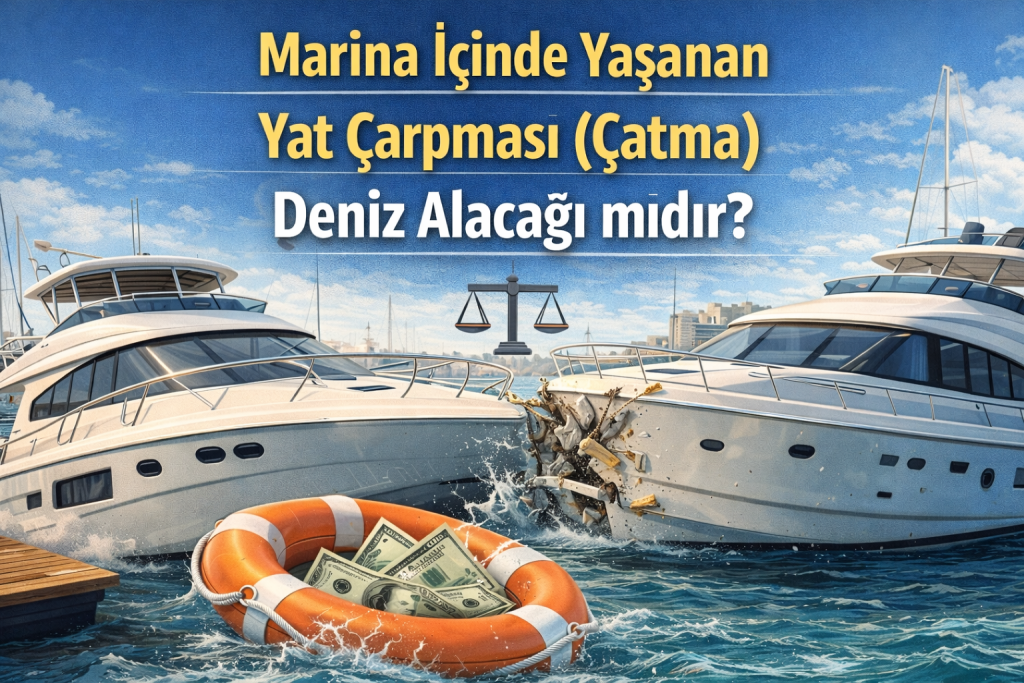
A collision (çatma) of a motor yacht with another yacht due to its engine stopping while entering its berth in the marina is a dispute regulated under the heading of “Maritime Trade” within the scope of the Turkish Commercial Code (TTK). In light of the examined court decisions, this situation is characterized as follows:
Nature of Maritime Claim: According to TTK art. 1352/1-l, damages arising from collisions (çatma) of ships are accepted as “maritime claims.” In the decisions of the Istanbul 17th Civil Court of Commerce (2018/551 E. ) and the Istanbul Anatolian 4th Civil Court of Commerce (2023/682 E. K), collisions occurring during maneuvers within the marina are directly defined as “maritime trade” disputes and maritime claims under TTK Book 5.
Maritime Lien Right: According to TTK art. 1320/1-e, claims based on torts arising from material loss or damage caused by the operation of the ship grant the injured party a “maritime lien right” (Istanbul 18th Civil Court of Commerce, 2024/488 E.).
Collision Provisions: The incident is subject to the “collision” provisions regulated in TTK art. 1286 and subsequent articles. The engine stopping or a maneuvering error is considered the fault of the shipowner or the crew, and liability is assigned to the faulty shipowner according to TTK art. 1288.
2. Plaintiff and Defendant Parties (Against Whom is it Filed?)
The injured yacht owner or the insurance company that has become a subrogee by paying the insurance indemnity (TTK art. 1472) may direct the lawsuit against the following persons:
Shipowner (Vessel Owner/Operator): According to articles 1061/2 and 1288 of the Turkish Commercial Code (TCC), the primary responsible party is the shipowner.
Captain: A lawsuit can be filed against the captain who performed the maneuver and was at fault, based on tort provisions (Turkish Code of Obligations article 49).
Liability Insurer: It is possible to file a direct lawsuit against the liability insurer of the colliding vessel (Istanbul 17th Commercial Court, 2018/551 E. K).
Joint and Several Liability: Lawsuits are generally filed jointly and severally against the shipowner, captain, and insurer.
3. Competent and Authorized Court (Where to File?)
Competent Court: In such cases, exclusively Specialized Maritime Courts (within the scope of Civil Courts of First Instance for Commercial Matters) are competent. According to HSYK (Council of Judges and Prosecutors) decisions, the Istanbul 17th Civil Court of First Instance for Commercial Matters has been authorized for this purpose in Istanbul. In places where there is no specialized maritime court, the 1st Civil Court of First Instance or Civil Court of First Instance for Commercial Matters hears the case in this capacity (Court of Cassation 11th Civil Chamber, 2010/14990 E.
Authorized Court: The lawsuit can be filed in the court of the place where the accident occurred or in the court of the defendant’s domicile.
4. Period for Filing a Lawsuit and Statute of Limitations (When to File?)
Statute of Limitations for Collision: According to Articles 1259 and 1297 of the Turkish Commercial Code (TCC), compensation lawsuits arising from collision must be filed within 2 years from the date of the incident (Turkish Supreme Court 11th Civil Chamber, 2010/14990 File No. K)
Exceptional Circumstances: In some decisions, reference is also made to the 2-year statute of limitations for torts (Turkish Code of Obligations Article 72). However, in cases where maritime commercial provisions apply, the special periods specified in the TCC are paramount.
5. Concrete Examples and Analysis
Example 1 (Engine Failure): In an incident where a motor yacht collided with another yacht at Bodrum Palmarina due to its port engine stopping while entering its berth, the court found the shipowner primarily at fault and ordered compensation for the damage amount according to market rates (Istanbul 17th Commercial Court, 2018/551 File No. K).
Example 2 (Maneuvering Error): In a collision incident caused by wind during a maneuver assisted by a marina mooring boat, the court characterized the incident as a “collision” and accepted the lawsuit filed within the 2-year statute of limitations period (Istanbul 17th Commercial Court, 2024/40 File No. ).
Example 3 (Enforcement Proceeding): In practice, those who suffer damage generally first initiate enforcement proceedings, and upon objection, they file a “Cancellation of Objection” lawsuit in the Maritime Specialized Court.
6. Secondary Sources and Special Cases
Consumer Court Exception: In some cases, if both boats have “private boat” status and the relationship between the parties (e.g., the mooring contract between the marina and the boat owner) is not commercial in nature, the dispute may fall within the jurisdiction of the Consumer Court. Izmir 5th Commercial Court of First Instance (2024/352 E. K) ruled that it lacked jurisdiction by considering an accident caused by a private boat during marina assistance as a consumer transaction.
Marina Operator’s Liability: If the accident is caused by incorrect guidance from marina personnel (e.g., mooring boat), a lawsuit can also be filed against the marina operator. However, clauses such as “liability lies with the boat owner” in marina contracts are subject to debate during litigation.
Tort vs. Maritime Commerce: In some rulings (Istanbul RCoA 37th Civil Chamber, 2022/1465 E. K), it has been stated that general courts might have jurisdiction if the boats are private vessels and the incident is more in the nature of a general tort rather than directly a ship operating activity. However, established practice tends to consider collisions between boats as “maritime collision” within the scope of the Turkish Commercial Code (TCC).
Conclusion: A collision caused by an engine stop is a “maritime claim”. The damaged party must file a lawsuit for compensation or annulment of objection within 2 years from the incident, against the owner, captain, or insurer of the colliding vessel, in the Maritime Specialized Court.
Frequently Asked Questions
Marina içinde meydana gelen yat çarpması deniz alacağı sayılır mı?
Evet. Marina sahası içinde dahi gerçekleşse, teknelerin manevra sırasında birbirine çarpması Türk Ticaret Kanunu m.1352/1-l kapsamında çatma niteliğindedir ve bu tür zararlar deniz alacağı olarak kabul edilir. Yargı uygulamasında marina içi manevralar da deniz ticareti faaliyeti kapsamında değerlendirilmektedir.
Motorun stop etmesi donatanın sorumluluğunu ortadan kaldırır mı?
Hayır. Motorun stop etmesi teknik bir arıza olsa dahi, bu durum geminin işletilmesiyle bağlantılı kabul edilir. Bakım, seyre elverişlilik ve güvenli manevra sorumluluğu donatana aittir. Bu nedenle motor arızası sonucu meydana gelen çarpışmalarda donatan asli kusurlu sayılabilmektedir.
Zarar gören kime karşı dava açabilir?
Zarar gören yat sahibi veya halef olan sigorta şirketi; çarpan teknenin donatanına, kaptanına ve varsa sorumluluk sigortacısına karşı müştereken ve müteselsilen dava açabilir. Uygulamada en sık açılan davalar tazminat ve itirazın iptali davalarıdır.
Why is Expert Legal Support Necessary?
Although yacht collisions occurring within a marina may at first glance seem like a simple “maneuvering accident,” from a legal perspective, they are highly technical disputes. In such incidents, issues regarding the dispute’s nature, such as;
Whether it constitutes maritime commercial law or a general tort,
Whether the competent court is a Maritime Specialized Court or a Consumer/Civil Court of First Instance,
Whether the statute of limitations is 2 years or a different period,
And issues such as whether the marina operator’s liability arises directly determine the outcome of the lawsuit.
Lawsuits filed in the wrong court can lead to years of litigation ending with a lack of jurisdiction, missing the statute of limitations, and irreparable loss of rights. Technical details such as engine stoppage, wind effect, and mooring boat guidance, in particular, should be handled correctly within the framework of expert examination and Supreme Court precedents.
Furthermore, clauses such as “all responsibility belongs to the boat owner” found in marina contracts are not considered valid in every concrete case; the validity of these provisions is debated separately from the perspectives of maritime commercial law and consumer law. An incorrect legal characterization at this point could result in the entire liability being placed on the injured party.
In this context, 2M Hukuk Law Office strategically manages the process from the outset with specific practical experience in disputes arising from marina accidents, yacht collisions, collisions caused by engine failure, maritime claim determination, and provisional attachment processes; especially in dense marina regions such as Istanbul, Bodrum, Göcek, and Marmaris.
Processes conducted without the support of an expert lawyer in marina accidents often result in even the rightful party failing to receive compensation.