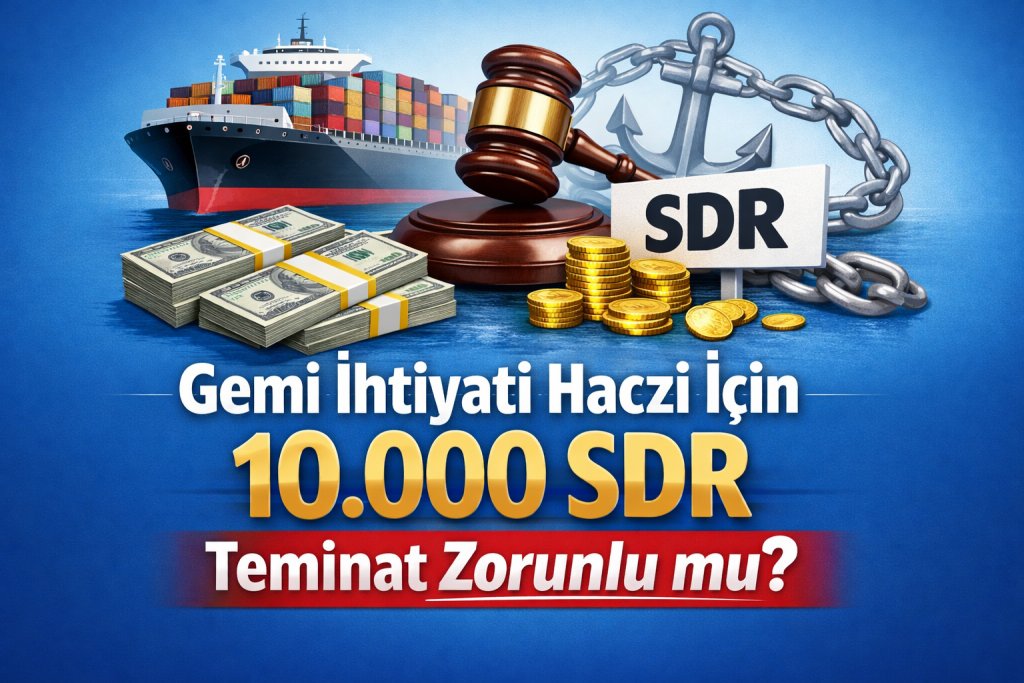
When is Security Increased, Decreased, or Does the Attachment Automatically Fall?
1. Nature of the Obligation to Provide Security and the 10,000 SDR Rule
In accordance with Article 1363/1 of the Turkish Commercial Code (TTK) numbered 6102, it is a mandatory obligation for a creditor seeking a precautionary attachment order to secure a maritime claim, to provide security in the amount of 10,000 Special Drawing Rights (SDR). In judicial decisions, it is observed that this amount is converted into Turkish Liras according to the data from the Central Bank of the Republic of Turkey (CBRT) on the date of the decision and then ruled upon.
Sakarya Regional Court of Justice, 7th Civil Chamber (2023/846): The court issued an attachment order for a fuel supply claim on the condition that 222,563.00 TL, equivalent to 10,000 SDR, be deposited in cash or a bank guarantee letter be submitted.
Antalya Regional Court of Justice, 11th Civil Chamber (2017/556 ): It described the deposit of security in the amount of 10,000 SDR as a “mandatory provision” and stipulated this deposit as a prerequisite for the execution of the precautionary attachment order.
Izmir Regional Court of Justice 17th Civil Chamber (2024/619 ): A provisional attachment order was issued upon the deposit of 392,092.00-TL, which is the equivalent of 10,000 SDR based on the exchange rate dated 25.12.2023. Similarly, in the decision numbered 2023/2367 of the same chamber, the submission of a bank letter of guarantee for 300,000.00-TL was deemed sufficient for an obligation amounting to 270,372.00-TL.
Istanbul Regional Court of Justice 15th Civil Chamber (2023/609 K): The provisional attachment request was granted upon the deposit of a 243,500.00-TL cash collateral within the 3-day definitive period given by the court.
2. Requests for Increase in Collateral Amount and Evaluation Criteria (TCC Art. 1363/2)
The debtor may request an increase in the collateral amount at any stage of the provisional attachment process. When evaluating this request, the duration the vessel was withheld from service, daily operating expenses, and lost profits are taken into account.
Antalya Regional Court of Justice 11th Civil Chamber (2023/1192 K): The debtor requested an increase in collateral, citing the high value of the vessel (over 100 Million TL). However, the court rejected the request for an increase, stating that no operating expenses or loss of profit had occurred as the vessel was still under construction. The Regional Court of Justice (BAM) affirmed this decision, stating that an increase could be requested again once the vessel is completed.
Istanbul Regional Court of Appeals 13th Civil Division (2019/1297 Decision): The debtor claimed to have suffered a daily loss of 3,100 USD and requested an increase in security; however, this request was denied because they could not present concrete evidence to prove this loss.
Antalya 4th Commercial Court (2024/350 Decision): The court emphasized that the security deposited by the creditor safeguarded the potential losses and preservation expenses that the shipowner might incur.
3. Reduction of Security Amount and Exemption Cases (TCC Art. 1363/3-4)
The creditor may request a reduction in the security amount. Furthermore, maritime creditors listed in Article 1320/1-a of the TCC are exempt from the security obligation.
Istanbul Regional Court of Appeals 12th Civil Division (2025/293 Decision): The court determined that the creditor’s request was not within the scope of exemption (TCC Art. 1320/1-a) and found the decision for attachment without security to be procedurally unlawful. However, in accordance with TCC Art. 1363/4, considering the balance of rights and interests, it ruled that a security of 100,000 TL would be sufficient instead of 10,000 SDR.
Istanbul Regional Court of Appeals 15th Civil Division (2023/609 ): The creditor’s request for the reduction of the 10,000 SDR security amount was rejected by the first instance court.
Ankara Regional Court of Justice 21st Civil Chamber (2024/370 K): The request for collateral exemption by public banks under special laws was rejected on the grounds that they are not covered by the relevant regulation during the provisional attachment process, and the deposit of collateral was made mandatory.
4. Consequences of Non-Fulfillment of Collateral Obligation
If the collateral is not deposited within the specified period or if the additional collateral is not completed, the provisional attachment order is automatically lifted.
Antalya Regional Court of Justice 7th Civil Chamber (2024/1082 K): The court explicitly warned that if the collateral, determined at 15% of the receivable, is not deposited within the definite period of 10 days, the provisional attachment order will be automatically lifted.
Istanbul Regional Court of Justice 12th Civil Chamber (2025/293 ): It was ruled that if the reduced collateral amount is not completed within 3 days, the attachment will be automatically lifted.
Conclusion: Judicial decisions consistently apply that, pursuant to Article 1363/1 of the Turkish Commercial Code (TCC), collateral in the amount of 10,000 SDR is generally mandatory for maritime claims, and this amount can be reduced by the court according to the specifics of the concrete case (TCC Art. 1363/4) or increased in line with the debtor’s proven damages (TCC Art. 1363/2). The deposit of collateral is a condition for the execution of the attachment, and in its absence, the attachment is automatically lifted.
Deniz alacaklarında neden mutlaka 10.000 SDR teminat istenir?

Türk Ticaret Kanunu m. 1363/1 uyarınca, deniz alacağına dayalı ihtiyati haciz talep eden alacaklının 10.000 SDR tutarında teminat göstermesi emredici bir kuraldır. Bu teminat, haksız haciz ihtimaline karşı gemi maliki veya işletenin uğrayabileceği zararları güvence altına almak amacıyla öngörülmüştür. Mahkemeler bu tutarı, karar tarihindeki TCMB SDR kuru üzerinden Türk Lirası’na çevirerek belirlemektedir.
10.000 SDR teminat artırılabilir mi? Borçlu bunu nasıl ister?

Evet. TTK m. 1363/2 gereğince borçlu, ihtiyati haciz sürecinin her aşamasında teminatın artırılmasını talep edebilir. Ancak mahkemeler soyut iddialarla değil;
geminin seferden alıkonulma süresi,
günlük işletme giderleri,
fiilen yoksun kalınan kazanç
gibi somut ve belgeli zararları esas alır. Bu zararlar ispatlanamazsa teminat artırımı talepleri reddedilmektedir.
Alacaklı teminatın azaltılmasını isteyebilir mi?
Kural olarak hayır; ancak istisnai durumlar vardır. TTK m. 1363/4 uyarınca mahkeme, hakkaniyet ve menfaat dengesini gözeterek teminatı 10.000 SDR’nin altında belirleyebilir. Bununla birlikte bu bir otomatik hak değildir; alacaklı, somut olayda yüksek teminatın orantısız zarar doğurduğunu ikna edici şekilde ortaya koymalıdır.
Hangi alacaklılar teminat yatırmadan haciz alabilir?
Sadece TTK m. 1320/1-a kapsamında yer alan gemi alacaklıları (özellikle mürettebat ücretleri gibi) teminat yükümlülüğünden muaftır. Bunun dışındaki yakıt, onarım, sigorta primi, tersane, satış bedeli gibi deniz alacaklarında teminatsız haciz mümkün değildir.
Teminat süresinde yatırılmazsa ne olur?
Teminat, ihtiyati haczin infaz şartıdır. Mahkemece verilen kesin süre içinde teminat yatırılmaz veya eksik tamamlanmazsa, ihtiyati haciz kararı kendiliğinden ortadan kalkar. Bu durumda yeniden haciz talebi için baştan başvuru yapılması gerekir ve gemi çoğu zaman limanı terk etmiş olur.
Gemi ihtiyati haczinde 10.000 SDR teminat hangi durumlarda artırılır?
İstanbul Bölge Adliye Mahkemesi 13. Hukuk Dairesi’nin 10.07.2019 tarihli, E.2019/1297 – K.2019/975 sayılı kararına göre; gemi ihtiyati haczinde 10.000 SDR teminat ancak borçlu tarafından, ihtiyati haciz nedeniyle uğranıldığı iddia edilen zararın soyut beyanlarla değil, somut, ölçülebilir ve belgeye dayalı olarak ispat edilmesi halinde artırılabilir; bu kapsamda yalnızca “gemi sefer yapamıyor”, “günlük zarar ediliyor” veya “teminat yetersiz kalıyor” şeklindeki iddialar yeterli görülmemekte, günlük gelir kaybı, işletme gideri, navlun veya charter gelirinin kaybı gibi zarar kalemlerinin sözleşme, muhasebe kaydı veya fatura gibi delillerle ortaya konulması gerekmekte olup, somut olayda borçlu bu yönde herhangi bir delil sunamadığından teminat artırım talebi reddedilmiştir.
Gemi ihtiyati haczinde 10.000 SDR teminat hangi hâllerde artırılabilir? Somut olay üzerinden nasıl örneklendirilir?
İstanbul Bölge Adliye Mahkemesi 13. Hukuk Dairesi’nin 10.07.2019 tarihli, E.2019/1297 – K.2019/975 sayılı kararına konu somut olayda teminat artışı, borçlu tarafın ihtiyati haciz nedeniyle uğradığını ileri sürdüğü günlük 3.100 USD zararı somut, ölçülebilir ve belgeye dayalı olarak ispat etmesi hâlinde mümkün olabilirdi; örneğin geminin haciz nedeniyle iptal edilen seferlerine ilişkin charter sözleşmeleri, kaybedilen navlun gelirini gösterir ticari kayıtlar, haciz süresince katlanılan günlük işletme giderlerini gösteren muhasebe belgeleri veya faturalar dosyaya sunulmuş olsaydı mahkeme TTK m.1363/2 kapsamında 10.000 SDR teminatın yetersiz kaldığı sonucuna vararak artırıma gidebilirdi; ancak borçlu bu zarar iddialarını yalnızca soyut beyanlarla ileri sürmüş, hiçbir somut delil sunamamış olduğundan teminat artırım talebi reddedilmiştir.
Bedensel zarar ve manevi tazminat talepleri için gemi ihtiyati haczi istenebilir mi?
Evet. Bu karara göre, gemilerin çatması sonucu yolcuların yaralanmasından doğan maddi ve manevi tazminat talepleri, TTK m.1352/1-b kapsamında “geminin işletilmesi ile doğrudan bağlantılı bedensel zarar” niteliğinde olup deniz alacağıdır ve bu alacaklar bakımından gemi hakkında ihtiyati haciz talep edilebilir. Mahkeme, manevi tazminatın miktarının yargılama sonunda belirlenecek olmasının, ihtiyati hacze engel oluşturmadığını açıkça kabul etmiştir.
Bu tür bedensel zarar alacaklarında ihtiyati haciz teminatsız verilebilir mi?
Hayır. Somut olayda Bölge Adliye Mahkemesi, bedensel zarar ve manevi tazminat alacaklarının TTK m.1320/1-a kapsamında teminattan muaf alacaklar arasında yer almadığını açıkça belirtmiştir. Bu nedenle, alacak ilama veya ilam niteliğinde belgeye dayanmadığı sürece TTK m.1363 gereğince teminat yatırılmadan ihtiyati haciz kararı verilemez. İlk derece mahkemesinin teminatsız ihtiyati haciz kararı bu gerekçeyle hukuka aykırı bulunmuş ve kaldırılmıştır.
Why is Expert Lawyer Support Necessary for Maritime Claims?
The issue of security in provisional attachments for maritime claims is one of the areas where the most mistakes are made and which leads to the most severe consequences in practice. Creditors often lose attachment protection merely because they mismanage the security, even though they are in the right.
Expert legal support becomes critical for the following reasons:
If security is determined incorrectly, the attachment effectively becomes meaningless.
An incorrect SDR exchange rate, insufficient amount, a faulty bank guarantee letter, or a cash deposit not made on time can suddenly render an obtained attachment null and void.
Requests for increase or decrease (in security) require technical knowledge of case law.
Courts do not accept every request. Under what circumstances security is increased or decreased; which evidence is convincing, and which is rejected — these are entirely determined by the case law practice of the Regional Courts of Appeal (BAM) and the Court of Cassation (Yargıtay).
A timing error can lead to the vessel escaping.
While the vessel is in Tuzla, Ambarlı, or Aliağa port today, due to a delay in the security period, it might be in another country tomorrow under a foreign flag. This risk is specific to maritime law.
The debtor’s move to convert the attachment into security must be managed correctly. According to Article 1371 of the Turkish Commercial Code (TTK), when the debtor shifts the attachment to security, the status, return, and protection of the security initially deposited by the creditor require separate expertise. Therefore, working with an Istanbul-based maritime law team experienced in port and ship arrest applications, especially in the Tuzla Shipyards Region, is not a luxury but a necessity for the collection of claims. In this field, 2M Hukuk Avukatlık Bürosu (2M Law Firm) stands out with its expert approach, mastering Istanbul and port practices in maritime claims, ship arrest, security management, and the process of converting attachment into security.