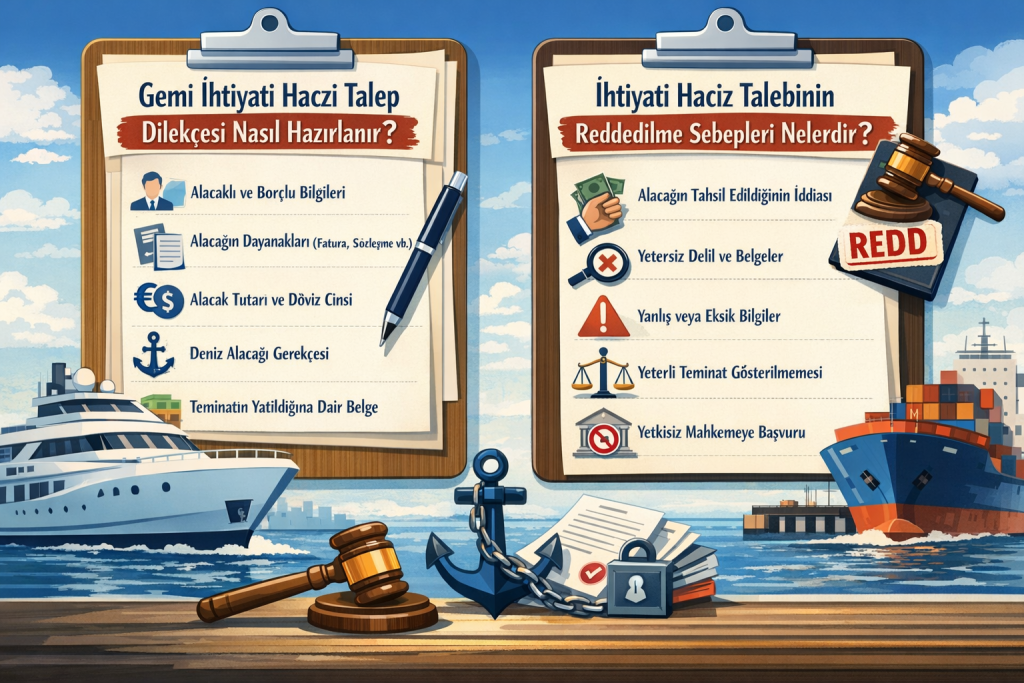
What are the Reasons for the Rejection of a Ship’s Precautionary Arrest Request?
1. Introduction and Legal Framework
Claims arising from cargo damage in maritime trade are considered a “maritime claim” pursuant to Article 1352/1-(h) of the Turkish Commercial Code (Law No. 6102). The precautionary arrest of a ship to secure these claims is subject to Article 1353 and subsequent provisions of the Turkish Commercial Code and the relevant articles of the Enforcement and Bankruptcy Law (EBL). Judicial decisions indicate that a petition for precautionary arrest must meet certain procedural and substantive standards; otherwise, the request will be rejected.
Claims arising from cargo damage in maritime trade are considered “maritime claims” pursuant to Article 1352/1-(h) of the Turkish Commercial Code No. 6102. The precautionary arrest of a ship to secure such claims is governed by Article 1353 and subsequent provisions of the Turkish Commercial Code and the relevant provisions of the Enforcement and Bankruptcy Law. Judicial decisions establish that a ship arrest petition must meet certain procedural and substantive standards; otherwise, the request will be rejected.
2. Elements to be Included in a Ship Precautionary Arrest Petition
In light of case law examples, the essential elements that must be included in a ship arrest petition are as follows:
Status and Identity Information of the Parties: The status of the parties against whom the arrest is sought (shipowner, operator, charterer, or master) must be clearly specified. In particular, pursuant to Article 1369 of the Turkish Commercial Code, it must be clarified whether the shipowner is the debtor or responsible for the debt (Izmir Regional Court of Appeal 17. Civil Chamber-2023/471 K).
The legal status of the parties against whom the arrest is sought (shipowner, operator, charterer, or master) must be clearly specified. In particular, under Article 1369 of the Turkish Commercial Code, it must be clarified whether the shipowner is the debtor or responsible for the debt.
Vessel Information and Location: The vessel’s name, flag, IMO number, and its current location at the time of the arrest (port or territorial waters information) must be included in the petition (Supreme Court 11. Civil Chamber-2013/1820 K).
The vessel’s name, flag, IMO number, and its current location at the time of the arrest request (port or territorial waters) must be stated in the petition.
Specification that the Claim is a Maritime Claim: The demand must be presented with legal justifications that it is based on Article 1352/1-(h) (cargo damage) of the Turkish Commercial Code or, depending on the situation, on paragraphs (f), (g) thereof (Istanbul Regional Court of Appeal 43. Civil Chamber-2022/666 K).
The request must be supported with legal reasoning showing that the claim qualifies as a maritime claim under Article 1352/1-(h) (cargo damage) or, where applicable, subparagraphs (f) or (g) of the Turkish Commercial Code.
Detailed Explanation of the Incident: The manner in which the damage occurred (water leakage, improper stowage, collision, etc.), voyage details, bill of lading information, and breakdown of damages must be explained in detail (Regional Court of Justice Istanbul 43rd Civil Chamber-2024/1308 Decision). In an example dispute, 34 containers fell into the sea in block form during discharge operations at the port, and the port operator claimed damages. It was alleged that the incident resulted from improper stowage and vessel stability issues.
The manner in which the damage occurred (water leakage, improper stowage, collision, etc.), voyage details, bill of lading information, and breakdown of damages must be explained in detail. In an example dispute, 34 containers fell into the sea in block form during discharge operations at the port, and the port operator claimed damages. It was alleged that the incident resulted from improper stowage and vessel stability issues.
Provisional Evidence: According to Article 1362 of the TCC, evidence that will convince the court regarding the existence and amount of the claim must be attached. These include; bills of lading, invoices, survey reports, silver nitrate test results, letters of protest, photographs, and bank receipts (Regional Court of Justice Istanbul 12th Civil Chamber-2020/117, Regional Court of Justice Izmir 17th Civil Chamber-2023/1206).
Pursuant to Article 1362 of the Turkish Commercial Code, evidence sufficient to convince the court regarding the existence and amount of the claim must be submitted. Such evidence includes bills of lading, invoices, survey reports, silver nitrate test results, protest letters, photographs, and bank receipts.
3. Deficiencies Leading to the Rejection of the Claim and Concrete Examples
Court decisions summarize the critical deficiencies leading to the rejection of precautionary attachment requests under the following headings:
A. Failure to Meet the Condition of Approximate Proof
Courts reject the request if the existence of the claim “requires litigation.”
Uncertain Damage Cause: The request is rejected when it is unclear whether the damage originated from the carriage or the nature of the cargo itself. For instance, the remark “Weight, measure, quality… unknown” on the bill of lading can weaken the evidentiary function regarding the cargo being loaded in sound condition (BAM İzmir 17. HD-2023/471 K Yargıtay 11. HD-2014/13476 ).
Conflicting Documents: Contradictory bills of lading or uncertainties in the chain of endorsement (determining the legitimate holder) lead to rejection (BAM Adana 9. HD-2021/2071).
Insufficient Evidence: Requests made solely with email correspondence or faint expense lists are rejected because they do not form sufficient conviction regarding the amount of the claim (BAM İstanbul 13. HD-2019/899 ).
B. Procedural and Formal Deficiencies
Deficiency in Fee: Failure to pay the provisional attachment application fee is a fundamental procedural error that necessitates the rejection of the request without examining its merits (BAM Denizli 4. HD-2025/518 ).
Errors in Capacity and Adversary Status: Naming the party against whom the provisional attachment is sought (e.g., the agent) as the debtor, or failing to establish the relationship between the vessel owner and the debtor (TCC Art. 1369), leads to its rejection (BAM İzmir 17. HD-2023/471 , Yargıtay 11. HD-2013/12716
Jurisdiction Issue: The vessel not being within the court’s jurisdiction at the time of the request (TCC Art. 1355) may lead to the rejection of requests made prior to filing a lawsuit due to lack of jurisdiction (BAM İstanbul 14. HD-2019/1063 Source).
C. The Claim Not Being Due or Being Secured by a Pledge
A provisional attachment order cannot be issued if the claim is not yet due or if it is requested for the value of goods subject to a right of retention (BAM İstanbul 12. HD-2024/61 S).
4. Additional Context from Secondary Sources
The following points, while not directly cargo damage decisions, provide secondary information regarding the provisional attachment regime for maritime claims:
Variety of Evidence: In other maritime claims such as submarine cable damage or fuel receivables, courts do not merely rely on an invoice but deem supporting documents like survey reports, price quotes, and cost tables essential for “prima facie evidence” (BAM Istanbul 12th HD-2023/987 , BAM Istanbul 14th HD-2024/1067
Previous Waivers: The waiver of a previous enforcement proceeding for the same claim may lead to the rejection of a new request for precautionary attachment by undermining the “prima facie evidence” requirement (BAM Istanbul 14th HD-2024/1067
5. Conclusion
An attorney requesting the precautionary attachment of a ship due to cargo damage must fully state the identity details of the ship and the parties in their petition, emphasize the nature of the claim under Article 1352/1-(h) of the Turkish Commercial Code (TCC), and most importantly, concretize the amount and occurrence of the damage (with bill of lading, survey report, technical tests, etc.) to the extent of prima facie evidence. Negligence in procedural matters such as fee payment or leaving the existence of the claim completely uncertain (requiring litigation) results in the rejection of the request.
Frequently Asked Questions
Yük hasarının nedeni belirsizse gemi ihtiyati haczi kararı verilir mi?
Hayır. İzmir Bölge Adliye Mahkemesi 17. Hukuk Dairesi’nin 25.05.2023 tarihli kararına göre, taşınan yükte meydana gelen hasarın taşıma sırasında mı yoksa yükün kendi niteliğinden veya yükleme öncesi durumundan mı kaynaklandığı açık şekilde ortaya konulamamışsa ihtiyati haciz için gerekli “yaklaşık ispat” şartı gerçekleşmiş sayılmaz.
Somut olayda aspir tohumu yükünde küflenme ve topaklanma tespit edilmiş olmakla birlikte hasarın geminin taşıma faaliyetinden mi yoksa yükün önceden yüksek nem oranına sahip olmasından mı kaynaklandığı net şekilde belirlenememiştir. Ayrıca konşimentoda yer alan “weight, measure, quality, quantity, condition unknown” kaydı taşıyanın yükün niteliğine ilişkin sorumluluğunu sınırlayıcı nitelikte görülmüş ve taşıyana atfedilebilir kusur yaklaşık ispat düzeyinde ortaya konulamadığı için ihtiyati haciz talebinin reddi hukuka uygun bulunmuştur.
Deliller yetersizse gemi ihtiyati haczi kararı verilir mi?
Hayır. İstanbul Bölge Adliye Mahkemesi 13. Hukuk Dairesi’nin 10.07.2019 tarihli kararına göre, ihtiyati haciz talebinde alacağın deniz alacağı niteliğinde olması tek başına yeterli değildir. Alacağın varlığı, miktarı ve muaccel olduğu hususunda mahkemede kanaat oluşturacak nitelikte somut ve güçlü deliller sunulması gerekir.
Somut olayda davacılar gemiye yaptıkları masraflar ve ortaklık ilişkisine dayalı alacaklarını ileri sürmüş; ancak sundukları e-posta yazışmaları, silik masraf listeleri, ödeme dekontları ve ihtarnameler alacağın varlığı ve miktarı konusunda mahkemede yeterli kanaat oluşturacak nitelikte görülmemiştir. Mahkeme, alacağın varlığının ve miktarının yargılamayı gerektirdiğini, yaklaşık ispat şartının sağlanmadığını belirterek ihtiyati haciz talebinin reddine karar vermiştir. Ayrıca sadece alacağın “deniz alacağı” olarak nitelendirilmesi ihtiyati haciz kararı verilmesi için yeterli görülmemiştir.
İhtiyati haciz talebinde yanlış tarafa yöneltme (sıfat ve husumet hatası) talebin reddine neden olur mu?
Evet. İzmir Bölge Adliye Mahkemesi 17. Hukuk Dairesi’nin 25.05.2023 tarihli kararına göre, gemi ihtiyati haczi talebinde borçlu sıfatının açık şekilde belirlenmemesi ve talebin doğru kişiye yöneltilmemesi ihtiyati haciz talebinin reddine neden olabilir.
Somut olayda ihtiyati haciz talep eden taraf; geminin donatanı, işleteni, şirketler ve kaptan hakkında talepte bulunmuş ancak bu kişilerin hangi hukuki sıfatla sorumlu olduğunu dilekçesinde açıklamamıştır. Oysa Türk Ticaret Kanunu m. 1369 uyarınca ihtiyati haciz talebinin kabul edilebilmesi için deniz alacağının borçlusunun kim olduğu ve bu kişinin geminin maliki veya sorumlusu olduğu açık şekilde ortaya konulmalıdır. Mahkeme, talebin kime ve hangi sıfatla yöneltildiğinin belirsiz olduğunu, gemi maliki ile borç ilişkisi kurulamadığını ve taraf sıfatının somutlaştırılmadığını belirterek yaklaşık ispat şartının gerçekleşmediği sonucuna ulaşmış ve ihtiyati haciz talebinin reddine karar vermiştir. Bu karar, gemi ihtiyati haczi taleplerinde donatan, işleten, kiracı veya kaptanın sorumluluk statüsünün açıkça gösterilmesinin zorunlu olduğunu ortaya koymaktadır.
Hapis hakkına konu alacaklar için geminin ihtiyati haczi istenebilir mi?
Kural olarak hayır. Hapis hakkına konu bir alacağın teminatı için geminin ihtiyati haczi talep edilemez. İstanbul Bölge Adliye Mahkemesi 12. Hukuk Dairesi’nin 22.02.2024 tarihli kararında, zaman çarter sözleşmesinin feshi sonrası gemide kalan yakıt bedelinin tahsiline ilişkin ihtiyati haciz talebi değerlendirilmiştir. Mahkeme, sözleşme gereği gemide kalan yakıtın kiracıya iadesi gerekse bile bu alacağın Türk Ticaret Kanunu kapsamında hapis hakkına konu edilebilecek bir alacak niteliğinde olduğunu tespit etmiştir. TTK m. 1136/3 hükmüne göre zaman çarteri ilişkisine dayanan bazı alacaklar bakımından tahsis edene, taşınırlar üzerinde hapis hakkı ve alacak rehni gibi ayni teminat imkânı tanınmaktadır. Mahkeme, kanunen hapis hakkı kapsamında güvence altına alınabilecek bir emtia bedeli için ayrıca ihtiyati haciz kararı verilemeyeceğini belirtmiştir. Bu nedenle somut olayda gemide bulunan yakıt bedeline ilişkin alacak bakımından ihtiyati haciz şartlarının oluşmadığı kabul edilerek talep reddedilmiştir. Karar, deniz ticareti uyuşmazlıklarında alacağın hukuki niteliğinin doğru belirlenmesi gerektiğini, hapis hakkı gibi özel teminat mekanizmalarının bulunduğu durumlarda ihtiyati haciz yoluna başvurulamayacağını ortaya koymaktadır.
Aynı deniz alacağı için daha önce icra takibinden feragat edilmişse geminin ihtiyati haczi yeniden talep edilebilir mi?
Kural olarak aynı alacağa ilişkin önceki icra takibinden feragat edilmiş ve borcun kalmadığı beyan edilmişse, aynı alacak için yeniden geminin ihtiyati haczi talep edilmesi mümkün değildir. İstanbul Bölge Adliye Mahkemesi 14. Hukuk Dairesi’nin 11.07.2024 tarihli kararında, gemiye yakıt tedarikinden doğan alacak nedeniyle ihtiyati haciz talebi incelenmiştir. Dosya kapsamında, alacaklının aynı yakıt faturalarına dayalı alacağı daha önce başka bir mahkemede ihtiyati hacze konu ettiği, ardından icra takibi başlattığı ve icra dosyasına sunduğu dilekçede borcun kalmadığını bildirerek takipten feragat ettiği tespit edilmiştir. Mahkeme, önceki icra dosyasında sunulan faturalar ile yeni ihtiyati haciz talebine dayanak yapılan faturaların aynı olduğunu belirlemiş; alacaklının önceki dosyada borcun kalmadığını beyan etmiş olması nedeniyle alacağın varlığının artık yaklaşık ispat edilemediğini kabul etmiştir. Bu nedenle ihtiyati haciz kararına yapılan itirazın kabulü ve haczin kaldırılması hukuka uygun bulunmuştur. Karar, geminin ihtiyati haczinde alacağın varlığının yaklaşık ispatının zorunlu olduğunu; daha önce tahsil edildiği veya sona erdiği beyan edilen alacaklar bakımından yeniden ihtiyati haciz talep edilemeyeceğini ortaya koymaktadır.
Why is Expert Legal Assistance Necessary?
Why Should Expert Legal Assistance Be Sought in the Process of Maritime Claims and Precautionary Attachment of Ships?
Maritime trade disputes are legal processes that require expertise due to technical evidence, international legislation, the necessity of rapid intervention, and high commercial risks. Even a small procedural error in requests for precautionary attachment of ships due to cargo damage can lead to the rejection of the request and the inability to collect the claim.
1. Procedural error can lead to direct rejection of the claim
Lack of fees, incorrect entry of ship information, or erroneous determination of the competent court leads to the rejection of the claim without examining its merits.
2. The requirement for prima facie evidence demands technical knowledge
The correct presentation of bills of lading, survey reports, technical tests, and damage analyses requires expert maritime law knowledge.
3. The ship may depart from the port shortly
Timing is critical in ship arrest procedures. If rapid legal intervention is not made, the possibility of collection may disappear.
4. International maritime trade rules apply
Foreign flagged vessels, international conventions, and P&I insurance processes require specialized legal knowledge.
5. There are high commercial damage and liability risks
An incorrect legal strategy can lead to significant compensation liability and loss of rights.
Safe Management of Maritime Claim Processes with 2M Hukuk Law Office
2M Hukuk Law Office provides legal consultancy and litigation representation services in maritime claims, cargo damage disputes, and ship arrest procedures, headquartered in Istanbul, primarily in Tuzla Shipyards Region, Pendik, Kartal, and Gebze, including the Anatolian Side of Istanbul, Kocaeli – Izmit Gulf ports, Ambarlı Port, Haydarpaşa Port, Zeytinburnu Port, and along the Yalova/Altınova shipyards line.
2M Law Office, taking swift action in port and shipyard areas with intense maritime commercial activities, provides strategic legal solutions to domestic and foreign clients in ship arrest applications, maritime claim collection, cargo damage lawsuits, and international maritime trade disputes.
2M Law Office is based in Istanbul and provides legal consultancy and litigation services in maritime claims and ship arrest procedures in Tuzla Shipyards Region, Pendik, Kartal, Gebze, Izmit Gulf ports, Ambarlı, Haydarpaşa, and Yalova/Altınova shipyards.