Introduction
This study analyzes how the payment plan for debt repayment operates after the court’s approval of the concordat, in light of judicial decisions. The examined court decisions reveal the legal nature, content, variety, supervision of implementation, and consequences of non-compliance with the payment plan. The study summarizes the fundamental dynamics of this binding process for debtors and creditors, and the differing approaches of courts in practice.
Key Findings
The key findings regarding the operation of the payment plan after concordat, resulting from the examination of judicial decisions, are as follows:
Legal Binding Force: The payment plan, with the court’s decision to approve the concordat, becomes legally binding gelir. Many decisions emphasize that this binding force begins immediately, without waiting for the decision to become final.
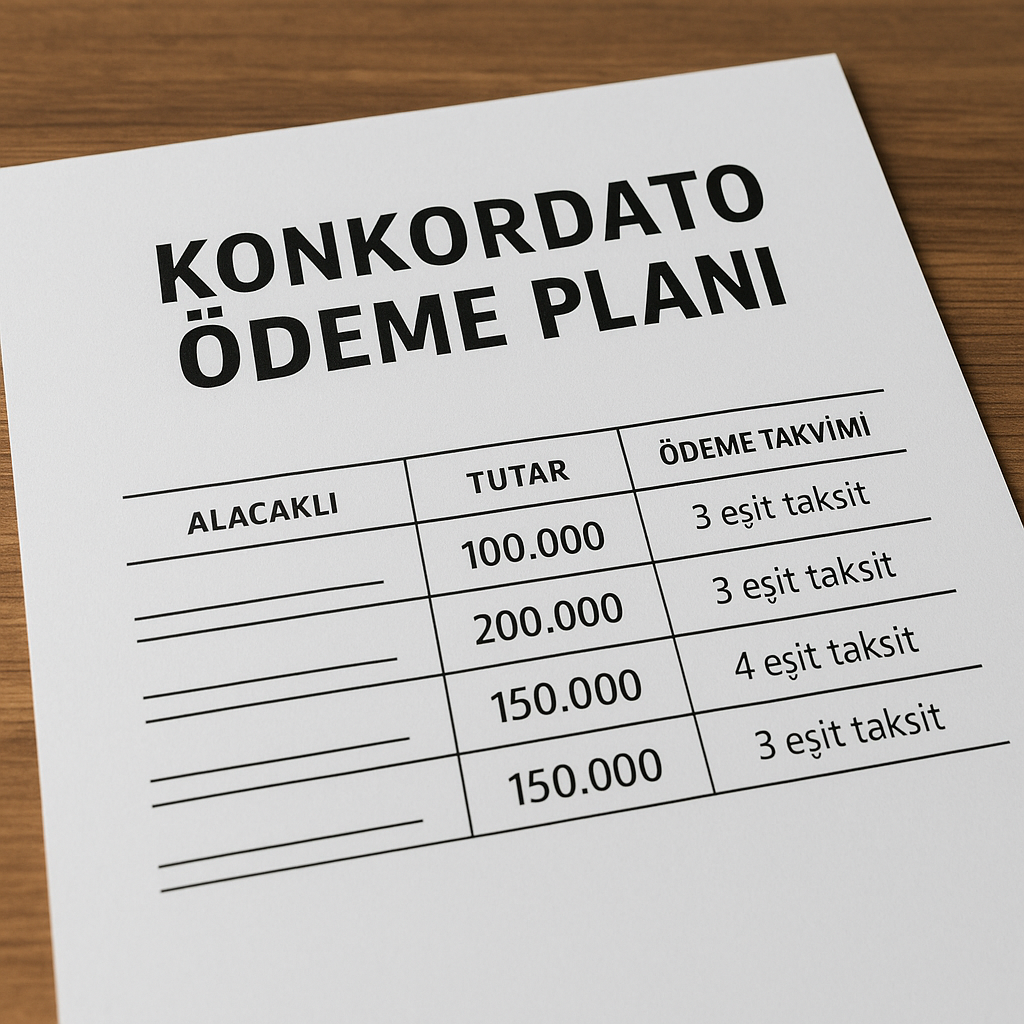
Content of the Plan: Payment plans detail the amount of debt to be paid (discounted or full), the payment due date, the number of installments, the frequency of installments (monthly, quarterly, etc.), the start date of payments, and whether interest will be applied. This plan is considered an integral part of the court decision.
Variety in Practice: Court decisions show that a wide variety of payment plans are approved, depending on the debtor’s financial situation and the nature of the project. Some plans include grace periods, some restructure debts with or without interest, and some stipulate increasing installments.
Supervision and Oversight: After the confirmation of concordat, a trustee is usually appointed to supervise the implementation of the payment plan and oversee the debtor’s activities. The trustee provides information about the progress of the process by submitting periodic reports to the court.
Sanction for Non-Compliance with the Plan: If the debtor fails to comply with the confirmed payment plan and does not pay installments on time, the creditor gains the right to, in accordance with Article 308/e of the Enforcement and Bankruptcy Law (EBL), request the termination of the concordat for their own part.
Annulment of Decisions: A concordat project and payment plan confirmed by the first instance court may be revoked by the Regional Court of Justice as a result of an appeal review. In this case, the approved payment plan effectively does not come into force.
1. Legal Nature and Entry into Force of the Concordat Payment Plan
The common and most fundamental point in the examined decisions is that the payment plan, along with the court’s approval decision, transforms into a legally binding document for creditors and the debtor. As stated by the Bakırköy 1st Civil Court of Commerce, “it must be accepted that the concordat becomes binding with the court’s approval decision, and creditors are obliged to comply with the payment plan presented within the scope of the concordat project approved with the necessary majority.”
When this bindingness will begin is a critical detail. This point has been clearly emphasized in the decisions of the Konya and Istanbul Anatolian courts. In the decision of the Konya Regional Court of Justice, it was stated that “it was decided that the approval decision would become binding immediately (as of 13/01/2020) without waiting for the reasoned decision to become final,” indicating that the process began to proceed quickly. This situation is important for creditors to receive their rights as soon as possible and for the debtor to start fulfilling their obligations.
2. Content and Diversity of Payment Plans
Court decisions show that there is no “one-size-fits-all” payment plan, and each concordat file is shaped according to its specific conditions.
Payment Amount and Discount: Plans may stipulate the full payment (100%) of the debt (concordat with maturity) or a certain percentage of discount (discounted concordat). For instance, while the Bakırköy 3rd Civil Court of Commerce stated in one decision that 100% of the debts would be paid without interest, the Ankara 2nd Civil Court of Commerce, in another file, ruled that “…all its debts be paid with a 39.56% discount, and the remaining 60.44% balance be payment-free for one year… with a 36-month maturity…”
Term and Installment Plan: Payment periods and installment frequency vary significantly. A wide range is available, from short-term plans, such as “3 equal installments over 3 months” seen in the decision of the Izmir Regional Court of Justice, to long-term plans, such as “a total of 72 installments” in the decision of the Bakırköy 1st Commercial Court of First Instance. Payments can be arranged in monthly, quarterly, semi-annual, or annual periods.
Grace Period: In many projects, grace periods are stipulated to allow the debtor to recover their financial situation. In a case reviewed by the 6th Civil Chamber of the Court of Cassation, it was decided that payments would commence after a “1-year payment-free, interest-free” period.
Interest Application: Plans can be interest-bearing or interest-free. While interest-free payment is a common practice, some decisions show interest being applied to the debt. For example, the Bakırköy 3rd Commercial Court of First Instance ruled in one of its decisions that payment should be made “in equal installments with 5% interest on the principal (100% + 5% interest)”. The Antalya 1st Commercial Court of First Instance, in another decision, stipulated payment “with an annual interest of 24%”.
Distinction Between Secured and Unsecured Creditors: In some decisions, different payment plans are observed to be created for secured creditors and unsecured creditors. Debts with secured creditors are usually restructured by signing separate protocols in accordance with Article 308/h of the Enforcement and Bankruptcy Law (İİK).
3. Supervision of Implementation and the Role of the Trustee
Monitoring compliance with the payment plan after the concordat’s approval is a critical stage. For this purpose, courts usually appoint a trustee. In the decision of the Istanbul Anatolian 1st Commercial Court of First Instance, the trustee’s duty was defined as: “to submit a report to our court every two months regarding the debtor’s business operational status and whether they maintain the ability to pay their debts in accordance with the project” . Trustee reports serve as important evidence in determining whether the payment plan has been violated.
4. Legal Consequences of Non-Compliance with the Payment Plan
The debtor’s failure to comply with the approved payment plan is one of the most sensitive aspects of the concordat institution. In a decision by the Gaziantep Regional Court of Appeal, this situation was clearly stated: “that failure to pay one of the installments written in the project on time will be sufficient” and “that there will be no need for a new grace period or for the debtor to be additionally put into default following non-performance” .
A creditor who has not received payment, in accordance with Article 308/e of the EBL, may apply to the court that approved the concordat and request its annulment concerning themselves. In a decision by the Ankara 2nd Commercial Court of First Instance, when the debtor defaulted on payments, the concordat was partially annulled, and the principle that the creditor “while preserving the new rights acquired under the concordat, may apply to the court that approved the concordat and have the concordat annulled concerning themselves” was applied.
Conclusion
Court decisions reveal that the payment plan after the approval of a concordat is a structured process conducted under court supervision, balancing the debtor’s financial rehabilitation and the creditors’ rights. The payment plan is the fundamental document that becomes immediately binding with the approval decision, meticulously regulating elements such as maturity, installments, interest, and grace periods, and shaping the debtor’s financial future. Although the content of the plans varies significantly from case to case, their common goal is to ensure the payment of debts within a predictable timeline. The success of this process, conducted under the supervision of a trustee, depends on the debtor’s adherence to the payment plan; non-compliance grants creditors the right to terminate the concordat, thereby safeguarding the system’s effectiveness. A paper suggestion.

Why is Expert Concordat Lawyer Support Necessary?
The concordat process is a restructuring mechanism that requires technical knowledge and legal experience, leaving no room for error. Especially in the stages of preparing, implementing, and overseeing post-approval payment plans, a small error can jeopardize both the debtor’s financial rehabilitation and the creditors’ receivables. Therefore, working with an expert concordat lawyer from start to finish of the process is of great importance.
Istanbul, especially in regions with intense commercial and industrial activities such as Tuzla, Pendik, Kartal, Maltepe, Gebze, and Çayırova, concordat cases are frequently observed. Businesses operating in these regions, with the support of an experienced concordat lawyer , can prepare their payment plans in accordance with regulations, professionally manage court and creditor relations, and ensure the successful conclusion of the process.
In short, the concordat process is not just a debt postponement; when managed correctly, it is an opportunity that ensures the company’s rebirth. For this opportunity to be carried out in a legally secure manner, the guidance of a lawyer specialized in concordat is mandatory.