Short answer
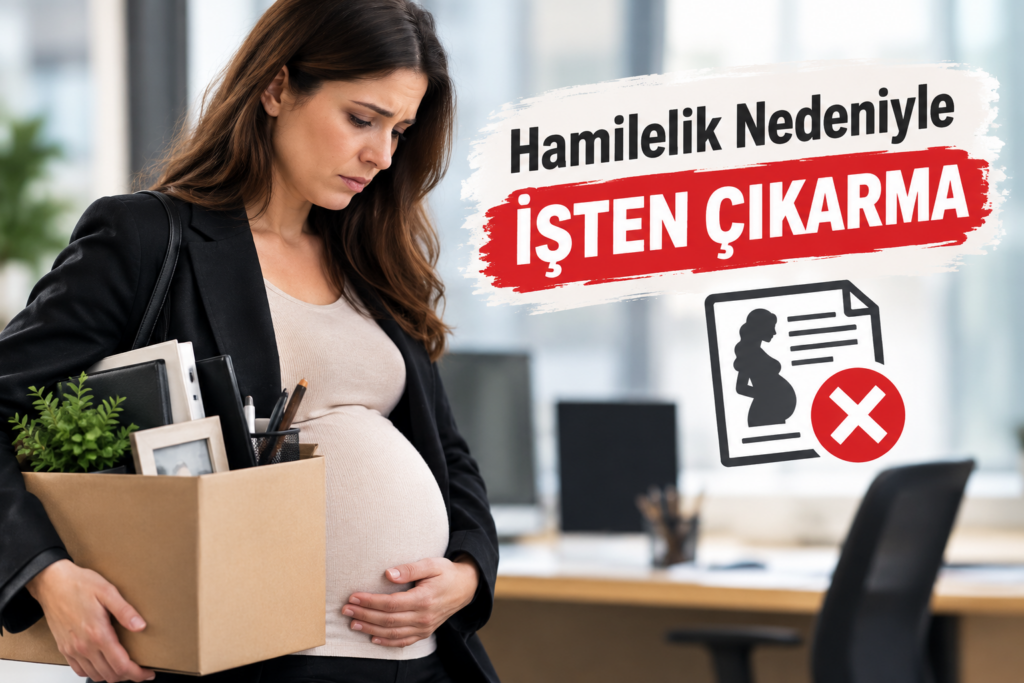
Turkish labour law says three things about an employee dismissed after announcing a pregnancy: pregnancy is never a valid ground for termination; if the employer has disguised the real reason as “performance” or “restructuring”, it must prove that reason with concrete evidence; and once the employee shows how close the dismissal came to the pregnancy announcement, the burden of proof shifts to the employer.
Two routes exist. If you fall within job security protection, you must apply to a mediator within one month of service of the termination notice and seek reinstatement. If you do not, you may claim severance and notice pay plus discrimination compensation of up to four months’ wages. The one-month period is a forfeiture period: miss it and the reinstatement route closes permanently.
Contents
- The familiar sequence: announcement, silence, then “performance”
- The employer’s real motive and what changed on 1 May 2026
- The legal framework in one map
- Equal treatment and the ban on pregnancy discrimination (Art. 5)
- Pregnancy is an invalid ground for dismissal (Art. 18/3-d)
- If they claim poor performance: no written defence, no valid dismissal (Art. 19/2)
- Maternity leave, nursing leave and the 2026 durations (Art. 74)
- Severance and notice pay: even force majeure does not help the employer
- How the burden of proof shifts
- How courts unpick manufactured performance files
- Two routes compared
- Route 1: invalidity of dismissal and reinstatement
- Route 2: direct claim for compensation and receivables
- Which claims cannot be combined
- A third channel outside the courts: the Human Rights and Equality Institution
- Deadlines and limitation periods
- Procedural traps
- Building the evidence file
- Frequently asked questions
- Why running these files correctly matters
1. The familiar sequence: announcement, silence, then “performance”
Most of these files begin the same way. The employee informs HR of her pregnancy. For a few weeks nothing happens. Then comes a first-ever “assessment meeting”, followed by a written record, a warning letter, or a termination notice. The stated reason is never pregnancy: it is inadequacy, declining output, a change in workplace organisation, downsizing, or sometimes a “mutual agreement”.
Dismissing a pregnant employee who has already completed the minimum service period for severance entitlement — whether directly because of the pregnancy or by concealing the true reason behind an apparent one — is a serious breach frequently encountered in Turkish employment practice. The dispute then unfolds along three axes at once: breach of the equal treatment principle, the prohibition of discrimination, and the invalidity of the dismissal.
Maternity and pregnancy are protected by constitutional and statutory guarantees in Turkish law. The remedies available against direct or disguised pregnancy-related dismissals, and the compensation that may be claimed, have been mapped out in detail by the legislator and by the case law of the higher courts, depending on whether the employee falls within job security protection. This article sets out that map in full.
2. The employer’s real motive and what changed on 1 May 2026
The underlying motive is usually the same: to prevent the employment relationship from remaining active in Social Security Institution (SGK) records throughout maternity leave, and to avoid maternity-related obligations. The employer does not want to keep the post open, arrange temporary cover, grant nursing leave and then reopen the same position on the employee’s return.
That motive became more visible in 2026. Law No. 7578, published in the Official Gazette of 1 May 2026 (No. 33240) and effective the same day, increased post-natal leave under Article 74 of Law No. 4857 from 8 to 16 weeks, raising total maternity leave from 16 to 24 weeks. Parallel amendments to Articles 15 and 18 of Law No. 5510 extended the period of the temporary incapacity allowance for maternity to 24 weeks as well.
The consequence runs both ways: the employee’s protection grew, and so did the incentive to avoid it. Courts measure exactly that — the distance between the pregnancy announcement and the termination.
3. The legal framework in one map
The core provisions are Articles 5, 17, 18, 19, 20, 21, 25 and 74 of Labour Law No. 4857, together with Article 14 of the former Labour Law No. 1475, which remains in force. Two further layers apply from outside labour law.
| Provision | What it protects |
|---|---|
| Law 4857, Art. 5 | Equal treatment duty, ban on pregnancy discrimination, compensation of up to four months’ wages, shifting burden of proof |
| Art. 17 | Notice periods, notice pay, bad-faith compensation for employees outside job security (Art. 17/6) |
| Art. 18 | Scope of job security; pregnancy expressly listed as an invalid ground (Art. 18/3-d) |
| Art. 19 | Written notice of termination and the duty to obtain a written defence in conduct or performance dismissals |
| Arts. 20–21 | Reinstatement procedure, deadlines, burden of proof, non-reinstatement compensation and idle-period wages |
| Art. 25 | Immediate termination for just cause and force majeure grounds (Art. 25/III) |
| Art. 74 | Maternity leave, paid leave for periodic check-ups, transfer to lighter work, unpaid leave, nursing leave (amended by Law 7578) |
| Additional Art. 3 | Five-year limitation period for severance, notice, bad-faith and equal-treatment compensation |
| Law 1475, Art. 14 | Severance pay: 30 days’ gross “dressed” wage for each full year of service |
| Law 6701, Arts. 3 and 6 | Prohibition of sex-based discrimination covering recruitment, employment and termination processes |
| Regulation on Working Conditions of Pregnant or Nursing Women (Official Gazette 16.08.2013, No. 28737) | Notification of pregnancy, risk assessment, adaptation of working conditions, night-work ban and daily hour limit |
The health and safety layer most files overlook
Issued under Occupational Health and Safety Law No. 6331, the Regulation turns the pregnancy announcement into the trigger for a set of employer duties. Under Article 6 the employee informs the employer of her pregnancy, and the employer must assess the effects of chemical, physical and biological agents and take the required measures. Under Article 7, if a risk is identified, working conditions or hours must be temporarily adjusted; if that is not possible, the employee must be transferred to another role. Article 8 provides that pregnant employees cannot be compelled to work at night from medical confirmation until birth, and that night work is prohibited for one year following birth. Article 9 caps daily working time for pregnant or nursing employees at seven and a half hours.
This matters in litigation. If the employer claims output fell, the question becomes whether the fall was caused by the employer’s own failure to adapt working conditions. An employer that ignored its duty cannot draw an advantage from the consequence.
4. Equal treatment and the ban on pregnancy discrimination (Art. 5)
Under Article 5, the employer must treat employees equally at the formation, continuation and termination of the employment relationship. Paragraph three protects pregnancy expressly: the employer may not, unless required by biological reasons or the nature of the work, treat an employee differently on grounds of sex or pregnancy, whether directly or indirectly, in the making of the contract, the setting and application of its terms, or its termination.
Paragraph six sets the sanction: where the relationship or its termination breaches those rules, the employee may claim appropriate compensation of up to four months’ wages, in addition to the rights of which she was deprived.
As the Constitutional Court emphasised in its decision of 1 February 2017, Application No. 2014/19081, where an employer breaches the equal treatment principle and the prohibition of pregnancy discrimination, the mandatory provisions of Article 5 come into play.
A breach also carries an administrative fine. Under Article 99/1-a of Law No. 4857, an employer acting contrary to the equal treatment principle is fined for each affected employee. The amount is revalued annually and was announced as TRY 2,531 per employee for 2026. It is separate from any compensation claim and arises from a labour inspection following a complaint to the Ministry of Labour and Social Security.
Dismissed after announcing your pregnancy?
The one-month mediation deadline cannot be recovered once it expires. Let us review your termination notice and correspondence without delay.
5. Pregnancy is an invalid ground for dismissal (Art. 18/3-d)
For employees within job security protection, pregnancy can never constitute a valid ground for termination. Article 18(3)(d) lists race, colour, sex, marital status, family responsibilities, pregnancy, childbirth, religion, political opinion and similar grounds as incapable of forming a valid reason.
Court of Cassation, 9th Civil Chamber, 05.10.2017, File 2016/21953, Decision 2017/15076: the Chamber held that those grounds are laid down as invalid reasons, that this constitutes discrimination, and that subjecting an employee to different treatment because of her pregnancy is regarded as discrimination.
9th Civil Chamber, 25.05.2015, File 2015/11182, Decision 2015/18740: the Chamber repeated that Article 18/3-d provides that an employee’s pregnancy does not constitute a valid ground for dismissal.
The key point is that the rule prohibits pregnancy from being the motive behind the decision, not merely from being written in the notice. Writing something else in the reason box does not defeat the protection.
6. If they claim poor performance: no written defence, no valid dismissal (Art. 19/2)
Where an employer relies on performance, output or conduct in order to conceal the pregnancy motive, Article 19(2) makes obtaining the employee’s written defence before termination a mandatory procedural requirement: an indefinite-term contract may not be terminated for reasons related to the employee’s conduct or output without first taking her defence against the allegations, the employer’s right of termination under Article 25(II) being reserved.
In practice this rule alone can decide the file, because hastily constructed performance dismissals either skip the defence step entirely or date it after the termination.
22nd Civil Chamber, 14.09.2012, File 2012/2034, Decision 2012/18276: the employee must be given the opportunity to answer the allegations before a dismissal based on conduct or inadequacy. Where the employer terminated on conduct grounds without taking the defence, rejecting the claim instead of upholding it was held to be erroneous.
9th Civil Chamber, 13.02.2017, File 2016/3618, Decision 2017/1588: even where severance and notice pay were paid and the employer characterised the termination as one for valid cause, the failure to take the employee’s defence beforehand rendered the dismissal invalid and required an order for reinstatement.
In other words, payment of your severance entitlement does not make the dismissal valid. Employers frequently assume the opposite.
7. Maternity leave, nursing leave and the 2026 durations (Art. 74)
Article 74 grants female employees maternity leave before and after birth, paid leave for periodic medical check-ups, the right to lighter work on medical advice, unpaid leave, and one and a half hours of daily nursing leave. Under the final paragraph, these provisions apply to every employee working under an employment contract, including those outside job security protection.
| Entitlement | Before Law 7578 | From 1 May 2026 |
|---|---|---|
| Pre-natal leave | 8 weeks | 8 weeks (unchanged) |
| Post-natal leave | 8 weeks | 16 weeks |
| Total maternity leave | 16 weeks | 24 weeks |
| Multiple pregnancy, total | 18 weeks | 26 weeks (two extra pre-natal weeks) |
| Working up to birth with medical approval | Until 3 weeks before birth | Until 2 weeks before birth; time worked is added to post-natal leave |
| Unpaid leave after maternity leave | Up to 6 months after 16/18 weeks | Up to 6 months after 24/26 weeks |
| Paternity leave (Additional Art. 2) | 5 days | 10 days |
| SGK maternity incapacity allowance | 16 weeks | 24 weeks (Law 5510, Arts. 15 and 18) |
Provisional Article 1 of Law No. 7578 also introduced a transition rule granting eight additional weeks of maternity leave to employees who, as at 1 April 2026, had not yet completed 24 weeks from the date of birth. The half-time working entitlement after maternity leave (60 days for the first birth, 120 for the second, 180 for subsequent births), the half-time working allowance under Additional Article 5 of Law No. 4447, and the one-off right to request part-time work until the child reaches primary school age all remain in force.
9th Civil Chamber, 11.04.2019, File 2019/1399, Decision 2019/8536: where the employee was called back to work before her Article 74 maternity leave had expired and her contract was then terminated, the dismissal did not rest on just cause and reinstatement had to be ordered. The Chamber also held that absence records and a termination letter bearing dates later than the date on which the employee said the contract had been ended orally could not be given weight.
7th Civil Chamber, 26.05.2016, File 2016/3497, Decision 2016/11599: treating a period that included statutory maternity leave as a disruption of workflow — by counting 145 days of medical leave over a year — was contrary to the general principles of law and to the constitutional and statutory provisions protecting maternity, and constituted a ground for reversal.
The second decision is particularly useful: periods spent on statutory leave and medical reports cannot be recast as absenteeism or workflow disruption. Employer defences built on adding up days of pregnancy-related leave are met with this line of authority.
8. Severance and notice pay: even force majeure does not help the employer
Because a pregnancy-related dismissal does not rest on just cause, an employee with at least one year’s service is entitled under Article 14 of Law No. 1475 to severance pay of 30 days’ gross “dressed” wage for each full year. The dressed wage includes recurring benefits such as transport, meals, bonuses and regular premiums, so calculations based on the bare wage are usually understated. Where statutory notice periods were not observed and their wage equivalent was not paid in advance, notice pay arises under Article 17.
22nd Civil Chamber, 13.03.2014, File 2013/5327, Decision 2014/5737: where the contract is terminated for force majeure under Article 25(III), the employer owes no notice or notice pay, but severance pay must still be paid under Article 14 of Law No. 1475.
So even where the employer argues that continued work had become medically impossible, the severance entitlement survives.
9. How the burden of proof shifts
Employers know that a pregnancy-based dismissal is unlawful, so they usually shelter behind apparent reasons such as poor performance, neglect of duties or downsizing. The decisive question is who has to disprove them.
The two-stage rule (Art. 5/7)
As a rule the employee bears the burden of proving discrimination. However, paragraph seven of Article 5 provides that once the employee establishes a situation strongly indicating the likelihood of a breach, the employer becomes obliged to prove that no such breach occurred.
9th Civil Chamber, 09.09.2025, File 2025/5550, Decision 2025/6083: the employee had put forward a situation strongly indicating a breach, and the employer — on whom the burden then lay — had failed to establish, by concrete facts, why the employee’s pre-birth position and duties had been changed after the birth, or what reasons required her to be treated differently.
9th Civil Chamber, 15.05.2019, File 2016/1423, Decision 2019/11167: although the burden of proving breach of the equal treatment duty rests on the employee, once she adduces evidence strongly indicating the breach, the employer must prove the contrary. On the evidence, the contract had been terminated by discrimination on grounds of pregnancy and the conditions for discrimination compensation were met.
To the same effect: 22nd Civil Chamber, 09.06.2015, File 2015/15750, Decision 2015/20058; 22nd Civil Chamber, 27.03.2018, File 2015/28332, Decision 2018/7866; 9th Civil Chamber, 07.03.2012, File 2009/46881, Decision 2012/7621.
In reinstatement proceedings the burden already lies with the employer (Art. 20/2)
9th Civil Chamber, 05.10.2017, File 2016/21953, Decision 2017/15076: Article 20(II) expressly places on the defendant employer the burden of proving that the dismissal rested on valid grounds. The employer must also prove that the employee’s conduct or inadequacy caused adverse effects in the workplace and rendered the employment relationship untenable.
Facts treated in practice as strong indicators
- A short interval between the pregnancy announcement and the termination
- No warnings or records before the announcement, followed by a run of records afterwards
- Several pregnant employees dismissed in the same period while recruitment continues
- Demotion, relocation or a travel-heavy new job description on return from maternity leave
- Refusal of nursing leave or of paid leave for periodic check-ups
- A shifting justification within the file (first downsizing, later performance)
- A “resignation” or settlement document signed in a process where the initiative came from the employer
Your correspondence decides the case
Messages, e-mails, internal records and medical report dates, assembled together, can shift the burden of proof. Let us assess them with you.
10. How courts unpick manufactured performance files
Performance assessment cannot ignore pregnancy
7th Civil Chamber, 21.12.2016, File 2016/31743, Decision 2016/21732: a woman living through pregnancy and childbirth cannot be compared in the abstract with the results achieved by other employees without regard to her situation; and two years of negative performance, assessed without regard to the general course of her work, are not sufficient to end the contract. The dismissal was held invalid.
This is one of the most practically useful authorities against performance defences: any comparison must be with the employee’s own record and the circumstances of the period, not with other employees’ raw figures.
Satisfied yesterday, dissatisfied today
22nd Civil Chamber, 22.01.2014, File 2013/36923, Decision 2014/707: the file and witness evidence showed the employer had been satisfied with the employee’s work and output before the birth, that nursing leave was refused afterwards and that this caused friction. The first-instance finding that the dismissal was unjustified and invalid, and the order for reinstatement, were consistent with the file and the employer’s appeal points were rejected.
Downsizing and restructuring are reviewable too
9th Civil Chamber, 22.02.2018, File 2018/1222, Decision 2018/3833: where the restructuring rationale and its content were not concretely established, and it was not proved that the need for the employee’s work had disappeared or why she had been selected for redundancy, the dismissal could not be treated as valid.
The second question decides these defences: even if the downsizing is genuine, why was this employee selected? If the selection criterion cannot be explained, the dismissal does not survive.
If a mutual termination agreement was signed
Even where the parties used a mutual termination (ikale) agreement, as the 9th Civil Chamber indicated on 17.09.2015 (File 2015/18686, Decision 2015/26045), the agreement is invalid and reinstatement follows if the pregnant employee’s reasonable benefit was not met. An arrangement that strips away job security and maternity rights while paying only the statutory entitlements does not meet that test.
The exception: a genuine, pregnancy-independent ground
The honest side of the picture must also be stated. If the employer proves by concrete evidence that the termination arose directly from conduct contrary to the duty of honesty and loyalty under Article 25(II), independently of the pregnancy, the claim may be dismissed (9th Civil Chamber, 19.09.2022, File 2022/8179, Decision 2022/9724). These cases are therefore built on evidence, not on categories.
11. Two routes compared
| Criterion | Route 1: reinstatement within job security (Arts. 18–21) | Route 2: direct claim for compensation and receivables |
|---|---|---|
| Scope requirements | At least 6 months’ service and 30 or more employees at the employer’s workplaces in the same branch of activity | Less than 6 months’ service or fewer than 30 employees; or pursuing termination-related entitlements without bringing a reinstatement claim |
| Mandatory procedure and deadlines | Mediation is compulsory within one month of service of the notice. If no settlement, proceedings within two weeks of the final mediation minutes | Mediation and proceedings within the general limitation periods |
| Principal claims | Invalidity of the dismissal and reinstatement; non-reinstatement compensation of 4 to 8 months’ wages; up to 4 months’ idle-period wages and other entitlements | Severance pay (with at least one year’s service); notice pay; discrimination compensation of up to 4 months’ wages (Art. 5/6) or bad-faith compensation of three times the notice period (Art. 17/6); other unpaid entitlements |
| Discrimination / bad-faith compensation | Discrimination is already weighed when setting the non-reinstatement compensation, so separate discrimination compensation is not awarded. Bad-faith compensation cannot be claimed at all (Art. 17/6) | Discrimination compensation may be claimed independently under Art. 5. Bad-faith and discrimination compensation cannot both be recovered for the same act |
12. Route 1: invalidity of dismissal and reinstatement (Arts. 20, 21)
An employee within job security (at least six months’ service and 30+ employees) must apply to a mediator within one month of service of the termination notice. If no settlement is reached, proceedings must be filed in the labour court within two weeks. Where the court finds the dismissal invalid and orders reinstatement, two heads of claim arise (7th Civil Chamber, 27.02.2015, File 2014/17377, Decision 2015/2732; 9th Civil Chamber, 17.09.2015, File 2015/18686, Decision 2015/26045):
Non-reinstatement compensation
If the employee applies in time but the employer does not take her back within one month, Article 21 requires compensation of between four and eight months’ wages. As the 7th Civil Chamber held on 21.12.2016 (File 2016/31743, Decision 2016/21732), this job-security compensation must be set by reference to factors such as the employee’s length of service and the reason for dismissal. Where the dismissal breaches the prohibition of discrimination, courts may assess it close to the upper limit; in 22nd Civil Chamber, 22.01.2014 (File 2013/36923, Decision 2014/707) it was fixed at five months’ wages.
Idle-period wages
Wages and other accrued entitlements for up to four months of the period until the judgment becomes final are also awarded. That period counts for social security purposes too, which matters for maternity leave and allowance records.
13. Route 2: direct claim for compensation and receivables
- Severance and notice pay: severance under Article 14 of Law No. 1475 for employees with at least one year’s service, and notice pay under Article 17 where no notice period was given.
- Discrimination compensation (Art. 5/6): up to four months’ wages. As the 9th Civil Chamber held on 09.09.2025 (File 2025/5550, Decision 2025/6083), this is not compensation in the technical sense: it is enough that the employee was subjected to a discriminatory act or treatment, and no separate loss need be shown.
- Bad-faith compensation (Art. 17/6): for employees outside job security, three times the notice period where the right of termination has been abused.
- Other entitlements: unpaid wages, overtime, national holiday and weekly rest pay, annual leave pay, and nursing leave not granted (payable under the overtime rules in Article 41 by reference to Article 74/7).
14. Which claims cannot be combined
a) Reinstatement and discrimination compensation are not awarded together
9th Civil Chamber, 25.05.2015, File 2015/11182, Decision 2015/18740: because the employer’s discriminatory conduct is already discussed in determining the invalidity of the dismissal and the amount of the non-reinstatement compensation, discrimination compensation cannot be awarded at the same time; awarding it instead of rejecting the claim was erroneous. To the same effect: 9th Civil Chamber, 17.09.2015, File 2015/18686, Decision 2015/26045.
In a direct claim, by contrast, discrimination compensation is awarded as an independent head (9th Civil Chamber, 05.11.2014, File 2012/39721, Decision 2014/32640).
b) Employees within job security cannot claim bad-faith compensation
9th Civil Chamber, 05.11.2014, File 2012/39721, Decision 2014/32640: under the plain wording of Article 17(6), employees within job security cannot acquire a right to bad-faith compensation; awarding it, and overlooking that a second award cannot be made on the same legal ground, required reversal.
c) Discrimination and bad-faith compensation cannot be claimed together
22nd Civil Chamber, 27.03.2018, File 2015/28332, Decision 2018/7866: under the Chamber’s practice, the two cannot be paid at the same time.
For employees outside job security the correct approach is to identify at the outset which head is higher and easier to prove on the facts, and to frame the claim accordingly. Where notice periods are short, discrimination compensation (up to four months’ wages) is usually the larger figure.
15. A third channel outside the courts: the Human Rights and Equality Institution
Pregnancy discrimination is not a matter for the labour courts alone. Article 3 of Law No. 6701 on the Human Rights and Equality Institution of Türkiye prohibits discrimination on grounds of sex, and Article 6 provides that an employer may not discriminate in any work-related process, including information, application, selection criteria, recruitment conditions, employment and the termination of employment. Paragraph three expressly forbids rejecting an employment application on grounds of pregnancy, maternity or childcare; paragraph five extends the article to work contracts falling outside Law No. 4857.
Under Article 25, a breach attracts an administrative fine set by reference to the gravity of the breach and its consequences, the perpetrator’s financial position and the aggravating effect of multiple discrimination. The Institution has held that an applicant whose recruitment process was concluded negatively after she disclosed her pregnancy suffered discrimination on grounds of sex (Board Decision No. 2020/176).
This channel has two practical uses. First, because the prevailing scholarly view is that the discrimination compensation in Article 5/6 of the Labour Law does not cover the recruitment stage, Law No. 6701 is the principal route where a candidate is refused employment. Second, a Board decision can be filed as evidence in the labour court proceedings. Applications may also be submitted through governorships and district governorships; the procedure is set out in Article 17 of Law No. 6701.
Law No. 6701 also defines workplace harassment — deliberate acts aimed at alienating, excluding or wearing down a person on a prohibited ground — and victimisation, meaning adverse treatment of those who initiate or take part in administrative or judicial processes against discrimination. Both concepts apply directly where an employee is isolated or stripped of duties after announcing a pregnancy, or pressured for having brought a claim.
16. Deadlines and limitation periods
| Step | Period | Starting point |
|---|---|---|
| Mediation application for reinstatement | 1 month (forfeiture period) | Service of the termination notice |
| Reinstatement proceedings | 2 weeks | Date of the final mediation minutes |
| Application to return to work after judgment | 10 working days | Service of the judgment |
| Severance, notice, bad-faith and equal-treatment compensation | 5 years (Additional Art. 3) | Date of termination |
| Wages and wage supplements | 5 years (Art. 32) | When they fall due |
Additional Article 3, inserted into Law No. 4857 by Article 15 of Labour Courts Law No. 7036, sets a five-year limitation period for annual leave pay, severance pay, compensation for termination without notice, bad-faith compensation and compensation arising from termination in breach of the equal treatment principle. Because the wording refers to termination, claims arising from discrimination during an ongoing employment relationship remain debated, with the ten-year period in Article 146 of the Turkish Code of Obligations arguably applying. Under Article 3(17) of Law No. 7036, limitation is suspended and forfeiture periods do not run between the application to the mediation office and the date of the final minutes.
17. Procedural traps
- Missing the forfeiture period: the one-month mediation deadline in Article 20 is a forfeiture period; if it is missed the reinstatement claim is dismissed on procedural grounds.
- The 30-employee threshold is examined ex officio: 9th Civil Chamber, 18.12.2017, File 2016/32626, Decision 2017/21574 held that, since the job security provisions (Arts. 18–21) are mandatory, whether the employee falls within their scope must be investigated by the court of its own motion.
- Organic link between companies: where fewer than 30 employees appear on paper at the date of dismissal, allegations of group companies, organic links and employees being registered under different entities must be examined carefully (9th Civil Chamber, 05.11.2018, File 2018/9291, Decision 2018/19546).
- Quantifying the claim and paying court fees: 9th Civil Chamber, 22.02.2018, File 2018/1222, Decision 2018/3833 held that where no amount was stated for the bad-faith compensation claim and no fee was paid, no judgment whatsoever can be given on an unquantified and unfee’d claim.
- Duty to examine the facts concretely: rejecting a pregnancy discrimination claim on abstract reasoning is a ground for reversal; all allegations, defences and evidence must be examined individually (9th Civil Chamber, 04.10.2018, File 2018/8282, Decision 2018/17510).
18. Building the evidence file
While you are still employed
- Notify the pregnancy in writing (e-mail or registered electronic mail). An oral notification is hard to prove.
- Keep hospital reports and check-up documents with their dates.
- Collect every role change, target change, warning and internal record issued after the announcement, with dates.
- Do not sign anything unread, particularly documents headed resignation, mutual termination or settlement.
- Obtain copies of earlier performance reviews, bonus letters and promotion notices.
If the dismissal has already happened
- Document the date of service of the termination notice; the one-month period runs from it.
- Note whether the notice states a reason, whether your defence was taken, and on what date.
- Check the exit code on the SGK departure notification via e-Devlet; a code that contradicts the stated reason is a common crack in the employer’s case.
- Identify any other pregnant colleagues dismissed in the same period; witness lists are built from there.
- Check whether the same role has been re-advertised and take screenshots.
- Payment of your severance does not close the door; it does not validate the dismissal.
Choosing the right route decides the outcome
Reinstatement or a direct claim? The wrong choice costs entitlements. We handle employment files before the labour courts in Istanbul and the surrounding provinces.
19. Frequently asked questions
I was dismissed a week after announcing my pregnancy. Is that enough on its own?
Not conclusive on its own, but a strong indicator. Temporal proximity can amount to a situation “strongly indicating the likelihood of a breach” under Article 5(7) and shift the burden to the employer, who must then explain the dismissal by concrete facts unconnected to the pregnancy.
My employer paid my severance and notice pay. Can I still sue?
Yes. As the 9th Civil Chamber held on 13 February 2017, a dismissal carried out without taking the employee’s defence is invalid even where severance and notice pay were paid, and reinstatement must be ordered. Payment does not make the dismissal lawful.
There are fewer than 30 employees at my workplace. Do I have no rights?
No. Reinstatement is unavailable, but you may claim severance and notice pay plus discrimination compensation of up to four months’ wages, or bad-faith compensation where its conditions are met. The 30-employee threshold is also examined by the court ex officio, and group company or organic link allegations are investigated; the visible headcount does not always reflect reality.
They asked me to sign a mutual termination agreement and I did. Is there any way back?
The validity of such an agreement is tested against the “reasonable benefit” provided to the employee. A pregnant employee giving up job security and maternity rights in return for no more than her statutory entitlements is generally not treated as receiving reasonable benefit; the 9th Civil Chamber’s decision of 17 September 2015 is to that effect. The deadlines continue to run, so seek advice promptly.
How long is maternity leave in Türkiye in 2026?
Under Law No. 7578, eight weeks before and sixteen weeks after birth, twenty-four weeks in total; in multiple pregnancies two further weeks are added before birth, giving twenty-six. The SGK maternity incapacity allowance now runs for twenty-four weeks as well. The change took effect on 1 May 2026.
They called me back before my maternity leave ended and then dismissed me.
The 9th Civil Chamber addressed exactly this on 11 April 2019 and ordered reinstatement on the ground that the dismissal did not rest on just cause. The same decision held that absence records drawn up after the employer had already expressed its intention to terminate carry no weight.
Can I claim both discrimination and bad-faith compensation?
Not for the same act of termination (22nd Civil Chamber, 27 March 2018). If you are within job security, bad-faith compensation cannot be claimed at all. The right approach is to select the head that is higher and easier to prove on your facts.
If I win reinstatement, must I actually return to work?
No, but you must apply to return within the prescribed period. Without that application, neither non-reinstatement compensation nor idle-period wages arise. If the employer does not take you back within one month, compensation of four to eight months’ wages becomes payable.
My employer refuses to grant nursing leave. Is that a separate right?
Yes. Article 74 grants one and a half hours per day to nurse a child under one year, and time not granted is paid under the overtime provisions of Article 41. Refusal also weighs in the discrimination assessment, as the 22nd Civil Chamber’s decision of 22 January 2014 shows.
A job offer was withdrawn once they learned I was pregnant. What can I do?
The prevailing scholarly view is that the discrimination compensation in Article 5/6 does not extend to the recruitment stage. The principal route is therefore Article 6(3) of Law No. 6701: an employer may not reject an employment application on grounds of pregnancy, maternity or childcare. The application is made to the Human Rights and Equality Institution of Türkiye and may result in an administrative fine.
How long do I have to bring a claim?
One month for mediation in reinstatement cases and two weeks thereafter for proceedings. Severance, notice, bad-faith and equal-treatment compensation are subject to a five-year limitation period running from the date of termination (Additional Article 3).
20. Why running these files correctly matters
Pregnancy discrimination files sit at the intersection of the strictest deadlines and the most case-law-dependent rules in Turkish employment law. Two different choices on identical facts produce entirely different outcomes.
On the employee’s side
- The one-month mediation deadline is a forfeiture period and cannot be recovered; it must be calculated from the correct service date.
- The choice between reinstatement and a direct claim determines whether discrimination compensation can be claimed at all.
- Discrimination and bad-faith compensation cannot be combined, so the claim must be built on the right head from the outset.
- No judgment can be given on a head that is not quantified and fee-paid.
- Severance is calculated on the gross dressed wage; omitting transport, meals and regular premiums causes real loss.
- The evidence that shifts the burden of proof must be presented systematically in the statement of claim.
On the employer’s side
- Failure to take a written defence in conduct or performance dismissals invalidates the termination by itself.
- A business-decision defence must explain not only the downsizing but why this employee was selected.
- Performance assessment must rest on objective criteria and cannot disregard pregnancy and childbirth.
- Mutual termination agreements without a reasonable benefit balance are invalid.
- Undocumented health and safety duties towards pregnant and nursing employees weaken the entire defence.
Where these disputes concentrate in Istanbul
Pregnancy discrimination files cluster in particular employment zones of Istanbul. On the European side, manufacturing, textile, logistics and call-centre employment dominates in Başakşehir (İkitelli Organised Industrial Zone), Esenyurt, Beylikdüzü, Bağcılar, Küçükçekmece, Avcılar, Bahçelievler and Zeytinburnu, while white-collar, finance, technology and services employment concentrates in Şişli, Sarıyer (Maslak), Beşiktaş (Levent) and Beyoğlu. On the Anatolian side, Ataşehir, Ümraniye, Kadıköy, Sancaktepe, Çekmeköy, Sultanbeyli and the Tuzla Organised Industrial Zone, together with the industrial and logistics belt in Gebze, Çayırova, Darıca and Dilovası in Kocaeli, account for a significant share of these files.
The structure of employment shapes the file. In organised industrial zones the issues tend to be shift patterns, the night-work prohibition and headcount split across group companies; in corporate offices they are performance system documents, target cards, e-mail records and post-maternity role changes. In both, what decides the case is whether the evidence was gathered correctly before the dismissal.
2M Hukuk Law Firm
Founder: Meryem Günay, Attorney at Law. The firm practises in employment law, condominium and urban transformation law, maritime commercial law, immigration law and administrative litigation, handling files before the labour courts on both the Anatolian and European sides of Istanbul and in the Kocaeli region.
Address: Postane Mahallesi, Seher Sokak No: 18/2, Tuzla / Istanbul, Türkiye
Phone: +90 505 390 25 48 | E-mail: info@2mhukuk.com
Sources and legislation
- Labour Law No. 4857 — mevzuat.gov.tr
- Labour Law No. 1475, Article 14 (still in force)
- Law No. 7578 amending the Social Services Law and certain other laws — Official Gazette, 1 May 2026, No. 33240
- Social Insurance and Universal Health Insurance Law No. 5510, Articles 15 and 18
- Labour Courts Law No. 7036, Articles 3 and 15
- Law No. 6701 on the Human Rights and Equality Institution of Türkiye — mevzuat.gov.tr
- Regulation on the Working Conditions of Pregnant or Nursing Women, Nursing Rooms and Childcare Facilities — Official Gazette, 16 August 2013, No. 28737
- Constitutional Court, 1 February 2017, Application No. 2014/19081
This article is provided for general information only and does not constitute legal advice. Every file must be assessed on its own evidence. The current texts of the judgments cited should be verified through UYAP and the official case-law databases.