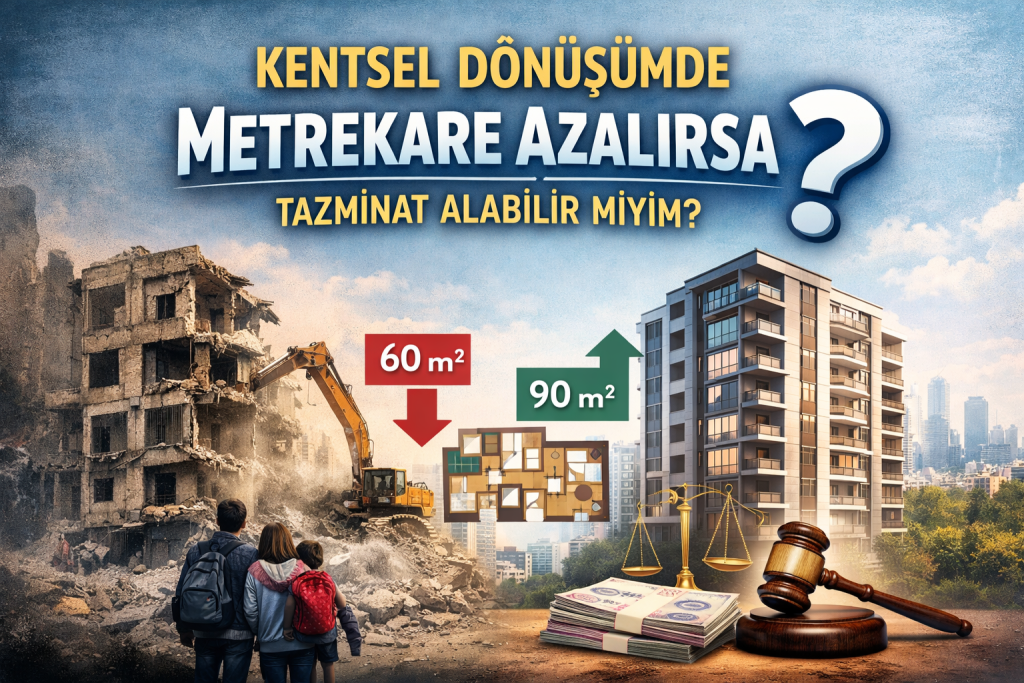
Introduction and Basic Legal Approach
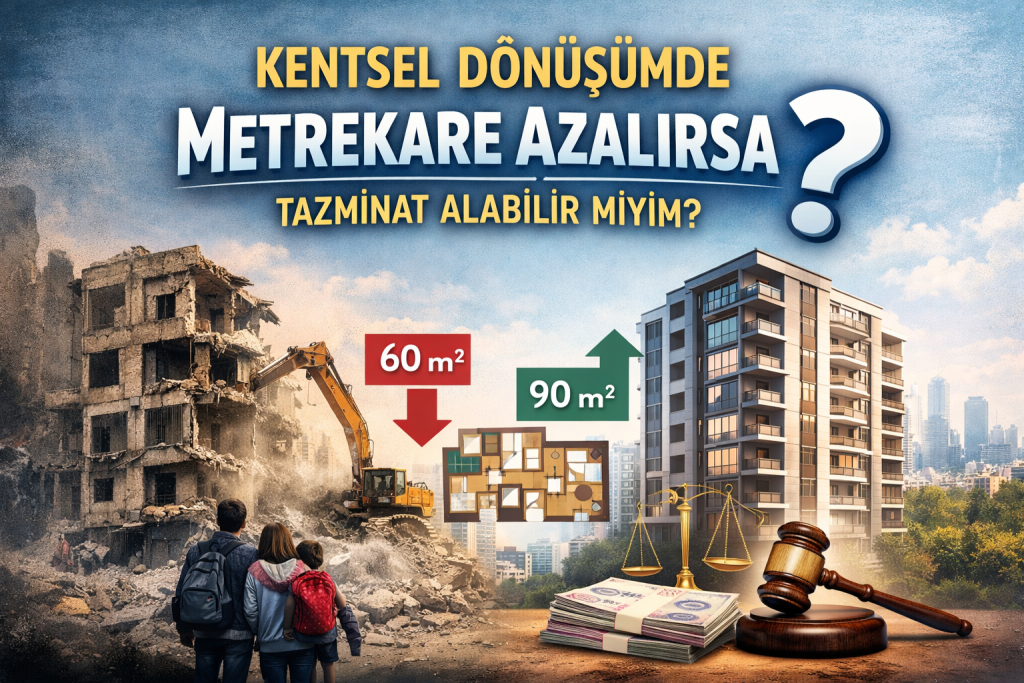
Changes in the square meters of independent sections during the urban transformation process lead to different legal consequences depending on the parties to the dispute (between owners or against the administration) and the legal basis on which the transformation relies (private law contracts or Article 6/A of Law No. 6306). Judicial decisions evaluate the clear imbalances in square meters and value, especially those arising between owners, within the framework of “unjust enrichment” provisions, while administrative practices (especially in post-disaster allocation by lottery) exhibit a different approach.
1. Unjust Enrichment and Compensation Liability Among Owners
According to the established jurisprudence of the 3rd Civil Chamber of the Supreme Court (2022/5267 E., 2023/1448 K.; 2018/4855 E., 2019/8655 K.), in buildings demolished and rebuilt within the scope of urban transformation, a disproportionate change in the square meters of independent sections may infringe upon property rights. The increase in usable areas for some owners while others experience a decrease in the new project creates an “explicit imbalance in value and use” between the parties.
In this case, the Supreme Court accepts that the provisions on unjust enrichment regulated in Articles 77-82 of the Turkish Code of Obligations should be applied. In concrete cases, an expert examination determines the amount of value increase or decrease in each apartment; it is ruled that owners who benefited from a square meter increase must pay this difference as compensation to the aggrieved owners. When calculating the compensation amount, the values of the independent sections and their land shares on the date the building occupancy permit was obtained are taken into account.
2. Administrative Practices and Limitations Under Law No. 6306 (Article 6/A)
Recent decisions of the 4th Chamber of the Council of State (2024/1079 , 2024/984 , 2024/948 , 2024/949 , 2024/947 , 2024/1132 ) have established a different legal standard, particularly in projects carried out under Article 6/A of Law No. 6306 after the Izmir earthquake on 30/10/2020. Administrative judicial authorities, in residences built after the disaster;
that differences in square footage, floor, location, and facade compared to old residences are a “natural consequence”,
that the allocation of residences being determined “by lottery” cannot be considered a fault of the administration,
emphasize that it is technically and legally impossible to provide all disaster victims with residences that have exactly the same characteristics as their old ones.
In this context, meeting urgent housing needs is considered a priority in accordance with the principles of “Social State” and “National Solidarity” of the Constitution, and compensation claims arising from a decrease in square footage are rejected on the grounds of the administration’s blamelessness.

3. Special Circumstances Preventing or Limiting Compensation Claims
Specific circumstances leading to the rejection or set-off of compensation claims have been identified in judicial decisions:
Management Plan and Waiver: The 11th Civil Chamber of the Court of Cassation (2022/2744 E., 2022/3943 K.) rejects compensation claims in cases where the management plan accepts square meter changes and contains waiver provisions stating that no lawsuit will be filed regarding this matter.
Liquidation of Illegal Areas: In the decisions of the 6th Civil Chamber of the Court of Cassation (2024/468 E., 2025/1210 K.) and the Ankara 9th Civil Court of Commerce, it has been ruled that if the square footage in the old building was large due to “illegal additions” or “unjust use of common areas” (e.g., merging the caretaker’s flat), and this situation was brought within legal limits in the new project, the owner cannot claim compensation due to the reduction in square footage.
Principle of Set-off: In the decision of the Antalya 1st Civil Court of Commerce (2017/809 E., 2019/438 K.), it was stated that if the owner’s apartment was reduced in size but the shop given to them within the same project increased in size, the damage incurred should be set off against the benefit provided.
4. Secondary Sources and Additional Context
The decisions of the Council of State and the Court of Cassation, which serve as secondary sources, provide the following additional contexts regarding the issue:
Administrative Fault and Service Fault: In the decisions of the 6th Chamber of the Council of State (2022/1524 E.) and the 4th Chamber of the Council of State (2024/995 E.), it is emphasized that compensation liability may arise if the administration has zoning and supervision faults in structures demolished due to landslide or earthquake risk rather than urban transformation, but that this is focused on “service fault” rather than an imbalance between owners.
Goodwill and Location Difference: The Administrative Litigation Chambers Board of the Council of State (2023/3171 E.) has indicated that administrative actions can be annulled if proposing economically imbalanced locations (e.g., rear facade instead of front facade) to minority shareholders, instead of their formerly valuable locations, is found to be contrary to the “fair sharing” principle.
Freedom of Contract: The 3rd Civil Chamber of the Court of Cassation (2016/9265 E.) may find that requesting compensation later on the grounds of a value difference, if registration was made in accordance with the sharing stipulated in a construction contract in return for flats signed by the owner’s free will, is “contrary to the rule of good faith.”
Conclusion An owner who experiences a decrease in square footage after urban transformation can claim compensation based on “unjust enrichment” provisions if the dispute involves other floor owners and there is a clear imbalance in the project. However, if the transformation is carried out as an administrative procedure under Law No. 6306 (especially a lottery after a disaster), the administrative judiciary tends to reject compensation claims by accepting these differences as a natural result of the lottery process. Illegal uses in the rightful owner’s old property or explicit consent in the contract may eliminate the right to compensation.
Kentsel dönüşüm sonrası dairem küçülürse tazminat alabilir miyim?
Eğer dönüşüm kat malikleri arasında yapılan bir proje kapsamında gerçekleşmiş ve yeni projede bağımsız bölümler arasında açık bir metrekare veya değer dengesizliği oluşmuşsa, Yargıtay uygulamasına göre sebepsiz zenginleşme hükümleri kapsamında tazminat talep edilebilir. Ancak dönüşüm 6306 sayılı Kanun kapsamında idari bir uygulama (özellikle afet sonrası kura yöntemi) ile yapılmışsa, metrekare farkı çoğu durumda tazminat sebebi sayılmamaktadır.
Afet sonrası devlet tarafından verilen yeni konut eski konutumdan küçükse dava açabilir miyim?
Danıştay kararlarına göre, afet sonrası yapılan konut tahsislerinde eski konutla birebir aynı metrekare, kat veya cephe özelliklerinin sağlanması zorunlu değildir. Kura ile yapılan tahsisler sosyal devlet ilkesi kapsamında değerlendirilmekte ve idarenin kusuru bulunmadıkça metrekare farkına dayalı tazminat talepleri genellikle reddedilmektedir.
Eski dairemde kaçak alan veya ortak alan kullanımı varsa metrekare kaybı için tazminat isteyebilir miyim?
Hayır. Yargıtay kararlarına göre eski yapıda bulunan kaçak eklentiler, ortak alanların haksız kullanımı veya projeye aykırı büyütmeler nedeniyle oluşan metrekare fazlalığı yeni projede kaldırılmışsa, bu durum hak kaybı sayılmaz ve malik tazminat talep edemez.
Why Is Expert Legal Support Necessary?
Urban transformation disputes require technical and complex legal evaluations. The following issues, in particular, require expertise:
Technical expert examination of land share and square meter calculations
Determination of whether the conditions for an unjust enrichment lawsuit have been met
Litigation strategy against administrative actions within the scope of Law No. 6306
Validity of contract provisions and waiver clauses
Calculations of goodwill, location, and value imbalance
Determining the correct legal path without experiencing loss of rights
Therefore, it is critically important to obtain support from an expert real estate and urban transformation law lawyer to avoid loss of rights and determine the correct legal strategy during the urban transformation process.
2M Law Office, operating in the field of urban transformation and real estate law, especially in Istanbul, particularly throughout Tuzla, Pendik, Kartal, and the Anatolian Side, provides professional legal consultancy in urban transformation contracts, square meter disputes, land share lawsuits, and compensation processes.