
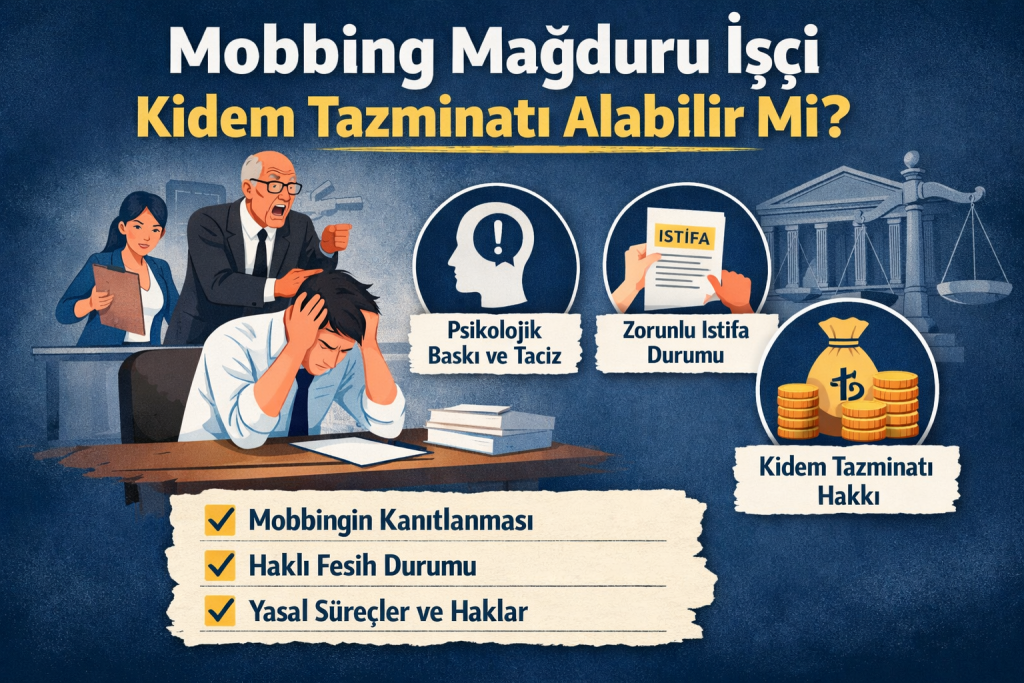
Right to Severance Pay for a Worker Who is a Victim of Mobbing
In light of the judicial decisions examined, whether a worker who is a victim of mobbing (psychological harassment) can receive severance pay varies depending on the proof of mobbing, the reason for termination, and the existence of other just causes. The issue has been analyzed under the following headings in line with Supreme Court precedents and court decisions.
1. General Principle: Mobbing is a Just Cause for Termination and Severance Pay
According to the established precedents of the Supreme Court General Assembly of Law and relevant chambers, a worker subjected to mobbing in the workplace has the right to terminate their employment contract for just cause in accordance with Article 24/II. of the Labor Law No. 4857. This type of termination grants the worker the right to severance pay.
Legal Basis: The Supreme Court General Assembly of Law (2017/486 E.K) has confirmed that mobbing constitutes an assault on personal rights and that a worker’s termination of the contract for this reason entitles them to severance pay.
Employer’s Responsibility: The 9th Civil Chamber of the Supreme Court (2021/12218 E.K), stated that the employer has a duty to protect and supervise the employee pursuant to Article 417 of the Turkish Code of Obligations, and that mobbing constitutes a violation of this duty. Systematic psychological harassment enables the employee to terminate the employment contract for just cause and receive severance pay.
Constructive Termination: The 22nd Civil Chamber of the Supreme Court (2014/23541 E.K), stated that leaving the workplace due to mobbing is considered as “constructive termination” and that in this case, the employment contract is deemed to have been unjustly terminated by the employer, and the employee may be entitled to severance and notice pay.
2. Elements of Mobbing and Burden of Proof
In court decisions, certain criteria are sought for the acceptance of the existence of mobbing, and the burden of proof is placed on the employee asserting the claim.
Definition and Continuity: Mobbing has been defined as a set of systematic, continuous, intentional behaviors aimed at intimidation. The 9th Civil Chamber of the Supreme Court (2017/16925 E.K) and the 22nd Civil Chamber of the Supreme Court (2015/18297 E.K) have ruled that instantaneous rude behaviors or stressful environments resulting from a general management approach, which do not show continuity, will not be considered mobbing, and consequently, claims for severance pay based on mobbing in such situations will be rejected.
Method of Proof (Approximate Proof): The 22nd Civil Chamber of the Supreme Court (2016/3654 E.K) and the 9th Civil Chamber of the Supreme Court (2016/36185 E.K) have stated that the condition of “absolute proof” is not required in mobbing claims, and that “approximate proof” is sufficient. If the consistency of evidence such as witness statements, health reports, emails, and camera recordings forms a conscientious conviction, mobbing is accepted and severance pay is made.
Cases of Failure to Prove: Severance pay claims have been rejected in situations where the mobbing allegation remained abstract, witnesses failed to describe concrete events, or spoke based on hearsay (e.g., Supreme Court 22nd Civil Chamber 2014/32562 Dec.ision, Supreme Court 9th Civil Chamber 2025/2247 Dec.ision). Furthermore, if it cannot be proven that the letter of resignation was submitted under duress, the resignation intent is considered valid, and compensation is rejected (Supreme Court 9th Civil Chamber 2015/24193 Dec.ision).
3. Cases Giving Rise to Severance Pay Entitlement Even if Mobbing Cannot Be Proven
One of the most prominent trends in Supreme Court decisions is the acceptance of severance pay even if the claim of mobbing cannot be proven, provided there is another reason in the file that would necessitate the employee’s justified termination.
Wage and Overtime Receivables: In many decisions (Supreme Court 9th Civil Chamber 2023/9686K, Supreme Court 7th Civil Chamber 2013/21292, Supreme Court 7th Civil Chamber 2013/21255), even if the claim of mobbing was rejected, the termination of the employment contract by the employee due to reasons such as unpaid overtime, general holiday pay, or underreporting of wages to SGK (Social Security Institution) (Supreme Court 9th Civil Chamber 2015/9980K) was found to be justified, and severance pay was awarded.
Adverse Change in Working Conditions: The 9th Civil Chamber of the Supreme Court (2020/9019 E.K) stated that even if elements of mobbing are not present, changes made adversely to the employee’s working conditions constitute a just cause for termination and necessitate severance pay. Similarly, the 7th Civil Chamber of the Supreme Court (2015/8164 E.) approved compensation by considering constant changes in assignment location and being given tasks incompatible with one’s career as within the scope of mobbing.
Insult and Degrading Behavior: Even if the element of systematicity in mobbing is not present, an employer or their representative insulting an employee (Supreme Court 9th Civil Chamber 2017/18581 E.K) or uttering degrading words (Supreme Court 22nd Civil Chamber 2015/29410 E.K) has been considered a just cause for termination on its own, leading to the award of severance pay.
Occupational Health and Safety Violation: The 22nd Civil Chamber of the Supreme Court (2013/11788 E.K) emphasized that even if rude behavior in the workplace is not considered mobbing, the employer’s breach of their duty to protect the employee provides grounds for justified termination and that severance pay must be paid.
4. Situations Outside the Scope of the Labor Law
It has been stated that for employees not subject to the Labor Law (e.g., service contracts under the Code of Obligations), no payment can be made under the name of “severance pay”.
The 13th Civil Chamber of the Supreme Court (2014/11415 E.K) and the 3rd Civil Chamber of the Supreme Court (2020/4364 E.K) ruled that in cases of mobbing or justified termination under such contracts, it is not the Labor Law compensation, but “reasonable compensation” that can be claimed according to the provisions of the Code of Obligations.
5. Additional Findings from Secondary Sources
The information in this section is based on responses from secondary sources that contain limited information or provide indirect context in the decision texts.
Calculation Errors and Procedure: In some decisions (Supreme Court 9th Civil Chamber 2021/12341, Supreme Court 7th Civil Chamber 2014/7955), although there was a claim of mobbing, the Supreme Court’s reason for reversal focused not on the essence of mobbing, but on technical errors in the calculation of severance pay or other receivables (such as timesheets, offset operations). This situation indicates that courts primarily verify mathematical and procedural accuracy, even when there is an allegation of mobbing.
Non-Pecuniary Damages Distinction: Decisions of the Constitutional Court (15/11/2023) and the Supreme Court 9th Civil Chamber (2010/38293) show that claims for non-pecuniary damages stand out in mobbing cases, but that the standards of proof (especially causal link and systematicity) are kept high. Although these decisions do not directly address severance pay, they indirectly confirm the difficulty of proving mobbing and that compensation claims (non-pecuniary or severance) may be rejected due to insufficient evidence.
Public Personnel/Different Statuses: The Supreme Court 4th Civil Chamber (2022/5711) indicates that claims of mobbing concerning public officials (professors, etc.) are handled within the framework of administrative jurisdiction or material compensation law, and that a different procedure applies compared to severance pay under labor law.
Conclusion
According to court decisions; an employee who is a victim of mobbing, if they prove this situation within the framework of approximate evidentiary rules (witness, document, health report, etc.), can terminate their employment contract for just cause and receive severance pay. Even if the systematic nature of mobbing cannot be proven; in cases where there is insult to the employee, non-payment of wages, underpayment of social security premiums, or a significant worsening of working conditions, courts also rule in favor of the employee for severance pay. However, in cases where the claim remains abstract and the resignation is not based on a just cause, the compensation request is rejected.
Mobbing nedeniyle istifa eden işçi kıdem tazminatı alabilir mi?
Evet. Yargıtay içtihatlarına göre işyerinde mobbinge maruz kalan işçi, 4857 sayılı İş Kanunu m.24/II kapsamında haklı nedenle fesih yapabilir. Bu durumda istifa etmiş görünse bile hukuken bu fesih “haklı fesih” sayılır ve işçi kıdem tazminatına hak kazanır. Ancak bunun için mobbingin belirli delillerle (tanık, yazışma, sağlık raporu vb.) ortaya konulması gerekir.
Mobbingi ispatlamak zor mu, hangi deliller geçerlidir?
Mobbing davalarında “kesin ispat” değil, Yargıtay uygulamasına göre yaklaşık ispat yeterlidir.
Geçerli deliller şunlardır:
Tanık beyanları
E-posta ve mesaj kayıtları
Sağlık raporları (psikolojik etkiler)
Kamera kayıtları
Ancak tek seferlik tartışmalar veya genel iş stresi mobbing sayılmaz. Sistematik ve süreklilik arz eden davranışlar aranır.
Mobbing ispatlanamazsa kıdem tazminatı tamamen kaybedilir mi?
Hayır. Uygulamada en önemli nokta burasıdır. Yargıtay’a göre mobbing ispatlanamasa bile;
Ücretin ödenmemesi
Fazla mesai alacakları
SGK primlerinin eksik yatırılması
Hakaret veya onur kırıcı davranışlar
gibi başka bir haklı fesih nedeni varsa işçi yine kıdem tazminatı alabilir. Bu nedenle dava stratejisi çok kritik önem taşır.
Why Should You Get Support from an Expert Employee Lawyer?
Mobbing cases are, in practice, one of the most difficult labor law disputes to prove. The biggest mistakes made are; Wrong presentation of evidence, relying solely on mobbing, and not asserting alternative just causes for termination. An expert Istanbul employee lawyer manages the process as follows:✓ Correctly collects evidence supporting the mobbing claim,✓ Adds alternative just causes for termination (wages, SSI, overtime, etc.) to the file,✓ Establishes the witness strategy correctly,✓ Creates the legal framework to prevent the rejection of severance pay
Especially for those seeking a Tuzla employee lawyer, Gebze employee lawyer, Çayırova employee lawyer, and Şekerpınar employee lawyer, knowing local labor court practices provides a significant advantage. At this point, 2M Hukuk Law Office effectively protects employees’ rights with its expert approach in mobbing and employee receivables cases.