Introduction
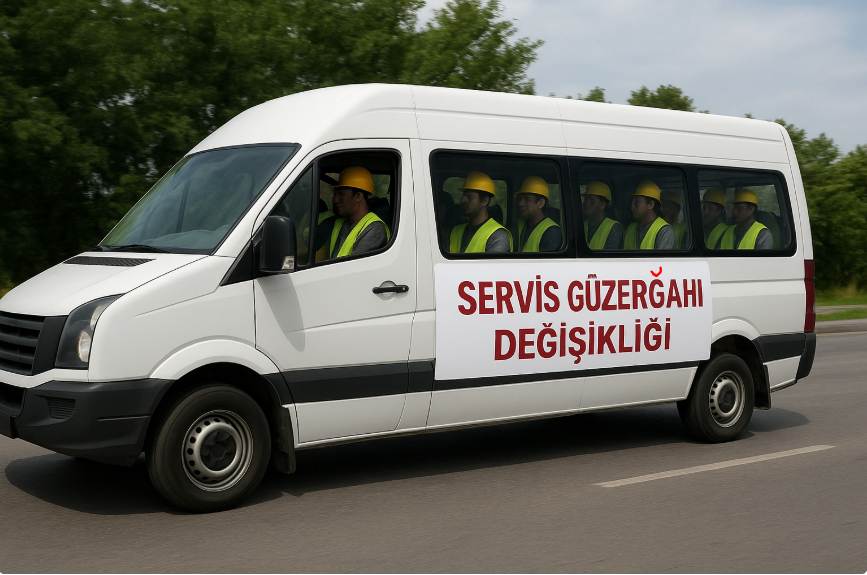
This study includes an analysis of Supreme Court and Regional Courts of Justice decisions regarding whether situations such as the unilateral removal of the shuttle service provided by the employer, the change of its route, or the service starting to be provided from a point further away from the employee’s residence, give the employee the right to terminate the employment contract for just cause. The review was conducted within the framework of the provisions on “fundamental change in working conditions” regulated in Article 22 of the Labor Law No. 4857 and “non-application of working conditions” in subparagraph II-f of Article 24.
General Rule: According to the established jurisprudence of the Supreme Court, the unilateral removal by the employer of the shuttle service provided by the employment contract or workplace practice, or the change of its route in a way that significantly hinders the employee’s commute, is considered a “fundamental change in working conditions.”
Right to Justifiable Termination: Such fundamental changes made without the written consent of the employee entitle the employee, in accordance with Article 24/II-f of the Labor Law, to immediately terminate the employment contract for just cause.
Compensation Rights: An employee who terminates the employment contract based on this just cause is entitled to severance pay. However, as consistently emphasized in Supreme Court decisions, the party (employee) who terminates the employment contract, even if for just cause, cannot claim notice pay.
Exceptions and Special Cases: In situations such as the change being accepted in writing by the employee, the employee continuing to work without objecting to the change for a long time (evaluated within the scope of the rule of honesty/good faith), the change made being minor and reasonable, or this authority being explicitly granted to the employer in the employment contract, the just cause for termination may be negated.
1. The Nature of Removal or Modification of Shuttle Service as a “Fundamental Change”
The Supreme Court considers the shuttle service provided to the employee as part of the employment contract or an established workplace practice. The removal or adverse modification of this service without the employee’s consent constitutes a worsening of working conditions.
The 9th Civil Chamber of the Supreme Court (2012/33789 E., 2013/1994 K.) explicitly qualified the change in the shuttle route as a fundamental change: “In the concrete case, considering the plaintiff’s place of residence and the workplace’s location, a change in the shuttle route constitutes a fundamental change in working conditions.”
The 22nd Civil Chamber of the Court of Cassation (2012/6176 M., 2012/25856 D.) stated that the removal of the shuttle service made working conditions more onerous and gave the right to justified termination: “The workplace shuttle service used by the plaintiff became a working condition, and its unilateral removal by the employer without obtaining the plaintiff’s written consent constitutes a worsening of working conditions, giving the plaintiff employee the right to terminate the employment contract for just cause under Article 24/2-f of Law No. 4857. Therefore, the rejection of the plaintiff’s request for severance pay was erroneous and necessitated reversal.” Similarly, the relocation of the workplace and the failure to provide shuttle services at the new location are evaluated under the same scope. In its decision, the 7th Civil Chamber of the Court of Cassation (2015/5833 M., 2016/5440 D.) stated, “Since the failure to provide the shuttle service, which was available before the workplace relocation, after the relocation constitutes a change in working conditions to the detriment of the plaintiff, the plaintiff’s constructive termination of the employment contract should be considered a just termination by the employee.”
2. Legal Consequences of Termination: Distinction between Severance and Notice Pay
The most striking and consistent finding in the decisions concerns the compensation rights of an employee who terminates their employment for just cause. While the employee can receive severance pay, the claim for notice pay is rejected. Court of Appeals 9th Civil Chamber (2023/3247 E., 2023/3581 K.) clearly explains this situation: “…since changing working conditions also means that the conditions are not applied,” in this case, the employee cannot claim notice pay but is entitled to severance pay. According to the Court of Appeals, this is because “the party terminating the employment contract, even for just cause, does not have the right to notice pay.” Court of Appeals 22nd Civil Chamber (2018/11833 E., 2019/2367 K.) also reiterated the same principle: “Even if an employee terminates the employment contract for just cause, while they are entitled to severance pay, they are not entitled to notice pay,” it was emphasized that the claim for notice pay should be rejected.
3. Importance of Employee’s Written Consent and the Issue of Implicit Acceptance
For a substantial change to be valid, the employee’s written consent is required. A change made without this consent does not bind the employee.
Court of Cassation General Assembly of Civil Chambers (2018/938 M., 2021/1200 D.) explicitly stated this issue in its decision: “The removal of a shuttle service, which is a workplace practice, constitutes a fundamental change, and for the change to be valid, the employee’s written consent must be obtained. In the specific dispute, since the plaintiff employee’s written consent was also not present, the unilateral change made by the employer does not bind the plaintiff employee.” However, an employee’s continued work for a long period despite the change can be interpreted as an abuse of right. The 22nd Civil Chamber of the Court of Cassation (2017/16312 M., 2018/23574 D.) ruled that the termination of an employee who continued to work for one and a half years after the transfer was not based on a just cause. In contrast, the 9th Civil Chamber of the Court of Cassation (2016/18207 M., 2020/6369 D.) decided that working for 8 months would not constitute implicit acceptance of the change, thereby demonstrating that the circumstances of the specific case are determinative in this matter.
4. Different Perspectives and the Limits of the Employer’s Managerial Prerogative
Although the general rule is in favor of the employee, some decisions emphasize the employer’s management right and the nature of the change. In a decision by the 22nd Civil Chamber of the Court of Cassation (2012/9721 E., 2012/29524 K.), it was stated that “making changes to the service route or transitioning to a card system application at the workplace does not give the plaintiff the right to terminate their contract…”, indicating that not every route change may be substantial and may fall within the employer’s management right. This situation reveals that it is necessary to specifically evaluate to what extent the change makes the employee’s transportation difficult. Provisions of Collective Bargaining Agreements (CBA) are also important. In some decisions, it is seen that the CBA grants the employer the authority to determine service routes “within reasonable limits” (e.g., 9th Civil Chamber, 2023/8154 E.). However, the same CBAs can also impose alternative obligations, such as paying travel expenses in situations where service cannot be provided.

Conclusion
In light of the reviewed court decisions, the removal or modification of the shuttle service provided by the employer through an employment contract or workplace practice without the employee’s written consent, or in a way that objectively makes the employee’s transportation difficult, is considered, according to Articles 22 and 24/II-f of Labor Law No. 4857, as a “material change in working conditions” and “non-application of working conditions.” This situation grants the employee the right to terminate the employment contract for just cause and to claim severance pay. However, since the employee is the party terminating the employment contract, they will not be entitled to notice pay.
Each concrete case should be evaluated specifically, taking into account factors such as the nature of the change, its effect on the employee’s transportation, the provisions of the employment contract and collective labor agreement, and the employee’s attitude towards the change. Particularly, whether the change remains within reasonable limits and whether the employee implicitly consented to this change by remaining silent for a long time play a critical role in resolving the dispute. An article suggestion.
Why is Tuzla Lawyer Support Necessary?
Situations such as the cancellation of shuttle service or the alteration of its route can lead to serious consequences in terms of labor law. Whether the employee can justifiably terminate the contract, claim severance pay, or how the employer’s right to manage should be evaluated may differ in each concrete case. Incorrect steps can lead to loss of rights for both the employee and the employer.
Therefore, in regions such as Istanbul, Tuzla lawyer, Pendik lawyer, Kartal lawyer, Maltepe lawyer, Gebze lawyer, Orhanlı lawyer, Tepeören lawyer, Darıca lawyer, Bayramoğlu lawyer, Çayırova lawyer, for employees and employers operating in Tuzla, Tuzla lawyer support that closely follows local practices and Supreme Court precedents is of great importance for the proper management of the process and the protection of rights.