Introduction
This study has been prepared to answer fundamental legal questions regarding the concordat process. The study is based on the analysis of various decisions rendered by Regional Courts of Justice, First Instance Commercial Courts, and the Supreme Court. The focus of the review includes; the legal situation arising from the rejection of a creditor’s application to the concordat commissioner, the types of debts and claims that can be included in the concordat, the functioning of the payment plan after the approval of the concordat, and the importance of seeking legal advice in this complex process.
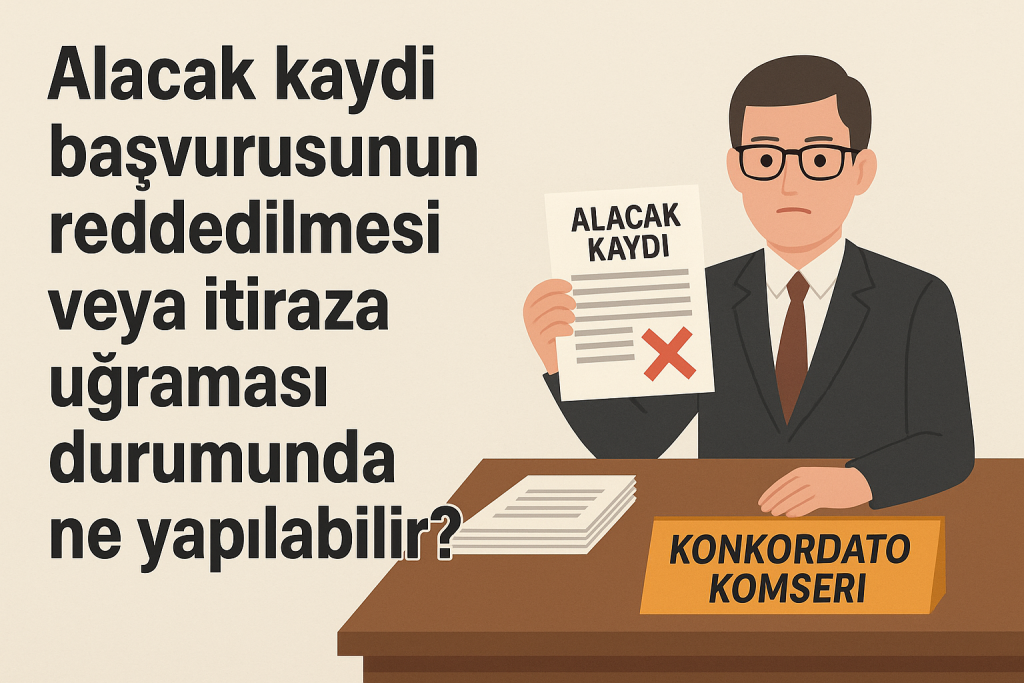
1. Rejection of Creditor’s Application to the Concordat Commissioner
In the reviewed decisions, it is clearly stated that if the creditor’s claim registration made to the commissioner is not accepted by the debtor or is rejected by the commissioner, the claim becomes “disputed claim”. This situation does not mean that the creditor’s right is terminated. On the contrary, a new legal process begins for the creditor.
Right to Action: Creditors have the right to file a lawsuit for claims that have become disputed. This situation was expressed as follows in a decision by the Bursa 1st Civil Court of Commerce: “this creditor’s right to file a lawsuit within 1 month from the announcement of the confirmation decision regarding the disputed claim, in accordance with Article 308/b of the EBL, is also reserved.” Similarly, the 23rd Civil Chamber of the Ankara Regional Court of Justice also “emphasized the provision that disputed claims can also be made subject to separate litigation (EBL Art. 308/b)”. If the creditor wins this lawsuit, they may demand the payment of their claim within the framework of the conditions specified in the concordat project.
Quorum Participation: Regarding voting rights (quorum) at the creditors’ meeting, the court decides whether the disputed claim will be taken into account and to what extent (EBL Art. 302/VI). However, this decision by the court does not constitute a definitive judgment in terms of the substance of the claim.
2. Types of Debts and Claims That Can Be Included in a Concordat
The fundamental principle of concordat, as stated in the decision of the Civil General Assembly of the Court of Cassation, is that “A concordat that becomes binding is mandatory for all claims arising before the concordat request or within the period without the commissioner’s permission.” However, there are important exceptions and different applications to this general rule.
Unsecured Claims: Unsecured (ordinary) claims constitute the main subject of the concordat. These include a wide variety of debt types such as bank loans, check and promissory note debts, debts arising from commercial activities, guarantee debts, and rental claims.
Secured Claims: Secured claims are part of the concordat process but have a special status. For secured creditors’ claims up to the value of the pledge, the discount or maturity provisions in the concordat project do not apply directly. However, in accordance with Article 308/h of the EBL (Enforcement and Bankruptcy Law), it is possible for the debtor to negotiate with these creditors to restructure their debts and for this restructuring to be approved by the court. In many decisions, it is observed that special protocols are signed with secured creditors.
Privileged and Public Claims: As stated in a decision by the 7th Civil Chamber of the Sakarya Regional Court of Justice, “The provision of the second paragraph of this article shall not apply to privileged claims specified in the first paragraph of Article 206, to claims of secured creditors up to the value of the pledge, and to public receivables under Law No. 6183.” This indicates that privileged claims, such as labor claims, must be paid in full or secured, and public claims are generally subject to their own restructuring laws.
3. Operation of the Approved Concordat Payment Plan
With the approval of the concordat, the debtor’s debt payment method and schedule are determined according to the project approved by the court. The decisions reviewed reveal that payment plans can vary widely.
Structure of the Plan: Plans generally begin with a grace period. In a decision by the Sakarya Civil Court of Commerce, “after an initial 6-month grace period,” an example of a plan where payments began was presented. Installments can be arranged in monthly, quarterly, or semi-annual periods and with different maturities such as 36, 48, or 60 months, depending on the nature of the project. While installments are equal in some plans, others foresee increasing payments over the years.
Supervision Mechanism: The implementation of the payment plan is not left to the debtor’s discretion. As stated in the decision by the Istanbul 2nd Civil Court of Commerce, a trustee is appointed “for the purpose of taking necessary supervision, management, and liquidation measures to ensure the fulfillment of the approved concordat.” The trustee monitors the debtor’s financial situation and whether payments are made on time, submitting reports to the court every two months.
Violation of the Plan: Non-compliance with the payment plan gives the creditor the right to request the termination of the concordat. In the decision by the Ankara West Civil Court of Commerce, it was stated that in the event of “the failure to pay one of the installments of the debt subject to concordat on its due date as stipulated in the project,” the creditor “reverts to the previous state and recovers their entire receivable.”
4. The Importance of Legal Consultancy in the Process
Although none of the decisions directly address the importance of legal consultancy under a specific heading, the content and reasoning of the decisions indirectly and strongly reveal this importance.
Sensitivity of Procedural Rules: Composition (concordat) is subject to strict procedural rules. In a decision by the Istanbul Regional Court of Justice, 45th Civil Chamber, it was emphasized that creditors lost their right to appeal because they did not object within a certain period and in accordance with the procedure: “Since no proper objection was made in accordance with Article 304 of the EBL, there is no right to appeal against the confirmation decision…” Such procedural errors can lead to irreversible loss of rights.
Conditions for Litigation and Representation Authority: In another decision, the request for composition was procedurally rejected because it was filed with a power of attorney given by a chairman of the board of directors who lacked the authority to represent the company. This situation demonstrates that properly fulfilling fundamental legal conditions, such as legal capacity to sue and representation authority, is essential for the merits of the case to be considered.
Complexity of the Process: The composition (concordat) process has a multi-layered structure involving financial analyses, legal interpretations, and negotiations with creditors. In a decision by the Istanbul 8th Commercial Court of First Instance, obtaining a report from a “panel of expert legal professionals specializing in composition law” for the resolution of the dispute is an indicator of how much expertise the matter requires.
Conclusion
The examination shows that concordat is a complex legal mechanism that offers a restructuring opportunity for debtors while also aiming to protect the rights of creditors within specific procedures and principles. A creditor whose claim registration is rejected being able to seek their rights through litigation is one of these protection mechanisms. The scope of the concordat project is broad, but different rules apply to debts with special status, such as secured, privileged, and public receivables. Approved payment plans must be meticulously implemented under trustee supervision. At the heart of all these processes lies the vital importance of procedural rules and legal deadlines. Therefore, it is an unavoidable necessity for parties involved in any stage of the concordat process to obtain qualified legal consultancy services to prevent loss of rights and manage the process effectively. A paper suggestion.

Why is Concordat Expert Lawyer Support Necessary?
The concordat process is a technically and procedurally complex legal mechanism for both debtors and creditors. In case a creditor’s claim registration application to the concordat commissioner is rejected or objected to by the debtor, it is necessary to pay attention to deadlines and special provisions such as Article 308/b of the Enforcement and Bankruptcy Law (EBL) to prevent loss of rights. At this point, the support of a concordat expert lawyer is of vital importance for the correct management of the process.
Operating in regions such as Istanbul, Tuzla, Gebze, Kartal, Pendik, Maltepe, Çayırova, and Tepeören, 2M Hukuk Law Office offers professional consultancy to its clients in concordat cases regarding claim registration, debt restructuring, and litigation processes. Our expert team meticulously evaluates court decisions, payment plans, and creditor rights to determine the most suitable strategy.
A procedural error or delay during the concordat process can lead to difficult-to-remedy consequences for both the creditor and the debtor. Therefore, working with an experienced lawyer in concordat law at every stage is essential for the successful completion of the process and ensuring legal security.