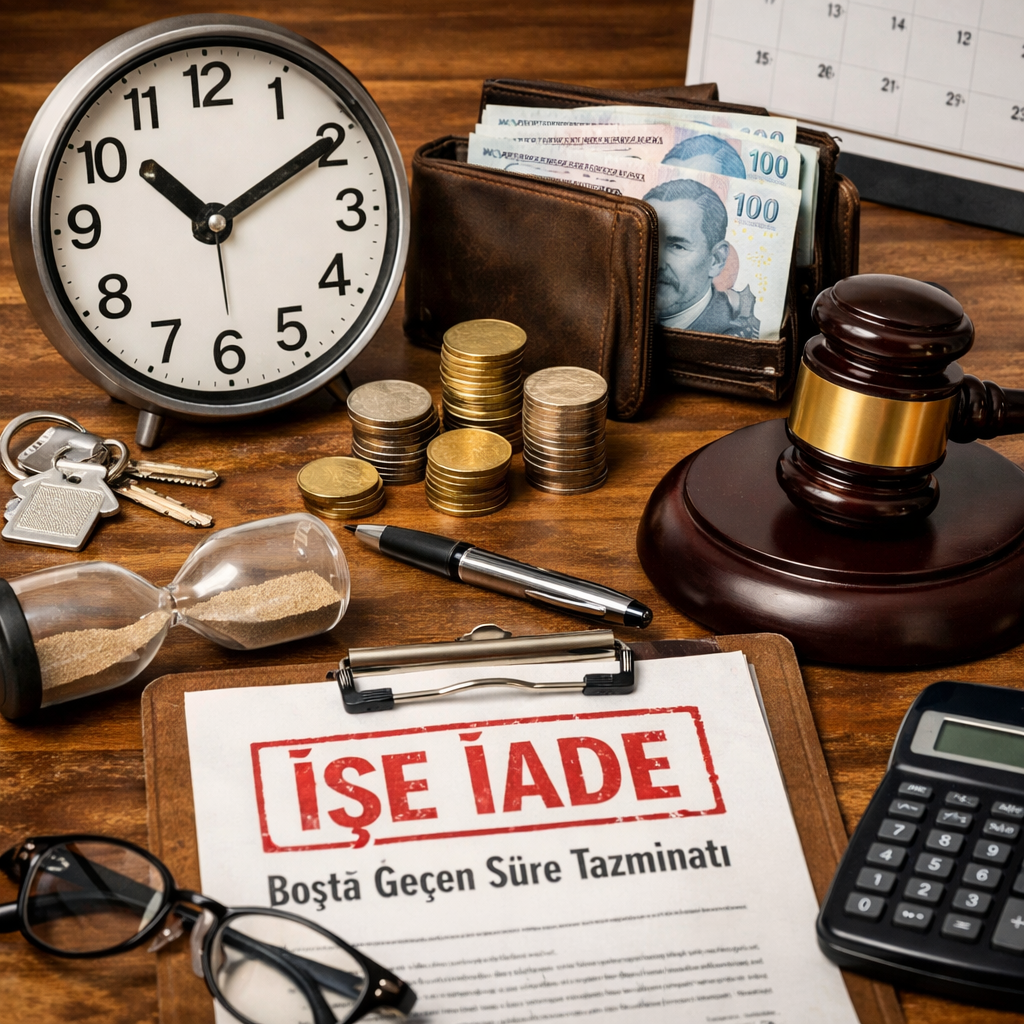
1. Duration of the Reinstatement Lawsuit
How long does a reinstatement lawsuit take, and does the employee receive a salary during the legal process? According to Article 20 of Labor Law No. 4857, specific time limits have been stipulated by the legislator for reinstatement lawsuits. According to the relevant article; the employee must file a lawsuit within one month from the notification of termination, the first instance court must conclude the case within two months according to the expedited trial procedure, and in case of appeal, the Supreme Court must render a final decision within one month. The legal regulation aims for the judicial process to be completed within a maximum of four months in total (Supreme Court 10th Civil Chamber, 2009/10508 E.; 22nd Civil Chamber, 2012/17965 E.D).
However, Supreme Court decisions frequently emphasize that due to the heavy workload in practice, it is not possible for cases to be finalized within these periods, and the process often exceeds four months. In specific case examples, the duration of lawsuits has been observed to vary:
In some disputes, it has been observed that periods of approximately 1.5 years (Supreme Court General Assembly of Civil Chambers, 2015/1035 E.D) or 2.5 years (Supreme Court 10th Civil Chamber, 2009/10508 E.) passed between the termination date and the finalization of the decision.
In exceptional cases, it has also been observed that if the employer reinstates the employee shortly after the lawsuit is filed, the process is concluded in a short period, approximately one month (Supreme Court 9th Civil Chamber, 2016/21600 E.).
2. Salary and Wage Rights During Reinstatement Lawsuit Process
While a reinstatement lawsuit is ongoing, the employee is not paid a regular salary. However, Article 21/3 of Labor Law No. 4857 regulates that if the termination is ruled invalid, an payment is made to the employee under the name of “idle period wage”.
Idle Period Wage: When the court rules that the termination is invalid, it orders the payment of the wages and other rights accrued for a maximum of four months for the period the employee was not employed until the decisions finalization. This four-month period is an upper limit; if the judicial process lasts less than four months, wages are paid only for the actual idle period (Court of Cassation 22nd Civil Chamber, 2016/25331 E.K; 9th Civil Chamber, 2010/2987 E.K).
Payment Time: This wage is not paid in advance during the lawsuit process. It is conditional upon the employee applying to the employer to start work within ten business days from the notification of the final decision. The employee cannot be entitled to this wage if they do not apply within the period or if their application is not found to be sincere (Court of Cassation 10th Civil Chamber, 2009/10508 E.; General Assembly of Civil Chambers, 2015/1035 E.).
Insurance and Premiums: It is mandatory for the employer to pay all insurance premiums, including for occupational accidents, occupational diseases, and unemployment insurance, for the maximum four-month period considered as if worked, and for this period to be counted towards service (Court of Cassation 10th Civil Chamber, 2008/13819 E.).
Reinstatement During Litigation: If the employee is reinstated while the lawsuit is ongoing, wages and other rights for the period between the termination date and the reinstatement date (again, limited to a maximum of 4 months) are determined and paid to the employee (Supreme Court 9th Civil Chamber, 2015/11668 E.).
3. Information Obtained from Secondary Sources
Judicial decisions, which are secondary sources, provide additional context regarding the appearance of litigation processes and wage rights in concrete cases:
Process Examples: In one case, the period between termination and finalization was 7 months (General Civil Assembly, 2018/176 E.), while in another, it was approximately 2.5 years (General Civil Assembly, 2013/428 E.). There are cases where the total process, including appeal and resistance decisions, can exceed 4 years.
Accrual of Wages: Wages and other rights for the idle period become due the moment the employee applies to the employer for reinstatement (Supreme Court 9th Civil Chamber, 2008/21859 E.).
Condition of Sincerity: It has been emphasized that the employee’s application to start work must be sincere, and that the claim for wages for the idle period can be rejected if the employee, despite the employer’s invitation, does not start work, on the grounds that their “true intention was not to start work” (Supreme Court 22nd Civil Chamber, 2011/15161 E.).
Reinstatement During the Lawsuit: If reinstatement occurs while the litigation is ongoing, the claims for reinstatement and compensation for non-reinstatement become moot, but the right to wages for the idle period up to that date (maximum 4 months) is reserved (Supreme Court 9th Civil Chamber, 2016/27391 E.; 9th Civil Chamber, 2015/27438 E.). A paper suggestion.
Why is Expert Lawyer Support Necessary? | To Avoid Loss of Rights in Reinstatement Cases
Reinstatement lawsuits are types of cases that contain technical details regarding strict deadlines, the condition of sincerity, wages for the idle period, insurance premiums, and procedural rules, and have zero tolerance for errors. A small procedural error made at any stage of the process can lead to the employee completely losing their wages for the idle period, and the employer facing unforeseen financial obligations.
Specifically;
Missing the one-month lawsuit filing deadline,
The application to start work, which must be made within 10 business days after the final decision, not being procedurally compliant and sincere,
Disregarding that wages for the idle period are limited to a maximum of 4 months,
Incorrect determination of the due date for insurance premiums and wage receivables,
Weakening the case with demands contrary to Supreme Court precedents
Such situations can lead to irreversible loss of rights.
Therefore, it is of great importance that the re-employment process is managed from start to finish by a lawyer experienced in labor law. Istanbul Tuzla-based 2M Hukuk Avukatlık Bürosu provides reliable and effective legal support to both employee and employer clients in re-employment lawsuits and labor receivables, with practices based on current Supreme Court and General Assembly of Civil Chambers (HGK) decisions.