

In maritime transportation, charterparty and freight agreements are among the most important commercial contracts established between the carrier and the cargo owner. In these contracts, the carrier’s primary obligation is to deliver the cargo on time, to the correct port, and safely.
However, in practice, contract breaches may arise due to reasons such as vessel malfunction, incorrect discharge port, violation of loading instructions, or technical inadequacy. When evaluating these breaches, judicial decisions particularly focus on fault, causal link, contractual provisions, and statutory liability limits.
1. CONTRACT BREACH AND LIABILITY DETERMINATION
In charterparty and freight contracts, the carrier’s failure to duly perform its obligations has been examined under various types of breaches in judicial decisions, and liability determination has been based on concrete evidence, causal link, and legal presumptions.
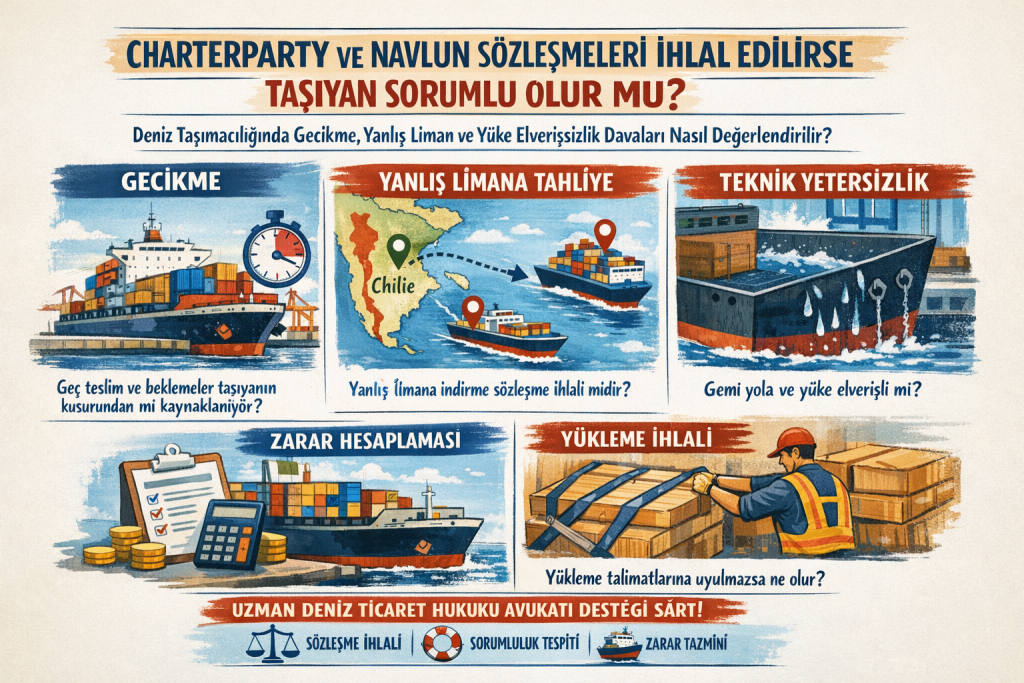
A. Late Delivery and Delay Disputes
In delay disputes, liability is determined based on whether the delay originated within the carrier’s sphere of control and fault.
Carrier’s Fault: The Istanbul 17th Civil Court of Commerce (2017/433 E. ), held the carrier responsible for a 15-day delay caused by a lack of personnel in customs procedures, as the claim of a strike (force majeure) could not be proven. Similarly, in delays caused by ship malfunctions (Istanbul 17th Civil Court of Commerce 2014/804 E. and Supreme Court 11th Civil Chamber 2020/1075 E. ), the carrier was found responsible because the cause of the malfunction and the circumstances for exemption from liability could not be proven.
Cases of No Fault: The Supreme Court 11th Civil Chamber (2021/4846 E. ), ruled that in cases of delayed discharge due to port congestion, the discharge risk belongs to the consignee according to the “F.I.O.S.” (Free In Out Stowed) clause in the bill of lading, and therefore, no fault could be attributed to the carrier. Additionally, adverse weather conditions and official waiting times during strait passages were deducted from the transport period and evaluated as force majeure (Regional Court of Appeals 13th Civil Chamber 2024/1361 E. ).
Delay After Collision: Even if the collision of the ship was not directly the carrier’s fault, the failure to transfer the undamaged cargo to another ship within a reasonable time after the collision was deemed an actionable delay violation (Supreme Court 11th Civil Chamber 2012/14753 E. ).
B. Failure to Follow the Route and Discharge at the Wrong Port Discharging cargo at a different port instead of the agreed-upon port is characterized as improper performance of the delivery obligation (Turkish Code of Obligations Art. 112).
In Chile, discharging cargo at a different port instead of the agreed-upon port was considered a breach of contract, and the carrier was held responsible (Istanbul 17th Civil Court of Commerce 2022/522 E. ).
Despite the entry “İzmir main sea port” on the bill of lading, the discharge of the cargo to a port not covered by this scope was considered a breach (İst. 17. ATM 2015/164 E. ). However, in the same decision, the multi-port vessel’s calling at more than one port as part of its usual route was not considered a delay, as it fell within a reasonable time..
C. Technical Competence of the Vessel and Unseaworthiness for Cargo
The vessel’s unseaworthiness (not fit for sea), unfitness for the voyage, and unsuitability for cargo (Turkish Commercial Code Art. 1019) is one of the most fundamental breaches of contract.
Physical Inadequacy: Seawater leaking from cargo hold hatches (Supreme Court 11th Civil Chamber 2010/9385 E. ), damage to sacks due to cargo holds not being double-skinned (double skinned) and box-shaped (İst. 17. ATM 2023/291 E. ) and contamination of chemical cargo due to hydraulic oil leakage from the pump (BAM 14. Civil Chamber 2018/1406 E. ) have been accepted as initial unsuitability.
Administrative Inadequacy: The vessel’s encountering a risk of detention due to deficiencies identified by the maritime administration in the port of Haifa, Israel, and its inability to load cargo, was considered a failure to provide technical competence (Supreme Court 11th Civil Chamber 2018/5130 E. ).
D. Breach of Loading/Discharging Instructions and Carriage Conditions
The carrier’s failure to comply with the shipper’s instruction to “secure the cargo by welding it to the vessel” and instead securing it with lashing was considered a breach of contract (İst. 17. ATM 2020/323 E. ).
Despite the charterer’s request, the failure to apply “Ramneck” (bituminous tape) to the hatch covers and deviation from the route in bad weather was considered a defect (İst. 17. ATM 2014/1074 E. ).
The carrier’s failure to deliver the cargo, by relying on a right of pledge despite not having a lien, was considered a breach of the obligation to deliver (İst. 17. ATM 2017/368 E. ).
2. DAMAGE CALCULATION
Damage calculation is based on the provisions of the Turkish Commercial Code (TCC), international conventions, and expert determinations.
Limited Liability (TCC Art. 1186/6): In cases of delay damages, the carrier’s liability is generally limited to two and a half times the freight payable for the delayed goods. In situations involving the exceeding of the transit period (İst. 17. ATM 2017/401 E. ), delay caused by unloading at the wrong port (İst. 17. ATM 2017/250 E. ), and trucks being kept waiting due to a ship breakdown (İst. 17. ATM 2014/804 E. ), courts have limited the damages to this upper cap.
Breaking of Limited Liability (Reckless Conduct): Despite the captain being personally present and giving approval during loading, his failure to comply with the lashing instructions was deemed “reckless conduct” under TCC Art. 1187, thereby lifting limited liability, and actual damages (440,600 Euro) were awarded (İst. 17. ATM 2020/323 E. ).
Damage Items: Among the damage items accepted in judicial decisions are; commodity value, customs duty, tank cleaning costs, loss of profit (BAM 14. HD 2018/1406 E. ), additional land transportation cost incurred due to discharge at the wrong port (İst. 17. ATM 2022/522 E. ), difference in substitute vessel charter fee (Yargıtay 11. HD 2018/5130 E. ), and drivers’ food and accommodation expenses (İst. 17. ATM 2014/804 E. ).
Detention and Demurrage: In cases where the vessel is delayed due to the consignee failing to make direct discharge (supalan) preparations, detention damages have been calculated based on the daily demurrage fee (8,000 USD) agreed upon in the contract (Istanbul 17th Commercial Court 2022/124 E. ).
Proof of Damage: Even if liability is established, compensation is not awarded if the damage cannot be proven. Therefore, in the case of a delay in air cargo, as loss of profit could not be proven, it was decided that the full transportation fee should be paid, based on the principle of “liability exists but no damage” (Kayseri 1st Commercial Court 2020/730 E. ).
3. INTERPRETATION OF CONTRACTUAL PROVISIONS
F.I.O.S. and Liner-Out Clauses: The F.I.O.S. clause has been interpreted as meaning that the risk and delay of discharge belong to the consignee (Supreme Court 11th Civil Chamber 2021/4846 E. ). However, the presence of a “Liner-out” clause does not relieve the consignee of the obligation to provide means of transport for direct discharge (Istanbul 17th Commercial Court 2022/124 E. ).
Penalty Clause: While the penalty clause regarding “underloading of empty containers” in the contract (Istanbul 17th Commercial Court 2017/433 E. ) is considered valid, claims for delay penalty clauses may be rejected due to reasons such as force majeure or res judicata (Regional Court of Appeals 13th Civil Chamber 2024/1361 E. ).
Definition of Contract Types: In the calculation of loss of hire, Time Charter (Time Contract) was taken as the basis by experts; this contract was defined as a model where the vessel is chartered for a specified period, and the fee is paid periodically (Istanbul 17th Commercial Court 2021/413 E. ).
4. ADDITIONAL CONTEXT FROM SECONDARY SOURCES (The findings below have been compiled from decisions classified as secondary sources to provide additional context for matters where limited information is available in the judgment texts.)
Time Charter and Lashing Liability: In time charter contracts, it has been assessed that the shipowner cannot, as a rule, be held responsible for stowage and lashing (securing) operations, and that severe weather conditions (9-10 Beaufort) may be considered a “peril of the sea,” exempting the carrier from liability (İst. 17. ATM 2019/190 E. ).
Technical Fault and Exemption from Liability: The act of “leaving the valve open,” which caused the ship to sink, was interpreted not as unseaworthiness of the vessel, but as a “fault in the technical management of the vessel” (TTK m. 1062/2), and the carrier was exempted from liability (Yargıtay 11. HD 2014/14780 E. ). Similarly, the inability to extinguish a fire on board due to crew panic was not considered unseaworthiness (BAM 13. HD 2025/1810 E. ).
Captain’s Fault and Limitation of Liability: In the event of a ship sinking due to the captain’s incorrect stability calculation during loading, this situation was not considered the personal fault of the shipowner, and the establishment of a limitation of liability fund was permitted in accordance with the 1976 Convention (İst. 17. ATM 2022/515 E. ).
“Clean on Board” Presumption: The entry of “clean on board” (temiz) on the bill of lading constitutes a presumption that the cargo was loaded undamaged and in accordance with proper procedures. In cases of damage caused by insufficient hatch covers (İst. 9. ATM 2013/287 E. ) or an erroneous stowage plan (İst. 17. ATM 2017/262 E. ), this entry reinforces the carrier’s liability.
Instruction Violations: In claims of non-compliance with pilot’s instructions during tugboat services, the vessel’s own equipment deficiency (non-standard lead line) may sever the causal link (Istanbul 17th Commercial Court 2023/310 E. ). In road transportation, non-compliance with the instruction to return goods after an exhibition was considered a direct violation causing additional shipping damage (Samsun Commercial Court 2020/350 E. ).
Frequently Asked Questions
Charterparty sözleşmesi nedir?
Charterparty, bir geminin belirli bir sefer veya süre için kiralanmasını düzenleyen deniz ticareti sözleşmesidir. Bu sözleşmede geminin hangi limanlar arasında sefer yapacağı, navlun bedeli, yükleme ve tahliye süreleri gibi önemli ticari şartlar belirlenir.
Taşıyan yükü yanlış limana indirirse ne olur?
Yükün sözleşmede kararlaştırılan liman dışında başka bir limana tahliye edilmesi sözleşme ihlali sayılır. Bu durumda taşıyan, yük sahibinin uğradığı zararları tazmin etmekle yükümlü olabilir.
F.I.O.S. kaydı ne anlama gelir?
F.I.O.S. (Free In Out Stowed) kaydı, yükleme ve tahliye işlemlerinin sorumluluğunun gönderici veya alıcıya ait olduğunu ifade eder. Bu durumda liman operasyonlarından doğan gecikmeler taşıyana yüklenmeyebilir.
Deniz taşımacılığında tazminat sınırı var mı?
Evet. Türk Ticaret Kanunu’na göre taşıyanın gecikmeden doğan sorumluluğu genellikle navlun bedelinin iki buçuk katı ile sınırlıdır. Ancak taşıyanın pervasız davranışı varsa bu sınır kaldırılabilir.
Gemi arızası nedeniyle yük geç teslim edilirse taşıyan sorumlu olur mu?
Evet, çoğu durumda sorumlu olur. Mahkemeler gemi arızasını genellikle taşıyanın organizasyon alanında gerçekleşen bir risk olarak değerlendirir. Örneğin İstanbul 17. Asliye Ticaret Mahkemesi (2014/804 E.) ve Yargıtay 11. Hukuk Dairesi (2020/1075 E.) kararlarında gemi arızası nedeniyle taşımanın gecikmesi halinde arızanın nedeni ve sorumsuzluk hali ispatlanamadığı için taşıyanın sorumlu olduğuna hükmedilmiştir. Ancak arızanın mücbir sebep veya kaçınılmaz bir teknik olay olduğu ispatlanabilirse taşıyan sorumluluktan kurtulabilir.
Ambar kapaklarının su sızdırması nedeniyle yük zarar görürse sorumluluk kime aittir?
Bu durum genellikle geminin yüke elverişli olmaması olarak değerlendirilir. Yargıtay 11. Hukuk Dairesi’nin 2010/9385 E. sayılı kararında ambar kapaklarının deniz suyu sızdırması nedeniyle yükün zarar görmesi, geminin başlangıçta yüke elverişli olmaması olarak kabul edilmiş ve taşıyan sorumlu tutulmuştur. Türk Ticaret Kanunu’na göre taşıyan gemiyi yola ve yüke elverişli halde sefere hazır bulundurmakla yükümlüdür (TTK m.1019).
Yükleme talimatlarına uyulmaması halinde sorumluluk doğar mı?
Evet. Taşıyanın yükleten tarafından verilen teknik talimatlara uymaması sözleşme ihlali sayılabilir. İstanbul 17. Asliye Ticaret Mahkemesi’nin 2020/323 E. sayılı kararında yükün kaynakla sabitlenmesi talimatına uyulmayarak kayışla sabitlenmesi pervasız davranış olarak değerlendirilmiş ve taşıyanın sorumluluk sınırından yararlanamayacağına karar verilmiştir. Bu nedenle taşıyan gerçek zararın tamamından sorumlu tutulmuştur.
Gümrük işlemleri veya liman yoğunluğu nedeniyle gecikme olursa taşıyan sorumlu olur mu?
Her zaman değil. Gecikmenin nedeni önemlidir. Yargıtay 11. Hukuk Dairesi’nin 2021/4846 E. sayılı kararında konşimentodaki F.I.O.S. kaydı nedeniyle tahliye işlemlerinin sorumluluğunun alıcıya ait olduğu kabul edilmiş ve liman yoğunluğu nedeniyle yaşanan gecikmeden taşıyan sorumlu tutulmamıştır. Ayrıca kötü hava koşulları veya resmi beklemeler de bazı durumlarda mücbir sebep kapsamında değerlendirilebilir.
Why is Expert Maritime Commercial Law Attorney Support Necessary?
Maritime transportation disputes are not merely limited to commercial contracts; they also require the combined assessment of the Turkish Commercial Code, international maritime conventions, and technical maritime practices.
Therefore, in disputes arising from charterparty agreements, working with an expert maritime commercial law attorney is of great importance.
Law firms experienced in this field, specifically:
detection of contract breaches
establishment of limitation of liability funds
ship arrest cases
provide comprehensive legal support in matters such as freight and demurrage disputes.
At this point, 2M Law Office, with its expert staff in maritime commercial law, provides professional legal services in contract drafting, consulting, and litigation processes for companies specifically seeking an Istanbul maritime commercial law attorney, Tuzla maritime commercial attorney, Gebze maritime commercial attorney, and Yalova maritime law attorney.
In disputes arising from maritime transport contracts, expert legal support obtained at an early stage plays a critical role in preventing high-cost disputes.


Do Carriers Become Liable If Charterparty and Freight Contracts Are Breached? How Are Delay, Wrong Port, and Unseaworthiness Disputes Evaluated in Maritime Transport?
In maritime transport, charterparty and freight contracts are among the most important commercial agreements established between the carrier and the cargo owner. Under these contracts, the carrier’s fundamental obligation is to deliver the cargo on time, to the correct port, and in a safe condition.
However, in practice, contract breaches may arise due to reasons such as vessel breakdowns, discharge at the wrong port, violation of loading instructions, or technical deficiencies of the vessel. When evaluating such breaches, court decisions primarily focus on fault, causation (causal link), contractual provisions, and statutory liability limitations.
1. BREACH OF CONTRACT AND DETERMINATION OF LIABILITY
In charterparty and freight contracts, the carrier’s failure to properly perform its obligations is examined by courts under various types of contractual breaches. The determination of liability is based on concrete evidence, causal links, and statutory presumptions.
A. Late Delivery and Delay Disputes
In delay disputes, liability is determined according to whether the delay arises within the carrier’s sphere of control and due to the carrier’s fault.
Carrier’s Fault
In the decision of the Istanbul 17th Commercial Court of First Instance (File No. 2017/433), the carrier was held liable for a 15-day delay caused by a lack of personnel in customs procedures, as the carrier failed to prove its claim that the delay resulted from a strike (force majeure).
Similarly, in cases involving delays caused by vessel breakdowns, courts held the carrier liable because the cause of the breakdown and grounds for exemption from liability were not proven (Istanbul 17th Commercial Court 2014/804 and Court of Cassation 11th Civil Chamber 2020/1075).
Situations Where No Fault Is Attributed to the Carrier
Not every delay results in the carrier’s liability. In the decision of the 11th Civil Chamber of the Court of Cassation (File No. 2021/4846), discharge was delayed due to port congestion, but the court held that under the F.I.O.S. clause (Free In Out Stowed) in the bill of lading, the discharge risk belonged to the consignee. Therefore, no fault could be attributed to the carrier.
Additionally, adverse weather conditions and official waiting times during strait transits were deducted from the transport period and evaluated as force majeure (Regional Court of Appeal, 13th Civil Chamber, 2024/1361).
Delays Following a Collision
Even if a vessel collision is not directly caused by the carrier’s fault, failing to transfer undamaged cargo to another vessel within a reasonable time after the collision may still be considered a delay breach (Court of Cassation 11th Civil Chamber 2012/14753).
B. Deviation from Route and Discharge at the Wrong Port
Delivering cargo to a port different from the contractually agreed port is considered improper performance of the delivery obligation under Article 112 of the Turkish Code of Obligations.
In the decision of the Istanbul 17th Commercial Court (File No. 2022/522), discharging cargo at a port other than the agreed port in Chile was considered a breach of contract, and the carrier was held liable.
Similarly, in another case, despite the bill of lading stating “İzmir main sea port,” the cargo was discharged at a port not included in that definition, which was also considered a breach (Istanbul 17th Commercial Court 2015/164).
However, in the same decision, the court noted that a tramp vessel calling at multiple ports as part of its ordinary route would not constitute delay if it remained within a reasonable time frame.
C. Technical Fitness of the Vessel and Cargo Unseaworthiness
One of the carrier’s most fundamental obligations under maritime law is to ensure that the vessel is seaworthy, voyage-worthy, and cargo-worthy (Turkish Commercial Code Article 1019).
Physical Deficiencies
Courts have considered the following situations as initial unseaworthiness:
seawater leaking through hatch covers (Court of Cassation 11th Civil Chamber 2010/9385)
cargo bags being damaged because the cargo hold lacked proper structural design (Istanbul 17th Commercial Court 2023/291)
hydraulic oil leaking from pumps and contaminating chemical cargo (Regional Court of Appeal 14th Civil Chamber 2018/1406)
Administrative Deficiencies
Administrative deficiencies may also constitute unseaworthiness. In the decision of the Court of Cassation 11th Civil Chamber (File No. 2018/5130), deficiencies detected by port authorities in Haifa Port prevented the vessel from loading cargo, and the carrier was held responsible for failing to ensure the vessel’s technical compliance.
D. Violation of Loading Instructions and Transport Conditions
Failure by the carrier to comply with technical instructions given by the shipper may also constitute a breach of contract.
In the decision of the Istanbul 17th Commercial Court (File No. 2020/323), cargo that should have been welded and fixed to the vessel was instead secured with straps. This was considered a contractual breach.
Similarly:
failing to apply “Ramneck” (tar tape) to hatch covers
deviating from the route during bad weather were considered faults of the carrier (Istanbul 17th Commercial Court 2014/1074).
In another case, the carrier’s refusal to deliver cargo by claiming a lien right that did not legally exist was considered a violation of the delivery obligation (Istanbul 17th Commercial Court 2017/368).
2. CALCULATION OF DAMAGES
The calculation of damages in maritime transport disputes is based on provisions of the Turkish Commercial Code, international conventions, and expert reports.
Limited Liability (TCC Article 1186/6)
Under Turkish Commercial Code Article 1186/6, the carrier’s liability for delay is generally limited to two and a half times the freight payable for the delayed goods.
Courts have applied this limitation in cases involving:
exceeding the transit time
delays caused by discharge at the wrong port
trucks waiting due to vessel breakdown
(Istanbul 17th Commercial Court 2017/401, 2017/250, 2014/804).
Breaking the Liability Limitation (Reckless Conduct)
However, the limitation of liability may be lifted if the carrier acts recklessly.
In the decision of the Istanbul 17th Commercial Court (File No. 2020/323), the captain personally approved the loading but failed to comply with stabilization instructions. This conduct was considered reckless, and the liability limitation was lifted. The court awarded actual damages amounting to €440,600.
Types of Recoverable Damages
Court decisions have recognized the following damage items:
value of the goods
customs duties
tank cleaning costs
loss of profit
additional inland transport costs due to wrong-port discharge
difference in substitute vessel charter costs
drivers’ accommodation and meal expenses during delays (Regional Court of Appeal 2018/1406, Court of Cassation 2018/5130, Istanbul 17th Commercial Court 2014/804).
Detention and Demurrage
If cargo cannot be discharged because the consignee fails to prepare for direct discharge, the vessel may be forced to wait.
In the decision of the Istanbul 17th Commercial Court (File No. 2022/124), detention damages were calculated based on the daily demurrage rate of USD 8,000 specified in the contract.
Proof of Damage
Even if liability is established, compensation will not be awarded unless the damage is proven.
In the decision of the Kayseri 1st Commercial Court of First Instance (File No. 2020/730) concerning delayed air cargo delivery, liability was acknowledged but no compensation was awarded because loss of profit could not be proven.
The court summarized this situation as “liability exists, but damage does not.”
INTERPRETATION OF CONTRACTUAL CLAUSES
F.I.O.S. and Liner-Out Clauses
The F.I.O.S. clause has been interpreted as transferring the risk of discharge delays to the consignee (Court of Cassation 11th Civil Chamber 2021/4846).
However, the presence of a liner-out clause does not remove the consignee’s obligation to provide vehicles for direct discharge (Istanbul 17th Commercial Court 2022/124).
Penalty Clauses
Penalty clauses concerning incomplete loading of empty containers were upheld as valid (Istanbul 17th Commercial Court 2017/433). However, penalty claims for delay may be rejected due to force majeure or res judicata (Regional Court of Appeal 13th Civil Chamber 2024/1361).
Definition of Charter Types
In calculating loss of hire, experts relied on the Time Charter model. This contract type is defined as a charter agreement where the vessel is hired for a specified period and the charter hire is paid periodically (Istanbul 17th Commercial Court 2021/413).
Additional Context from Secondary Sources
In Time Charter contracts, the shipowner is generally not responsible for stowage and lashing operations, and severe weather conditions (9–10 Beaufort) may be considered perils of the sea, releasing the carrier from liability (Istanbul 17th Commercial Court 2019/190).
If a vessel sinks due to a valve being left open, courts may interpret this as fault in the technical management of the vessel rather than unseaworthiness, thereby exempting the carrier from liability (Court of Cassation 11th Civil Chamber 2014/14780).
Similarly, a fire on board that could not be extinguished due to crew panic was not considered unseaworthiness (Regional Court of Appeal 2025/1810).
In another case, a captain’s incorrect stability calculation causing the vessel to sink was not considered the shipowner’s personal fault. Therefore, the court allowed the establishment of a liability limitation fund under the 1976 Convention on Limitation of Liability for Maritime Claims (Istanbul 17th Commercial Court 2022/515).
Frequently Asked Questions
What is a charterparty contract?
A charterparty is a maritime contract that regulates the chartering of a vessel for a specific voyage or period. It determines essential commercial terms such as freight, loading and discharge periods, and the ports involved.
What happens if the carrier discharges cargo at the wrong port?
Discharging cargo at a port different from the agreed port constitutes a breach of contract. The carrier may be required to compensate the cargo owner for the resulting damages.
What does the F.I.O.S. clause mean?
The F.I.O.S. (Free In Out Stowed) clause means that the responsibility for loading, unloading, and stowage operations belongs to the shipper or consignee.
Is there a compensation limit in maritime transport?
Yes. Under the Turkish Commercial Code, the carrier’s liability for delay is generally limited to two and a half times the freight payable. However, this limitation may be lifted in cases of reckless conduct.
Is the carrier liable if cargo is delivered late due to vessel breakdown?
In most cases, yes. Courts generally consider vessel breakdowns as risks within the carrier’s sphere of control unless the carrier proves force majeure or an unavoidable technical event.
Why Is Expert Maritime Law Counsel Necessary?
Maritime transport disputes are not limited to commercial contracts. They require the interpretation of the Turkish Commercial Code, international maritime conventions, and technical shipping practices together.
For this reason, obtaining legal assistance from an experienced maritime law attorney is crucial in disputes arising from charterparty contracts.
Experienced maritime law firms provide legal services in areas such as:
determining contractual breaches
establishing limitation of liability funds
ship arrest proceedings
freight and demurrage disputes
In this context, 2M Hukuk Law Firm, with its expertise in maritime law, provides professional legal services for companies seeking an Istanbul maritime law attorney, Tuzla maritime lawyer, Gebze maritime attorney, or Yalova maritime law counsel, particularly in contract drafting, advisory services, and litigation processes.
Early legal support in maritime transport disputes plays a critical role in preventing high-cost legal conflicts