
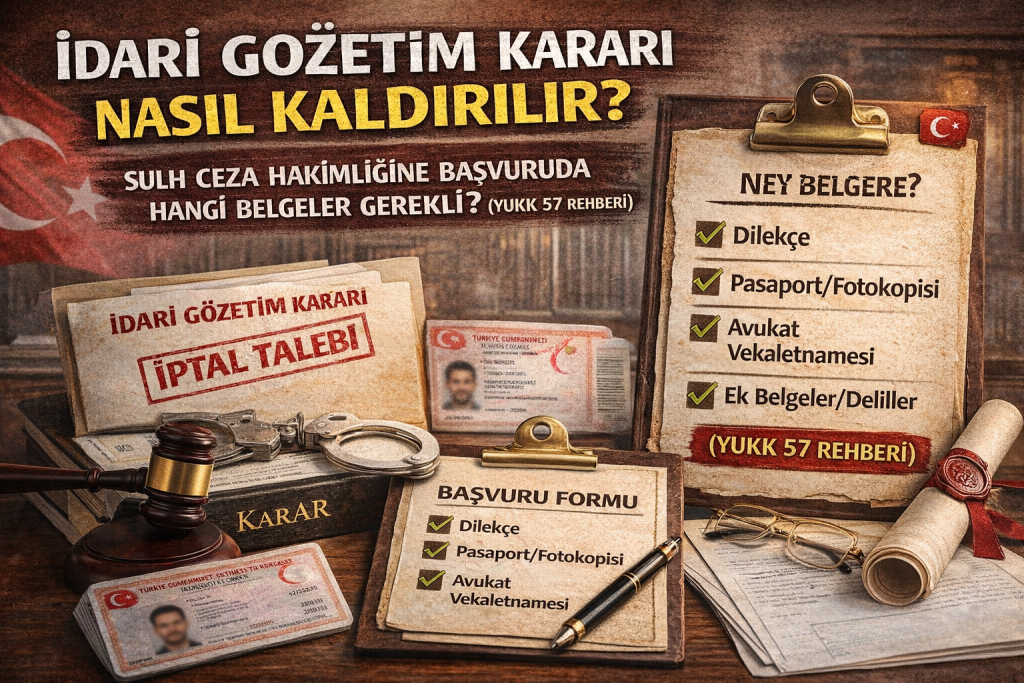
In Turkey, administrative detention decisions regarding foreigners are mostly applied during deportation procedures. However, an administrative detention decision is not absolute under Law No. 6458 on Foreigners and International Protection (YUKK), and it is possible to have it lifted with an objection to the Magistrate Penal Judgeship.
In practice, courts review whether the decisions made regarding foreigners held in administrative detention centers, especially in centers like the Tuzla Repatriation Center, are lawful. For these applications to be successful, the documents and legal justifications to be attached to the petition are of great importance.
1. Documents to be Attached to the Petition to be Submitted to the Magistrate Penal Judgeship for the Lifting of Administrative Detention
When judicial decisions are examined, although no legal list is provided regarding the specific documents to be attached to the objection petition against the administrative detention decision, the documents considered by the courts during the review phase and submitted by the applicants are as follows:
Administrative Decision Documents: The original or a copy of the “Administrative Detention Decision” being objected to, and if applicable, the “Deportation Decision”.
Identity and Passport Information: Photocopy of the foreigner’s passport, visa entry-exit records, or valid identification documents.
Judicial Decisions: If applicable, the “Acquittal Decision”, “Decision of No Grounds for Prosecution” (KYOK), or release decisions obtained for the relevant offense.
Administrative Judicial Documents: Endorsement regarding the lawsuit filed for the annulment of the deportation decision, decisions on the stay of execution, or annulment judgments.
International Protection Documents: Documents showing that an international protection application has been made or refugee acceptance documents.
Residency and Family Status Documents: A lease agreement or residence certificate showing a fixed residence in Turkey; family registration record and marriage certificate regarding Turkish citizen spouse or children.
Health Reports: Hospital reports showing chronic illnesses or current health conditions that may prevent detention.
2. Circumstances Affecting the Revocation of an Administrative Detention Decision
The main circumstances accepted by courts as grounds for revoking an administrative detention decision are as follows:
Procedural Deficiencies: The administrative detention decision not being regularly reviewed every month, extension decisions being unreasoned, or these decisions not being duly served to the foreign national/their representative.
Exceeding the Time Limit: The maximum period of 6+6 months (1 year in total) specified in Article 57/3 of Law No. 6458 having expired.
Lack of Concrete Evidence: The justifications of “posing a threat to public order or security” or “risk of flight and disappearance” not being based on concrete information and documents, and merely consisting of abstract claims.
Sufficiency of Alternative Measures: In accordance with the principle that administrative detention should be a “last resort”; the foreign national having a fixed address, a stable family structure, or judicial control measures (e.g., reporting obligation) being deemed sufficient.
Impossibility of Deportation Process: The deportation process becoming practically unenforceable due to interim injunctions issued by the Constitutional Court or the ECtHR, and the supervision becoming dysfunctional.
Personal Circumstances: The foreigner being in Turkey through legal means, having a work permit, maintaining student status, or not being subject to any judicial investigation/criminal element.
3. Documents Proving the Circumstances
The documents used to prove the circumstances forming the basis for the lifting of supervision are as follows:
Administrative Correspondence: Answers to warrants sent by the administration to the court, monthly evaluation forms, and notification-receipt records (to prove procedural violations).
Official Records: UYAP records, Directorate General of Migration Management (DGMM) system records, entry-exit (Pol-Net) records.
Status Documents: Work permit obtained from the Ministry of Labor and Social Security, university student certificate, UNHCR refugee document.
Judicial Control Documents: Judicial control (signature) decisions issued within the scope of another investigation and proving that the foreigner is reachable.
International Records: Passport and identity verification documents disproving name similarities or incorrect information in Interpol records.
4. Additional Context Obtained from Secondary Sources
Judicial decisions, which are secondary sources, provide the following contexts in addition to the above-mentioned points:
Emphasis on Abstract Justification: The Istanbul 9th Criminal Judgeship of Peace considered the verbatim and abstract citing of the legal provision and the failure to present concrete evidence as a reason for annulment.
Judicial Control and Fixed Address: In the decisions of the Court of Jurisdictional Disputes, the fact that the foreigner has an accessible address and is under judicial control has been evaluated as a strong presumption that there is no flight risk.
Education and Good Conduct: In the case of an Egyptian national student, university registration and student status in the passport were effective in converting administrative detention into a reporting obligation.
Detention as an Excuse: The Supreme Court of Appeals has accepted being under administrative detention as “de facto impossibility beyond one’s will” and a valid excuse for not being able to fulfill supervised release obligations.
Administrative Annotations: Although the continuation of administrative annotations on the passport or ongoing prosecutor’s investigations are cited by the administration as reasons for continued detention, the courts examine the concrete danger dimension of these situations.
Voluntary Return: The foreigner’s declaration of voluntary return has been recorded as a factor altering the conditions of detention.
Frequently Asked Questions
İdari gözetim kararı ne kadar süreyle uygulanabilir?

6458 sayılı Yabancılar ve Uluslararası Koruma Kanunu’na göre idari gözetim süresi en fazla 6 ay olarak uygulanabilir. Ancak sınır dışı işlemlerinin tamamlanamaması halinde bu süre 6 ay daha uzatılabilir. Böylece toplam azami süre 12 ay olmaktadır.
Ancak bu sürelerin uygulanabilmesi için idarenin her ay düzenli olarak değerlendirme yapması ve gözetimin devamını gerektiren somut gerekçeleri ortaya koyması gerekir. Eğer bu değerlendirmeler yapılmazsa veya uzatma kararları gerekçesiz verilirse, idari gözetim kararı hukuka aykırı hale gelebilir ve Sulh Ceza Hakimliğine yapılan başvuru ile kaldırılabilir.
İdari gözetim kararına kimler itiraz edebilir?
İdari gözetim kararına yabancının kendisi, yasal temsilcisi veya avukatı tarafından itiraz edilebilir. Başvuru doğrudan Sulh Ceza Hakimliğine yapılmaktadır ve bu başvurular genellikle hızlı şekilde incelenir.
Mahkeme, başvuru sırasında hem idarenin sunduğu belgeleri hem de başvurucu tarafından sunulan delilleri değerlendirir. Sabit adres, aile bağları, öğrenci statüsü, çalışma izni veya sağlık durumu gibi unsurlar mahkemenin değerlendirmesinde önemli rol oynar.
İdari gözetim yerine başka tedbirler uygulanabilir mi?
Evet. YUKK kapsamında idari gözetim son çare olarak uygulanması gereken bir tedbirdir. Eğer kişinin kaçma riski bulunmuyorsa veya ulaşılabilir bir adresi varsa, mahkemeler idari gözetim yerine alternatif tedbirler uygulanmasına karar verebilir.
Bu tedbirler arasında imza yükümlülüğü, belirli bir adreste ikamet zorunluluğu veya bildirim yükümlülüğü gibi uygulamalar bulunmaktadır. Özellikle aile bağları bulunan, öğrenci olan veya çalışma izni bulunan kişiler açısından bu alternatif tedbirler daha sık uygulanabilmektedir.
Why is Expert Legal Support Necessary?
Applications against administrative detention decisions are technical and rapidly progressing legal processes. Since most objections made to the Criminal Judgeship of Peace are evaluated based on the file and within a short period, it is of great importance that the petition’s legal grounds are strong.
In practice, many foreigners are unable to lift the administrative detention decision despite applying, due to missing documents or incorrect legal justifications. Since time is critical, especially for individuals in centers like the Tuzla Repatriation Center, the application must be prepared correctly.
Therefore, having the process handled by an Istanbul immigration lawyer is often crucial. An Istanbul lawyer working in the field of immigration law can evaluate whether the administrative detention decision is unlawful and prepare the application with the right strategy.
2M Hukuk Avukatlık Ofisi, operating in this field, provides consultancy especially in deportation decisions, objections to administrative detention, and legal processes for foreigners in repatriation centers. The Tuzla immigration lawyer team working within the office provides support in managing legal applications concerning the freedom of foreigners throughout Istanbul, particularly those in the Tuzla Repatriation Center.
Considering that incorrect or incomplete applications can lead to serious loss of rights, it is important that applications against administrative detention decisions are prepared by an experienced Istanbul immigration lawyer.