
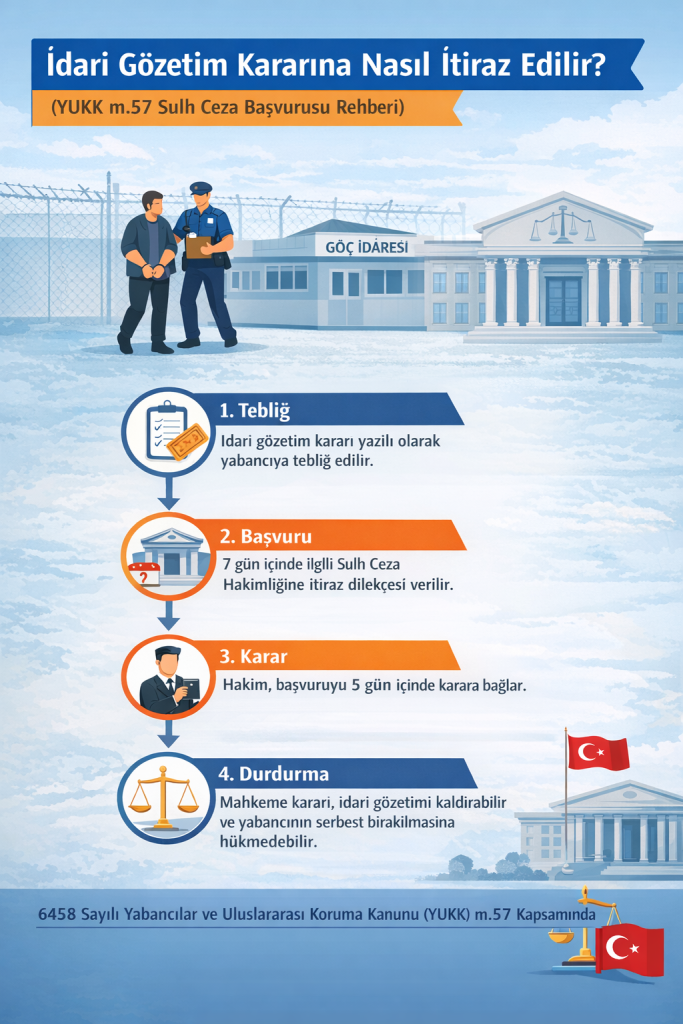
In applications to the criminal judgeship of peace against administrative detention decisions issued under Article 57 of Law No. 6458 on Foreigners and International Protection, legal grounds such as the decision not being based on concrete evidence, non-compliance with procedural safeguards, the foreigner having a settled life in Turkey, exceeding the detention period, failure to apply alternative measures, and disregarding the legal status can be put forward. Judicial decisions show that administrative detention is an exceptional measure that restricts liberty and can only be applied in compelling circumstances.
Legal grounds that can be put forward in objections to the criminal judgeships of peace against administrative detention decisions taken under Article 57 of Law No. 6458 on Foreigners and International Protection (YUKK) have been categorized and analyzed below in light of judicial decisions:
1. Lack of Concrete Evidence and Abstractness of Reasons
The claim of “posing a threat to public security or public order,” which forms the basis of administrative detention decisions, not being supported by concrete data, is one of the most fundamental grounds for objection.
Concrete Examples: The Edirne Criminal Judgeship of Peace (9/12/2014) and the Istanbul 9th Criminal Judgeship of Peace (16/3/2015) overturned detention decisions, stating that the articles of law (YUKK art. 57/2) were merely reiterated abstractly in the administrative detention decision, and there was no concrete evidence that the applicant endangered public security. In a decision by the Kırklareli Criminal Judgeship of Peace (17/8/2017), the lack of justification for the “G-87 general security code” concerning the applicant and the absence of evidence in the file regarding membership in a terrorist organization were cited as grounds for release.
2. Fixed Residence, Family Unity and the Best Interest of the Child
Having a settled arrangement for the foreigner in Turkey is a strong legal justification proving that there is no risk of escape or disappearance.
Concrete Examples: İzmir 2nd Criminal Judgeship of Peace (1/11/2022) considered the existence of a fixed residence where the objector lives with their family and the absence of any judicial/administrative investigation against them during their stay in Turkey as grounds for release. Muğla 2nd Criminal Judgeship of Peace (20/3/2020), on the other hand, ruled that the purpose of administrative detention had been achieved, taking into account that the applicant’s spouse and children are Turkish citizens, their residence is specific, and the best interests of their minor children.
3. Violation of Procedural Safeguards and Lack of Periodic Assessment
Violation of the procedural rules (monthly assessment, notification, extension decision) that the administration must comply with under Article 57 of the LFIP directly demonstrates the unlawfulness of the detention.
Concrete Examples: Adana 4th Criminal Judgeship of Peace (8/9/2014) and Adana 1st Criminal Judgeship of Peace (25/7/2014) cited the failure to regularly assess administrative detention every month (necessity assessment) and the failure to notify the foreigner or their representative of extension decisions with justification as grounds for annulment. Istanbul 6th Criminal Judgeship of Peace (2/10/2014) also terminated the detention with the finding that “an administrative detention decision was not taken in accordance with due procedure.”
4. Exceeding Administrative Detention Periods
The exceeding of maximum periods (6 months + 6 months) stipulated in the law, or the non-occurrence of conditions required for extension, such as “the foreigner’s lack of cooperation,” should be emphasized in objections.
Concrete Examples: The Istanbul 2nd Criminal Court of Peace (29/7/2019) lifted the administrative detention, stating that it cannot exceed 6 months, and that no concrete justification could be presented for the extension on the grounds that the foreigner did not cooperate. The Kırklareli Criminal Court of Peace (17/8/2017) found the extension of the 6-month period unlawful, on the grounds that there was no data in the file indicating that the foreigner did not provide correct information about their country.
5. Priority of Alternative Obligations (Principle of Proportionality)
It should be argued that administrative detention must be a “last resort” and that the same objective can be achieved with less restrictive measures.
Concrete Examples: The İzmir 2nd Criminal Court of Peace (1/11/2022) lifted the detention, stating that administrative detention is a last resort under international human rights law, and that alternative obligations (such as signature requirements) under Article 57/A of the Law on Foreigners and International Protection would be proportionate at this stage.
6. Legal Status and Work Permit
The foreigner’s entry into Turkey through legal channels or possession of a valid permit invalidates the detention decision.
Concrete Examples: The Istanbul 4th Criminal Court of Peace (25/7/2014) lifted the administrative detention because the applicant entered the country legally and possessed a valid work permit. Furthermore, being an international protection applicant or being among individuals who cannot be deported for humanitarian reasons, such as the civil war in Syria (Constitutional Court 20/4/2020), are also grounds that can be put forward in petitions.
Secondary Sources and Additional Context
The following points have been considered as secondary sources to provide additional context when information in the decision texts is limited:
Secondary Source (Court of Conflicts & Council of State): In cases where an administrative detention decision is overturned by a criminal judgeship of peace, it is possible to file a full remedy (compensation) lawsuit in administrative courts due to wrongful detention. However, disputes may arise regarding the competent branch of judiciary for compensation claims (Court of Conflicts 2022/225 ).
Secondary Source (Court of Cassation): It has been emphasized that being under administrative detention effectively makes it impossible for foreign convicts to apply to the probation directorate, and this situation should be considered a “valid excuse” in enforcement processes (Court of Cassation 1. CD, 2025/293 ).
Secondary Source (Constitutional Court General Principles): The Constitutional Court has stated that criminal judgeships of peace must conduct “effective judicial review” when examining objections, and that failing to conduct a review based on the administration’s erroneous inquiries (name error, etc.) constitutes a violation of rights (AYM 21.01.2025). Furthermore, infringement decisions made in the period before Law No. 6458 due to the lack of a legal basis for administrative detention reinforce (AYM 21/1/2015).
Frequently Asked Questions
İdari gözetim kararına hangi gerekçelerle itiraz edilebilir?

İdari gözetim kararına karşı en temel itiraz gerekçeleri; kamu düzeni veya güvenliği tehdidine ilişkin somut delil bulunmaması, kaçma riskinin kanıtlanamaması, sabit ikametgâhın varlığı, aile birliği, usul kurallarına uyulmaması, idari gözetim süresinin aşılması, alternatif yükümlülüklerin uygulanmaması ve yabancının yasal statüsünün göz ardı edilmesi gibi hususlardır. Sulh ceza hâkimlikleri kararlarında bu unsurların bulunmaması halinde idari gözetimin kaldırılmasına hükmedilebilmektedi
İdari gözetim kararının somut delile dayanmaması tahliye sebebi midir?

Yargı kararlarında, idari gözetim kararında yalnızca kanun maddelerinin tekrar edilmesi ve yabancının kamu güvenliğine tehdit oluşturduğuna ilişkin somut verilerin bulunmaması hukuka aykırılık nedeni olarak kabul edilmektedir. Özellikle G-87 gibi tahdit kodlarının gerekçelendirilmemesi veya dosyada suç isnadını destekleyen delil bulunmaması gözetimin kaldırılmasına yol açabilmektedir.
Türkiye’de aile ve sabit adres bulunması idari gözetimi kaldırır mı?

Yabancının Türkiye’de sabit bir ikametgâhının bulunması, ailesiyle birlikte yaşaması veya eş ve çocuklarının Türk vatandaşı olması kaçma riskinin bulunmadığını gösteren önemli bir hukuki kriterdir. Sulh ceza hâkimlikleri, aile birliği ve çocukların üstün yararı ilkesi gereği idari gözetimin amacına ulaştığını değerlendirerek tahliye kararı verebilmektedir.
İdari gözetim süresi ne kadar olabilir ve süre aşılırsa ne olur?

YUKK kapsamında idari gözetim süresi kural olarak 6 ay ile sınırlıdır ve yalnızca yabancının iş birliği yapmaması gibi durumlarda en fazla 6 ay daha uzatılabilir. Uzatma gerekçesinin somut olarak ortaya konulmaması veya azami sürenin aşılması halinde sulh ceza hâkimliği tarafından idari gözetimin kaldırılması mümkündür.
İdari gözetim yerine alternatif yükümlülükler uygulanabilir mi?
İdari gözetim son çare olarak uygulanması gereken bir tedbirdir. İmza yükümlülüğü, belirli adreste ikamet, teminat veya bildirim yükümlülüğü gibi alternatif tedbirlerle aynı amaca ulaşılabilecek durumlarda gözetimin ölçüsüz olduğu ileri sürülebilir. Yargı kararları, ölçülülük ilkesi gereği alternatif yükümlülüklerin öncelikli değerlendirilmesi gerektiğini kabul etmektedir.
Yasal giriş, çalışma izni veya uluslararası koruma başvurusu idari gözetimi etkiler mi?
Yabancının Türkiye’ye yasal yollarla giriş yapmış olması, geçerli çalışma izninin bulunması veya uluslararası koruma başvuru sahibi olması idari gözetim kararının hukuka uygunluğunu doğrudan etkileyen unsurlardır. Ayrıca sınır dışı edilmesi mümkün olmayan kişiler bakımından idari gözetim tedbirinin devamı hukuki denetime tabi tutulmaktadır.
Why is Expert Legal Support Necessary During the Administrative Detention Process?
Applications against administrative detention decisions are short-term processes requiring technical legal evaluation. In objections made to the Magistrates’ Criminal Court, many legal elements such as lack of concrete evidence, procedural errors, the principle of proportionality, international protection status, and restriction codes must be evaluated together. Incorrect or incomplete applications can lead to the prolongation of the process, resulting in the restriction of freedom.
2M Law Office, based in Istanbul, offers professional legal support regarding foreigner law, objections to administrative detention decisions, removal center processes, cancellation of deportation procedures, and the removal of restriction codes. The office provides strategic legal representation in administrative detention processes across Istanbul, Tuzla, Pendik, Kartal, Maltepe, and the Anatolian Side.
In processes directly affecting freedom, such as administrative detention, it is important for the legal process to be handled by an expert lawyer to prevent loss of rights.