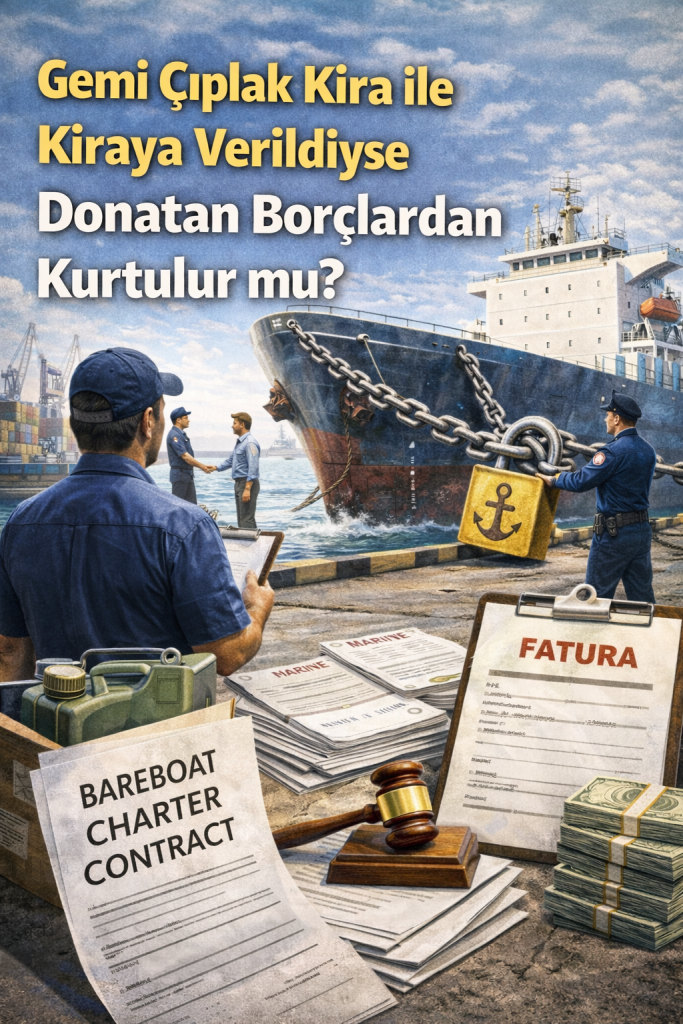
Bareboat Charter, Operator’s Liability and Defense of Payment to the Agent
This guide has been prepared for shipowners, charterers, and agents operating in Istanbul, especially the Tuzla shipyards region, Ambarlı Port, Haydarpaşa Port, and Tuzla shipyards.
The claim, which is the most frequently encountered defense in practice, stating “the owner is not liable due to bareboat charter,” is examined in light of court decisions.
1. Bareboat Charter Agreement (TCC Art. 1127) and Transfer of Operator Status
According to Turkish Commercial Code (TCC) Articles 1061 and 1127, it is consistently accepted in court decisions that when a vessel is leased under a bareboat charter agreement, the responsibilities related to the operation of the vessel are transferred from the owner (malik) to the charterer.
Determination of Operator Status: In its decisions numbered (2018/222 E., 2020/25 K.) and (2017/180 E., 2020/222 K K.), the Istanbul 17th Commercial Court of First Instance ruled that in cases where a vessel is leased under a bareboat charter agreement, without a crew, the registered owner cannot be considered as the “operator”. According to TCC Art. 1127, it was emphasized that when a bareboat charter agreement is concluded, the debts and obligations related to the crew belong to the charterer.
Transfer of Possession and Vessel Operating Contractor: The Istanbul Regional Court of Justice, 43rd Civil Chamber (Case No. 2020/581, Decision No. 2021/1339 Source), stated that with the transfer of the technical and commercial management of the vessel to the charterer in “Barecon 89” type contracts, the charterer acquires the status of a “vessel operating contractor” in the sense of Article 1061(2) of the Turkish Commercial Code (TTK) and is considered the owner (donatan) in its relations with third parties. In this situation, the shipowner loses its status as the owner and cannot be held responsible for operating expenses.
2. Responsibility for Operating Expenses and Agency Fees
Court decisions demonstrate with concrete examples that in the presence of a bareboat charter agreement, the owner cannot be held responsible for expenses such as crew wages, fuel, provisions, and agency fees.
Agency and Operating Expenses: The Istanbul 17th Commercial Court of First Instance (Case No. 2018/222) ruled that due to the vessel being bareboat chartered and the contract stipulating that operating expenses belong to the charterer, the defendant shipowner could not be held responsible for expenses such as oil, fuel, provisions, and agency fees.
Service Invoices and the Principle of Privity: The Istanbul Regional Court of Justice, 12th Civil Chamber (Case No. 2021/1003, Decision No. 2024/47) found that holding the owner responsible for the debt, in a situation where it was established that the vessel was operated by the charterer during the period the invoices were issued, was contrary to the “principle of privity of contracts.” The Court confirmed that the owner bears no personal liability for works commissioned by the vessel’s charterer.
Fuel Supply: Istanbul 17th Civil Court of Commerce (2014/437 E., 2021/182 K K.), stated that the debtor status under the fuel supply contract belongs to the possessor/lessee, and therefore, the lawsuit filed against the owner should be dismissed due to lack of passive standing.
3. Distinction Between Time Charter and Bareboat Charter
The validity of the defense is strictly dependent on the nature of the contract. If the contract is not a “bareboat charter” but a “time charter”, the owner’s liability may continue.
Non-transfer of Technical Management: Istanbul 17th Civil Court of Commerce (2018/168 E., 2024/365 K K.), ruled that if the contract stipulates that “only the commercial management of the vessel belongs to the charterer” and that the crew will be employed by the lessor, then this contract shall be considered a “time charter” under Article 1131 of the Turkish Commercial Code and the owner shall remain liable as the shipowner.
4. Impact of Payments Made to Agent on Liability
The fact that payment was made to the agent does not always relieve the shipowner of liability.
Joint and Several Liability: The 11th Civil Chamber of the Court of Cassation (2014/15674 E., 2015/11140 K.), accepted that the agent is jointly and severally liable with the shipowner for items such as pilotage and lighthouse fees, and that depositing money with the agent does not terminate the shipowner’s debt.
Rejection of Defense of Payment to Agent: The 11th Civil Chamber of the Supreme Court (2014/15124 Docket No., 2015/11141 Decision Decision No.) did not find the shipowner’s defense that they sent the pilotage fees to the agent’s bank account to be valid, and upheld the first instance court’s decision that the shipowner’s liability continues as long as payment has not been made to the service provider.
5. Secondary Sources and Additional Context
The following matters have been considered as secondary sources providing limited information in the decision texts:
Distinction of Ship Manager (Manager): Istanbul 17th Commercial Court of First Instance (2022/16 Docket No.) emphasized that the ship manager (manager) will not be considered the shipowner as long as they do not operate the ship in their own name and on their own account, and that the debts belong to the shipowner.
Insurance and Subrogation: Istanbul 17th Commercial Court of First Instance (2019/415 Docket No.) indirectly indicated that due to the bareboat charterer holding the status of shipowner in a bareboat charter agreement, the right to claim insurance compensation also belongs to the charterer, and that the owner’s liability could be limited in this context.
Freight Refund: Istanbul 17th Commercial Court of First Instance (2017/123 Docket No. Decision) stated that making the freight payment to the agent does not grant the agent the status of “carrier”, and that the shipowner is responsible for the freight refund.
Port Expenses and Bill of Lading: Istanbul Regional Court of Justice 13th Civil Chamber (2023/83 E. K), has shown that bill of lading records (CY-CY, CFS etc.) will be taken as a basis for the collection of expenses incurred by the agent on behalf of the carrier, and that this defense might be weak in cases where a bareboat charter relationship cannot be proven.
Sub-Lease Relationship: Izmir Regional Court of Justice 17th Civil Chamber (2021/1057 E. K), has emphasized that a sub-lease or transfer of operating rights made without the owner’s written permission, might not extinguish the shipowner’s liability towards third parties (such as port operators).
Conclusion: According to judicial decisions, if a vessel is leased under a bareboat charter agreement and this situation is registered in the registry, thereby gaining public notice, the defense that the owner is not responsible for operating expenses under Article 1127 of the Turkish Commercial Code is strongly accepted. However, the fact that payment was made only to the agent does not always terminate the debt owed to the principal creditor; furthermore, it is required that the agreement is a genuine bareboat charter contract that also transfers the technical management.
Frequently Asked Questions
Gemi çıplak kira (bareboat charter) ile kiraya verilmişse donatan kim sayılır?
Çıplak kira sözleşmesinde, gemi gemi adamlarından ari şekilde kiracıya teslim edilmiş ve teknik–ticari yönetim kiracıya devredilmişse, TTK m. 1127 uyarınca donatan sıfatı kiracıya geçer. Bu durumda sicilde malik olarak görünen kişi, üçüncü kişilere karşı işletme giderlerinden sorumlu tutulamaz.
Yakıt, kumanya ve acentelik ücretlerinden gemi maliki sorumlu olur mu?

Hayır, kural olarak olmaz. Yargı kararlarına göre; gemi gerçek bir çıplak kira kapsamında kiracı tarafından işletiliyorsa, yakıt, yağ, kumanya, acentelik ve benzeri işletme giderleri kiracıya aittir. Bu tür alacaklar için gemi malikine yöneltilen talepler çoğu zaman pasif husumet yokluğu nedeniyle reddedilmektedir.
Sözleşme çıplak kira değil de zaman çarteri ise sonuç değişir mi?
Evet, tamamen değişir. Eğer sözleşmede gemi adamları malikte kalmış, sadece ticari yönetim kiracıya bırakılmışsa, bu ilişki TTK m. 1131 kapsamında zaman çarteri sayılır. Bu durumda malik donatan sıfatını korur ve üçüncü kişilere karşı sorumluluk devam eder. Uygulamada savunmanın kaderi, sözleşmenin bu ayrımına bağlıdır.
Borcun acenteye ödenmiş olması donatanın sorumluluğunu ortadan kaldırır mı?
Her zaman hayır. Özellikle kılavuzluk, fener ve liman hizmetleri gibi kalemlerde Yargıtay; acenteye yapılan ödemenin, hizmeti sunan asıl alacaklıya ödeme yapılmadıkça donatanın borcunu sona erdirmeyeceğini kabul etmektedir. Bu nedenle “acenteye ödedim” savunması her olayda geçerli değildir.
Concrete Case Study
Bareboat Charter and Liability of the Ship Operator
A ship-owning company (owner) leased some of its vessels, including the **Chalna**, to a non-party company under a **bareboat charterparty (Barecon 89)**. Under this agreement, the **possession**, **technical and commercial management** of the vessels were fully transferred to the charterer; the charterer also appointed a **ship manager**. During the charterer’s period, an **execution proceeding based on invoices** was initiated by the service provider company, claiming that **satellite communication system (Iridium / Inmarsat)** services were provided to the vessels. The proceeding was directed against the ship owner (former bareboat owner). The owner, however;
That the services in question **were not received during their period**;
That the vessels **were operated by the charterer under a bareboat charter**;
Claiming that the charterer **invoiced the owner** for expenses incurred for its own vessels, filed a **negative declaratory action**.
Court’s Assessment
The Regional Court of Appeals meticulously examined the **Barecon 89 bareboat charterparty** within the scope of the file and made the following determinations:
With the bareboat charterparty, the **possession of the vessel passed to the charterer**.
With this transfer of possession, the charterer **acquired the status of “ship operating contractor” in the sense of Article 1061/2 of the TCC**.
The charterer, as the ship operating contractor, is considered **liable like an owner** in relations with third parties.
After this stage, the shipowner/disponent owner loses their status as such and cannot be held responsible for expenses arising from the operation of the ship. The court also emphasized that invoice and commercial ledger records alone would not be sufficient to prove the existence of the claim, and that it must be proven with concrete evidence that the service was actually rendered and to whom it was rendered. In the present case;
That the invoices were issued in the name of the charterer,
That the service belonged to the charterer’s operational period,
It has been determined that the shipowner had already fulfilled their obligation to deliver the ship in a seaworthy condition.
Conclusion (Clear Principle from the Perspective of the Ship Operating Contractor)
This decision yields the following concrete result for the ship operating contractor: The charterer who actually operates the ship under a bareboat charter agreement is the ship operating contractor. The ship operating contractor is responsible for expenses related to the operation of the ship, such as fuel, provisions, communication, maintenance, and similar costs. The shipowner appearing as owner in the register is not considered the disponent owner after this stage and cannot be held responsible for such claims. Service providers must direct their claims to the correct party (charterer/ship operating contractor)
This decision;
That the bareboat charter defense must be proven not merely theoretically, but by actual operation and transfer of possession,
That the ship operating contractor is the primary party responsible from the creditors’ perspective,
It clearly and unambiguously shows that legal proceedings mistakenly directed at the ship owner can be eliminated through a negative declaratory action.
Why Is Expert Lawyer Support Necessary?
(2M Law Firm – Istanbul / Tuzla Maritime Law Practice)
The bareboat charter defense is one of the most technical and most frequently misapplied defenses in maritime law. A wrongly established defense;
Can lead to the owner being subjected to seizure for a debt for which they are not liable at all,
To the acceptance that the debt continues despite payment being made to the agent,
To the incorrect determination of the owner’s status due to a wrong distinction between time charter and bareboat charter
It can lead to. Especially in busy maritime trade regions like Istanbul, Tuzla shipyards, and Ambarlı and Haydarpaşa ports;
Accurate determination of the nature of the contract,
Joint evaluation of registry records and actual operation,
Distinguishing in which receivables payment to the agent terminates the debt is only possible with expert legal counsel well-versed in maritime trade jurisprudence. Therefore, in situations where a bareboat charter defense needs to be put forward or acted against, working with a law firm like 2M Law Firm, which has a maritime law practice based in Istanbul and Tuzla, eliminates the risk of losing rights and ensures the process is conducted with the right strategy.