Condominium Law Art. 20 and Current Guide in Light of Supreme Court Decisions (2026)**
Can a Small-Large Apartment Distinction Be Made? Is Land Share Mandatory?
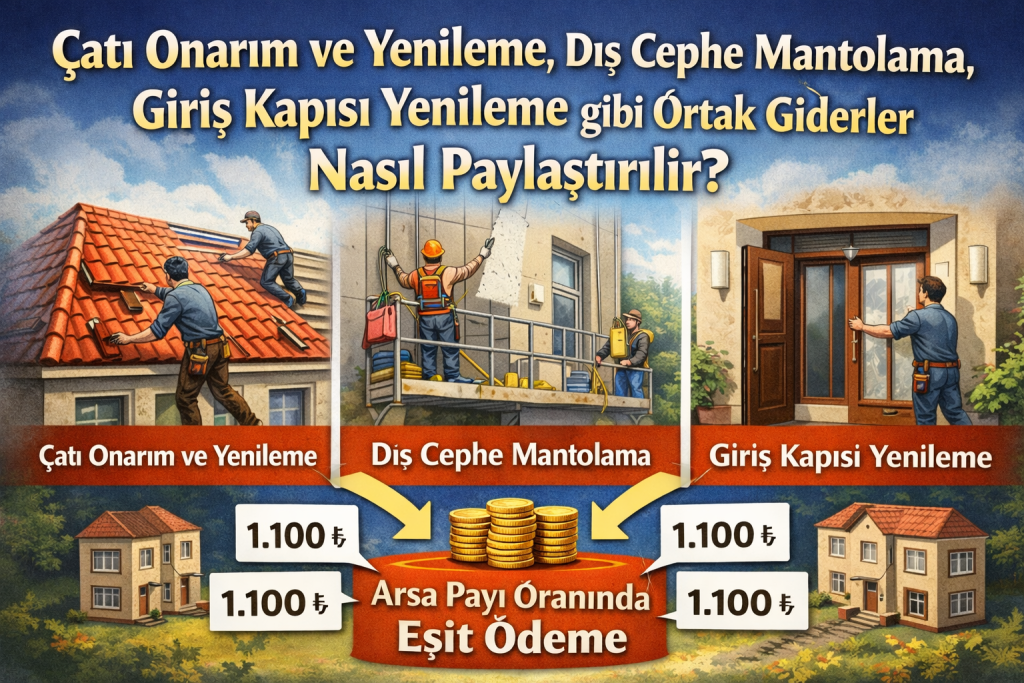
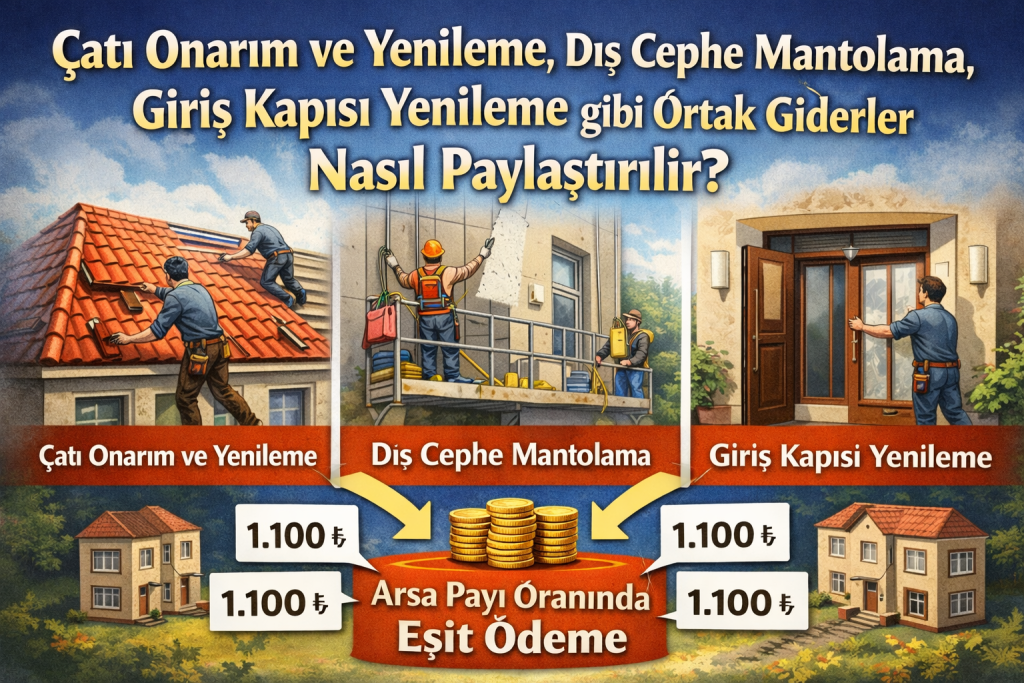
In buildings subject to condominium ownership, areas such as the main entrance door, roof, insulation (cladding), and elevator are considered common areas. According to Article 20 of Condominium Law No. 634, unless there is an explicit provision to the contrary in the management plan, all condominium owners must contribute to the maintenance, repair, and renovation expenses of these common areas in proportion to their land shares.
The consistent jurisprudence of the Supreme Court considers expense distributions made using methods such as apartment size, square meters, small-large apartment distinction, or equal division to be unlawful if there is no explicit provision in the management plan.
1. General Legal Framework and Condominium Law Article 20
According to Article 20 of the Condominium Law (KMK) numbered 634, unless unit owners have a different agreement among themselves (a contrary provision in the management plan), they are obliged to contribute to the maintenance, protection, reinforcement, and repair expenses of all common areas of the main immovable property in proportion to their land shares (Supreme Court 18th Civil Chamber-2013/20273 20th Civil Chamber-2019/2968 K). According to Article 4 of the Law, “general entrance doors” are considered common areas (Council of State 10th Chamber-2017/549 K). Therefore, the renewal or repair of the building’s main entrance door is a common area expense.
2. Principles of Common Expense Sharing and the Obligation of Land Share
Supreme Court decisions consistently emphasize that the fundamental criterion for sharing expenses related to common areas is the land share:
Main Entrance Door Expense: The Supreme Court 20th Civil Chamber (2017/4168) stated that unless there is a contrary provision in the management plan, renewal expenses for common areas such as the main entrance door should be paid in proportion to the land share, and that an equal division among residences or a distinction between shops/apartments is unlawful. Similarly, the 18th Civil Chamber (2011/8903) ruled that participation in expenses incurred for the entrance door should be in proportion to the land share.
Apartment Size and Square Meter Distinction: Decisions of the homeowners’ board regarding the distribution of expenses “according to external facade m²” or “according to apartment size” are not considered legal. The 20th Civil Chamber of the Supreme Court (2018/2036) annulled the decision to distribute insulation expenses according to the apartments’ external facade m². Also, the 20th Civil Chamber (2017/5547) found it erroneous to calculate the total cost by dividing it by the number of apartments, regardless of the land share.
Precedent Applications: Operations such as roof replacement, insulation, and elevator renovation are considered within the scope of “mandatory maintenance and repair,” and it is stated that all homeowners must contribute to these expenses in proportion to their land share (20. Civil Chamber-2017/4433, 20. Civil Chamber-2017/3748)
3. Binding Nature of the Management Plan and Exceptions
In the distribution of common expenses, the management plan may override the general rule in Article 20 of the Condominium Law (KMK).
If the management plan explicitly stipulates that expenses shall be shared “according to the number of rooms” (18. Civil Chamber-2015/7020) or “equally” (20. Civil Chamber-2017/3587), this provision shall apply.
However, if there is no such provision in the management plan or if the plan has adopted the “land share” principle, the homeowners’ board cannot determine a different distribution method (such as distinguishing between small/large apartments) without amending this plan (without securing a four-fifths majority) (20. Civil Chamber-2017/4526, 18. Civil Chamber-2013/15247
4. Assessment of the Current Situation
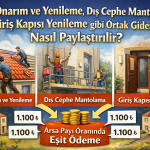
In the case at hand, the fact that roof and insulation expenses in previous years were paid in proportion to the land share indicates that the management plan likely adopted the land share principle or that Article 20 of the Condominium Law (KMK) was applied. The distribution determined by the management for the main entrance door replacement as “small flat 2200 TL, large flat 2400 TL” appears to be contrary to the land share ratio (1100 TL). The 20th Civil Chamber of the Court of Cassation (2019/2648) considered the failure to calculate dues and expenses in proportion to the land share as a ground for reversal.
5. Secondary Sources and Additional Context
Decisions that qualify as secondary sources draw attention to the following points in such disputes:
Amendment to the Management Plan: To change the expense sharing method in the management plan, a four-fifths (4/5) vote of all condominium owners is required. Decisions made without securing this majority are invalid (20. HD-2019/2658 20. HD-2017/4460
Benefit Ratio Debate: Although Article 42 of the Condominium Law (KMK) includes the principle that “those who benefit from innovations and additions should pay according to their benefit ratio,” in common areas used by all owners, such as the main entrance door, the general rule is interpreted with a focus on the land share (5. HD-1981/231 , 20. HD-2019/4235
Legal Action: Condominium owners have the right to file an annulment lawsuit in the Civil Court of Peace against expense sharing decisions that are contrary to the management plan or the law (18. HD-2012/9381
Conclusion: In light of the presented court decisions; unless there is a contrary provision in the management plan, it is not legal to apportion the cost of changing the building’s main entrance door by distinguishing between small and large flats. It is essential that expenses are collected in proportion to the land share (as you stated, to be 1100 TL) in accordance with Article 20 of the Condominium Law.
Kat malikleri kurulu kararıyla arsa payı yerine metrekare esas alınabilir mi?
Hayır. Kat malikleri kurulu, yönetim planı değiştirilmeden (4/5 çoğunluk sağlanmadan) arsa payı dışındaki bir paylaşım yöntemini tek başına belirleyemez. Aksi yöndeki kararlar iptale tabidir.
Why is Expert Lawyer Support Necessary?
The most common mistakes made in disputes arising from condominium ownership are:
Determination of dues and expenses without examining the management plan,
Decisions of the board of flat owners being implemented unlawfully,
Accrual of expenses based on arbitrary criteria (m², flat type, equal division) instead of land share,
Loss of rights due to the failure to file a cancellation lawsuit within the statutory period. Such errors can lead to flat owners being unlawfully indebted, the inability to recover paid amounts, and protracted litigation processes. 2M Hukuk Avukatlık Ofisi provides its clients with preventive and results-oriented legal support regarding condominium and apartment/complex law, covering topics such as;
Legal analysis of the management plan,
Annulment of flat owners’ board decisions,
Stopping incorrect dues and common expense accruals,
And conducting litigation and objection processes before the Civil Court of Peace.