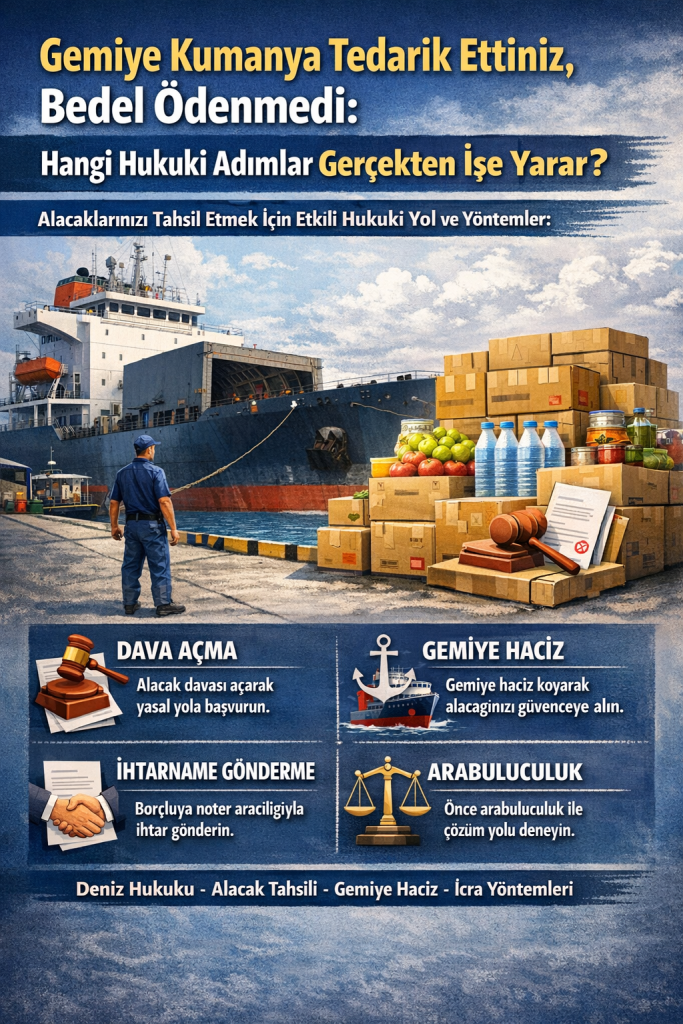
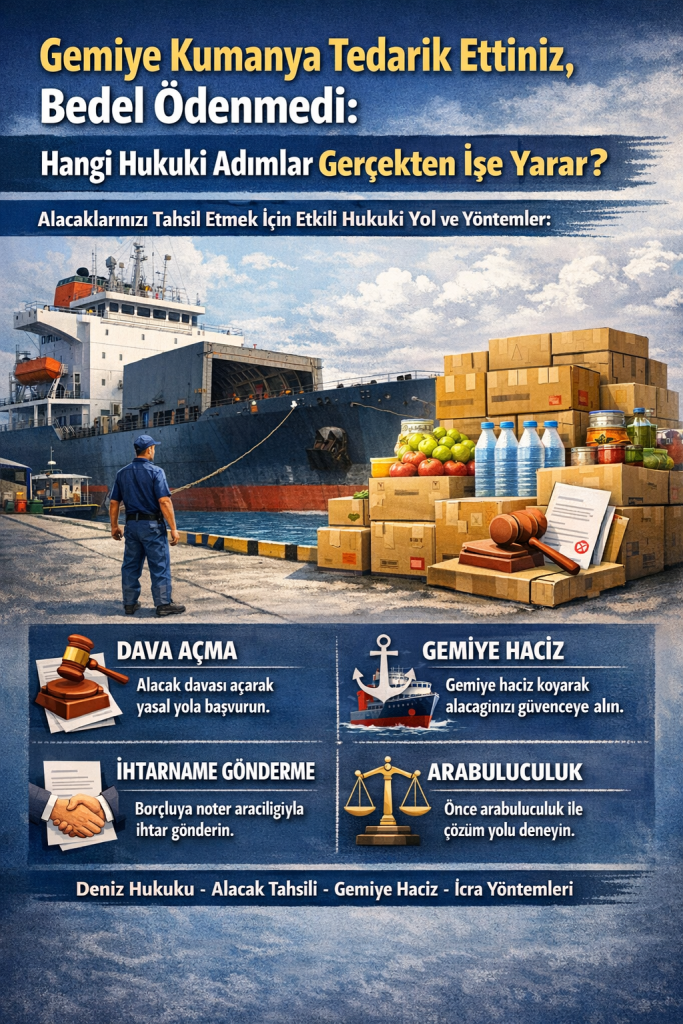
1. Legal Nature of the Claim: Maritime Claim
Pursuant to Article 1352/1-l of the Turkish Commercial Code (TCC) No. 6102; claims arising from goods, materials, provisions, fuel, and equipment supplied for the operation, management, protection, or maintenance of a ship, and from services rendered for these purposes are clearly defined as a “maritime claim” . The supply of fruit, vegetables, meat, and similar foodstuffs (provisions) to a ship is evaluated within this scope. Court decisions consistently emphasize that such claims must be pursued through procedures specific to maritime commercial law (Antalya BAM 11. HD-2017/556 D, İstanbul Anadolu 2. ATM-2025/713 D).
2. Main Legal Avenues to Be Pursued
A. Provisional Attachment and Arrest of the Ship
Pursuant to Article 1353 of the TCC, a provisional attachment of the ship may be ordered to secure maritime claims. The provisions creditor may have a provisional attachment placed on the ship when presenting evidence (invoice, waybill, delivery receipt, etc.) that persuades the court of the existence and amount of their claim (Antalya BAM 11. HD-2017/556
Case Study: Collection of the Cost of Provisions Supplied to the Ship
A provisions supplier company provided food and services to the vessel named M/V INA on different dates, but the issued invoices were not paid by the shipowner. Thereupon, the creditor filed a lawsuit for the collection of the provision cost; during the lawsuit, an arrest (precautionary injunction) order was issued against the vessel. For the vessel to continue its voyage, a cash collateral was deposited into the enforcement file by the agent on behalf of the vessel’s new owner, and the precautionary measure taken against the vessel was lifted and shifted to the collateral. Meanwhile, the vessel changed hands, and the new owner joined the lawsuit as an ancillary intervenor. The new owner argued that the provision claim was time-barred, that he was not responsible for the previous shipowner’s debt, and that the deposited collateral should be returned to him.
The court of first instance accepted the case and rejected the request for the return of the collateral, determining that the statute of limitations defense was not raised in due time by the principal debtor, that an ancillary intervenor cannot raise a statute of limitations defense on their own, and that the provision cost was proven by the creditor. The decision was brought before the Supreme Court for review; the 11th Civil Chamber of the Supreme Court, emphasizing the existence of the provision claim, the protection of the collateral, and that the ancillary intervenor has limited rights, upheld the local court’s decision. (Supreme Court 11th Civil Chamber – 2012/1298
B. Enforcement Proceedings and Lawsuit for Annulment of Objection
The creditor can initiate an enforcement proceeding without a court judgment for unpaid provision costs. If the debtor (owner or operator) objects to the proceeding, a “lawsuit for the annulment of objection” must be filed in accordance with Article 67 of the EBL.
Concrete Example: A company supplying dry provisions to vessels named MV … and MV … addressed the objection to the enforcement proceeding it initiated due to unpaid invoices by filing a lawsuit for the annulment of objection in the Maritime Specialization Court; the court ruled for a 20% enforcement denial compensation and the collection of the principal debt (Istanbul 17th Commercial Court of First Instance – 2019/160
Concrete Example: In the “Example 7” enforcement proceeding without a court judgment initiated for a receivable arising from the sale of ship supplies, with commercial ledgers and invoices accepted as evidence, the objection was annulled and it was decided that the proceeding should continue (Istanbul 11th Commercial Court of First Instance – 2018/913
C. Action for Debt and Request for Statutory Lien
The creditor can demand the collection of the provision cost by directly filing an action for debt. In some cases, creditors also demand the recognition of a “statutory lien” on the vessel due to the nature of the receivable as a “maritime claim.” However, in current judicial practice, the request for a statutory lien is generally rejected in provision sales based on credit transactions, and only the collection of the debt is ruled (Court of Appeals 11th Civil Chamber – 2013/15215 , 2011/8125).
3. Procedural Requirements and Points to Consider
Competent Court: Since a claim for ship’s stores (provisions) is a maritime claim under Article 1352 of the Turkish Commercial Code (TCC), the “Specialized Maritime Courts” (or Civil Courts of Commerce acting in this capacity) are competent to resolve disputes. Lawsuits filed in general commercial courts are dismissed due to lack of jurisdiction (Istanbul Anadolu 9th Commercial Court – 2016/745 Istanbul 14th Commercial Court – 2016/278
Proper Party to Sue (Correct Debtor): A lawsuit for debt or enforcement proceedings should be directed directly against the shipowner or operator. The ship agent cannot be held personally liable for the cost of goods under Article 119/2 of the TCC; therefore, lawsuits filed against the agent may be dismissed due to lack of standing (Supreme Court 19th Civil Chamber – 2014/4441
Means of Proof: Captain-signed receipts showing delivery, dispatch notes, e-archive invoices, and commercial ledger records are the most critical evidence. Failure to object to invoices within 8 days constitutes a presumption that their content has been accepted (Istanbul 17th Commercial Court – 2019/160, Istanbul 11th Commercial Court – 2018/913).
Conclusion: The person supplying provisions to the ship can first secure their claim by preventing the ship from sailing through a preliminary injunction (arrest of the ship), and then collect their claim, along with interest and execution denial compensation, by initiating enforcement proceedings or an action for annulment of objection in the Specialized Maritime Court.
Frequently Asked Questions and Practical Issues
Kumanya alacağı için gemi hakkında alınan ihtiyati tedbir veya yatırılan teminat, gemi satıldıktan sonra yeni malik tarafından geri alınabilir mi?
Hayır. Yargıtay 11. Hukuk Dairesi’nin 06.12.2012 tarihli kararına göre; kumanya alacağı nedeniyle geminin seferden men edilmesi üzerine geminin seferine devam edebilmesi için yatırılan nakdi teminat, gemi sonradan el değiştirmiş olsa dahi yeni malik tarafından geri istenemez.
Tedbir, gemi yerine teminat üzerinde devam eder ve alacak kesinleşinceye kadar korunur.
Yeni gemi maliki, kumanya alacağına karşı zamanaşımı def’inde bulunabilir mi?
Hayır. Kararda açıkça belirtildiği üzere; fer’i müdahil sıfatıyla davaya katılan yeni gemi maliki, davalı donatan adına zamanaşımı def’inde bulunamaz. Zamanaşımı itirazı yalnızca asıl borçlu tarafından süresi içinde ileri sürülebilir; aksi hâlde mahkemece re’sen dikkate alınamaz.
Gemi limandayken hangi adım alacağı gerçekten güvence altına alır?
En etkili yol, ihtiyati hacizdir. Mahkemeler, kumanya alacaklarında fatura, sevk irsaliyesi ve teslim tutanağı gibi belgelerle yaklaşık ispatın sağlanması hâlinde, geminin seferden men edilmesine karar verebilmektedir. Bu adım atılmadan gemi limanı terk ederse, alacağın fiilen tahsili çoğu zaman imkânsız hâle gelir.
Borçlu olarak acente mi, donatan mı muhatap alınmalı?
Bu ayrım kritik önemdedir. Gemi acentesi, kural olarak kumanya bedelinden şahsen sorumlu değildir. Takibin veya davanın doğrudan gemi donatanına ya da işletenine yöneltilmesi gerekir. Aksi hâlde dosya, esasa girilmeden husumet yokluğu nedeniyle reddedilebilir.
Kumanya alacağı için gemi üzerinde rehin hakkı her zaman doğar mı?
Hayır. Her kumanya alacağı otomatik olarak kanuni rehin hakkı vermez.
Yargı uygulamasında özellikle kredili ve rutin tedariklerde, “zorunluluk” unsuru ispatlanamazsa rehin talepleri reddedilmekte, sadece alacağın tahsiline karar verilmektedir. Bu nedenle rehin talebi dikkatle kurgulanmalıdır.
Why Should One Proceed with a Specialist Lawyer in Such Claims?
Provision claims, while strong in theory, are among the fastest lost maritime claims in practice. The reason for this is often not the claim itself, but the incorrect establishment of the procedure.
Proceedings directed at the wrong person
Lawsuits filed in the wrong court
Missing the opportunity to seize the ship while it is in port
Incorrect assertion of the right of pledge
The inability to manage time pressure on foreign-flagged vessels is frequently observed, especially in the applications of Istanbul ports, Tuzla Shipyard, marinas, and transit ports. Therefore, in claims for provisions, fuel, and ship supplies, proceeding with a lawyer who is knowledgeable about port practices, has a reflex for precautionary seizure, and understands maritime commercial law often determines whether the claim can be collected. 2M Hukuk Law Office, with experience in maritime commercial disputes centered in Istanbul, pursues provision and ship supply claims with strategies of fast seizure, correct adversarial party, and effective collection.