
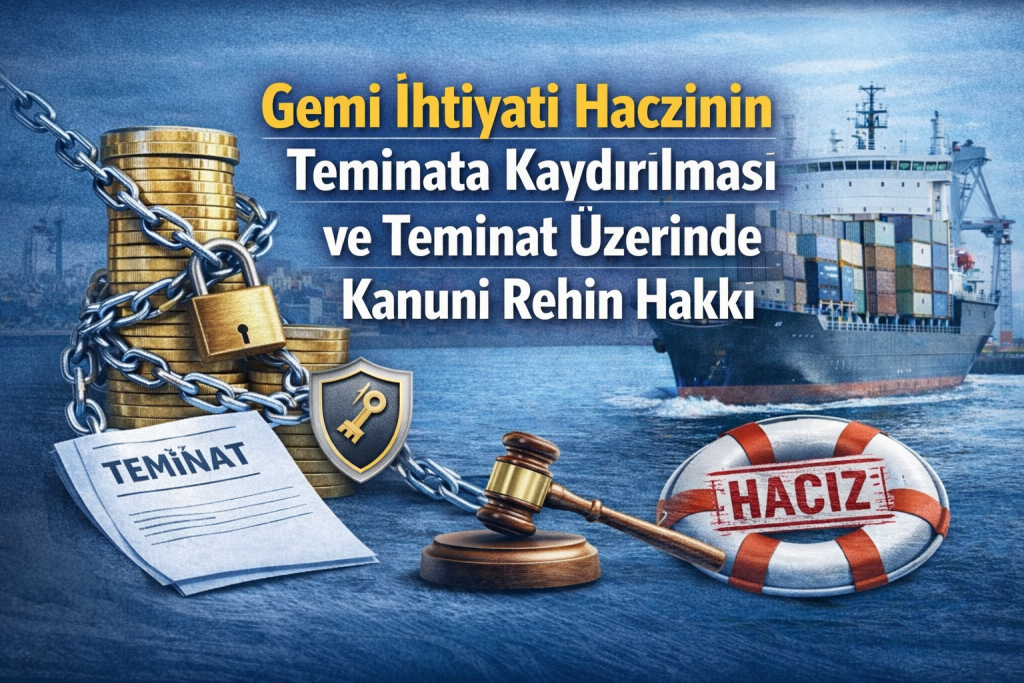
Application in Maritime Claims, Supreme Court Jurisprudence, and Critical Legal Processes
The lifting of a precautionary attachment placed on a vessel in exchange for security does not extinguish the creditor’s right; instead, the subject of the attachment is transferred from the vessel to a letter of guarantee or cash security. After this stage, the truly critical process is the establishment of a legal pledge right over the security and the collection of the claim from this security. Decisions by the Supreme Court and Regional Courts of Justice indicate that this process is highly technical and prone to errors.
Introduction and Legal Basis
The process of lifting a vessel’s precautionary attachment with security and establishing a legal pledge right over this security represents a special procedure where the provisions of the Turkish Commercial Code (TCC) and the Enforcement and Bankruptcy Law (EBL) merge with principles of maritime law. According to the established jurisprudence of the 11th Civil Chamber of the Supreme Court (2012/5290 E. – 2013/5238 K K.), a maritime creditor’s right is in the nature of a “statutory lien right”. As this right arises from the law, it takes effect without the need for registration or delivery and, as a right in rem, follows the vessel and its freight (repealed TCC art. 1236/2, current TCC art. 1321).
Procedure for Shifting Precautionary Attachment to Security
A decision for arrest or precautionary attachment issued against a vessel, if sufficient security is provided by the debtor or shipowner, is lifted from the vessel and “shifted” onto the security.
Nature of Security: Pursuant to Article 1371 of the TCC; the owner or debtor of the ship may request the lifting of the attachment by providing sufficient security (cash or bank letter of guarantee) for the entire maritime claim, its interest, and expenses, provided that it does not exceed the value of the ship.
Continuance of Attachment: When security is deposited, the provisional attachment does not terminate; it merely transfers from the attached ship to the security. As emphasized by the 43rd Civil Chamber of the Istanbul Regional Court of Justice (2023/1567 E. K), the provisional attachment continues on the security and as long as this attachment is not lifted, the return of the security is not possible.
Establishment of Statutory Lien Right on Security and Main Lawsuit
The transfer of the measure on the ship to security is an intermediate step for the creditor to effectively enforce their statutory lien right. For this right to be definitively established, it is mandatory for the main lawsuit, filed within the legal period, to be concluded in Turkish courts.
Jurisdiction and Arbitration: The Supreme Court considers it a legal obligation for the lawsuit for the establishment and enforcement of the lien right to be heard in Turkish courts, even if there is an arbitration clause between the parties, due to the statutory lien right being a real right and concerning public order (Supreme Court 11th Civil Chamber 2012/5290 E.).
Examination and Proof: The court, by delving into the merits of the case, examines whether the claim falls within the scope of “maritime claim” (repealed Article 1235, current Article 1320) under the TCC. If the claim is of this nature, the court rules for the determination of the statutory lien right on the security and for the collection of the claim through the realization of this lien right.
Illustration and Application Analysis
Example of Cargo Shortage: In the case examined by the 5th Civil Court of Commerce of Izmir (2014/419 E. K), the vessel was prohibited from sailing due to an alleged 800 Mton cargo shortage, and the precautionary measure was converted into a letter of guarantee for 336,000 USD upon its submission. The court continued to hear the case based on the guarantee; however, no maritime lien was established because the amount of the claim could not be proven during the examination (due to draft survey error, etc.).
Example of Collision Damage: In another decision by the 5th Civil Court of Commerce of Izmir (2016/458 E. K), the precautionary attachment placed on the vessel for damage caused by a collision was converted into a letter of guarantee for 197,984.60 USD. The court determined that the claim constituted a maritime claim under Article 1320/1-e of the Turkish Commercial Code (TTK), and at the end of the process replaced by the guarantee, ruled for the “determination of the existence of a statutory maritime lien and the collection of the claim by converting this lien into money.”
Example of Ship Supply Claim: In the decisions of the 11th Civil Chamber of the Supreme Court (2022/3921 E. K) and the General Assembly of Civil Chambers (2017/2223 E. K), a maritime lien was claimed for parts supplied to the vessel; however, the request for a maritime lien was rejected because there was no document proving that the captain had personally ordered them for essential and urgent reasons. This demonstrates that proving the nature of the claim is a prerequisite for establishing a lien on the guarantee.
Secondary Source Analysis Secondary sources provide additional details regarding the substitution of collateral for attachment and its procedure:
Collateral Amount: According to the decisions of Istanbul Regional Court of Justice 13th Civil Chamber (2024/1666 E. Decision) and (2024/689 E. ), the collateral amount is generally determined by adding a 15% interest and expense share to the principal debt amount (e.g., 2,034,539 USD collateral for a 1,769,164 USD debt).
Shift in Jurisdiction: According to the Supreme Court 11th Civil Chamber (2016/7449 E. ), after the provisional attachment is executed and the principal enforcement proceedings are initiated, the authority to shift the attachment to collateral passes from the court to the enforcement court.
Relationship to Possessory Lien: The Supreme Court 11th Civil Chamber (2013/8121 E. Source) states that, in addition to the maritime lien, the possessory lien may also arise by virtue of Article 23/2 of the Enforcement and Bankruptcy Law (İİK), and that the collateral preserves the actual enforceability of these rights.
Prohibition of Return: Istanbul Regional Court of Justice 43rd Civil Chamber (2023/1567 E. Decision) emphatically states that the attachment shifted to collateral constitutes an impediment to the return of the collateral until the main lawsuit is concluded or the attachment is lifted.
Result In the event of the release of a ship arrest by providing security, the statutory lien continues to exist on the security. The legal establishment of this right is realized through the court’s determination that the claim is a maritime claim, the exercise of exclusive jurisdiction by Turkish courts, and the recognition of the lien and decision for its conversion into money in the final judgment. If the existence or nature of the claim cannot be proven, the request for a lien on the security is also rejected.
Frequently Asked Questions
Gemi ihtiyati haczi teminata kaydırılınca alacaklı haciz hakkını kaybeder mi?

Hayır. Teminat yatırılmasıyla ihtiyati haciz sona ermez, yalnızca konu değiştirir. Haciz, gemi üzerinden kalkar ancak nakit teminat veya banka teminat mektubu üzerinde aynen devam eder.
İstanbul Bölge Adliye Mahkemesi 43. Hukuk Dairesi’nin yerleşik kararlarına göre, bu haciz kaldırılmadıkça teminatın borçluya iadesi mümkün değildir. Bu nedenle teminat, alacaklı açısından geminin yerine geçen hukuki bir güvence niteliğindedir.
Teminat üzerine kaydırılan hacizde kanuni rehin hakkı kendiliğinden mi doğar?
Hayır. Gemi alacaklısı hakkı kanundan doğan bir kanuni rehin hakkıdır, ancak teminat üzerinde fiilen uygulanabilir hâle gelmesi için mutlaka esas davanın açılması ve sonuçlandırılması gerekir.
Mahkeme, alacağın gerçekten TTK m.1320 kapsamında bir gemi alacağı olup olmadığını esas davada inceler. Bu nitelik ispatlanamazsa, teminat yatırılmış olsa bile rehin hakkı tesis edilmez.
Taraflar arasında tahkim şartı varsa kanuni rehin hakkı tahkimde ileri sürülebilir mi?
Hayır. Yargıtay 11. Hukuk Dairesi’nin yerleşik içtihatlarına göre, kanuni rehin hakkı ayni hak niteliğindedir ve kamu düzenini ilgilendirir.
Bu nedenle taraflar arasında geçerli bir tahkim şartı bulunsa dahi, teminat üzerinde kanuni rehin hakkının tesisi ve paraya çevrilmesi yalnızca Türk mahkemelerinde talep edilebilir. Tahkim yargılaması, bu ayni hakkı bertaraf etmez.
Why is Expert Maritime Law Attorney Support Necessary?
The process following the transfer of a ship arrest to security is one of the most technical and riskiest areas of maritime commercial law. A single procedural error made at this stage can result in the return of millions of dollars worth of security to the debtor.
Specifically;
The inability to properly establish the statutory lien on the security,
The filing of the main lawsuit in the wrong court or with an incorrect claim,
Incorrect distinction between arbitration and court jurisdiction,
Insufficient proof that the claim falls within the scope of Article 1320 of the Turkish Commercial Code (TCC)
lead to irreparable loss of rights for the creditor.
In maritime commercial disputes in Istanbul ports, Tuzla shipyards, and throughout Turkey, working with an attorney experienced in maritime commercial law and ship claims ensures both the protection of the security and the safe collection of the claim.
Therefore, obtaining professional support from a team specialized in maritime law, such as 2M Law Firm, in the processes of ship precautionary arrest, substitution of security, and statutory lien, is of critical importance for the correct management of the process from the very beginning.