Legal Basis: Law No. 6306 Article 3/1 | Implementing Regulation Article 7/5
A notice attached to your door, an e-Government notification on your mobile phone, or an announcement you saw at the headman’s office… The moment you learn that your building has been identified as a “risky structure” is a moment of both shock and great uncertainty for most people. But what if the assessment is wrong? What if your building isn’t really that risky? Law No. 6306 grants owners the right to object; however, there is only a 15-day window to exercise this right, and this period is of a preclusive nature. This article addresses the objection process for risky structure identification — from where, how, and when to apply, to the annulment lawsuit to be filed if the objection is rejected — within the framework of Article 3 of Law No. 6306 and Article 7 of the Implementing Regulation, with up-to-date information for 2026. (L. Art. 3/1 — I.R. Art. 7/5)
The Moment the Objection Period Begins: How is Notification Made?
To understand when the objection period begins, one must first know how the notification is made. When the risky building assessment is finalized, the Urban Transformation Directorate or the municipality contacts the owner simultaneously through three channels: (Law Art. 3/2 — Regulation Art. 7/4)
The report containing information regarding the assessment is personally posted on the building
Electronic notification is sent to the owners via the e-Government Gateway
It is announced in the relevant headman’s office for 15 days
The law clearly defines the date when the notification is deemed complete: The last day of the announcement made at the headman’s office is considered the date of notification for all real and personal right holders. This means the 15-day objection period starts to run from the last day of the headman’s office announcement. Risky buildings are also announced on the Presidency’s website for 15 days. (Law Art. 3/2 — Regulation Art. 7/4)
Critical Warning: Not having seen the e-Government notification, the mail not reaching you, or being unaware of the report posted on the building does not protect you. The notification procedure is deemed legally completed, and the 15-day period begins to run. Therefore, closely following the notification channels is of vital importance.
Who Can Object?
The right to object is granted only to building owners and their legal representatives. (Law Art. 3/1 — Regulation Art. 7/5)
Owners: Owners of independent sections mentioned in the title deed. Not all owners need to object simultaneously; the objection of a single owner has consequences for the entire building.
Legal representatives: Proxies acting on behalf of owners or legal representatives.
Heirs: In case of the owner’s death, their legal heirs have the right to object.
The following people cannot object: (Y. Md. 7/5)
Tenants
Holders of limited real rights
Other persons who do not hold the title of owner
Note: Although tenants do not have the right to administrative objection, their right to file a lawsuit in the administrative court for the annulment of the hazardous building determination process is reserved.
Where to Object?
The objection application is made by petition to the Urban Transformation Directorate in the place where the building is located, or to the relevant municipality if authority has been delegated by the Ministry. (Y. Md. 7/5)
Specifically for Istanbul, the Urban Transformation Presidency has delegated authority to district municipalities; therefore, objections in Istanbul are made to district municipalities.
If a technical committee has not been formed in the province where the objection is to be made, the objection petitions and relevant reports are sent to the Directorate in the province where the authorized technical committee for that province is located. (Y. Md. 7/6)
How Should the Objection Petition Be?
The necessary documents for objection are as follows: (Y. Md. 7/5)
Objection petition (containing reasoned and concrete technical claims)
Copy of identity document
Current title deed
If any, independent report or technical opinion document
A concrete technical justification must be provided in the petition. “My building should not be demolished” or “My building is sound” such as abstract and unsubstantiated claims are directly rejected by the technical committee. Valid grounds for objection may include: (Y. Md. 7/5 — Y. Md. 10/7)
Taking core samples from points contrary to the regulation
Inconsistencies in ground survey data
Incomplete or erroneous assessment of the structural system
Calculation methods being contrary to the regulation
Examination being conducted on a limited section instead of the entire structure
Assessment having been made by an unauthorized or unlicensed organization
The structure not having completed its economic life yet
Assessment not based on scientific data
Having previously passed an earthquake resistance test
Who Evaluates the Objection? How Does the Technical Committee Work?
Objections are examined by the 7-member Technical Committee established upon the request of the Presidency. The structure of this committee is as follows: (K. Md. 3/1 — Y. Md. 9)
4 university faculty members (from the relevant professional discipline, at least at the level of assistant professor with a doctorate)
2 civil engineers + 1 geology or geophysics engineer (from the Ministry/Presidency organization)
For the committee to convene, the participation of at least 5 members is mandatory; decisions are taken by majority vote. (Y. Md. 10/4)
The technical committee is not bound by the reasons stated in the objection petition; it re-examines all technical elements of the report from the beginning within the framework of the Principles for the Determination of Risky Structures. If deemed necessary, it may visit the structure on-site and have new samples taken. If deficiencies are found in the report, it is sent to the licensed institution for correction; after the deficiencies are rectified, a final decision is made as to whether the structure is risky or not. (Reg. Art. 10/7)
Important: After the technical committee makes a decision based on an owner’s objection, a new objection assessment for the same report by another owner will not be carried out. (Reg. Art. 10/7)
Outcomes of the Objection
The technical committee’s decision results in two ways:
If the Objection is Accepted: The decision to designate the structure as risky is canceled. The land registry annotation on the structure is removed; the situation is reported to the relevant land registry office, and the structure is removed from the scope of risky structures. (Reg. Art. 7/7)
If the Objection is Rejected: The determination of the structure as risky becomes final. The demolition and transformation process continues. However, this stage is not the end of the legal struggle; owners can apply to the administrative judiciary. (Law Art. 3/1 — Reg. Art. 7/7)
If the Objection is Rejected: Annulment Lawsuit
Although the technical committee’s rejection decision is final from an administrative perspective, judicial review is always possible. Owners can file an annulment lawsuit in the relevant Administrative Court within 30 days from the notification of the rejection decision. (Law Art. 6/9 — APL Art. 7)
An annulment lawsuit can be filed directly against the determination without resorting to any appeal; in this case, the 30-day lawsuit period starts from the date of notification of the report.
Stay of Execution (YD) Decision: Why Is It Vitally Important?
Filing an annulment lawsuit does not automatically stop the demolition process. While the lawsuit is ongoing, the municipality or administration may demolish the building. Therefore, it is essential to request a stay of execution (YD) when filing the lawsuit. (Administrative Procedure Law, Art. 27)
If a stay of execution (YD) decision is not obtained, even if the lawsuit is won, the demolished building will not be restored; even if compensation is sought, the loss of property will have actually occurred. Therefore, a request for a stay of execution (YD) is a critical step when filing an annulment lawsuit, and the court must evaluate this request expeditiously.
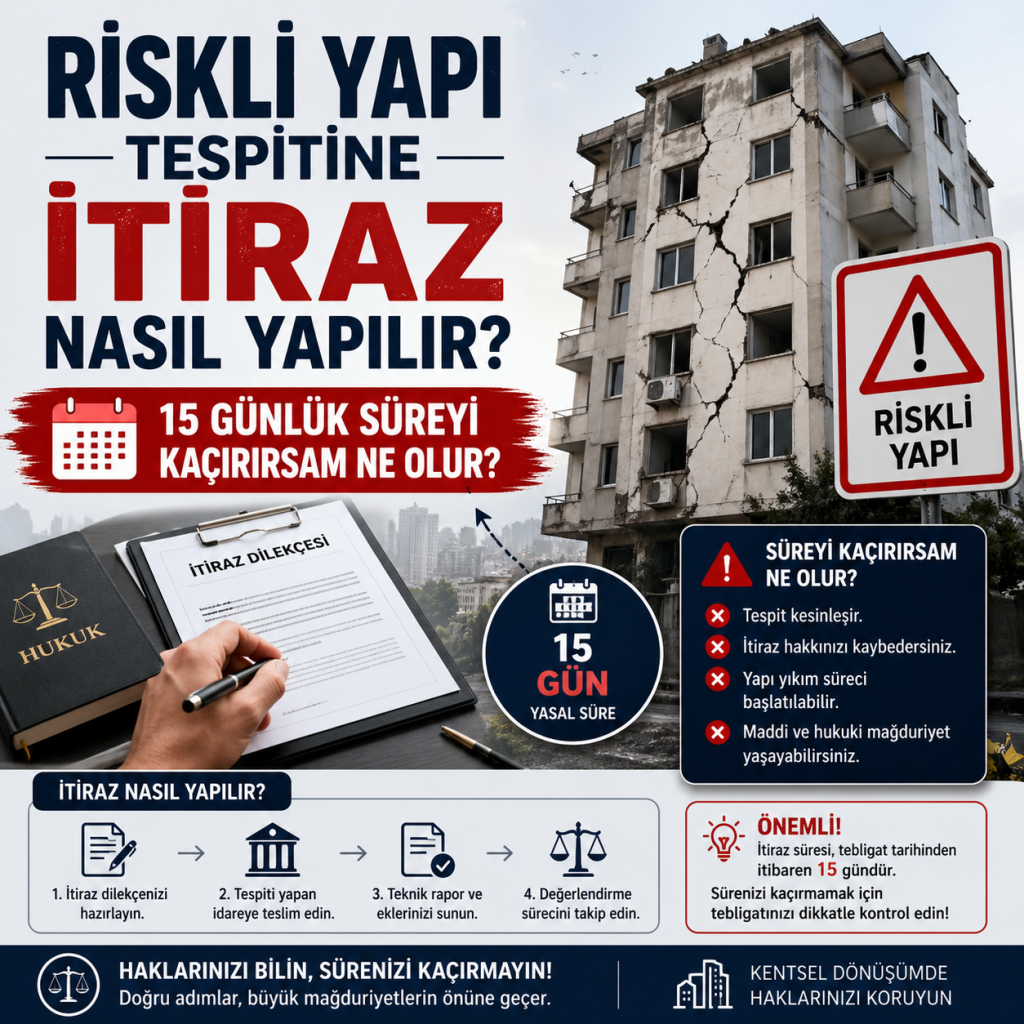
What Happens If I Miss the 15-Day Deadline?
The objection period for a risky building determination is 15 days from the date the report is notified to the owners, and this period is preclusive. The practical consequences of missing the deadline can be listed as follows:
1. The right to administrative objection is completely extinguished. The directorate or municipality will not process objections made after the deadline, nor will they conduct any examination. (Regulation Art. 7/5)
2. The determination becomes final and the demolition process begins. For structures not objected to or whose objections are rejected, the Administration grants a demolition period not exceeding 90 days. If not demolished within this period, the administration will carry out the demolition itself. (Law Art. 5/3 — Regulation Art. 8/3)
3. The land registry annotation becomes permanent. The risky building annotation does not prevent the sale of the immovable property but legally warns the buyer; the market value of the property significantly decreases.
4. Electricity, water, and natural gas may be cut off. If demolition is not carried out within the specified period, the Administration will request the discontinuation of these services. (Law Art. 4/3 — Reg. Art. 8/3c)
5. Demolition costs are collected from the owner. The costs of demolition carried out by the Administration are collected from the owners in proportion to their shares, in accordance with Law No. 6183. (Law Art. 5/4 — Reg. Art. 8/8)
What Can Still Be Done After the Deadline Is Missed
Even if the administrative objection period has passed, legal avenues are not entirely closed:
Direct action for annulment: An annulment lawsuit can be filed in the administrative court even without an administrative objection against the determination. The lawsuit period is 30 days from the notification of the report. If this period has also not been exceeded, a lawsuit can be filed. (Law Art. 6/9)
Claim of illegality: If there is a deficiency in the notification procedure, an objection to the deadline can be raised on the grounds that the notification was irregular.
Negotiation process: Even if the demolition has become final, a negotiation can be pursued for rental assistance and other supports under Article 5 of the Law before it is implemented. (Law Art. 5/1)
Impact of the Technical Committee’s Decision on the Land Registry
Regardless of the technical committee’s decision as a result of the objection, the outcome is immediately reported to the relevant land registry office: (Reg. Art. 7/7)
If the objection is accepted: The annotation of a risky building in the land registry is removed.
If the objection is rejected: The annotation remains, and the demolition process continues.
If the determination changed by court decision: The court decision is likewise notified to the land registry directorate and the annotation is updated.
Practical Warnings: Critical Mistakes Made During the Process
Do not object with an abstract petition. “My building is sound” is not enough. The technical committee rejects objections that lack concrete engineering grounds. If possible, have an independent technical opinion or counter-report prepared. (Y. Md. 10/7)
Follow the 15-day period day by day. The headman’s announcement lasts for 15 days; on the last day of the announcement, notification is deemed to have been made, and the objection period begins on that day. Calculate the start of the period correctly. (Y. Md. 7/4-5)
If you missed the objection, check the 30-day lawsuit period. After the administrative objection period has passed, the 30-day period for an annulment lawsuit might not have expired yet; seek legal assistance immediately. (K. Md. 6/9)
Do not forget the request for Stay of Execution (YD) in annulment lawsuits. Lawsuits filed without a request for Stay of Execution (YD) may become ineffective after the demolition has taken place. When filing a lawsuit, always request a stay of execution. (İYUK Md. 27)
Regularly follow notification channels. Keep e-Devlet notifications enabled, regularly check headman’s announcements. “I didn’t know” is not a valid excuse. (K. Md. 3/2 — Y. Md. 7/4)
Know that a single owner’s objection is sufficient. There is no need to convince other owners; you can make your objection alone within the period. (Y. Md. 7/5)
Conclusion
An objection to the identification of a risky structure, in accordance with Article 3 of Law No. 6306 and Article 7/5 of its Implementation Regulation, must be submitted with a petition containing concrete technical reasons to the Urban Transformation Directorate or the authorized municipality in the location of the structure, within a 15-day preclusive period. A 7-person technical committee evaluates the objection; if accepted, the annotation is lifted; if rejected, a 30-day cancellation lawsuit process begins. If the period is missed, the right to administrative objection is completely lost, while judicial remedies may partially remain open. (Law Art. 3/1 — Reg. Art. 7/5 — Law Art. 6/9)
Considering the complex nature of this process, which has both technical and legal dimensions, consulting an expert urban transformation lawyer without delay as soon as you receive the notification is the most sound way to protect your property rights.
Why is Expert Lawyer Support Essential?
Although the objection process to the identification of a risky structure may seem like merely a matter of a petition at first glance, it is actually a highly technical and legal process. The most common problem encountered by citizens in Istanbul, Tuzla, and its vicinity during this process is that objections are made with unsubstantiated petitions or that the 15-day period is unknowingly missed.
As 2M Hukuk Law Office, we observe the following during the consultancy process we provide in the field of urban transformation law throughout Istanbul, especially in Tuzla:
It is a process that requires both technical and legal knowledge. The objection petition to be submitted to the technical committee must combine engineering issues such as core sample collection procedure, structural system analysis, and compliance with regulations, with legal language. An urban transformation lawyer can build this technical-legal bridge by working in coordination with construction engineers. (Art. 10/7 of the Regulation)
Time management is critical. The 15-day administrative objection period and the subsequent 30-day cancellation lawsuit period are consecutive and extremely short tasks. An owner who receives a risky building notification in Tuzla or any district of Istanbul should contact an urban transformation lawyer without delay during this process.
Prompt action is essential for an injunction (stay of execution) decision. A request for a stay of execution (YD), which must be made concurrently with the cancellation lawsuit, may be rejected by the court if it is contrary to procedure or submitted late. This situation paves the way for the demolition of the building while the lawsuit is ongoing.
The settlement process also needs to be managed strategically. Even if the objection is unsuccessful, expert support from an Istanbul urban transformation lawyer makes a big difference in benefiting from rights such as rental assistance, temporary housing, and construction assistance under the best conditions before demolition. (Law Art. 5/1 — Regulation Art. 16/1)
2M Hukuk Avukatlık Ofisi, where we operate as a Tuzla lawyer, provides services concerning risky building objections, cancellation lawsuits, requests for stay of execution, and urban transformation consultancy under Law No. 6306. By receiving proper urban transformation consultancy from the very beginning of your process, you can prevent loss of rights in both technical and legal aspects.
This article has been prepared based on current open sources accessible as of April 2026, pursuant to Law No. 6306 (Art. 3/1) and the Implementing Regulation (Art. 7/5). Since each specific situation may vary, it is recommended to seek support from an expert urban transformation lawyer in legal processes.