1. Legal Nature of Gazebo Construction in the Site Garden: Distinction of Luxury, Useful, or Mandatory Expenditure
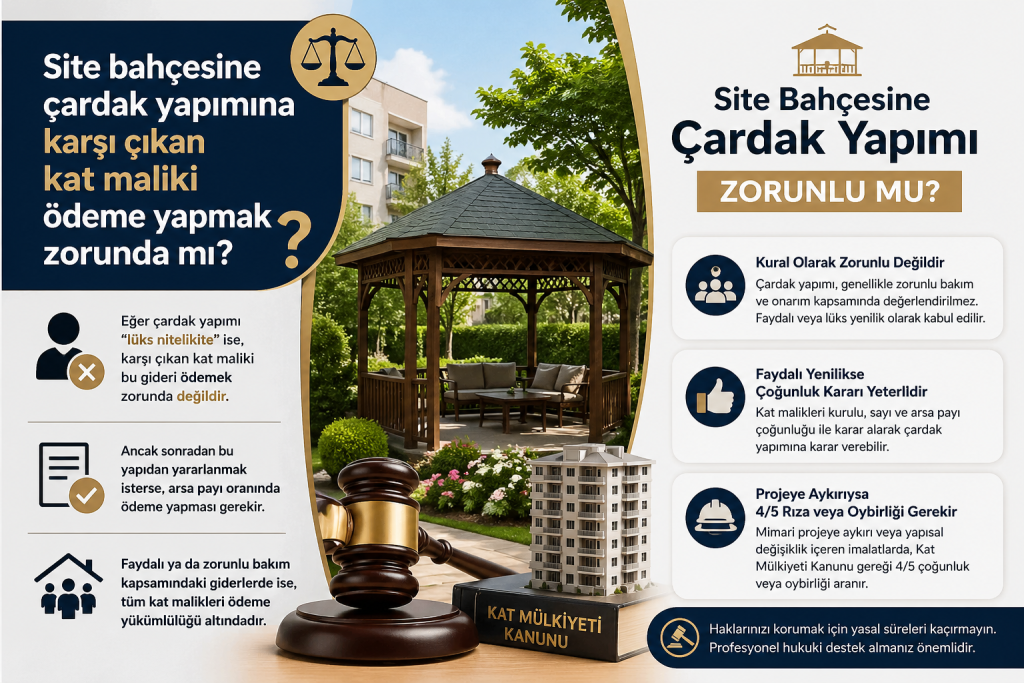
In light of judicial decisions, the construction of gazebos (pergolas) or similar structures in the site garden is considered as “innovation and addition” within the scope of the Condominium Law (KMK). The nature of these expenditures directly affects the obligation to contribute to expenses:
Useful Innovations and Additions (Condominium Law Art. 42): Innovations aimed at improving common areas, facilitating their use, or increasing their benefit are made upon a decision taken by the majority of co-owners in terms of number and land share. In its decision, the 20th Civil Chamber of the Supreme Court (2017/6353 E., 2019/771 K., 07.02.2019) qualified additions such as the installation of a vitamin bar and music system in the pool area as “useful expenditure” and stated that they could be made with a majority decision. Similarly, a gazebo to be built in the site garden can be evaluated within this scope if it increases the comfort of use.
Luxury Innovations and Additions (Condominium Law Article 43): If the desired innovation is very costly or if it qualifies as “luxury” according to the specific circumstances of the building, the condominium owner who does not wish to benefit from it is not obliged to contribute to the expense. As emphasized in the decisions of the Supreme Court 18th Civil Chamber (2016/4929 E., 2016/8102 K., 18.05.2016) and the Supreme Court 20th Civil Chamber (2017/2971 E., 2018/3385 K., 03.05.2018), an owner who initially does not consent to luxury additions is exempt from the cost; however, if they later wish to benefit from this addition, they must contribute to the construction costs in proportion to their land share.
Mandatory Repair and Maintenance (Condominium Law Articles 19 and 20): The construction of a gazebo is generally not considered within the scope of “mandatory repair” (e.g., roof repair, insulation, etc.). In the decision of the Supreme Court 20th Civil Chamber (2017/1984 E., 2017/5948 K., 29.06.2017), it was stated that mandatory constructions should be covered by all condominium owners, but luxury constructions are excluded from this obligation.
2. Construction in Common Areas and Violation of Architectural Project
Since the site garden is a common area, for any construction and installation to be made, in accordance with Article 19/2 of the Condominium Law, the written consent of four-fifths (4/5) of the condominium owners is required.
The 18th Civil Chamber of the Supreme Court (2014/14720 E., 2015/749 K., 20.01.2015) ruled that constructions such as gazebos, waterfalls, and storage units built in the garden can be made with 4/5 consent, but even with this consent, they must not violate zoning regulations and must not hinder the use by other owners.
The 5th Civil Chamber of the Supreme Court (2023/3152 E., 2023/8793 K., 11.10.2023) ruled that if structural changes not included in the architectural project (e.g., additional structures such as a connecting staircase or a gazebo) require a modification project, this situation must be decided by unanimous consent. Constructions that are contrary to the project and unlicensed cannot be considered “beneficial”.
3. What a Dissenting Co-owner Should Do and Ways to Seek Rights
A co-owner who objects to the construction of a gazebo can resort to the following legal remedies:
Entering a Dissenting Opinion in the Minutes: To be able to file a lawsuit against the decision, it is first necessary to attend the meeting of the board of co-owners, cast a negative vote, and have this recorded in the minutes as a “dissenting opinion”. The 20th Civil Chamber of the Supreme Court (2017/2242 E., 2018/5621 K., 17.09.2018) reminds that decisions for which no dissenting opinion is entered or against which no lawsuit is filed within the legal period will be considered valid.
Judicial Intervention and Annulment Lawsuit (CCP Art. 33): The unit owner may file a lawsuit in the Civil Court of Peace for the annulment of the board’s decision. The period for filing a lawsuit is 1 month from the date of the decision for those who attended the meeting, 1 month from the date of learning the decision for those who did not attend, and in any case, 6 months.
Lawsuit for Prevention of Intervention and Restoration to Former State: If the gazebo has been built without obtaining 4/5 consent or contrary to the architectural project, the unit owner may file a lawsuit for “prevention of intervention and restoration of the common area to its former state.” The decisions of the 5th Civil Chamber of the Supreme Court (2025/6028 P., 2025/11385 D., 15.09.2025) and the 18th Civil Chamber of the Supreme Court (2010/3217 P., 2010/6331 D., 27.04.2010) confirm that if constructions contrary to the project are determined by the court, a period can be given for restoration and a decision can be made for their demolition.
Refusal to Participate in Expenses (Claim of Luxury Expenditure): If the expenditure is claimed to be “luxury” within the scope of CCP Art. 43, the owner may object to the enforcement proceedings or file a negative declaratory action. In this case, the court will determine whether the construction is luxury by conducting an expert examination, based on the socio-economic status of the complex and the management plan (20th Civil Chamber of the Supreme Court, 2017/2971 P., 2018/3385 D.).
4. Secondary Source Assessment
According to sources providing secondary information;
Supreme Court 18th Civil Chamber (2016/4929-2016/8102): If additions like a gazebo are luxurious, the owner who does not wish to benefit is not obliged to contribute to the expense. However, the owner can later acquire the right to use by paying a share proportional to their land share.
Supreme Court 20th Civil Chamber (2017/4411-2018/7960 ): For elements such as elevators/gazebos not included in the architectural project, the consent of all flat owners may be required. An expert examination is essential for distinguishing between luxury and utility.
Constitutional Court (19/11/2020): To determine whether modifications in common areas fall under Article 19 (4/5 consent) or Article 42 (majority) of the Condominium Law (KMK), obtaining a technical expert report and serving this report to the parties to grant them the right to defense is a requirement of the right to a fair trial.
Conclusion: The construction of a gazebo in the site garden can, as a rule, be considered a “beneficial innovation” under Article 42 of the Condominium Law (KMK) and can be carried out with a majority of votes and land shares; however, if the structure is deemed “luxurious” due to its cost and nature, the objecting owner is exempt from the expense. If the gazebo constitutes a construction contrary to the architectural project, 4/5 consent or unanimity is required. The objecting owner has the right to file a lawsuit for annulment or restoration to the previous state in the Civil Court of Peace within the legal time limits.
Çardak yapımı zorunlu gider midir?

Hayır. Çardak yapımı genellikle zorunlu bakım ve onarım kapsamında değerlendirilmez. Daha çok faydalı veya lüks yenilik olarak kabul edilir
Çardak yapımına karşı çıkan kat maliki ödeme yapmak zorunda mı?
Eğer çardak lüks nitelikteyse, karşı çıkan kat maliki bu gideri ödemek zorunda değildir. Ancak sonradan kullanmak isterse payına düşen kısmı ödemesi gerekir.
Çardak yapılması için kaç kişinin onayı gerekir?
Ortak alanda yapılacak bu tür yapılar için genellikle:
Faydalı yeniliklerde çoğunluk kararı
Projeye aykırı veya yapısal değişikliklerde ise 4/5 çoğunluk veya oybirliği aranabilir.
Why is Expert Lawyer Support Necessary?
Although condominium disputes may appear simple on the surface, they are quite complex from a technical and legal perspective. Especially in interventions involving common areas like gazebos;
Whether the expenditure is luxury or beneficial requires an expert examination
Improperly filed lawsuits or missed deadlines can lead to loss of rights
In interventions in common areas, architectural projects, zoning regulations, and Supreme Court precedents are evaluated together
Processes such as enforcement proceedings, negative declaratory actions, or annulment lawsuits must be conducted with the right strategy
Therefore, working with an expert real estate and condominium law attorney from the beginning of the process provides significant advantages in terms of both time and cost. Especially to determine the right roadmap in practice and to avoid loss of rights, getting support from an experienced team in this field, such as 2M Law Office, ensures the healthy progress of the process.