Introduction: Legal Status and Principles of Liability of a Freight Forwarder
Within the framework of the Turkish Commercial Code (TCC) and international conventions (CMR, Montreal, Warsaw), the liability of a freight forwarder varies depending on the role undertaken and their possession of the goods. As a general rule, pursuant to Article 928 of the TCC, the commission agent is liable for loss and damage occurring while the goods are in their possession. However, in operational errors such as the mixing of cargo at transshipment ports or dispatch to the wrong port, the limit of liability is defined by the degree of fault, non-compliance with instructions, and the compensation limits set by the applicable legislation (maritime, road, or air).
1. Cargo Mixing and Wrong Shipment at Transshipment Ports: Analysis of Istanbul 17th Civil Court of Commerce (Secondary Source)
Secondary Source: Istanbul 17th Civil Court of Commerce, 10.09.2020, 2018/492 E. – 2020/159 K.
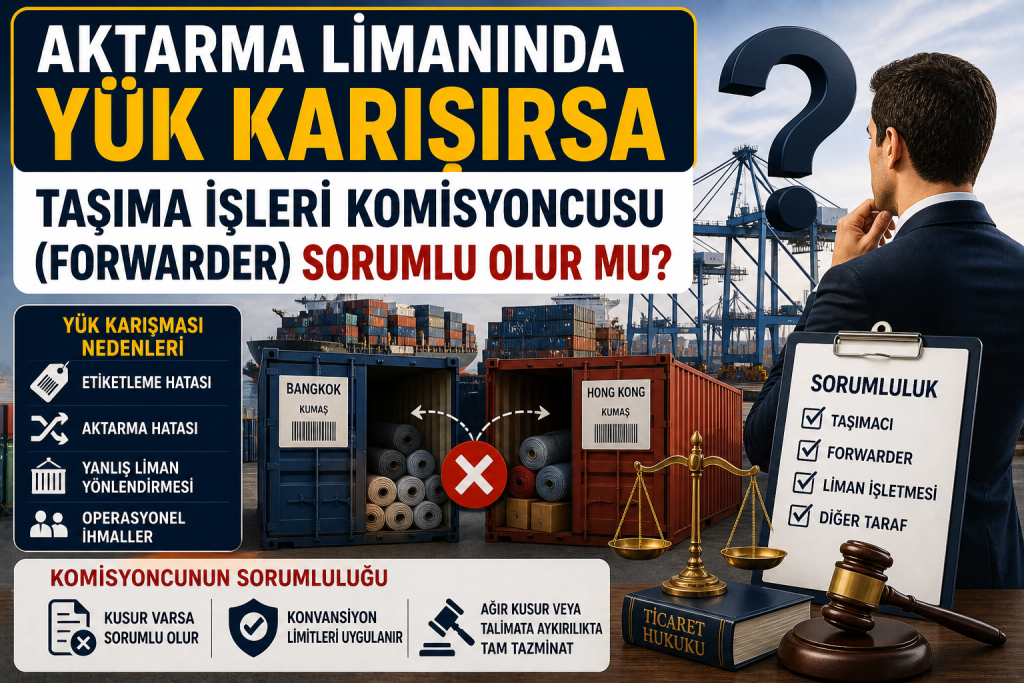
In the dispute subject to this decision, it was alleged that fabric rolls shipped from Ambarlı via Singapore to Bangkok and Hong Kong were mixed due to a labeling error (barcode mismatch) and were delivered with a delay of approximately 4 months.
Determination of Liability: The 13th Civil Chamber of the Istanbul Regional Court of Justice (22.12.2022, 2020/1730 E. – 2022/1930 K.), by overturning the local court’s decision of refusal, emphasized that it needs to be clarified whether the defendant is a “commission agent” or a “carrier”.
Limit of Liability: According to Article 928/2 of the Turkish Commercial Code (TCC), the commission agent is liable only if they fail to exercise “the care of a prudent merchant” for goods not in their possession. If the mixing of cargo results from a labeling error, the breach of marking and packaging obligations under Article 918 of the TCC is examined. In case of delay, the limit of liability may be limited to the freight charge according to Article 875/3 of the TCC. However, it is stated that limited liability cannot be invoked if there is a clear violation of instructions.
2. International Conventions and SDR-Based Liability Limits
When the mixing of cargo or its shipment to the wrong port is characterized as “loss” or “damage,” the liability of the commission agent (in their capacity as contractual carrier) is limited based on specific units:
Road (CMR) Limit: As emphasized in the decisions of the Bakırköy 4th Civil Court of Commerce (01.10.2020, 2018/1315 E. – 2020/506 K.) and the Istanbul Anatolian 1st Civil Court of Commerce (12.03.2020, 2015/735 E. – 2020/212 K.); pursuant to CMR Article 23/3, the upper limit for compensation is limited to 8.33 SDR (Special Drawing Rights) per kilogram of missing gross weight. In case of mix-ups at transshipment ports (including operations within the port area), this limit cannot be exceeded unless the carrier’s gross negligence is proven.
Air Transport (Montreal) Limit: Bakırköy 5th Civil Court of Commerce (18.12.2020, 2017/991 E. – 2020/689 K.) in its decision, it was stated that the liability of the commission agent in air transportations is limited to 17 SDR per kilogram (may have been updated to 22 SDR according to the current rule, but 17 SDR was taken as basis in the decision), in accordance with Article 22/3 of the Montreal Convention.
Sea Transport Limit: Istanbul 17th Civil Court of Commerce (15.10.2019, 2016/370 E. – 2019/422 K.) in its decision, it was stated that in cases of container unsuitability or transfer errors in maritime transport, liability limits per package or based on weight shall be applied in accordance with Article 1186 of the TCC (Turkish Commercial Code).
3. Cases Where the Right to Limited Liability is Lost
For the commission agent to benefit from the liability limit, it is contingent upon not exhibiting “intentional fault” or “reckless conduct”:
Breach of Instruction: Istanbul 13th Civil Court of Commerce (08.12.2022, 2014/881 E. – 2022/894 K.) in its decision, it was ruled that if the commission agent acts contrary to the bill of lading instructions and directs the cargo to the wrong consignee, they “cannot benefit from limited liability” and will be jointly and severally liable for the full damage incurred.
Gross Negligence: According to the Bakırköy 6th Commercial Court of First Instance (13.03.2019, 2017/83 E. – 2019/283 K.), unlimited liability arises pursuant to CMR Art. 29 for losses resulting from the reckless conduct of the driver or personnel (e.g., leaving unattended or obvious misdirection error).
4. Principle of “Dominion and Control” in the Transshipment Process
In case of mix-up of cargo at the transshipment port, responsibility is determined by whose “dominion and control” the goods were under.
In its decision, the 11th Civil Chamber of the Supreme Court (30.05.2014, 2013/4299 E. – 2014/10141 K.) emphasized that in damages occurring during the transfer of cargo from containers to trucks, the liability of the carrier (and consequently the commission agent) starts not with the actual loading of the goods onto the vehicle, but with taking control in the port area (discharge request form, invoice, etc.). Confusions at this stage give rise to the commission agent’s obligation for compensation in accordance with the principle of “liability for the fault of auxiliary persons” (CMR Art. 3).
Final Assessment and Summary Table
| Situation | Basis of Liability | Limit of Liability |
|---|---|---|
| General Misplacement/Loss | TTK m. 928 / CMR md. 23 | 8.33 SDR / kg (Road/Sea analogous) |
| Air Transport Transshipment Error | Montreal Convention | 17 SDR / kg |
| Wrong Port (Delay) | TTK m. 875/3 / CMR md. 23/5 | Limited to Freight Charges |
| Clear Violation of Instruction | TTK m. 886 / CMR md. 29 | Unlimited Liability (Full Damage) |
In conclusion; in cases where cargo is misplaced at transshipment ports or sent to the wrong port, the forwarder is generally held liable like a carrier and benefits from SDR limits per kilogram. However, if the misdirection is a clear violation of the sender’s instructions or constitutes a gross operational error (e.g., wrong labeling, barcode error), courts may reject the limited liability defense and award full compensation.
Frequently Asked Questions
Aktarma Limanında Yük Karışırsa Taşıma İşleri Komisyoncusu (Forwarder) Sorumlu Olur mu?
Evet. Eğer yük komisyoncunun fiili hâkimiyetinde, zilyetliğinde veya kontrol alanında karışmış ya da yanlış sevk edilmişse, Türk Ticaret Kanunu kapsamında forwarder doğrudan sorumlu tutulabilir. Özellikle etiketleme, barkodlama veya aktarma organizasyonundaki operasyonel hatalar tazminat sorumluluğu doğurabilir.
Forwarder Yanlış Limana Gönderilen Yük İçin Sorumluluk Limitinden Yararlanabilir mi?
Kural olarak evet. CMR, Montreal veya TTK hükümleri kapsamında kilogram başına SDR limitleri uygulanabilir. Ancak açık talimata aykırılık, ağır kusur veya pervasız davranış ispatlanırsa forwarder bu sınırlı sorumluluk hakkını kaybedebilir ve zararın tamamından sorumlu olabilir.
Yük Yanlış Alıcıya Teslim Edildiyse Tam Tazminat Talep Edilebilir mi?
Evet. Özellikle konşimento talimatlarına aykırı teslim, yanlış barkodlama, yanlış liman yönlendirmesi veya açık organizasyon hatası varsa mahkemeler sınırsız sorumluluk uygulayabilmekte ve forwarder’ın zararın tamamını ödemesine karar verebilmektedir
Why is Expert Legal Support Necessary?
Disputes regarding freight forwarding brokerage; involving the joint consideration of the Turkish Commercial Code, CMR Convention, Montreal and Warsaw Conventions, Hague-Visby Rules, and international commercial practices; constitute a highly technical branch of law that demands specialized support. The determination of fault as to whether the forwarder acted as a “carrier” or an “intermediary”, accurate information regarding SDR-based liability limits, proof of claims of non-compliance with instructions, and the assessment of cases involving unlimited liability; are critical elements that directly determine the outcome of a case. An incorrectly structured lawsuit or insufficient evidence submission; can lead to the inability to recover damages or to being condemned to unnecessarily high compensation.
In cases of cargo mix-ups at transshipment ports, incorrect dispatch, delays, labeling errors, and packaging damage; the legal classification of bills of lading, consignment notes, invoices, and correspondence is of great importance. Especially for matters such as proving gross negligence under CMR Article 29, defense against claims exceeding liability limits under Turkish Commercial Code Articles 886 and 875/3, and liability for the fault of auxiliary persons, it is indispensable to work with a lawyer experienced in the sector. Furthermore, in recourse actions filed under the subrogation right of an insurance contract, it also involves correctly structuring defense strategies for the carrier and the forwarder.
2M Law Office offers detailed legal support to shipping services, freight forwarders, insurance providers, and cargo owners, with many years of experience in transportation law, logistics disputes, and international trade law. Our team of Istanbul transportation law lawyers and logistics lawyers provides services across a wide range, from CMR cases to container damages, from demurrage and detention compensations to bill of lading cases, and from liability policy claims to international arbitration.
As Tuzla lawyers, Pendik lawyers, Kurtköy lawyers, and Kartal lawyers, our close proximity to Istanbul’s critical port and airport regions such as Ambarlı, Tuzla, Yeşilköy, and Sabiha Gökçen provides on-site support opportunities for firms operating in this hub where the logistics sector is concentrated. For logistics firms, we offer professional support for: drafting and revising transportation contracts, evaluating liability insurance policies, structuring the legal compliance of bills of lading and transportation documents, and for case follow-up and resolution.
If your cargo has been mixed up at a transshipment point, shipped to the wrong address, or if you have suffered damages due to delayed delivery, or if, as a freight forwarder, you are faced with an unfair compensation claim; you can work with 2M Law Office to create legal strategies specific to your concrete cases, to effectively protect your rights and correctly obtain compensation within the liability limits guaranteed by international conventions.