Legal Basis: Law No. 6306 Article 6/1 | Implementation Regulation Article 15/3
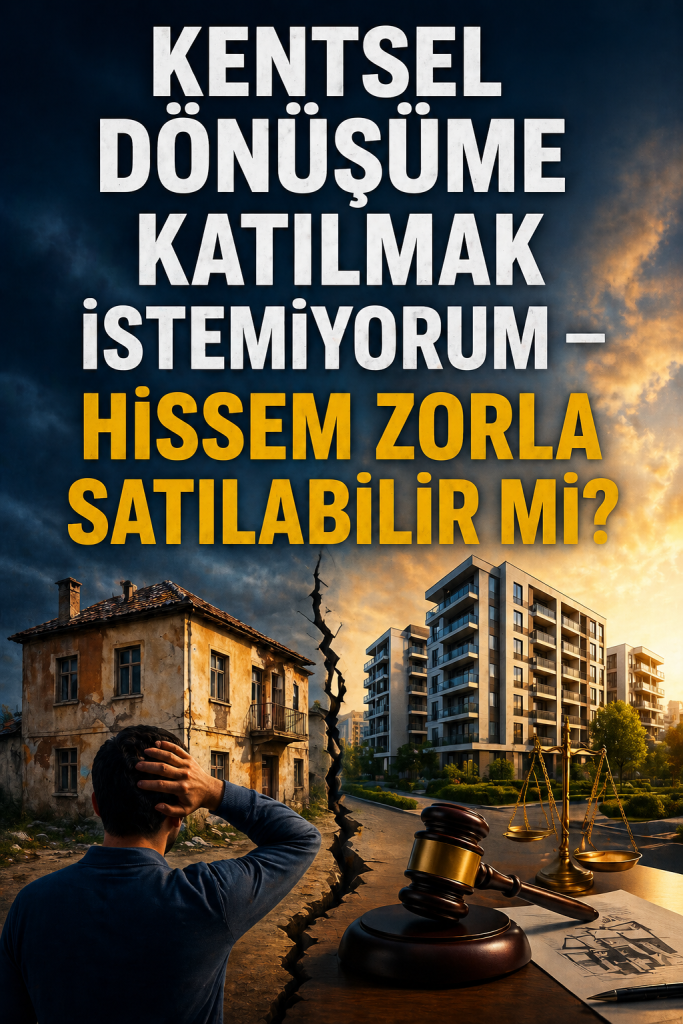
In urban transformation, most of your neighbors have decided on transformation, but you do not want to participate in this decision. So, in such a case, can your land share truly be forcibly sold, how legally secure is this sale, how is the price to be paid to you determined, and how can you object to this process? Article 6/1 of Law No. 6306 and Article 15/3 of the Implementation Regulation answer all these questions. The regulation amendment dated February 4, 2026, has radically re-regulated the functioning of this process. (Art. 6/1 of Law — Art. 15/3 of Reg.)
Legal Basis for Forced Sale of Land Share
Article 6/1 of Law No. 6306 explicitly regulates this authority: The land shares of owners who do not participate in the decision taken by a simple majority of shareholders in proportion to their shares shall be sold through an open auction procedure to other shareholders who have reached an agreement, provided that their fair market value is determined by the Presidency and the sale price is not less than this value. (Art. 6/1 of Law)
This regulation constitutes a direct interference with the right to property under Article 35 of the Constitution. The Constitutional Court has accepted in individual applications that this mechanism remains within constitutional limits; however, it has emphasized that minority owners receiving the actual fair market value and the full functioning of procedural safeguards are essential conditions for the legal legitimacy of this provision.
Under What Conditions Can a Sale Not Be Made?
First, the determination of the risky structure must have become final. If the determination is under objection or its execution has been suspended by a court decision, the sales process cannot proceed. (Law Art. 3/1 — Reg. Art. 7/5)
Subsequently, a urban transformation decision must have been made with a majority of more than fifty percent on a land share basis, by making a call with EK-12 form and documenting it with a record. (Reg. Art. 15/2)
It is mandatory that the decision and the offer containing the terms of the agreement have been notified to the non-participating owners via the EK-13 form, announcement board, and e-Government Gateway, and that the fifteen-day acceptance period has expired. (Reg. Art. 15/A)
It is also mandatory that the fair market value of the land share has been determined by an CMB-licensed valuation institution and that the Value Determination Commission has approved this value. The sales price cannot be below the determined fair market value. (Law Art. 6/1 — Reg. Art. 15/A)
How Is the Value of the Land Share Determined?
In the first stage, a CMB-registered licensed valuation institution determines the fair market value by taking into account the location, comparable sales, zoning status, and structural characteristics. In the second stage, the Value Determination Commission sets the base price based on this value; no bids below this price can be made in the open auction. (Law Art. 6/1 — Reg. Art. 15/A)
If the commission’s valuation falls below market reality, an independent CMB licensed valuation report serves as decisive evidence in both administrative appeals and judicial proceedings. (Reg. Art. 12)
How Does the Auction Work?
After the fair value is determined, the Directorate notifies all owners of the auction place and time via registered mail; the notification is deemed to have been made at the end of the tenth day following the date the notification document was posted. The auction date is set to be at least seven days after the notification. (Reg. Art. 15/A)
Rights such as mortgages, provisional attachments, seizures, and usufruct rights on the share subject to sale do not prevent the sale; these rights continue on the sale price, and the price is blocked, with creditors being notified. In the auction, sales are first made to shareholders who reach an agreement; if the sale does not occur, the process is repeated by seeking a simple majority request again. (Reg. Art. 15/A)
What Happens if It Cannot Be Sold to Other Shareholders?
In risky structures, the process is repeated until a sale is made to third parties. For third parties to participate in the sale, it is mandatory that they declare in writing their acceptance of the simple majority decision and provide a cash guarantee equal to ten percent of the fair value. In risky areas, it can be registered ex officio in the name of the Treasury by the Presidency, Administration, or TOKİ by paying the fair value. (Law Art. 6/1 — Reg. Art. 15/A)
How to Object to the Sale Process?
Objection to hazardous building determination, objection to meeting procedure (if EK-12 form has not been used or the fifteen-day announcement period has not been processed), objection to valuation (with an independent CMB report), and an annulment lawsuit with a request for stay of execution within 30 days from notification are the main legal remedies. (Law Art. 6/9 — Administrative Procedure Law Art. 7, 27)
Reversing the sale of the land share is an extremely difficult process. Even if a lawsuit is won after the sale to a third party, the cancellation of the land registry requires a separate process. Therefore, the lawsuit must absolutely be filed with a request for stay of execution.
Constitutional Right to Property Dimension
The Constitutional Court and the Council of State condition the constitutionality of this mechanism on the following: payment of the real market value, full operation of procedural guarantees, prior informing of owners about decision and sale processes, and keeping objection channels open. If there is a serious violation of any of these conditions, more comprehensive legal mechanisms, including individual application, can be activated.
Practical Warnings
Do not waste the fifteen-day acceptance period; immediately after receiving the notification, consult an urban transformation lawyer to identify procedural errors. Do not accept the commission value without obtaining an independent valuation report. Do not overlook errors in the meeting procedure —EK-12 form, fifteen-day announcement period, minutes—; these errors may constitute sufficient grounds for the annulment of the decision. If you have mortgages or foreclosures, contact your creditors in advance.
Why is Expert Lawyer Support Essential?
The land share sale process is an extremely difficult process to reverse. As 2M Hukuk Law Office, the most common scenario we encounter during the urban transformation consultancy process we provide throughout Istanbul, especially in Tuzla, is this: Owners who do not agree with the decision unknowingly let the fifteen-day period pass, and subsequently learn that their land shares have been put up for open auction.
Detecting procedural errors, annulment lawsuits with an injunction request, and valuation objections are the most critical legal steps in this process. 2M Hukuk Law Office, providing urban transformation consultancy in Tuzla and all districts of Istanbul, is by your side at every stage as an Istanbul urban transformation lawyer and Tuzla lawyerir.
Conclusion
The land shares of owners who do not participate in the urban transformation decision, taken by a simple majority, within the fifteen-day period, can be sold by open auction at fair market value, first to other shareholders, and if the sale is not realized, then to third parties. The realistic determination of fair market value, the full implementation of procedural safeguards, and the timely exercise of the 30-day right to file a lawsuit are fundamental safeguards. (Law Art. 6/1 — Reg. Art. 15/3 — Reg. Art. 15/A)