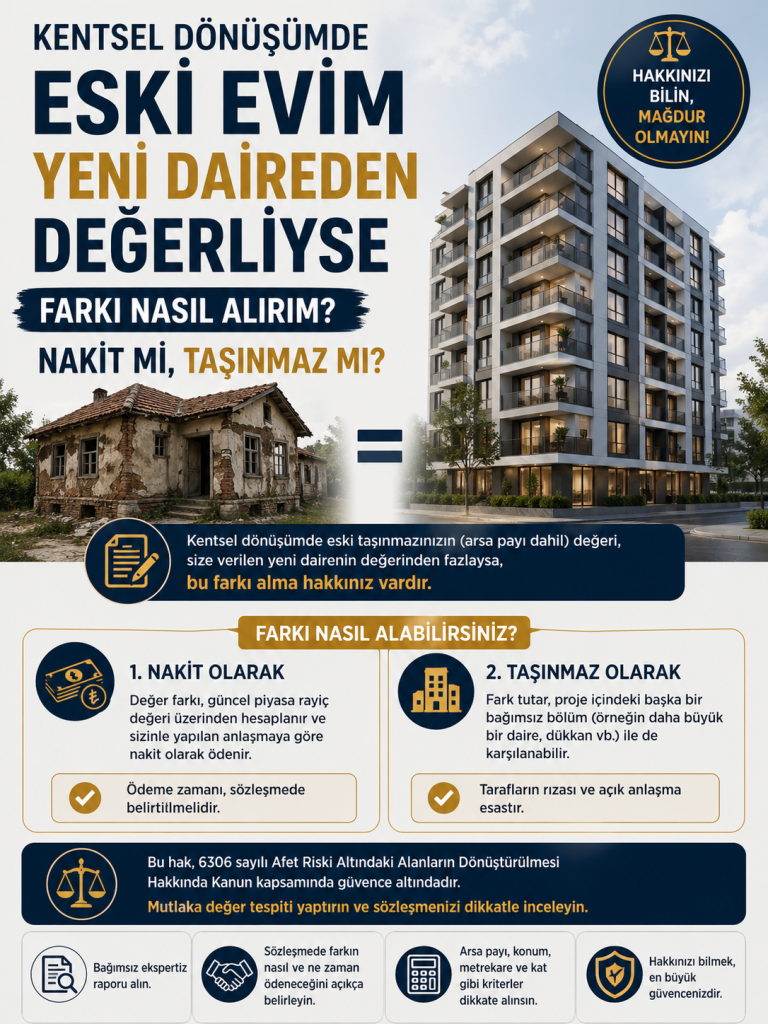
Legal Basis: Law No. 6306 Article 6/3 | Implementing Regulation Article 13/2a
One of the most frequently asked questions in the urban transformation process is: “I am demolishing my old house; if the new apartment I am to receive is cheaper than the value of my old house, how will I get the difference?” This question is critical both for the actual exercise of the right and for establishing a solid foundation in negotiations throughout the process. Article 6/3 of Law No. 6306 and Article 13/2a of the Implementing Regulation explicitly regulate this situation: the amount in question can be paid in cash, by providing real estate from the relevant institution, or by transferring the zoning right to another area. This article addresses in detail how the value difference right is calculated, the ways it can be obtained, what needs to be considered to protect these rights, and the legal framework of the process. (Law Art. 6/3 — Reg. Art. 13/2a)
Core Mechanism: Valuation and Set-off
Article 13 of the Regulation is titled “entitlement in the implementation area”. Paragraph 2 of this article outlines the legal framework for the value difference issue. The regulation is as follows: The value of the immovable property in the implementation area, determined according to Article 12, shall be deducted from the construction cost/current market value of the residence or workplace to be given to the owner. As a result of this deduction process, two different situations may arise. (Reg. Art. 13/2)
First situation: If the value of the old immovable property is higher than the value of the new residence or workplace to be given—i.e., if the owner is in a creditor position against the relevant institution—the amount subject to this claim may be paid in one of three ways, based on an agreement to be made between the parties: in cash, by giving immovable properties of the relevant institution that are not allocated for public service, or by transferring the development right to another area. (Reg. Art. 13/2a)
Second situation: If the value of the old immovable property is lower than the value of the new residence or workplace to be given—i.e., if the owner is indebted to the relevant institution—the amount subject to this debt may be paid by the property owner in installments. The principles of installment payment are determined by the relevant institution on a project-by-project basis. (Reg. Art. 13/2b)
These two situations are exactly opposite to each other, and which one will be encountered in practice depends entirely on the comparison of the value of the old immovable property with the value of the new residence.
How is the Value of the Old Immovable Property Determined?
The most critical pillar of the value difference calculation is the accurate and equitable determination of the value of the old immovable property. Article 12 of the Regulation governs this process. (Reg. Art. 12)
The value of the immovable property is determined in one of two ways: either by appraisal commissions consisting of at least three people from within the relevant institution or by procuring services. In both methods, the valuation is carried out considering the following factors: the location, size, nature, and structural characteristics of the immovable property; information obtained from individuals, institutions, or organizations specialized in property valuation; data compiled from local real estate agencies; and the valuation principles outlined in Article 11 of Expropriation Law No. 2942. (Reg. Art. 12)
If a unanimous agreement cannot be reached, the value of the risky structure is additionally determined by licensed valuation institutions operating under registration with the Capital Markets Board, and considering this value, the fair market value is determined by the Price Determination Commission. (Law Art. 6/1 — Reg. Art. 15/1)
The most critical point to consider during the valuation process is as follows: The valuations determined by the appraisal commissions within the relevant institution can, at times, be significantly below the market value in practice. There is a right to object to this value; having an independent Capital Markets Board (CMB) licensed valuation report prepared for an objection provides a strong basis in both administrative and potential judicial processes. (Reg. Art. 12)
What Does the Value of the New Residence Represent?
According to Article 13/2 of the Regulation, the figure to be used in offsetting for the housing to be given to the owner is the “construction cost/fair value.” In the current text, these two concepts are used together (“from the construction cost/from the fair value”); meaning that with the regulation amendment dated February 4, 2026, it has been expanded to also take fair value into account. This way, when the fair value is much lower than the theoretical construction cost, an unfavorable offsetting for the owner is attempted to be prevented. (Reg. Art. 13/2)
In practice, this figure is usually determined by the contractor or the relevant institution; offsetting is done based on this figure. Therefore, it is of great importance to clarify questions such as how the value of the new housing is calculated, which items are included, and whether it can be objected to, before signing the contract.
Methods of Receiving the Value Difference
Article 13/2a of the Regulation foresees three different payment methods. The choice among these methods is determined based on an agreement to be made between the parties; meaning the owner can negotiate with the relevant institution which method to use. (Reg. Art. 13/2a)
First method: Cash payment. This is the most common and clearest method. If the value of the old property is higher than the value of the new housing, the difference is paid in cash. A special schedule must be determined for this payment; as a general rule, the time and method of payment should be clearly stipulated within the contract. It should be noted that in practice, a large portion of cash payments are made after the housing is delivered or dependent on the construction phases.
Second method: Payment from the relevant institution’s real estate. The real estate not allocated for public service belonging to the relevant institution —i.e., the Urban Transformation Presidency, TOKİ, or the Administration— can be used for value difference payments. Real estate allocated for public service is excluded from this scope. This method may come into play especially when it becomes difficult for the institution to make cash payments; however, it is recommended that the owner obtain an independent valuation regarding the value and location of the acquired real estate. (Reg. Art. 13/2a)
Third method: Transfer of development rights to another area. The development potential of the real estate can be transferred to another parcel or area; this method is one of the mechanisms that can be used for value compensation, especially in cases where the existing parcel has development restrictions or an increase in floor area ratio cannot be achieved. This method is more complex from a technical and legal perspective; it is essential that the value of the development right to be transferred is independently determined and explicitly stipulated in the contract. (Reg. Art. 13/2a)
Right to Acquire More Than One Residence
Article 13/2c of the Regulation stipulates that a value imbalance does not always have to be remedied by a difference payment. In cases where the right to acquire more than one residence or workplace arises, a contract can be established for the provision of multiple smaller residences or a combination of residences and workplaces instead of a single large residence. (Reg. Art. 13/2c)
In this case, if the property owner needs to incur debt to the relevant institution, payments are made in installments according to a schedule determined by the institution after a notary draw conducted to determine the housing or workplace to be provided. The value difference that creates the right to acquire more than one residence may arise especially in old properties with a high land share, large area, or valuable location.
The Real Picture in Practice: Flat-for-Land Model with a Contractor
The vast majority of transformations under Law No. 6306 are not carried out directly by TOKİ or the Presidency, but by property owners agreeing among themselves to have a contractor firm undertake the work. In this “flat-for-land construction contract” model, the mechanism works differently: the owner transfers a certain share of the land to the contractor; the contractor builds on this share and delivers the remaining shares to the owners as new apartments.
To understand how the value difference arises in this model, the following question must be answered: Is the new apartment to be given to you in exchange for your old apartment more valuable or less valuable than your old apartment? If the value of the owners’ land share is higher than the value of the apartment they receive in the new construction—for example, if they are receiving a small new apartment or if the building ratio (emsal) is limited—this difference can be compensated by agreement either in cash or as an additional independent section. If the new apartment is much more valuable—if an increase in building ratio (emsal artışı) was provided, or if the number of floors increased—the owner may have to incur debt and pay this debt in installments. (Art. 13/2b)
As of 2026, construction costs per square meter in urban transformation projects range between 19,000 TL and 28,000 TL. Valuation differences vary significantly per building depending on zoning status, location, and project size.
Special Regulations in Public Institution Practices
In applications carried out by the Presidency, for rights holders deemed poor or low-income under the Squatter Housing Law, a special mechanism applies if they declare that they cannot afford the debt: registration is made in the land registry based on shared ownership principles, both in the name of the rights holder and the Presidency, taking into account the value determined by an SPK-licensed valuation institution for the new independent section, and the rights holder is granted the right of occupancy. (Reg. Art. 13/13)
This regulation serves as a social safeguard for low-income owners, preventing them from completely losing their building due to the burden of debt.
What Happens If Rights Holders Do Not Take Delivery?
If the independent section allocated to the rights holder is not taken delivery of within the periods specified by the Presidency, the right over that independent section terminates. In this case, the value of their property before the transformation is updated and deposited into a fixed-term account opened in the name of the rights holder. Annotations in the land registry, such as mortgages, precautionary attachments, attachments, and usufruct rights, continue over this deposited amount. The independent section(s) registered in the name of the Treasury are transferred to the Presidency. (Law Art. 6/3 last paragraph)
This regulation includes an extremely severe sanction against the owner who does not take delivery. Therefore, closely following the delivery schedule specified in the contract and seeking legal support in case of possible delays is of vital importance.
Right to Object to Valuation
The owner can object to the value of the old real estate determined by the appraisal commission. This objection can be made in two ways: a written objection to the Commission through administrative channels; or through judicial channels, a full remedy lawsuit filed to request the re-determination of the real estate value with the help of an expert witness. (K. Md. 6/9 — İYUK Md. 7)
At this point, an independent SPK-licensed valuation report serves as critical evidence. If the Commission’s valuation deviates excessively from market realities, the independent report provides strong support in both administrative objections and potential court proceedings. (Y. Md. 12 — K. Md. 6/7)
Elements That Must Be Included in the Contract
The greatest losses of rights regarding how the value difference will be paid stem from this issue being uncertain, vague, or not regulated at all in the signed contracts. It is essential that the following elements are explicitly included in the contract:
How and when the old real estate will be valued; on what value the new residence’s value will be calculated during offsetting; by what means the difference receivable will be paid — cash, real estate, or transfer of development rights —; if cash payment is foreseen, the payment schedule and interest or penalty provisions to be applied in case of delay; if more than one housing right arises, the selection procedure and the timing of the notary lottery. The absence of these elements in the contract or leaving them vague paves the way for serious disputes and loss of rights in the future.
Practical Warnings
Never obtain the appraisal report from a single source. In addition to the appraisal conducted by the commission of the relevant institution, obtaining an independent CMB-licensed appraisal report before the process begins both increases your negotiation power and keeps the path open for objection. (Art. 12)
Before signing the contract, clarify the difference amount and the payment method. After the contract is signed, negotiating these matters becomes extremely difficult; the contractor or the relevant institution will often base their actions on the signed contract text.
Pay attention to the timing of cash payments. In practice, there are different applications such as part of the cash value differences being paid before the housing delivery, part upon delivery, or all of it after construction is completed. Clearly regulating this matter in the contract is essential for securing your receivable.
Fulfill your obligation to take delivery. Failure to take delivery of the independent section within the period determined by the Presidency results in the forfeiture of the right and the transfer of the property’s value to a term account. Closely follow the delivery schedule and seek legal support in case of delay. (Art. 6/3)
Why is Expert Legal Support Necessary?
Although the rights regarding the value difference may appear clear on paper, in practice, as 2M Hukuk Law Office, we observe that this issue is one of the stages that most frequently lead to loss of rights during the urban transformation consultancy process we provide throughout Istanbul, particularly in Tuzla.
During the appraisal stage, the difference between an independent report and the commission’s determination can sometimes reach millions of liras. A urban transformation lawyer helps you pre-plan how to interpret the independent appraisal report and how to object to it based on this report. (Y. Art. 12)
In contract negotiations, the payment method and schedule for the value difference are the most critical items for the rights holder. As an Istanbul urban transformation lawyer, we examine contracts; we strengthen the contract text against potential loss of rights regarding cash payment timing, appraisal assurance in case of property transfer, and the legal validity of zoning right transfers.
The offsetting method and borrowing conditions also require a delicate balance. In cases where one has to incur debt for a new dwelling, the more clearly issues such as installment principles, interest or update clauses, and lottery procedures are regulated in the contract, the more protected the owner will be. Within the scope of urban transformation consultancy, these issues are evaluated before the contract to ensure clients complete the process without suffering any loss of rights.
2M Hukuk Law Office, operating as a Tuzla lawyer, provides services throughout Istanbul at every stage of urban transformation, from objecting to value determination and contract negotiations, to pursuing value difference receivables and full jurisdiction lawsuits.
Conclusion
Article 6/3 of Law No. 6306 and Article 13/2a of the Implementing Regulation explicitly stipulate that in cases where the value of the old property exceeds the value of the new residence, the resulting difference amount receivable shall be paid in one of three ways —cash, property of the relevant institution, or transfer of development rights—. The effective exercise of this right depends on the independent and accurate conduct of the valuation stage, the meticulous negotiation of the contract, and the securing of the payment schedule. The right to object to the price determined by the valuation commission is always available; an independent CMB-licensed appraisal report serves as fundamental evidence in both the administrative and judicial aspects of this objection. (Law Art. 6/3 — Reg. Art. 13/2a — Reg. Art. 12)
This article has been prepared based on Law No. 6306 (Art. 6/3) and the Implementing Regulation (Art. 13/2a), current legal resources available as of April 2026, the Regulation amendment dated February 4, 2026, and publicly available data. Since each specific situation may vary, it is recommended to seek support from a specialist urban transformation lawyer for legal processes.