One of the most important international mechanisms protecting seafarers’ rights in the maritime sector is the ITF (International Transport Workers’ Federation) inspectors. However, in practice, many seafarers do not fully know what ITF inspectors can and cannot do. This situation can lead to serious errors in the process of seeking rights. So, what does an ITF inspector actually do? How far does their authority extend? Can they ensure a seafarer receives their wages? In this article, we examine the true role, powers, and limitations of ITF inspectors in detail.
How Was the ITF Inspector System Established and How Widespread Is It Today?
The ITF inspectorate system was first established in 1971 and has since evolved into a global monitoring network. Today, the ITF has more than 140 inspectors and contact persons operating in over 120 ports across 57 countries. This structure is a strong inspection and intervention network, rarely seen on an international scale in the maritime sector.
ITF inspectors operate particularly within the scope of the ITF’s Flag of Convenience (FOC) campaign. This campaign aims to prevent seafarers from facing issues such as low wages, poor working conditions, and precarious employment.
The vast majority of inspectors are former seafarers or port workers. This ensures that they are individuals who know the problems in the field not theoretically, but practically. Furthermore, inspectors can speak not only English but also their native languages and, often, more than one language. This enables effective communication with crew members of different nationalities.
What Do ITF Inspectors Do?
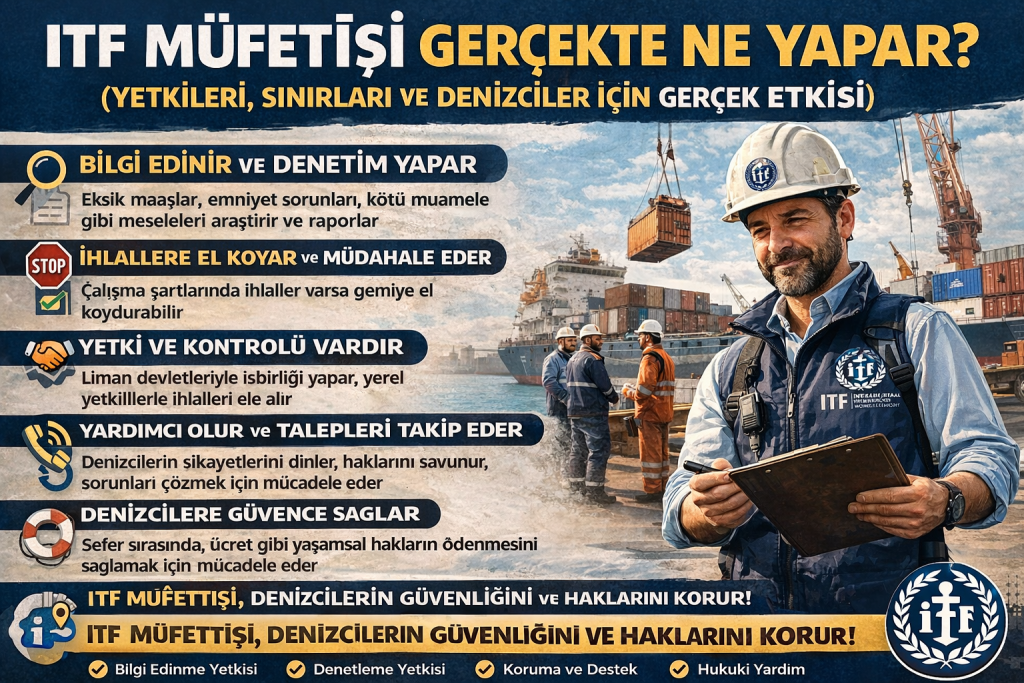
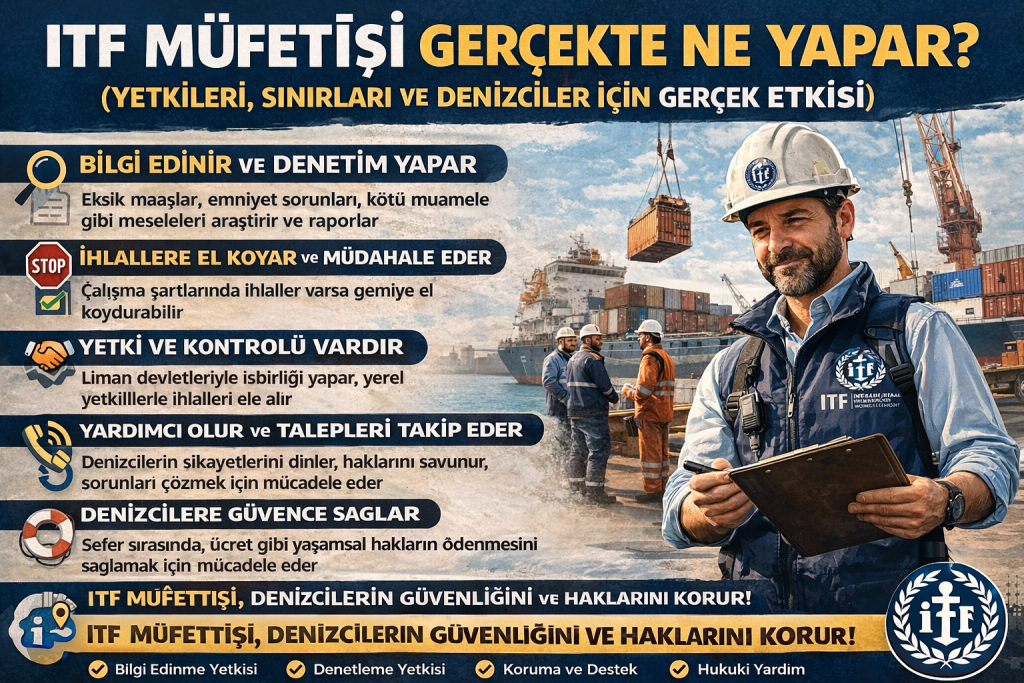
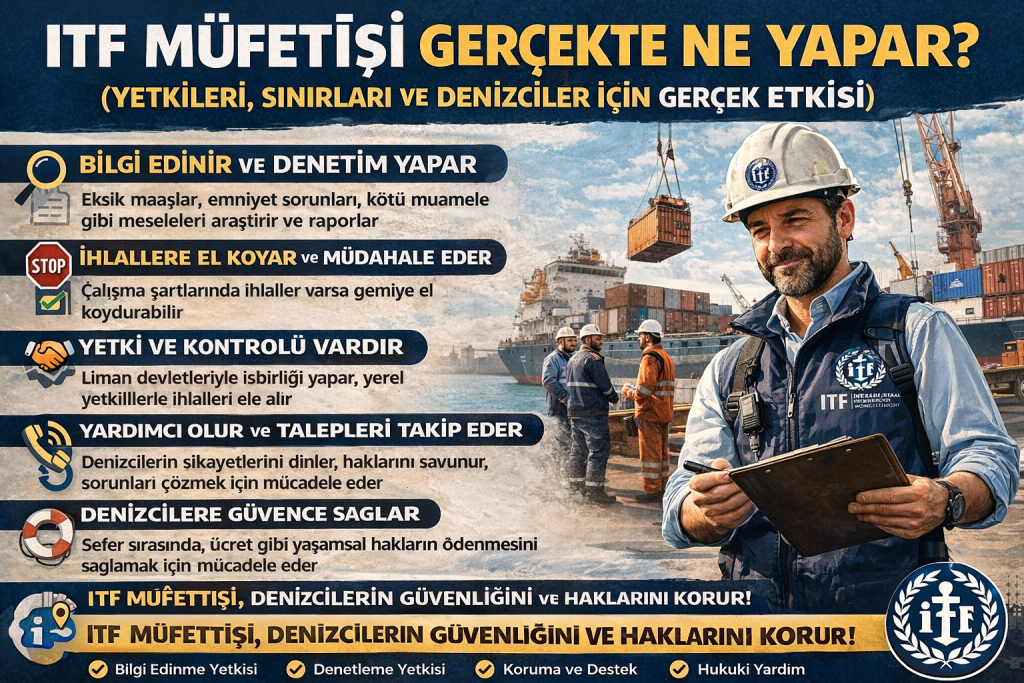
The primary duty of ITF inspectors is to inspect ships arriving at their ports and to verify that seafarers have decent wages, working conditions, and living conditions. In this context, inspectors conduct more than 10,000 inspections annually. These inspections can be carried out routinely or upon the request of the crew.
An ITF inspector boards the ship to examine working conditions, conducts one-on-one interviews with the crew, and evaluates any complaints. Additionally, if an ITF collective bargaining agreement is in place on the ship, compliance with this agreement is checked. It is verified whether wages have been paid, overtime records are kept, and living conditions meet the required standards.
What Can an ITF Inspector Do?
The powers of an ITF inspector are quite extensive, and they possess significant influence in the field. Inspectors can examine working and living conditions on board, interview the crew, and provide direct advice and support to seafarers. Especially concerning wage claims, inspectors can calculate unpaid wages and process retroactive claims.
Furthermore, inspectors can put pressure on shipowners by communicating directly with them to resolve issues. If necessary, they can contact Port State Control (PSC) to report violations related to safety or working conditions. If the crew wishes to initiate legal proceedings, inspectors provide guidance and inform them about legal avenues available in the relevant country.
ITF inspectors can also provide support to seafarers in strike situations, act as representatives on behalf of the crew, and facilitate contact with unions affiliated with the ITF. Thanks to the international network, they can communicate with ITF inspectors in other countries, ensuring the process is monitored at a global level.
In addition, inspectors can facilitate the signing of ITF-approved collective bargaining agreements on board and accelerate the resolution process by sharing issues experienced on board with third parties (such as flag states, embassies, and social welfare organizations). They also have humanitarian duties, such as providing support to hospitalized seafarers.
What Can’t an ITF Inspector Do?
Although ITF inspectors have a strong influence, their authority is not limitless. Primarily, inspectors cannot go beyond the limits permitted by the national legislation of the country they are in. For this reason, access to the vessel may not be possible in some situations.
Furthermore, inspectors cannot resolve issues without the cooperation of the crew. If a seafarer does not file a complaint, many violations may not be detected. In addition, inspectors cannot guarantee any seafarer that they will not lose their job or be blacklisted.
ITF inspectors are not a recruitment agency on board and have no obligation to provide employment to seafarers. Furthermore, they do not have the authority to change ITF policies and cannot act contrary to the policies of the union they are affiliated with. Most importantly, they cannot engage in any illegal activities whatsoever.
How to Contact an ITF Inspector?
Contacting ITF inspectors is quite easy. For this, the official ITF systems can be used. To find the nearest inspector, the following address should be used:
👉 https://www.itfseafarers.org/en/look-up
Additionally, the ITF Seafarers mobile application can be downloaded for free from Google Play Store and Apple App Store. Inspectors can be contacted directly via email, phone, WhatsApp, or other messaging applications.
What is the Real Impact of ITF Inspectors?
The power of ITF inspectors relies more on practical pressure than legal enforcement. When an issue is identified on a ship, significant international pressure is exerted on the shipowner. This pressure can result in difficulties for the ship to leave port, disruptions to operations, and damage to the company’s reputation.
For this reason, in many cases, shipowners prefer to pay seafarers’ outstanding wages before the ITF process escalates. This makes ITF inspectors an extremely effective actor in the maritime sector.
Frequently Asked Questions
1. How does an ITF inspector board a ship, and how does the inspection process work?
ITF inspectors usually board a ship for inspection when it docks at port. This inspection can be routine or initiated based on a complaint from the crew. The inspector boards the ship and examines contracts, payrolls, working hours, and living conditions. They also conduct one-on-one interviews with the crew to understand the actual situation. If a violation is identified, the shipowner is contacted directly, and pressure is applied to resolve the issue. This process often yields quick results.
2. Can an ITF inspector directly collect my wages?
An ITF inspector is not an authority that makes direct payments; however, they are one of the most effective mechanisms for ensuring payment is made. The inspector facilitates the collection of unpaid wages by creating international pressure on the shipowner. Especially in interventions made while the ship is in port, wages are often seen to be paid in a short period. However, in some cases, legal processes may also need to be initiated.
3. Can an ITF inspector board every ship?
No, ITF inspectors do not have the authority to board every ship. This depends on the legislation of the country where the ship is located and the port rules. However, inspections are much easier on ships with an ITF agreement. For ships not covered by an ITF agreement, the inspector’s access may be limited; however, in such cases, indirect pressure mechanisms come into play.
4. Will an ITF inspector keep my complaint confidential?
Yes, ITF inspectors usually keep the seafarer’s identity confidential in most cases. This is a significant advantage, especially for seafarers who fear losing their jobs. However, in some situations, the crew openly lodging a complaint can expedite the process. Therefore, the strategy should be determined based on the circumstances of the case.
5. Can an ITF inspector solve the problem alone?
Not always. While ITF inspectors have a strong influence, they may not be sufficient on their own in some cases. Especially when dealing with high-value receivables, complex contracts, or malicious shipowners, legal processes need to be involved. Therefore, running the ITF process and the legal process concurrently is the most effective method.
6. Will applying to an ITF inspector cause me to lose my job?
This risk theoretically exists; however, ITF applications are often conducted confidentially, and it becomes difficult for employers to exert pressure, especially in collective applications. Furthermore, due to the international power of the ITF, employers generally act more cautiously. Nevertheless, the process should be managed professionally.
7. In which situations does an ITF inspector intervene?
ITF inspectors primarily intervene in the following situations: non-payment of wages, unpaid overtime, poor living conditions, contractual breaches, and safety violations. Such situations are considered serious breaches under international agreements and necessitate ITF intervention.
8. What is required to contact an ITF inspector?
To apply to an ITF inspector, ship information (name, IMO number), employment contract, wage information, and any documents proving non-payment are required. The more detailed this information is, the faster the resolution of the process will be. You can reach inspectors via the ITF’s official system:
👉 https://www.itfseafarers.org/en/look-up
9. Can an ITF inspector initiate legal proceedings?
ITF inspectors do not directly file lawsuits; however, they guide seafarers through the legal process and provide information about the legal system of the relevant country. Furthermore, when necessary, they refer seafarers to lawyers or unions affiliated with the ITF. Initiating legal proceedings, however, requires separate professional support.
10. Can an ITF inspector and a lawyer work together?
Yes, and this is the most effective method. While the ITF inspector applies pressure on-site, the lawyer manages the legal process. Thanks to this combination, both quick and lasting results are achieved. This collaborative working model yields very strong results, especially in cases of ship liens and provisional attachment.
Why is Expert Lawyer Support Necessary?
Although ITF inspectors provide strong support, the legal dimension of the process requires separate expertise. Especially in high-value claims and complex disputes, relying solely on the ITF process may not be sufficient.
At this point, the process needs to be managed professionally with the support of an Istanbul seafarer lawyer and a Tuzla seafarer lawyer. Because, alongside the ITF process, legal remedies such as provisional attachment, ship lien lawsuits, and enforcement proceedings may also need to be initiated.
2M Hukuk Avukatlık Bürosu, specializing in maritime law, combines ITF processes with legal strategy to collect their clients’ receivables in the fastest and safest way.