
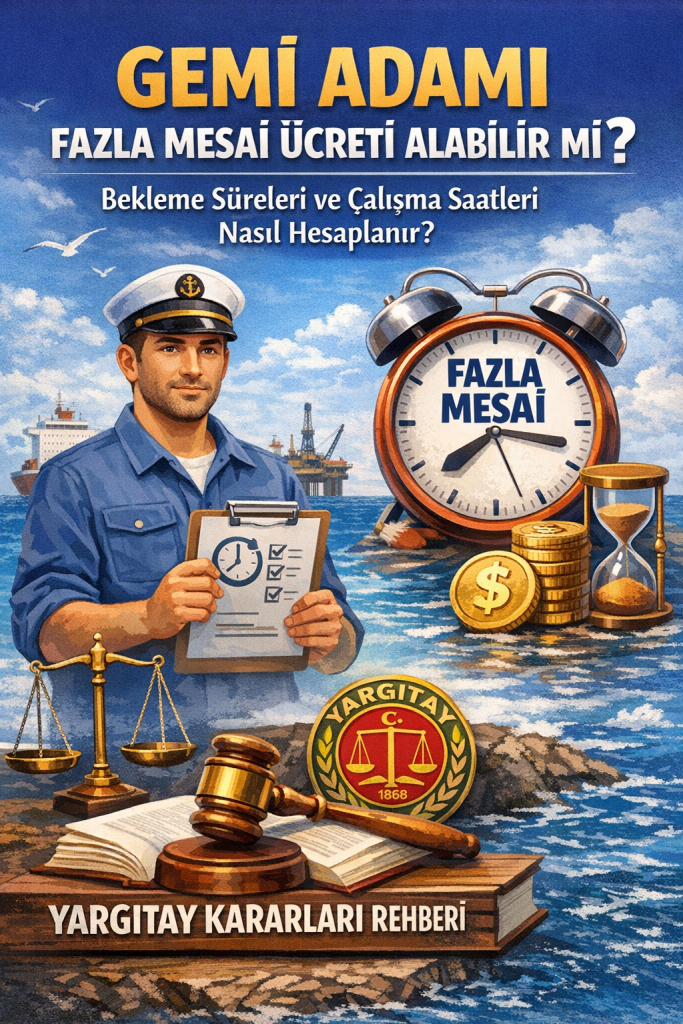
1. Scope of Seafarers’ Working Hours and Waiting Periods
In accordance with Article 26/2 of Maritime Labour Law No. 854, the working hours of seafarers are the periods during which they actually work on duty or keep watch. As consistently emphasized in the precedents of the Court of Cassation, the time during which a seafarer, although not actually working, keeps their power at the disposal of the employer, and periods spent waiting for work to be assigned or to depart, should also be counted as working hours (9th Civil Chamber of the Court of Cassation, 25.04.2022, 2022/4079 E., 2022/5197 K.; 9th Civil Chamber of the Court of Cassation, 16.09.2013, 2013/4624 E., 2013/22560 K.).
However, the Supreme Court states that the entirety of the time spent by a seafarer on board cannot be considered working time. Periods such as eating, sleeping, and resting, which the seafarer uses sfreely while on board, are not counted as working time (Supreme Court 9th Civil Chamber, 31.10.2017, 2017/25780 E., 2017/17080 K.; Supreme Court 9th Civil Chamber, 16.02.2016, 2014/28257 E., 2016/2751 K.). For example, a deduction of 10 hours or 4 hours for intermediate rest must be made for a seafarer working on a 24-hour shift system, depending on whether their sleep needs are met (Supreme Court 9th Civil Chamber, 10.10.2017, 2017/24514 E., 2017/15287 K.). Merely being on board does not entitle one to overtime pay; it is essential to concretely prove the time spent on duty and on shift (Supreme Court 9th Civil Chamber, 16.02.2016, 2014/28257 E., 2016/2751 K.).
2. Determination of Overtime Periods and International Limits
According to the Maritime Labour Law, work exceeding 8 hours daily or 48 hours weekly is considered overtime work (overtime) (Court of Cassation 9th Civil Chamber, 13.02.2012, 2009/43344 E., 2012/3135 K.). The Court of Cassation has ruled that the annual overtime limit of 270 hours stipulated in Labour Law No. 4857 cannot be applied under the Maritime Labour Law. Instead, the rule that the maximum working period cannot exceed 14 hours within a 24-hour period and 72 hours within a 7-day period, in accordance with ILO Convention No. 180 and Directive 1999/63/EC, should be adopted (Court of Cassation 9th Civil Chamber, 11.02.2014, 2012/25671 E., 2014/3980 K.; Court of Cassation 9th Civil Chamber, 11.02.2014, 2011/54095 E., 2014/3957 K.). Even if it is stipulated in employment contracts that overtime pay is included in the basic wage, this is considered valid for work up to 72 hours per week, and portions exceeding 72 hours must be calculated and paid separately (Court of Cassation 22nd Civil Chamber, 17.03.2020, 2017/28448 E., 2020/5098 K.; Court of Cassation 22nd Civil Chamber, 10.02.2014, 2013/2444 E., 2014/1795 K.).
Furthermore, in accordance with the special provision in Article 28 of the Maritime Labour Law, overtime pay must be calculated with a 25% increase. The general provision of the Turkish Code of Obligations No. 6098, which foresees a 50% increase, cannot be applied to seafarers (Court of Cassation 9th Civil Chamber, 31.05.2022, 2022/6018 E., 2022/6890 K.).
3. Proof of Overtime Work and the Obligation to Keep a Notarized Register
Pursuant to Article 28/last of the Maritime Labour Law, the employer or employer’s representative is obliged to keep a separate, notarized ledger to document overtime work. The Supreme Court mandates that courts obtain and examine this notarized ledger, ship’s logbooks, and shift schedules when resolving disputes. Ruling on overtime claims solely based on witness statements, without examining these official records, constitutes grounds for reversal due to insufficient investigation (Supreme Court 9th Civil Chamber, 17.12.2012, 2010/51135 E., 2012/43019 K.; Supreme Court 9th Civil Chamber, 17.12.2012, 2010/50020 E., 2012/43016 K.; Supreme Court 9th Civil Chamber, 17.12.2012, 2011/32857 E., 2012/43022 K.). Even if the employer has not kept this ledger, the seafarer can prove their overtime work with other evidence; however, it is essential for the court to first request these records, which are legally mandated to be kept (Supreme Court 9th Civil Chamber, 19.11.2019, 2018/10617 E., 2019/20333 K.).
4. Special Circumstances Regarding Pilot Captains and Ship Captains
According to Article 27 of the Maritime Labor Law, since captains can be employed without being subject to daily or weekly working hour regimes, they generally cannot claim overtime. However, it is possible for these individuals to be subject to a daily and weekly working basis through a collective labor agreement (Supreme Court 9th Civil Chamber, 07.10.2013, 2011/27532 E., 2013/25072 K.). Regarding pilot captains, the Supreme Court has ruled that although these individuals must be ready to work at any moment of the 24-hour day, the time they are not actually working cannot be counted as working hours, and since their monthly wages are determined by considering their working patterns, they cannot claim overtime (Supreme Court 9th Civil Chamber, 06.02.2024, 2023/20378 E., 2024/1581 K.; Supreme Court 9th Civil Chamber, 26.11.2024, 2024/10846 E., 2024/15290 K.; Supreme Court 9th Civil Chamber, 13.03.2024, 2024/3407 E., 2024/4744 K.).
5. Additional Context from Secondary Sources
The information below has been compiled from secondary source decisions that provide additional context when there is limited information in the main decision texts:
Obtaining and Examining Records: For the determination of working hours and overtime of seafarers, witness statements alone are not considered sufficient; records must be obtained from the Port Authority to clarify the dates the vessel was in operation (Supreme Court 7th Civil Chamber, 12.12.2013, 2013/14351 E., 2013/21920 K.). Furthermore, it is mandatory to physically examine the voyage records at the workplace (Supreme Court 9th Civil Chamber, 02.04.2019, 2016/11460 E., 2019/7541 K.).
Intermediate Rest and Boarding-Disembarking Hours: A detailed breakdown of records related to boarding and disembarking times in 24-hour operations should be produced, and actual working hours should be calculated by deducting a daily 10-hour intermediate rest period (Supreme Court 9th Civil Chamber, 14.03.2023, 2023/3703 E., 2023/3903 K.).
Priority of Special Law Provision: In the calculation of overtime pay for seafarers, the 25% increase rate in Article 28 of Maritime Labour Law No. 854 is considered a special provision, and is applied with priority over the 50% increase rate in Article 402 of the Turkish Code of Obligations No. 6098 (Supreme Court 9th Civil Chamber, 08.11.2022, 2022/9669 E., 2022/14487 K.).
Scope of Waiting Periods: It is stated that waiting periods spent in port operations related to ship transportation (loading, unloading, customs procedures) should also be considered within the scope of overtime, taking into account the nature and intensity of the work, and that timekeeping records reflecting only active driving/processing time would lead to an incomplete examination (Supreme Court 9th Civil Chamber, 27.04.2017, 2017/9527 E., 2017/7424 K.; Supreme Court 9th Civil Chamber, 19.12.2017, 2016/4308 E., 2017/21823 K.).
Gemi adamının bekleme süreleri çalışma süresinden sayılır mı?
Evet, ancak her bekleme süresi otomatik olarak çalışma süresi kabul edilmez. Yargıtay içtihatlarına göre gemi adamının fiilen çalışmasa bile işverenin emrinde hazır bulunduğu, iş verilmesini beklediği süreler çalışma süresinden sayılır. Özellikle limanda yükleme, boşaltma, gümrük işlemleri veya vardiya bekleme süreçleri bu kapsamda değerlendirilebilir.
Buna karşılık gemi adamının serbestçe kullandığı yemek, uyku ve dinlenme süreleri çalışma süresi sayılmaz. Bu nedenle fazla mesai hesabı yapılırken fiili çalışma ile dinlenme sürelerinin ayrıştırılması gerekir. Mahkemeler bu ayrımı somut deliller ve kayıtlar üzerinden yapmaktadır.
Gemi adamı fazla mesai ücretine ne zaman hak kazanır?
Gemi adamı, günlük 8 saati veya haftalık 48 saati aşan çalışmalar için fazla mesai ücretine hak kazanır. Ancak denizcilik sektörüne özgü uluslararası düzenlemeler gereği, haftalık çalışma süresi 72 saate kadar çıkabilmekte ve bu sınıra kadar olan çalışmalar bazı durumlarda ücretin içinde kabul edilebilmektedir.
Bu sınırın aşılması halinde ise fazla mesai ücretinin ayrıca ödenmesi zorunludur. Ayrıca Deniz İş Kanunu’na göre fazla mesai ücreti %25 zamlı olarak hesaplanır. Bu yönüyle gemi adamlarının fazla mesai alacakları, klasik iş hukukundan farklı ve teknik bir hesaplama gerektirir.
Gemi adamı fazla mesaisini nasıl ispat eder?
Fazla mesainin ispatı açısından en önemli husus, işverenin tutmak zorunda olduğu noter tasdikli fazla mesai defteri, gemi jurnalleri ve vardiya çizelgeleridir. Yargıtay’a göre mahkemeler bu kayıtları incelemeden karar veremez.
Ancak işveren bu kayıtları tutmamışsa, gemi adamı fazla çalışmasını tanık beyanları, yazışmalar ve diğer delillerle de ispat edebilir. Bununla birlikte uygulamada en güçlü deliller resmi kayıtlar olduğu için, dava sürecinde bu belgelerin temini kritik önem taşır.
Why is Expert Legal Support Necessary?
Seafarers’ working hours, overtime, and receivables calculations have a much more technical and complex structure compared to classical labor law. Issues such as whether waiting times should be included in working hours, the application of international conventions, special provisions like the 25% increase rate, and the evaluation of records require serious legal expertise. Furthermore, significant loss of rights may occur if overtime receivables are not calculated correctly, are claimed insufficiently, or if the burden of proof is managed incorrectly.
Therefore, working with an experienced Istanbul seafarer lawyer from the outset of the process provides a significant advantage. Especially a Tuzla seafarer lawyer operating in regions with high maritime activity can manage the process more effectively due to their expertise in shipyard and ship practices. With the support of an Istanbul lawyer operating in Istanbul, the correct strategy can be determined by evaluating both local and international legislation together. At this point, 2M Hukuk Avukatlık Ofisi, specialized in maritime trade law, provides professional, fast, and results-oriented legal support to its clients in seafarer receivables and overtime disputes.