1. Validity of Fixed-Term Employment Contracts Made with Seafarers
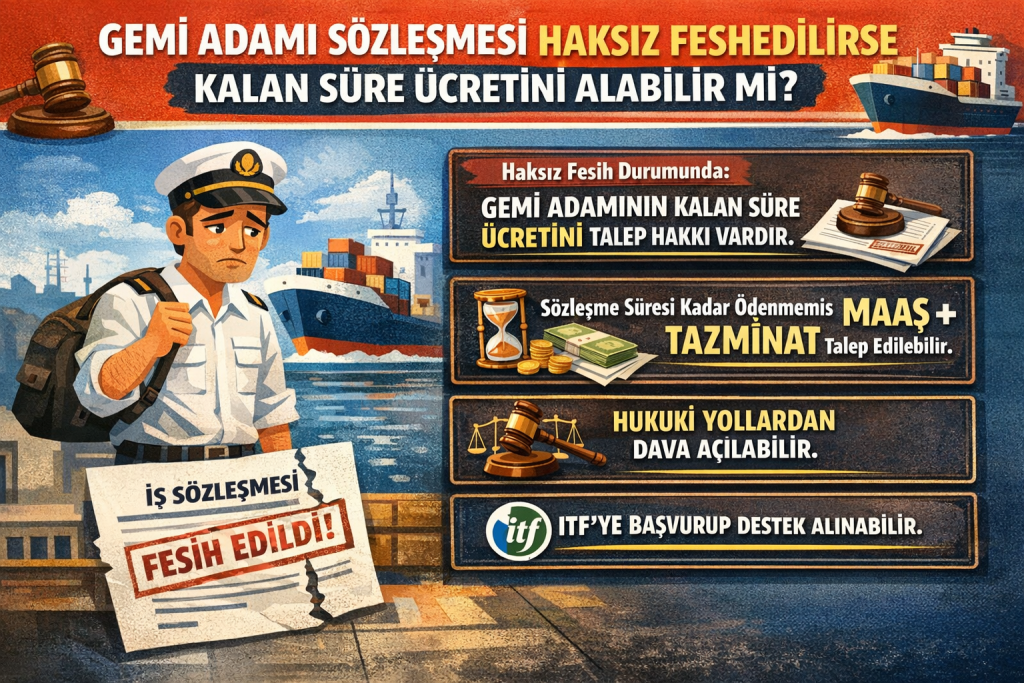
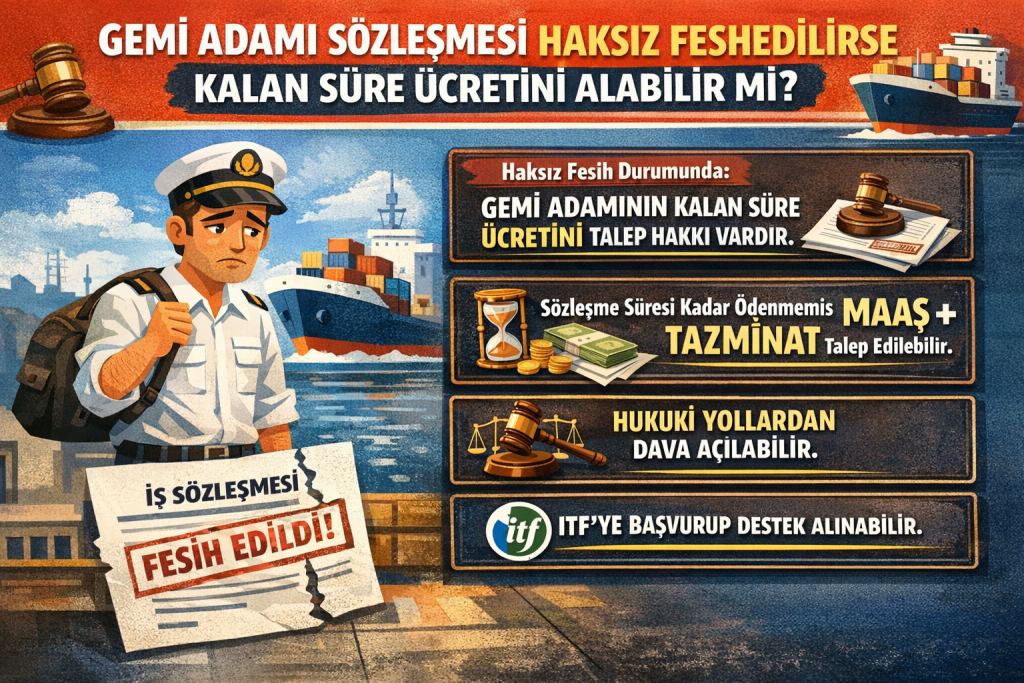
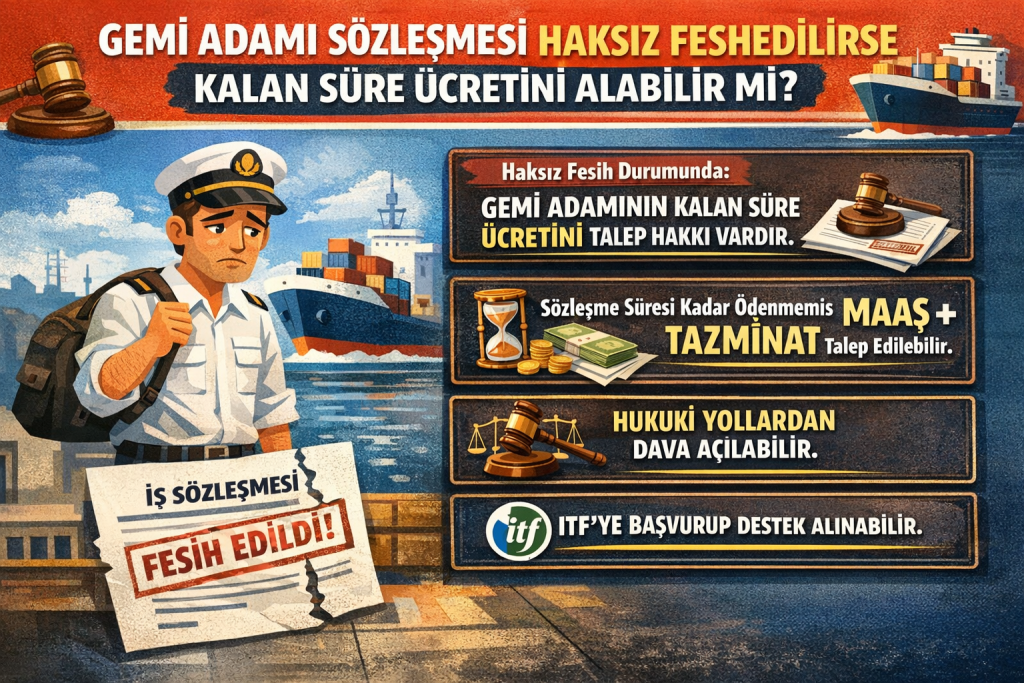
While objective reasons are sought for the establishment of fixed-term employment contracts in general labor law, an exception to this rule has been introduced for seafarers. According to the decision of the 9th Civil Chamber of the Supreme Court of Appeals dated 17.02.2015, numbered 2013/10445 E. and 2015/6930 K., fixed-term contracts can be made with seafarers in accordance with Article 7 of the Maritime Labor Law No. 854, and “In the regulation of the Maritime Labor Law, no objective or essential reason is sought for the first-time conclusion of a fixed-term employment contract.” For this reason, the first fixed-term contracts made with seafarers are considered valid, and in case of unfair termination before their term expires, the seafarer acquires the right to claim the remaining term’s wages.
2. Calculation of Remaining Term Wages in Case of Unfair Termination
In the event that a fixed-term employment contract is unfairly terminated prematurely by the employer, the employee may claim their wages for the remaining term of the contract as compensation, in accordance with Article 438/1 of the Turkish Code of Obligations (TBK) no. 6098 (repealed Article 325 of the Code of Obligations no. 818).
In judicial decisions, these calculations are based on concrete data:
In the decision of the Istanbul Regional Court of Justice 13th Civil Chamber, dated 29.09.2021, numbered 2019/1901 E. and 2021/1286 K. (and the decision upheld by this ruling, Istanbul 17th Civil Court of Commerce, dated 10.12.2018, numbered 2015/196 E. and 2018/482 K.); the wage that could be claimed for the remaining period of 2 months and 7 days by a ship captain who signed a 4-month contract with a monthly salary of 11,000 USD and whose contract was unfairly terminated after working for 1 month and 23 days, was calculated as a net 24,567.00 US Dollars.
In the decision of the Istanbul 17th Civil Court of Commerce, dated 15.04.2019, numbered 2016/104 E. and 2019/191 K.; the receivable for the remaining 117 days after unfair termination for an engine bosun working on a 6-month contract with a monthly salary of 1,600 USD was calculated as 6,320.99 USD.
3. Deductions from the Remaining Period Wage (Savings Deduction and Income Earned from Another Job)
In accordance with Article 438/2 of the TCO, amounts saved by the employee due to not performing their work (e.g., travel, food, etc.) and income earned from another job or deliberately avoided from earning should be deducted from the remaining period wage. The courts apply these deductions as follows:
Proportional/Discretionary Discount Application: In the decision numbered 2019/1901 E., 2021/1286 K. of the 13th Civil Chamber of the Istanbul Regional Court of Justice, taking into account the seafarer’s savings during the period he was not working, with reference to the established jurisprudence of the Court of Cassation, it was adopted that “a discretionary discount of 35% could be applied” and it was ruled that 15,743 USD should be collected by applying a 35% discount on the requested 24,220 USD.
Necessity of Concrete Investigation: The Court of Cassation emphasizes that discounts should not be arbitrary or solely discretionary, but must be based on concrete investigation. In its decisions dated 23.02.2021, numbered 2021/892 E. and 2021/4707 K., and dated 07.12.2021, numbered 2021/8864 E. and 2021/16270 K., of the 9th Civil Chamber of the Court of Cassation, rendering a decision without investigating whether the employee worked in another job after termination, their earned income, and saved amounts was considered a ground for reversal.
Cancellation of Repeated and Erroneous Discounts: In the decision dated 08.12.2022, numbered 2022/15900 E. and 2022/16315 K., of the 9th Civil Chamber of the Court of Cassation, it was found erroneous to apply an additional 65% discount after deducting income earned from another job. Similarly, in the decision dated 02.02.2015, numbered 2013/29324 E. and 2015/2033 K., of the 22nd Civil Chamber of the Court of Cassation, the court’s direct application of a “50% discretionary discount” from the remaining period’s wages was deemed a ground for reversal. Furthermore, in the decision dated 21.03.2017, numbered 2017/277 E. and 2017/4600 K., of the 9th Civil Chamber of the Court of Cassation, the local court’s 2/3 discount was found to be excessively high, and it was stated that a more reasonable discount should have been applied.
4. Contract Provisions, Interest, and Other Receivable Items
Invalidity of Restrictive Provisions in the Contract: According to the decision of the 9th Civil Chamber of the Supreme Court dated 22.11.2022, numbered 2022/12798 E. and 2022/14978 K., clauses in employment contracts stating that the contract will be terminated and no compensation will be paid in cases such as project cancellation, etc., are contrary to the mandatory provision of Article 438/1 of the Turkish Code of Obligations (TBK) and cannot be deemed valid.
Interest on Foreign Currency Receivables: In the same decision (2022/12798 E., 2022/14978 K.), it was ruled that “the highest interest rate applied to one-year time deposits opened in USD by state banks” should be applied to the remaining period’s fee awarded in foreign currency (USD). However, in the decision of the 9th Civil Chamber of the Supreme Court dated 13.12.2016, numbered 2015/7361 E. and 2016/22080 K., it was also stated that statutory interest should be applied from the date of enforcement, as there is no regulation for deposit interest in the Maritime Labor Law.
Notice Indemnity: According to the decision of the 9th Civil Chamber of the Supreme Court dated 17.02.2015, numbered 2013/10445 E. and 2015/6930 K., since notice indemnity is only applicable in cases of termination of indefinite-term contracts, it cannot be awarded in fixed-term contracts.
Annual Leave Pay: According to the decision of the 9th Civil Chamber of the Supreme Court dated 09.11.2020, numbered 2016/31624 E. and 2020/15354 K., in accordance with Article 40/1 of the Maritime Labor Law, it is a condition to have actually worked for 6 months to be entitled to annual leave. Unjust termination of the contract does not grant the seafarer the right to leave pay for the remaining days not actually worked.
Employee’s Resignation: According to the decision of the 9th Civil Chamber of the Court of Cassation dated 08.01.2025, numbered 2024/14452 E. and 2025/94 K., if the employment contract is terminated (resignation) by the employee (seaman) himself, claims for remaining term wages and unfair termination compensation within the scope of Article 438 of the Turkish Code of Obligations should be rejected.
Additional Context and Evaluations Obtained from Secondary Sources
The information below has been compiled from responses providing secondary information, aiming to offer additional context for matters where limited information is available in the decision text:
Employer’s Defenses Contrary to the Rule of Honesty: In the decisions of the Civil General Assembly of the Court of Cassation dated 27.01.2022 (2021/778 E., 2022/65 K.) and the 9th Civil Chamber of the Court of Cassation dated 27.01.2021 (2019/907 E., 2021/2498 K.), after a fixed-term contract was made between the parties and unfair termination was carried out by the employer, the employer’s defense that “there was no objective reason in the contract and that it was for an indefinite period” in order not to pay the remaining term wages was deemed contrary to the rule of honesty and an abuse of right according to Article 2 of the Turkish Civil Code.
Limitations of Hypothetical Discounts: In the decisions of the 9th Civil Chamber of the Court of Cassation dated 04.11.2025 (2025/6832 E., 2025/8430 K. and 2025/7450 E., 2025/8476 K.) and dated 25.03.2021 (2020/9011 E., 2021/6982 K.); hypothetical discounts such as 30%, 40%, or 50% made by courts have been criticized. While the Court of Cassation accepts that hypothetical discounts can be applied for unknown future periods, it emphasized that if the unworked period becomes known as of the decision date, it is mandatory to investigate with concrete evidence whether the worker obtained income from another job and the amounts saved.
Minimum Term Protection in the Maritime Labor Law: In the decision of the 9th Civil Chamber of the Court of Cassation dated 08.04.2013 (2012/21256 E., 2013/11389 K.), it was stated that even in indefinite-term contracts under Article 16 of the Maritime Labor Law, the contract cannot be terminated within six months from the date of employment of the seafarer, and in cases of unfair termination before this minimum period expires, the seafarer can claim the remaining balance of the period’s wages, thereby confirming strict termination control for seafarers.
Determination of Applicable Law: In the decision of the Grand Chamber of Civil Cases of the Court of Cassation dated 24.05.2023 (2022/549 E., 2023/527 K.), it was stated that for workers/seafarers working on the high seas or abroad, if the parties make a valid choice of law in the contract (e.g., Russian legislation) and the customary place of work is a foreign country, disputes such as the remaining period’s wages and the nature of the contract should be resolved according to the chosen foreign law under Article 27 of the Law on International Private and Procedural Law (MÖHUK).