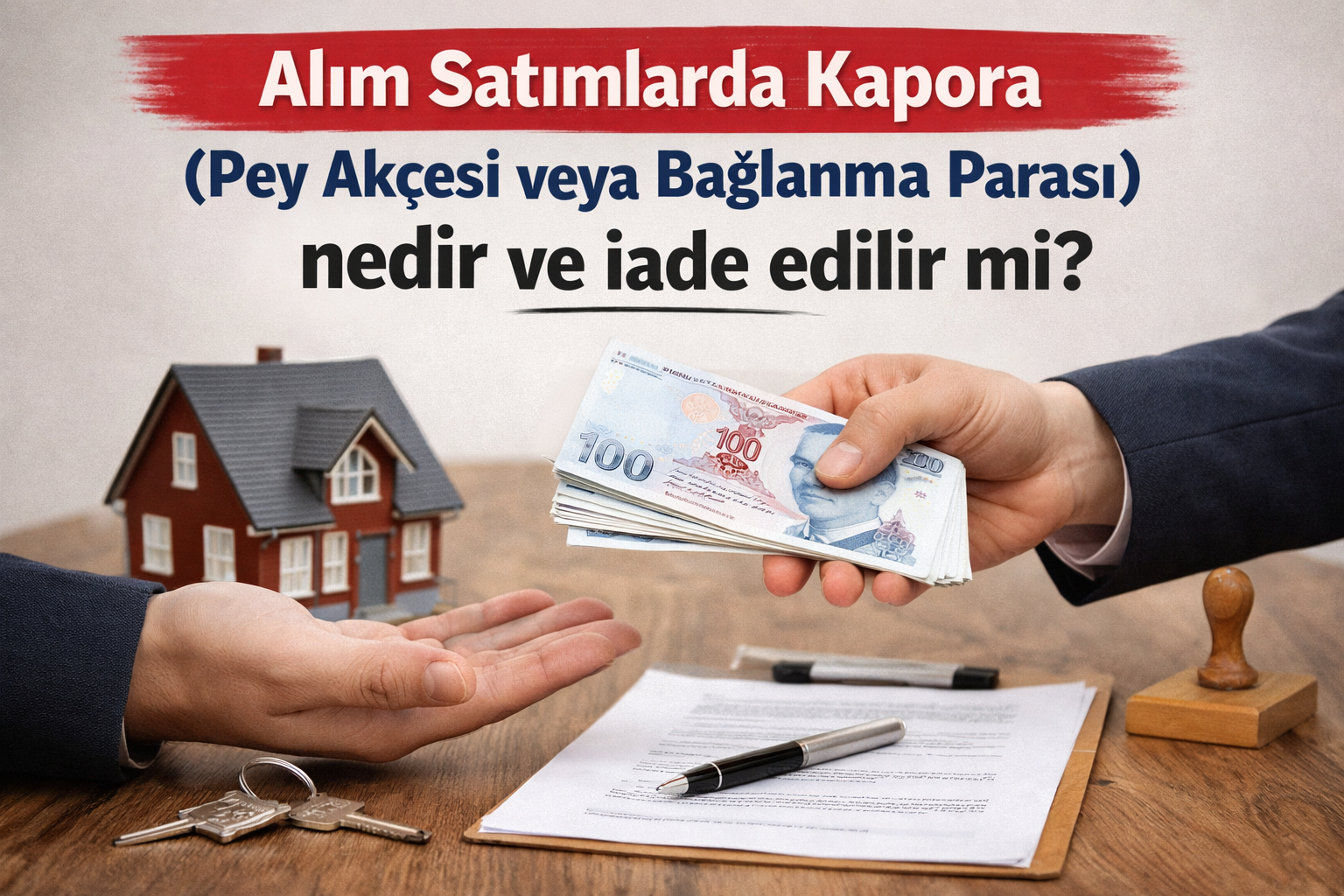
1. Definition and Legal Nature of Earnest Money
According to judicial decisions, earnest money (pey akçesi) is regulated in Article 177 of the Turkish Code of Obligations (TCO) No. 6098. Pursuant to this article, a sum of money given by a person when a contract is made is considered to have been given as proof that the contract has been made, rather than as a penalty for withdrawal. The main functions of this money, also referred to as “down payment” in practice, are as follows:
Evidentiary Function: It serves as evidence that the contract has been established.
Partial Performance: Unless there is a contrary agreement or local custom, the earnest money is deducted from the principal debt.
Security Function: In case the contract is not performed, it serves as a kind of security.
In the decisions of the Supreme Court General Assembly of Civil Chambers and Regional Courts of Justice, it has been emphasized that if the purpose for which the money given when the contract is established cannot be clearly understood, it will be presumptively accepted as “earnest money”. For this money to be considered “penalty for withdrawal” (TCO Art. 178), the parties must have explicitly agreed upon this matter, or it must be proven that the money is a withdrawal penalty. Otherwise, by law, it is considered earnest money.
2. Validity Conditions for Down Payment / Earnest Money
The validity of earnest money is dependent on the validity of the main contract. The following points stand out in the decisions:
Ancillary Nature: Earnest money is an ancillary (subsidiary) right dependent on the main claim. Therefore, if the main contract is invalid, the earnest money agreement also becomes invalid. Form Requirement: No special form requirement is stipulated by law for the stipulation of earnest money. However, if the main contract is subject to a formal requirement (e.g., sale of real estate or sale of a vehicle to be made before a notary) and an external contract is made without complying with this requirement, since the contract will be deemed invalid, the earnest money will also lack legal basis.
Formation of the Contract: Earnest money is given at the stage where contract negotiations are concluded and the contract is formed. If an agreement cannot be reached on the essential elements of the contract (e.g., the price of goods), the contract is deemed not to have been formed, and the money given is subject to refund.
3. Conditions for Refund of Earnest Money
Court decisions have evaluated the refund of earnest money in different categories based on the validity and performance status of the contract:
A. In Case of Invalidity or Non-Formation of the Contract
Unjust Enrichment: If the contract becomes invalid due to reasons such as lack of form (e.g., sale of a vehicle or real estate not made before a notary), nullity, or cancellation, the party who received the money is obliged to refund it under the provisions of “unjust enrichment” (TCO Art. 77-82).
Fault and Conditions: In invalid contracts, parties only have the right to claim back what they have given. Even if the contract contains provisions such as “money will not be refunded in case of withdrawal”, these provisions are not binding because the contract is invalid, and the money must be refunded.
B. In Case of Non-Performance or Termination of the Contract
Seller’s Fault: If the seller fails to perform their obligation (e.g., does not deliver the goods), they must return the earnest money received, along with interest.
Buyer’s Fault and Seller’s Damages (TCO Art. 236): If the buyer wrongfully withdraws from the contract or defaults, the seller may deduct these damages from the earnest money, provided they prove the damages incurred pursuant to Article 236 of the TCO.
If the damages proven by the seller are less than the earnest money, the remaining amount is refunded to the buyer.
If the seller cannot prove their damages, they must return the entire earnest money.
Contractual Provisions: In a valid contract, if there is an explicit provision stating that the payment will not be refunded if the buyer withdraws (e.g., if specified in the proforma invoice), courts have ruled this provision to be binding and that a refund might not be possible. However, this situation may vary depending on whether the money is classified as “withdrawal penalty”.
C. Distinction of Withdrawal Penalty If the given money is explicitly agreed upon as a “withdrawal penalty” (TCO Art. 178), the refund regime changes:
If the party giving the money withdraws, they forfeit the money given (cannot get a refund).
If the party receiving the money withdraws, they must return double the amount received. However, in judgments, it is observed that in cases where it cannot be proven that the money is a withdrawal penalty, it is considered as “earnest money”, and the general refund rules mentioned above (deduction for damages or unjust enrichment) are applied..
4. Additional Findings from Secondary Sources
The information in this section is based on responses from secondary sources, which are presented in a limited context in decision texts or provide indirect information:
Difficulty of Proof: The proof that money sent for purchases made through e-commerce or social media is a “deposit” depends on the clarity of the receipt descriptions and the identification of the parties. If sufficient evidence (clear receipt, correspondence) cannot be provided, requests such as precautionary attachment may be rejected (Istanbul Regional Court of Justice 13th Civil Chamber).
Compensatory Justice: There are Supreme Court approaches indicating that when refunds are made in invalid real estate sales, the loss of purchasing power between the date the money was paid and the date of refund should be taken into account in accordance with the “principle of compensatory justice,” and that the refund of only the nominal amount may not be sufficient (Supreme Court 13th Civil Chamber).
Set-off in Commercial Sales: It was stated that in commercial sales, if the contract is rescinded, the seller may set off expenses such as freight, storage, or sample production from the earnest money, but these damages must be proven with concrete evidence (Istanbul Anatolian 7th Commercial Court, Istanbul Regional Court of Justice 13th Civil Chamber).
Frequently Asked Questions
Kapora ile cayma parası aynı şey midir?

Hayır. Kapora (bağlanma parası), sözleşmenin kurulduğunu gösteren ve genellikle ana borçtan düşülen bir bedeldir. Cayma parası ise taraflara sözleşmeden dönme hakkı verir. Bu ayrım açıkça kararlaştırılmamışsa verilen para kural olarak bağlanma parası sayılır
Kapora hangi durumlarda iade edilir?
Sözleşme hiç kurulmamışsa, geçersizse veya satıcı yükümlülüğünü yerine getirmezse kapora iade edilir. Ayrıca satıcı zararını ispat edemezse yine kaporanın tamamı geri alınabilir.
Alıcı vazgeçerse kapora yanar mı?
Her durumda yanmaz. Eğer kapora bağlanma parası niteliğindeyse, satıcı ancak uğradığı zararı ispat ederse bu bedeli mahsup edebilir. Zarar ispat edilemezse kapora iade edilir.
Yazılı sözleşme olmadan verilen kapora geri alınabilir mi?
Evet, ancak ispat sorunu yaşanabilir. Banka dekontu, mesajlaşmalar ve diğer delillerle ödemenin kapora olduğu kanıtlanmalıdır. Aksi halde hak talebi zorlaşabilir.
Why is Expert Legal Assistance Necessary?
The practice of earnest money (deposit) is one of the areas where disputes most frequently arise in practice. Especially, the incorrect determination of the contract’s nature (whether it’s earnest money or withdrawal penalty), the failure to clearly state the rights and obligations of the parties, and issues with proof can lead to significant loss of rights.
At this point, getting support from an Istanbul lawyer, Tuzla lawyer, Gebze lawyer, Pendik lawyer, and Çayırova lawyer is of great importance for the correct management of the process.
Thanks to professional support;
The legal nature of the deposit is correctly determined
Contracts are prepared clearly and in accordance with Supreme Court precedents
Refund and damage calculations are made correctly
The burden of proof is supported by strong evidence
Potential litigation processes are prevented in advance. Especially, receiving support from an experienced team in this field, such as 2M Hukuk Avukatlık Ofisi, both prevents financial losses and ensures the process is concluded quickly and safely.