
Legal Basis: Law No. 6306, Article 3/1 | Implementing Regulation, Article 7/3
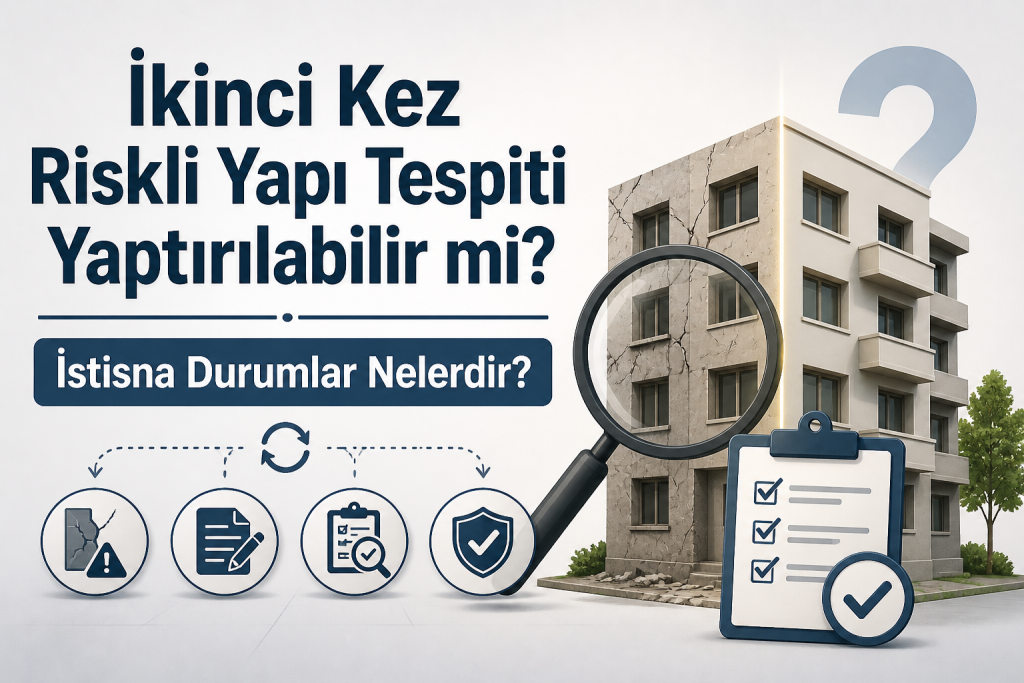
Your building’s risky structure report was prepared, but something went wrong: the report was erroneous, the objection was rejected, subsequently the building suffered serious damage or was reinforced, and the annotation was lifted. Now you want to have another assessment done — but there’s a previous report. Is this possible? Law No. 6306 and its Implementing Regulation stipulate that, as a rule, only one risky structure assessment report shall be issued for each building. However, this rule is not absolute: Article 7/3 of the Regulation foresees three separate exceptions. This article details the single report principle, its exceptions, the role of the electronic system in this process, and how to delete a building’s record, in light of the current 2026 legislation. (L. Art. 3/1 — R. Art. 7/3)
Basic Rule: One Report Per Structure
Article 7/3 of the Implementing Regulation clearly stipulates the basic principle: Except in exceptional circumstances, only one risky structure assessment report can be issued for each building. (R. Art. 7/3)
The rationale for this rule serves multiple purposes. Firstly, it ensures process security: Issuing multiple reports for the same structure can lead to conflicting results and create legal uncertainty regarding which report should be taken as a basis. Secondly, it prevents manipulation: It prevents the owner from trying to obtain a different result by applying to a different licensed institution if they are not satisfied with the determination result. Thirdly, it regulates administrative operations: Land Registry Offices, Urban Transformation Directorates, and licensed institutions process based on a single report for the same structure.
The practical consequence of this rule is extremely important: After a determination report is prepared for a structure and submitted to the administration, a new report cannot be prepared for the same structure without exceptional circumstances occurring, and the structure’s record in the electronic system will show only one report.
Control Obligation of Licensed Institutions
To implement the single report principle, the Regulation has imposed an active obligation on licensed institutions: Licensed institutions and organizations, when they receive a request for risky structure determination, must check through the electronic software system whether a risky structure determination report has been previously issued for that structure. (Reg. Art. 7/3)
This control is mandatory for both licensed private organizations and the Administration. If a previous record appears in the system and none of the three exceptions have occurred, a new report cannot be issued, and a structure record cannot be created. Thanks to this auditing mechanism, the single report principle becomes practically implementable.
Three Exceptions Where a Second Report Can Be Issued
Article 7/3 of the Regulation has regulated three situations where the single report principle does not apply, under the principle of limited number (numerus clausus). No exceptions are accepted outside of these three cases. (R. Art. 7/3)
First Exception: Need for Re-determination Upon Objection or Court Decision
In the first report, the structure was deemed “risk-free”; however, if a re-technical examination is required as a result of an objection or a court decision, a new report may be prepared. Or the opposite situation may arise: if the structure was found “risky” in the first report, and it has been determined, upon objection by the technical committee or by court decision, that the report needs to be re-examined, a second report may be issued. (R. Art. 7/3)
For this exception to apply, it is essential that either an administrative objection has been formally made through official channels or a court decision exists. An attempt by the owner to commission a new report merely because they are dissatisfied with the outcome, without resorting to the objection process, does not fall within the scope of this exception. If, during the technical committee’s review of the objection, it is ruled that the report needs to be re-prepared, the licensed organization prepares the new report and submits it to the Directorate; this process does not violate the single report principle. (L. Art. 3/1 — R. Art. 7/5, 10/7)
In practice, this exception most frequently arises in these two scenarios: Upon an objection, the technical committee decides that the initial report contains deficiencies and orders its correction; or the court grants a stay of execution and issues a cancellation decision, ordering the administration to act again.
Second Exception: Discovery that the Report Was Prepared Contrary to Fact
If it is later understood that the initial report was prepared contrary to fact, either intentionally or due to gross negligence, a new report may be issued. (R. Art. 7/3)
This exception is subject to an extremely strict condition. A mere technical error or interpretational difference is not considered “contrary to the truth”. The regulation has not explicitly defined which cases fall within this scope; however, judicial precedent has established that being contrary to the truth must be based on a verifiable, objective fact. Examples of situations that can be given for this case are: core samples being presented as taken when they were not; use of fake photographs or measurement values that do not reflect the actual condition of the structure; generating results without any structural system evaluation being performed; use of data from another building.
The falsity must be revealed during Ministry inspections, complaint examinations, or the judicial process. The owner requesting a new report on this ground must prove the falsity with concrete facts and, if possible, documentary evidence. Administrative sanctions may also be applied against the licensed entity, and its license may be revoked if necessary. (Art. 3/1 of Law — Art. 6 of Regulation)
Third Exception: Occurrence of a Concrete Event Other Than Intentional Intervention
A new assessment can be made if a concrete event occurs that may affect the risk status of the structure but does not result from the owner’s intent. (Art. 7/3 of Regulation)
The regulation has limited this situation with two elements: The event being concrete and of a nature that affects the risk status of the structure; and this event stemming not from an intentional intervention, but from an objective occurrence.
Events that can be considered under this exception are: new damage occurring in the structure as a result of natural disasters or unexpected events such as earthquake, storm, flood, fire, or collapse; new damage occurring in the structure later despite the structure having been reinforced and the risky structure annotation removed after the initial detection; external factors such as a construction accident affecting the building’s load-bearing system or ground subsidence.
The term “intentional intervention” covers the owner’s or a third party’s knowing and deliberate intervention aimed at changing the risk status of the structure. Situations such as intentionally weakening some columns of the structure, demolishing load-bearing walls, or deliberately taking action to partially damage the building are outside this scope. The legislator aimed to prevent the misuse of the risky structure process by excluding intentional intervention from the exception.
Deletion of Building Record from the Electronic System: Two Separate Periods
The Regulation provision, linked to the single report principle but regulating a different matter, concerns the deletion of building records. After a building record is created via the electronic software system: (Art. 7/3 of Reg.)
If the detection is not made within two months, the building record is deleted from the electronic system upon the owner’s request. This rule allows the owner to reset the system in cases where the application is stuck and no progress can be made.
If the detection is not made within six months, the building record is deleted ex officio by the Presidency without waiting. This rule serves as an automatic cleaning mechanism against administrative bottlenecks.
The practical importance of deleting the record is as follows: When a building record is deleted, the ‘fulfillment’ status of the single report principle for that building is considered to have ceased. After the deletion, a new building record can be created by reapplying, and a new assessment process can be initiated. This situation is technically not a ‘second assessment’; it is a new initial assessment process initiated after the record is deleted.
Re-assessment After Strengthening: A Special Case
If, after the risky building annotation is entered in the land registry, the owner has chosen the strengthening method, completed the strengthening, and the annotation has been removed, the building’s re-entry into a risky state in the future can be considered under the third exception. In this case, a new assessment report can be issued, provided that both the existence of a new concrete incident and the absence of intentional intervention conditions are met. (Y. Art. 7/3)
The second assessment conducted after the strengthening is completed and the annotation is removed is technically considered the first assessment after the date the building was “reset”; therefore, the existence of any of the three exception conditions is not sought. This is because a building from which the annotation has been removed is no longer in a risky building status, and the re-assessment is initiated as a new process.
Attempts to Override the Single Report Principle and Their Legal Consequences
In practice, it is observed that some owners, dissatisfied with the initial assessment result, attempt to obtain a second report by applying to a different licensed institution. These attempts remain unsuccessful for several reasons.
If the licensed institution sees a previous record in the electronic system, a new record cannot be created; therefore, the second report technically cannot find a record in the system. A licensed institution that issues a second report contrary to the system faces the risk of losing its Ministry license; license revocation comes directly onto the agenda as an administrative sanction. (Regulation Art. 6)
If a second report reaches the administration for any reason, the Directorate will refuse to process the new report, citing the previous record. Judicial precedent is also consistent on this matter: the Council of State and administrative courts do not consider second reports prepared contrary to the single report principle to have legal validity.
Relationship of the Single Report Principle with Property Rights
From the perspective of property rights, guaranteed under Article 35 of the Constitution, the single report principle requires a separate evaluation. The Constitutional Court has rendered principal decisions on this matter in individual applications: it has accepted that the single report principle does not violate property rights, provided that avenues for objection and judicial review against risky building determination are kept open. In this context, if the owner is not satisfied with the first report, there are three avenues they can pursue: administrative objection (15-day period), judicial remedy (30-day lawsuit period), and the alternative of reinforcement. (Law Art. 3/1 — Regulation Art. 7/5)
The effective use of these three avenues forms the fundamental basis for aligning the single report principle with the constitutional guarantee of property rights.
Frequently Asked Questions
The report concluded that the structure is risk-free, but I believe the structure is actually risky, can I have another one done?
Mere dissatisfaction with the outcome is not a sufficient reason for a second report. However, in this situation, three paths are open: You can request an assessment by the technical committee through administrative appeal; you can resort to legal action; or if there are concrete facts indicating that the report was falsely prepared, you can file a complaint with the Directorate.
My building was damaged after the earthquake, is the old “risk-free” report still valid?
An earthquake can be considered a “concrete event affecting the risk status of the building” under the third exception. In this case, you can submit a written application to the Directorate requesting a new assessment. For your request to be accepted, it is sufficient to document the damage and demonstrate that there was no deliberate intervention.
The licensed firm did not carry out the assessment within two months, what can I do?
If no assessment is carried out within two months after the building record is created, the record will be deleted from the system at the owner’s request. You can reapply, choose a new licensed entity, and restart the process from the beginning. (Reg. Art. 7/3)
The annotation from the previous report was removed after reinforcement. What happens if it is later found to be risky again?
In this situation, since the building is legally in a “risk-free” status, a new initial assessment is in question. As the previous assessment and annotation removal procedures have been completed, a new assessment for this building will not be subject to the single report principle.
Practical Warnings
Exercise your right to object in a timely manner. If you are not satisfied with the outcome of the first report, instead of having a second report prepared due to the single report principle, effectively use the 15-day objection period. If the technical committee accepts the objection, it will make it possible to issue a new report in the system. (Reg. Art. 7/5)
If you believe the report is false, document it. If you are going to take this claim to the Directorate, you must support it with concrete facts and, if possible, another engineering opinion.
In case of a natural disaster or external damage, document it immediately. Record any changes in the structure with photographs after an earthquake, flood, or external damage. These documents form the basis for a new detection request under the third exception.
Check your existing record by searching the electronic system. An inquiry made via e-Devlet shows whether a report has been previously issued for your building. In addition, the licensed organization must also perform this check during the application process.
Verify if the building record has been deleted. If you will request the deletion of the record because no detection was made within the two-month period, confirm through the electronic system whether the deletion has occurred. Applying to a new licensed organization before the record is deleted will result in a system blockage.
Why is Expert Legal Support Necessary?
The single report principle and its exceptions constitute one of the most technical legal details of the urban transformation process. As 2M Hukuk Law Office, in the urban transformation consultancy we provide across Istanbul, particularly in Tuzla, we observe the following:
Property owners often apply to a second licensed organization unaware of the single report principle, which leads to a system blockage and valuable time being lost. An urban transformation lawyer assesses in advance which exception can be applied or how to effectively utilize the objection and litigation process in cases where the initial report is not satisfactory.
The process of filing a complaint regarding the report being untrue with the Directorate, the application for administrative sanctions against the licensed organization, and subsequent requests for new determinations are procedures requiring legal justification and document support. As an Istanbul urban transformation lawyer, we provide effective legal representation at every stage of these processes.
Making a new determination request under the third exception after an earthquake or external damage is also a process that needs to be managed with a written application to the Administration and the correct set of documents. This service, which we offer within the scope of urban transformation consultancy, is provided throughout Istanbul through 2M Hukuk Avukatlık Ofisi, operating as a Tuzla lawyer.
Conclusion
In accordance with Article 3/1 of Law No. 6306 and Article 7/3 of the Implementing Regulation, generally, only one risky building determination report can be issued for each structure. Licensed organizations must check the previous record in the electronic system when they receive a new request. There are only three exceptions under which a second report may be issued: a re-determination being required due to an objection or court decision; the determination that the report was issued contrary to the truth; and the occurrence of a concrete incident affecting the risk status of the structure, other than intentional intervention. If the determination is not made within two months after the building record is created, it is deleted at the owner’s request; if not made within six months, it is deleted ex officio by the Presidency; a new application is possible after deletion. (Law Art. 3/1 — Reg. Art. 7/3)