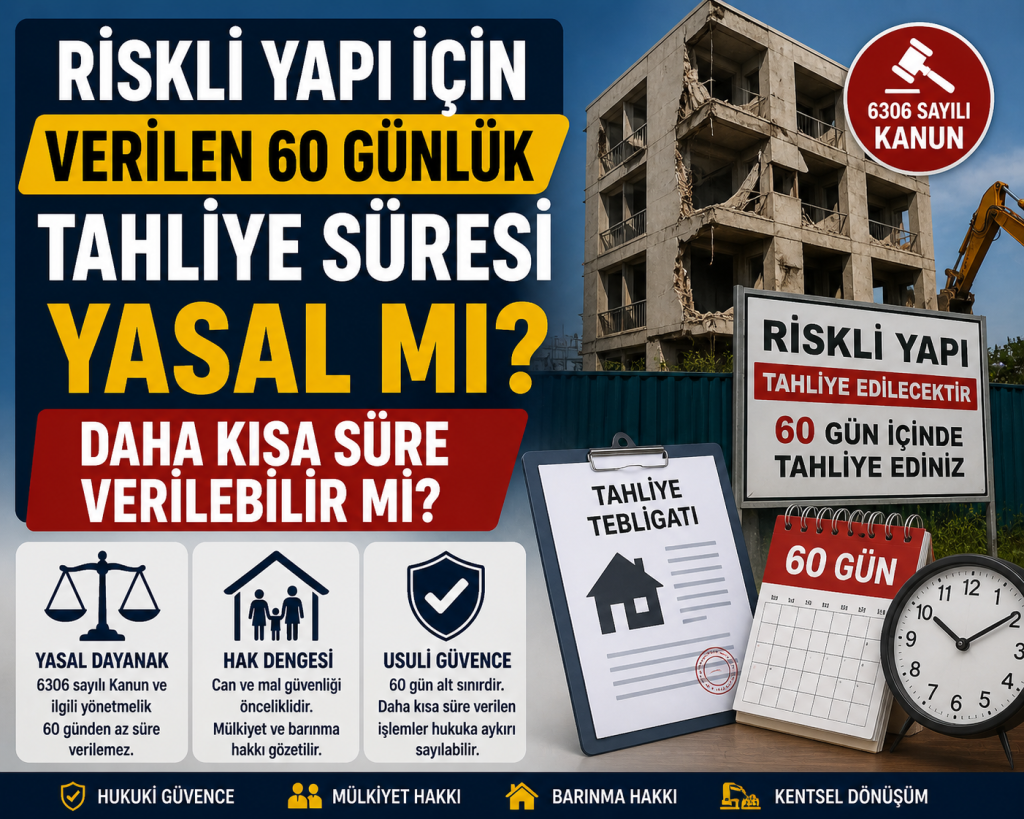
Introduction: Legal Framework of Evacuation Periods Under Law No. 6306
Law No. 6306 on the Transformation of Areas Under Disaster Risk and its related Implementation Regulation stipulate that a period of “not less than sixty days” shall be granted to property owners for the evacuation and demolition of risky structures. The adequacy of this period in terms of property rights (Constitution Art. 35) and the right to housing (Constitution Art. 57) is being debated before high judicial authorities, focusing on the balance between public interest and individual rights.
1. Evaluation of the 60-Day Period from the Perspective of Property Rights
Judicial decisions concur that the 60-day period does not violate property rights; on the contrary, it aims to protect life and property safety.
In the decision of the 6th Chamber of the Council of State dated 17/11/2021 and numbered E:2019/16858, K:2021/12684, the plaintiffs’ claims regarding the short duration and the difficulty for apartment owners to make a decision were rejected. The Court emphasized that risky structures are detrimental to life and property safety, and that not implementing measures without delay would lead to irreparable damages, thus ruling that the 60-day period is proportionate and sufficient in terms of property rights. This decision was finalized by the approval decision of the Administrative Litigation Chambers Board of the Council of State dated 22/02/2023 and numbered E:2022/1040, K:2023/301.
The Constitutional Court (AYM), in its decision dated 27/02/2014 and numbered 2012/87 E., 2014/41 K., ruled that the 60-day period was not unconstitutional. The Court stated that this period was a “first period”, and that if eviction did not occur, administrative authorities would grant a second period, thereby indicating that the balance between the right to property and public interest was maintained.
In its examination within the scope of AYM’s Refike Gündüz application (dated 07/10/2021 and numbered 2018/30809 ), it was determined that eviction and demolition were essential due to the threat posed by the risky building stock to life safety, and that the 60-day period did not impose an “excessive burden” on the right to property.
2. Analysis in the Context of the Right to Housing and the Principle of the Social State
The right to housing (Constitution Article 57) is generally not accepted as a direct ground for violation in court decisions, but is addressed indirectly in terms of process management.
The Constitutional Court (2012/87 E., 2014/41 K.), within the framework of the state’s duty to establish healthy and safe living environments (Constitution Articles 5 and 56), viewed the eviction of risky structures as a requirement of the right to housing.
Secondary Source Analysis: In the decision numbered 2024/864 E., 2021/4902 K. of the 6th Chamber of the Council of State, it is essential to reach an agreement with owners in eviction processes in reserve building areas, and it is implied that mechanisms such as temporary housing or rent assistance (Law art. 5/1) balance the process for the protection of the right to housing. However, in the decision numbered 2019/16858 E., 2021/12684 K. of the 6th Chamber of the Council of State, it should be notedr. that a separate in-depth assessment regarding the right to housing was not made.
3. Procedural Safeguards and Manner of Application of the Period
The judiciary emphasizes that the 60-day period is not merely a calendar day, but a procedural safeguard.
Secondary Source Analysis: In the decision dated 10.02.2022 and numbered 2020/2160 E., 2022/1329 K. of the 6th Chamber of the Council of State, it was stated that carrying out eviction procedures quickly, in order to “not to leave the urban transformation process in abeyance,” is consistent with the ordinary course of life.
Secondary Source Analysis: In the decision dated 23.03.2022 and numbered 2021/5048 E., 2022/3542 K. of the 6th Chamber of the Council of State, granting a period of 29 days instead of the legal minimum period of 60 days was found to be unlawful. This proves that the 60-day period is a lower limit that cannot be shortened by the administration.
Secondary Source Analysis: In the decision of the 5th Civil Chamber of the Supreme Court of Appeals, dated 27.02.2025, numbered 2024/8181 E., 2025/2657 K., it was discussed that the decision of the condominium owners’ board to reduce the eviction period to 7 days might be contrary to the mandatory 60-day provision in the regulation.
4. Risks and Uncertainties in Light of Secondary Sources
The brevity of the period can create concrete grievances, especially for commercial activities and tenants:
Commercial Losses: In the decision of the Bakırköy 4th Civil Court of Commerce, dated 19.04.2018, numbered 2018/75 E., 2018/465 K., it was determined that sudden demolitions carried out without granting a 60-day period led to the loss of commercial ledgers and significant economic damages.
Tenants’ Situation: In the decision of the Ankara Regional Administrative Court 9th Administrative Disputes Chamber, dated 01.03.2018, numbered 2018/66 E., 2018/212 K., it was emphasized that in addition to the 60-day period given to owners, tenants should also be given a reasonable eviction notice, and the importance of completing this process before utility subscriptions (electricity, water, gas) are cut off.
Current Legislative Amendment: In the dissenting opinion of the Council of State 6th Chamber’s decision, dated 25.09.2024, numbered 2024/862 E., 2024/4904 K., it was noted that with the legal amendment in 2023, the period was updated to “not exceeding ninety days.” This situation can be considered a reflection of a need for flexibility in periods in practice.
Final Assessment
In light of judicial decisions, the 60-day period stipulated for the evacuation of risky structures;
Regarding the Right to Property: It is considered “sufficient and proportionate” due to the priority of life safety and public interest (Council of State 6th Chamber, 2019/16858 E. ).
Regarding the Right to Shelter: While not considered a direct violation, it is attempted to be balanced with rent assistance and additional time (30 days) provisions (Constitutional Court, 2012/87 E. ).
Regarding Procedure: It is a mandatory minimum period for the administration; periods granted below this duration invalidate the process (Council of State 6th Chamber, 2021/5048 E. ).
In conclusion; the judiciary characterizes the 60-day period as a “reasonable balance” between the pace of urban transformation and individual rights, but warns that procedural errors, depending on the specific characteristics of the case (commercial activity, tenant status, etc.), can lead to a violation of property rights.
Why is Expert Lawyer Support Necessary?
Urban transformation and its constituent parts; requires the joint evaluation of the provisions of the Law on the Transformation of Areas Under Disaster Risk No. 6306, the Implementing Regulation, the Constitution, the Turkish Civil Code, the Condominium Law, and the Administrative Procedure Law, and is a complex branch of law with both administrative and private law dimensions. Objections to risky building determinations, challenging the legality of the 60-day evacuation period, annulment of two-thirds majority decisions, proper structuring of rent assistance and temporary housing rates, distribution of payments to owners with whom no agreement can be reached, and full remedy lawsuits filed against the administration; all constitute distinct aspects of this field.
Judicial decisions, along with clearly stating that the 60-day period is a minimum limit that cannot be shortened by the administration; many technical details such as the manner of applying this period, the notification procedure, the continued validity of evacuation notices, instructions to be given to those vacating, and the order of maintenance deductions, directly determine the course of the lawsuit. Especially the economic losses of commercial enterprises, the evacuations of their owners, disputes over floor shares among co-owners, and the allocation of reconstruction shares after demolition, are too technical to proceed without professional legal support. An incorrectly planned cancellation lawsuit or a request for a stay of execution not filed in time; can lead to an unfavorable structuring of the distribution of property shares.
2M Hukuk Law Office offers detailed legal support to condominium owners, tenants, contractors, and site managements, drawing on many years of broad experience in the spectrum of legal and administrative disputes concerning urban transformation and property rights. Our team of urban transformation lawyers in Istanbul and real estate lawyers frequently provides services across a wide range, from challenging general building assessment reports and annulment of eviction proceedings, to supervising the legality of two-thirds majority decisions, negotiating construction agreements in return for land share, and resolving disputes with contractors.
As lawyers in Tuzla, lawyers in Pendik, lawyers in Kurtköy, and lawyers in Kartal; the urban transformation process is ongoing intensively, and property owners and contractors operating in the Anatolian Side districts are provided with on-site support. Within the scope of urban transformation investment, we offer professional support for the evaluation of building assessment reports, ensuring the eviction process complies with the law, tracking rent assistance applications, drafting and revising construction agreements in return for land share, and mediating disputes or handling necessary litigation in case of disagreements.
If you have been faced with a risky building determination, received an eviction warning, if your rights are being violated during the urban transformation process, or if you wish to obtain professional legal advice during the contract negotiation phase with a contractor; to effectively protect your rights and your right to housing, you can consult with 2M Hukuk Law Office to create a specific legal strategy tailored to your concrete situation.