
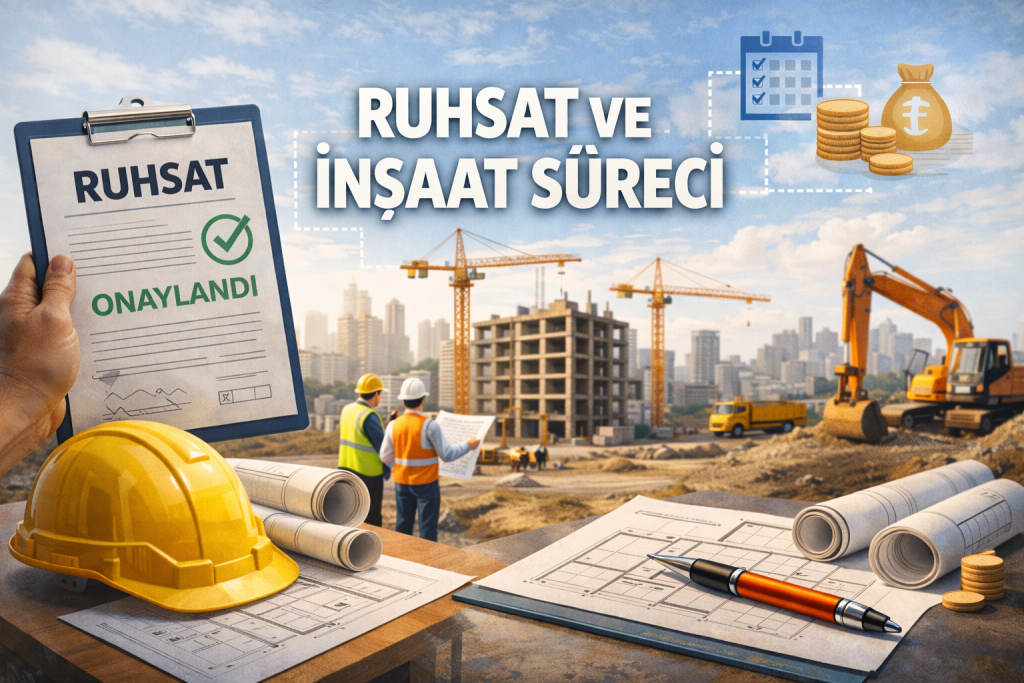
Licensing and Construction Process
Basis: Law on the Transformation of Areas Under Disaster Risk and the Implementation Regulation of Law No. 6306 The phase that begins after the demolition of a risky structure in the urban transformation process is the process of designing, licensing, constructing, and bringing the new structure into use. This phase is not solely based on the private law relationship between the owner and the contractor; it is also a multi-layered administrative process involving the municipality, the Presidency of Urban Transformation, directorates, building inspection bodies, land registry directorates, and other relevant administrations. Therefore, the licensing and construction process is one of the most technical and dispute-prone stages of urban transformation. The Law has meticulously regulated the procedures for decision-making, bid submission, share sales, collateral, licensing, evacuation, demolition, inspection, and registration phases before proceeding with the construction of the new building. Law No. 6306 Art. 6, Art. 8/6; Implementation Regulation Art. 13, Art. 15, Art. 15/A, Art. 17, Art. 18 To proceed with the design of the new structure, the owner’s will regarding how an application will be made on the parcel where the risky structure is located or in the area subject to transformation must be established. In accordance with the Law, in risky structures and application areas; decisions can be made by an absolute majority of shareholders, proportional to their shares, regarding operations such as rebuilding, construction in exchange for flats, revenue sharing, consolidation, parceling, division, abandonment, establishment, registration, and sale of shares. The Regulation also stipulates that, for a decision to be made regarding a new application on parcels where risky structures are located, all owners must be called to a meeting at the request of one of the owners, and the meeting must be notified by announcement for fifteen days at the headman’s office or on the building’s door/notice board, or via a notary. For the meeting to be held, at least an absolute majority is required, and for a decision to be made, again, an absolute majority is necessary. This decision forms the legal basis for the subsequent license and construction process. Law No. 6306 Art. 6/1; Implementation Regulation Art. 15/1-2 At this point, it is important to note that the demolition of structures is not always a prerequisite for making a decision. The Regulation, especially with recent amendments, has accepted that certain decisions in risky areas, reserve building areas, and risky structures can be made even before demolition is completed. Thus, the stages of project development, contractor selection, and preparation for permits can effectively be brought forward. Implementation Regulation Art. 15/2; Art. 15/A/1 One of the most common mistakes made in practice is the assumption that one can directly proceed to the project and licensing phase after a simple majority decision has been made. However, when the law and regulations are considered together, it is mandatory to duly notify the owners who did not participate in the decision of the proposal containing the decision made and the terms of the agreement. This notification is made, to those who have registered an electronic notification address with the land registry, via electronic notification; for those who have not registered, it is made through a notary or by being announced for fifteen days in the relevant headman’s office. The owner who did not participate in the decision is given the opportunity to review and accept the proposal within fifteen days from the date the notification was made or deemed to have been made. Law No. 6306, Art. 6/1; Implementation Regulation, Art. 15/2 More importantly, before applying for a building permit, this proposal must have been duly served on the owners who did not participate in the decision, and an application must also have been made to the directorate or, if authority has been delegated, to the administration for the sale of these owners’ shares. The directorate or administration, in its preliminary review of the sales file, evaluates whether a simple majority has been achieved and whether the notification procedures have been completed; a letter containing these matters is then sent to the administration that will issue the building permit. In other words, in practice, merely an architectural project is not enough to proceed to the licensing stage; majority decision + proposal notification + application regarding the sale process are important together. Implementation Regulation, Art. 15/4 The technical backbone of the licensing process involves the preparation of architectural, static, electrical, mechanical, ground, and other technical projects for the new structure. These projects must be prepared by authorized architects and engineers; they must take into account all technical and legal parameters such as the zoning plan, plan notes, setback distances, floor area ratio (FAR), number of floors, use function, fire, and earthquake regulations. Planning and project preparation in urban transformation projects can be carried out not only at the parcel scale but also, if necessary, based on the phase, block, or application integrity. 6306 sayılı Kanun m. 6/1, m. 6/5-a, ç; Uygulama Yönetmeliği m. 13/6, m. 18 If the application is carried out in a risky area or reserve building area, plan proposals are usually prepared together with an urban design project; and in parcels with risky structures, if the Ministry or Presidency requests it, an urban design project may need to be prepared again. In plan proposals prepared by district municipalities within metropolitan municipality borders, the opinion of the relevant metropolitan municipality is obtained; if the metropolitan municipality does not provide an opinion within fifteen days, a favorable opinion is deemed to have been given. If there are site areas or areas within the scope of Law No. 2863 in the application area, the opinion of the Ministry of Culture and Tourism is obtained, and this opinion is expected to be given within thirty days. In these respects, the project design process is often not merely architectural drawing but a preparatory stage that also has a planning law dimension. Uygulama Yönetmeliği m. 18/3-5 In order for the new structure to be built in accordance with the prepared projects, it is mandatory to obtain a construction permit from the relevant administration. The construction permit is the fundamental administrative procedure indicating that the administration has accepted that the new structure complies with both zoning regulations and decisions made within the scope of urban transformation. Regarding new applications to be made on parcels containing risky structures, the law explicitly accepts that all types of permits and license procedures and transactions related to merger, subdivision, area correction, partition, creation, abandonment, registration, and similar operations, as well as demolition and construction, can be carried out based on a decision taken by the simple majority of shareholders, proportional to their shares. This regulation abolishes the classic understanding of unanimity in transformation areas and enables the permit process to proceed with a majority decision. Law No. 6306, Art. 6/1 The same principle has been preserved in terms of the regulation. In particular, to proceed with a building permit application, it must be shown to the administration that the offer has been notified to the owners who did not participate in the decision and that an application has been made for the sale of their shares. Therefore, the permit application must be supported not only by project attachments but also by legal documents demonstrating that the majority decision and the preconditions for the sale process have been completed. Implementation Regulation, Art. 15/4 There is also an important special provision here: According to the regulation added to Law No. 6306, for structures to be built or commissioned by the Presidency, provided that they are allocated for that purpose in the zoning plans, are not contrary to the implementation zoning plan and legislation, technical responsibility is assumed by the Presidency, and ownership is documented, a building permit is issued based on the preliminary project within thirty days from the application date, without requiring any other document; and after completion, an occupancy permit is arranged within thirty days. This provision pertains not to general practice, but specifically to projects carried out by the Presidency, and foresees a special regime that accelerates the licensing process. Law No. 6306, Additional Article 2 A matter often overlooked during the licensing phase but of vital importance to owners is obtaining collateral from the contractor. Both the law and the regulation stipulate that the construction contractor undertaking the work must be subject to certain guarantee mechanisms during the licensing phase. According to the law, for projects within the scope of this Law, the construction contractor undertaking the work is obliged to obtain building completion insurance, the scope and conditions of which are determined by the relevant administration, or to provide other guarantees and conditions determined by the Presidency, before obtaining a building permit. Law No. 6306, Article 8/6 The regulation, on the other hand, has made the collateral regime more concrete. If implementation is carried out by real persons or private legal entities in parcels where risky structures are located, it is mandatory for the contractor undertaking the construction work to provide the administration with collateral amounting to 6% of the approximate cost of the construction before obtaining the construction permit. However, for structures on a single parcel, with a maximum of two stories excluding a basement, and a total construction area not exceeding 500 square meters, this collateral requirement is not sought if the parcel owner builds their own structure and a note is placed in the land registry stating that no sales will be made to third parties before the completion of construction. The values specified in Law No. 4734 are accepted as collateral; when the project is completed in accordance with the contract and specifications and the occupancy permit is obtained, the collateral is returned. Otherwise, the collateral may be converted into cash and allocated for the completion of the project. Implementation Regulation Art. 13/9-c, ç, d, e, f, ğ This regulation is one of the most fundamental safeguard tools for owners against the risk of “the contractor started but left it unfinished” in practice. While the permit process for the new structure is actively progressing, the evacuation and demolition of the old structure must also be completed in accordance with the procedures. For risky structures, it is essential that the owners carry out the evacuation and demolition; according to the law, owners are given a period not exceeding ninety days, and if the structure is not demolished within this period, it is announced that evacuation and demolition will be carried out by administrative authorities. If demolition does not occur within this period either, evacuation and demolition are carried out by the administration and, if necessary, with the support of law enforcement from the civil authority. Law No. 6306 Art. 5/3-4 The Regulation also introduces detailed provisions regarding demolition permits. In the case of risky buildings, if an application is made by one or more of the building owners or their representatives, a demolition permit is issued within six working days, without requiring the owner’s consent, provided that documents proving that the building to be demolished has been evacuated and electricity, water, and natural gas services have been cut off are submitted, or it is determined by the administration that these services have been actually cut off, and a structural engineer is designated as the demolition supervisor for buildings with a height exceeding 21.50 meters. This is a very important period in practice. Implementation Regulation Art. 8/3-b In risky areas and reserve building areas, a demolition permit may be issued by the administration upon the application of the contractor or one or more of the owners, in the form and under the conditions stipulated in the agreement made with the simple majority of the owners. Implementation Regulation Art. 17/2 After the demolition is completed and the building permit is obtained, the contractor begins construction in accordance with the permit and approved projects. At this stage, the legal legitimacy of the construction to be carried out stems not only from a private contract but also from the entirety of the approved project + permit + building inspection system + guarantee regime. Urban transformation legislation has accepted that owners can re-evaluate their properties through floor-for-flat agreements, revenue sharing, or other methods; and has granted the Presidency, the administration, and those implementing the project the authority to carry out construction, determine land shares, execute title deed transactions ex officio, and personally carry out the project if necessary. Law No. 6306 Art. 6/1, Art. 6/5; Implementation Regulation Art. 13/5-8 For this reason, the construction process is not merely a contractor’s activity; especially in large projects, land acquisition, consolidation, floor easement, independent section distribution, and entitlement calculations can also proceed simultaneously. Constructions carried out within the scope of urban transformation are designed not as a free market activity, but as an application primarily focused on public interest, subject to continuous supervision. While building inspection agencies conduct inspections regarding compliance with the project, material standards, structural system safety, and building safety; the administration and relevant directorate also serve a supervisory function regarding licenses, sales, progress rates, contracts, collateral, and implementation decisions. The law has regulated that numerous works and transactions in urban transformation areas can be carried out ex officio by the Presidency, TOKİ, or the administration; and the regulation has confirmed the active role of the administration regarding works and transactions in the implementation area. Law No. 6306 Art. 6/1, Art. 6/5, Art. 8/2; Implementation Regulation Art. 13/6, Art. 15 Specifically, the contractor’s ability to sell independent sections allocated to their share to third parties is also tied to the construction progress rate. According to the regulation, the contractor applies to the administration for permission to sell the independent sections allocated to their share; the administration determines the construction completion rate by conducting on-site inspections or controls through the building inspection system and may permit the sale of the contractor’s share at a rate below 10 percent of this rate. The independent sections belonging to the contractor cannot be sold without a written consent from the administration. If the contractor wishes to make a sale at a rate equal to or higher than the construction completion rate, the consent of all owners is required. This rule aims to prevent the rights of the owners from being harmed by early sales in the project. Law No. 6306 Art. 6/13; Implementation Regulation Art. 13/10 When the construction process is completed, the next stage is to obtain the occupancy permit, known in practice as iskân (occupancy certificate), which makes the building legally usable. Iskân is an extremely important administrative document that shows the building has been completed in accordance with the license, approved project, and technical regulations. Building inspection reports must be positive, there should be no manufacturing deviations from the project, and the necessary technical documents must be completed. In practice, the actual delivery of independent sections is often tied to obtaining the occupancy permit; because without the occupancy permit, the legal use of the building and subsequent condominium ownership transactions can lead to serious problems. In special applications carried out by the Presidency, the special provision stipulating the issuance of a building permit within thirty days from the application date and an occupancy permit within thirty days after completion, aims for the expedited completion of this stage as well. Law No. 6306, Annex Article 2 The regulation also clearly stipulates that after the project or construction work is completed in accordance with the contract and specification provisions, the collateral will be returned to the relevant party after the occupancy permit is obtained. This indicates that the occupancy permit is a threshold that generates not only technical but also financial and legal consequences. Implementation Regulation, Art. 13/9-e The licensing and construction process is not considered complete merely with the finishing of rough and fine construction. The true legal consequence arises from the proper creation and registration of independent sections in the new structure in the name of the rightful owners. The law allows for the ex officio annulment of old condominium ownership or construction servitude on properties that become vacant land after demolition; subsequently enabling the establishment of construction servitude and condominium ownership for new structures. Old real rights, personal rights, and annotations in the title deed generally continue on shares; however, during the new construction servitude and condominium ownership phase, these rights can only be continued on the independent sections allocated to the obligated owner. Law No. 6306, Article 6/1 The Regulation also stipulates that regarding the building to be constructed based on a construction-for-land-share or assignment-for-land-share contract between the landowner and the contractor, the establishment of construction servitude or condominium ownership can be carried out by the Presidency, TOKİ, or the administration if requested; and that in title deed transactions, the architectural project and management plan approved by the administration will be taken as a basis, and a landowner’s signature may not be required on these documents. This stage completes the land registry law dimension of the licensing and construction process. Implementation Regulation Art. 15/12 The licensing and construction process in urban transformation is often summarized simply as “project drawn, license obtained, building constructed”; however, legislation has established a much more detailed structure. In this process, elements such as simple majority decision, notification of offer to owners not participating in the decision, application for share sale, collateral or building completion insurance, demolition permit, sale with administrative permission, construction inspection control, occupancy permit, and establishment of floor easement and condominium ownership are interconnected. A deficiency in one of these elements can lead to license cancellation, registration issues, contractual disputes, or project delays in subsequent stages. Therefore, the licensing and construction process is the area of urban transformation that needs to be managed most carefully. Law No. 6306 Art. 5, Art. 6, Art. 6/13, Art. 8/6, Add. Art. 2; Implementation Regulation Art. 8, Art. 13, Art. 15, Art. 15/A, Art. 17, Art. 18 Hayır, kentsel dönüşüm kapsamında yapılacak yeni yapılar için ilgili belediyeden veya yetkili idareden inşaat ruhsatı alınmadan inşaata başlanması mümkün değildir. İnşaat ruhsatı, yapılacak yapının imar planına, şehircilik ilkelerine ve teknik mevzuata uygun olduğunu gösteren resmi izin belgesidir. Ruhsat başvurusu sırasında mimari proje, statik proje, zemin etüdü raporu, yapı denetim sözleşmesi ve diğer teknik belgelerin idareye sunulması gerekir. Bu belgeler incelendikten sonra uygun bulunması halinde ruhsat düzenlenir ve ancak bu aşamadan sonra inşaat faaliyetleri başlatılabilir. Kentsel dönüşüm projelerinde müteahhitin bağımsız bölümleri satabilmesi belirli şartlara bağlıdır. Mevzuata göre müteahhit, kendisine düşen bağımsız bölümleri ancak inşaatın ilerleme seviyesine bağlı olarak satışa çıkarabilir ve çoğu durumda idarenin yazılı izninin bulunması gerekir. İnşaatın ilerleme oranı yapı denetim sistemi veya idarenin yerinde incelemesi ile tespit edilir. Bu düzenleme, henüz başlanmamış veya çok erken aşamadaki projelerde yapılan satışların arsa sahipleri ve alıcılar açısından risk oluşturmasını önlemek amacıyla getirilmiştir. Kentsel dönüşüm uygulamalarında çoğu durumda eski yapının yıkılmasının ardından yeni yapı için ruhsat alınır. Ancak uygulamada proje hazırlığı, müteahhit seçimi ve mimari projelerin hazırlanması yıkım tamamlanmadan önce başlatılabilir. Bu durum projelerin daha hızlı ilerlemesini sağlar. Yine de yeni binanın fiilen inşa edilebilmesi için yapı ruhsatının alınmış olması zorunludur ve bu ruhsat genellikle yıkım süreci tamamlandıktan sonra düzenlenir. Kentsel dönüşüm kapsamında yapılan binalar hem yapı denetim kuruluşları hem de ilgili idareler tarafından denetlenir. Yapı denetim firmaları, projeye uygunluk, kullanılan malzemelerin kalitesi, statik güvenlik ve mühendislik standartları açısından inşaatın tüm aşamalarını kontrol eder. Ayrıca belediyeler ve ilgili kamu kurumları da ruhsat, proje ve uygulama süreçlerini denetleyerek yapının mevzuata uygun şekilde yapılmasını sağlar. Bu çok katmanlı denetim sistemi sayesinde yeni yapıların deprem güvenliği ve teknik standartlara uygunluğu garanti altına alınır. İnşaat tamamlandıktan sonra alınan yapı kullanma izin belgesi (iskan), binanın ruhsata ve onaylı projelere uygun şekilde tamamlandığını gösteren resmi belgedir. İskan alınmadan binanın hukuken kullanılması ve kat mülkiyetine geçilmesi çoğu zaman mümkün değildir. Ayrıca elektrik, su ve doğalgaz gibi abonelik işlemlerinin yapılabilmesi için de iskan belgesi büyük önem taşır. Bu nedenle kentsel dönüşüm projelerinde inşaatın tamamlanmasının ardından iskan işlemlerinin eksiksiz şekilde gerçekleştirilmesi gerekir. Urban transformation projects are not merely a construction process; they are also a complex legal process involving land law, contract law, zoning law, and administrative law concurrently. Decisions to be made among owners, construction contracts in exchange for flats with the contractor, licensing and project processes, independent unit sharing, and title deed transactions lead to serious legal consequences. Therefore, obtaining legal support from the outset of the process is of great importance in preventing potential disputes that may arise in the future. Among the most common problems encountered in urban transformation projects are poorly prepared contracts, contractor-induced delays, disputes over the sharing of independent sections, errors in title deed transactions, and unfinished projects. To prevent such risks, especially revenue-sharing construction contracts and urban transformation contracts must be prepared or reviewed by an expert lawyer. In this context, 2M Law Office offers consultancy and litigation services in the field of urban transformation law. Professional support is provided for landowners and investors, especially those seeking an **Istanbul urban transformation lawyer**, regarding contract preparation, contractor selection, project consultancy, and dispute resolution. In transformation projects carried out in Tuzla and its surroundings, seeking the support of a **Tuzla urban transformation lawyer** provides significant advantages both for the correct management of the contract process and the protection of property owners’ rights. In conclusion, working with an expert lawyer in the urban transformation process is not merely legal consultancy; it also serves as a strategic safeguard that prevents loss of rights in projects of high financial value. Especially, obtaining professional legal support during contract preparation, agreements with the contractor, and licensing processes contributes to the safe and smooth completion of the project.1. Transition to the Project Design Process and Owner’s Decision
2. Notification of Offer to Owners Not Participating in the Decision and Prerequisite for Obtaining a Permit
3. Preparation of Architectural, Static, and Technical Projects
4. Construction Permit Application and the Legal Nature of the Permit
5. Obtaining Collateral from the Contractor and Building Completion Guarantee
6. Evacuation, Demolition of the Old Structure, and Demolition Permit
7. Commencement of Construction and the Legal Framework of Construction Activity
8. Technical and Administrative Supervision of the Construction Process
9. Completion of Construction, Occupancy Permit, and Habitation
10. Transition to Floor Easement, Condominium Ownership, and Delivery Stage
11. The Most Critical Point in Practice: The Licensing Process Is Not Only Technical, But Also a Legal Process
Frequently Asked Questions
Kentsel dönüşümde inşaat ruhsatı alınmadan inşaata başlanabilir mi?
Kentsel dönüşümde müteahhit bağımsız bölümleri inşaat bitmeden satabilir mi?
Riskli bina yıkılmadan yeni proje için ruhsat alınabilir mi?
Kentsel dönüşümde yapı denetimi nasıl yapılır?
İnşaat tamamlandıktan sonra iskan almak neden önemlidir?
Why is Expert Lawyer Support Necessary in Urban Transformation?