
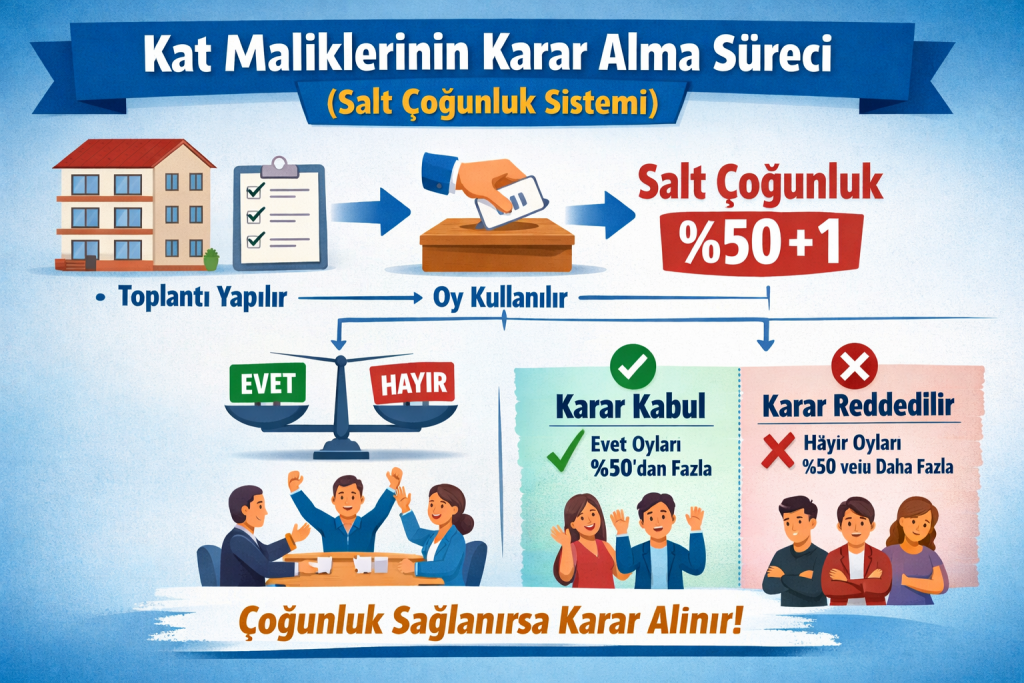
Property Owners’ Decision-Making Process and the Simple Majority System
Legal Evaluation After the 2019 and 2023 Amendments Within the Scope of Law No. 6306
This study examines the decision-making process of property owners from an academic and practical perspective, particularly within the framework of the provisions of the Law on the Transformation of Areas Under Disaster Risk amended by Law No. 7181 dated 2019 and Law No. 7471 dated 2023. Each heading below has been evaluated in detail by specifying the relevant article of the law. Additionally, the provisions of the Implementation Regulation of Law No. 6306 have been integrated into the relevant sections.
1. Annulment of Condominium Ownership (Article 6/1)
In accordance with the first paragraph of Article 6 of Law No. 6306, with the demolition of the risky structure, the immovable property becomes land, and the previously established condominium right or condominium ownership is automatically annulled by the land registry office upon the request of the Presidency, without seeking the consent of the interested parties. This regulation was introduced to prevent the transformation process from being blocked due to the objection of one of the owners.
In accordance with Article 8 of the Implementation Regulation, after the completion of the demolition of the risky structure, the “risky structure” annotation in the land registry is cancelled; however, an annotation stating that the immovable property is within the scope of Law No. 6306 is recorded in the land registry. Thus, the immovable property ceases to be under the classic condominium ownership regime and enters a special status subject to the transformation regime.
After the cancellation process, the immovable property is re-registered based on its previous qualification, in proportion to the landowners’ shares. Real and personal rights such as mortgages, foreclosures, precautionary attachments, and usufruct rights, which are present in the land registry, continue over the land shares. According to Article 15/A of the Regulation, these rights continue over the sale price during the public auction process.
With the 2019 amendment, the requirement for the consent of all owners in transactions related to consolidation, subdivision, partition, area correction, establishment of floor easement, and condominium ownership was also removed. This amendment eliminated the problem known in practice as the ‘unanimity obstacle’. Article 15 of the Regulation also explicitly stipulated that these transactions could be carried out with a simple majority.
2. Concept of Simple Majority and Its Legal Nature (Article 6/1)
As a result of the amendment made by Law No. 7471, the phrase ‘at least two-thirds majority’ in Article 6 was removed and replaced with the phrase ‘simple majority of shareholders in proportion to their shares’. Simple majority refers to more than 50% of the total land share.
The criterion adopted here is not the number of owners, but the land share ratio. According to Article 15/2 of the Regulation, the call for a meeting is made through an announcement for 15 days at the headman’s office or via notary notification; the decision is again calculated based on the land share ratio. The last day of the headman’s announcement is considered the date of notification.
Therefore, contrary to the common mistake made in practice, calculations should be based on the percentage of land share, not on the number of individuals. This regulation aims to ensure faster urban transformation decisions and prevent minority shareholders from blocking the process.
3. Transition from the Two-Thirds System to the Simple Majority System (Amendment to Article 6/1)
In the system in force between 2012 and 2023, approval from at least two-thirds of the land shares was required for decisions. With the amendment made in 2023, this ratio was reduced to a simple majority. This change signifies a paradigmatic transformation in urban transformation law.
The two-thirds majority system, in practice, led to projects being stalled for years, especially due to small-share owners blocking the process. With the transition to the simple majority system, the decision-making threshold has been lowered, the emphasis on public interest strengthened, and the acceleration of transformation projects has been targeted.
Article 15 of the Regulation concretized this transformation at the implementation level by stipulating that actions such as rebuilding structures, making flat-for-land agreements, determining revenue sharing models, merging parcels (tevhit), subdividing parcels (ifraz), and selling shares can be performed with a simple majority.
4. Sale of Land Shares of Owners Who Do Not Participate in the Decision (Article 6/1)
After a decision is made by a simple majority, a special sales procedure is stipulated for the land shares of owners who did not participate in the decision. According to the law, the content of the offer is communicated to the owners who did not participate in the decision via a notary or by being publicly announced in the headman’s office for 15 days. The last day of the announcement made in the headman’s office is considered the date of notification. Furthermore, it is mandatory to make an e-notification via UETS to owners who have an electronic notification address.
If acceptance does not occur within the specified period, the land shares are sold by public auction, after their fair market value is determined by the Presidency. In accordance with Article 15/A of the Regulation, a Price Determination Commission and a Sales Commission are established for the sale; the fair market value is determined by SPK-licensed valuation institutions.
Priority is given to other shareholders who have reached an agreement. In the first sale, only these shareholders can participate in the tender. In subsequent sales, the participation of third parties is possible; however, a deposit of 10% of the fair market value is required.
If the sale cannot be realized in this manner, shares in risky areas or reserve building areas can be purchased by the Presidency, Administration, or TOKİ at their fair market value. This regulation is a compulsory legal mechanism aimed at preventing minority owners from obstructing the process.
5. Public Auction Procedure and Legal Consequences of the Sale Transaction (Article 6/1)
The fair value determined during the auction process constitutes the lower limit of the sale. It is not possible to sell below this value. In accordance with Article 15/A/5 of the Regulation, restrictions such as mortgages, attachments, and usufruct rights do not prevent the sale; these rights continue over the sale price.
After the sale, rights and annotations in the title deed record are canceled upon the administration’s request.
In the event that the sale transaction is canceled by a court decision, if a cancellation decision is given for reasons other than the price being calculated incorrectly, in accordance with Article 15/A/16 of the Regulation, the land share is registered ex officio in the name of the former owner. If the cancellation is due to an insufficient price, the transaction can be rectified by the purchasing owner paying the difference along with legal interest.
6. Fair Value Determination and Valuation Process (Articles 6/1 and 6/7)
In accordance with the Law, the valuation of properties subject to transformation is carried out or commissioned by the Presidency, TOKİ, or the Administration. In accordance with Article 12 of the Regulation, valuation is carried out by an appraisal commission of at least 3 people or services are obtained from CMB-licensed institutions.
The valuation process is carried out taking into account the current status of the property, development rights, location, and economic conditions.
Fair value determination is a key determining factor, especially in land share sales. The claim that the value was calculated incorrectly can be subject to a lawsuit. However, with the 2022 and 2023 amendments, the grounds for cancellation of sales have been narrowed, and a correction mechanism has been introduced through the payment of the price difference. This approach aims to prevent projects from being halted by judicial processes.
7. Electronic Notification Requirement and Notification Procedure (Article 6/1, 3/2 and 5/5)
With the 2023 amendments, digitalization in the notification system has been strengthened. Risk assessment and demolition notifications are carried out in accordance with Articles 7 and 8 of the Regulation;
Posting of a report on the building,
15-day public announcement at the headman’s office,
e-Government notification,
If there is an electronic notification address, notification via UETS is carried out. The last day of the announcement made at the headman’s office is considered the notification date. Notifications to owners who do not agree with the decision are also subject to the same announcement-notification system. This regulation aims to reduce claims of irregular notifications and to accelerate the process.
Conclusion and Evaluation
The amendments made to Law No. 6306 in 2019, and especially in 2023, have brought about a radical transformation in the decision-making process for property owners. The de facto abolition of the unanimity requirement, the abolition of the two-thirds majority system and the transition to a simple majority system, the subjection of land shares of owners who do not agree with the decision to a mandatory sale mechanism through public auction, and the strengthening of the electronic notification system, demonstrate that transformation law has been restructured around the axis of public interest.
In current practice, the most critical legal issues are the correct calculation of the simple majority, the proper conduct of the proposal notification process, ensuring announcement deadlines are not missed, and the lawful determination of fair market value. This area is subject to intensive litigation practice in both administrative and judicial courts.
Urban transformation is not merely a technical zoning application; it is a complex legal process that establishes a delicate balance between property rights, public safety, and economic interests. Therefore, expert legal evaluation in each specific case is of great importance.
Why is Expert Lawyer Support Necessary?
The urban transformation process carried out under Law No. 6306 has gained a technical and demanding legal structure, especially after the 2019 and 2023 amendments. The correct calculation based on the majority’s land share, the flawless execution of meeting and notification procedures, the share sale process for owners who do not participate in the decision, and the lawful determination of the fair market value are of great importance. Procedural errors made at these stages can lead to the annulment of decisions and serious loss of rights.
The open auction process, valuation reports, UETS notifications, and process management are subject to both administrative and judicial review. Furthermore, construction for land share and revenue sharing agreements entail high financial risk for landowners. Improperly structured agreements can lead to disputes lasting for many years.
Therefore, obtaining expert legal consultancy from the beginning of the process prevents loss of rights and ensures the safe progression of the project. 2M Hukuk Avukatlık Ofisi, operating from Istanbul and Tuzla, provides professional support nationwide in urban transformation consultancy, contract drafting, and litigation.