Evacuation and Demolition of Risky Buildings (Within the Scope of Article 5 and Regulation Article 8)
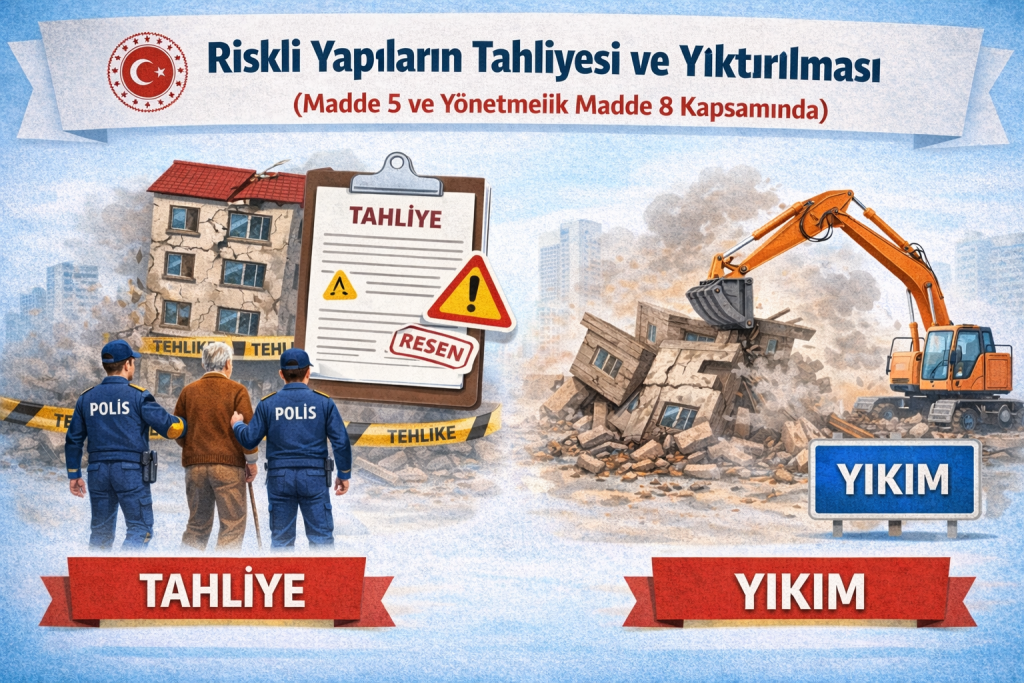
The most critical and consequential stage in the urban transformation process is the evacuation and demolition of the risky building. Article 5 of Law No. 6306 and Article 8 of the Implementing Regulation govern this process in a detailed and binding manner. Especially after the amendment to Law No. 7471, extensive powers have been granted to the administration regarding notification procedures, deadlines, law enforcement support, and the collection of expenses.
Below, the process is explained with its legal bases and practical results in implementation.
Finalization of Risky Building Detection and the 2-Day Objection Period (Article 6/A/2)
4
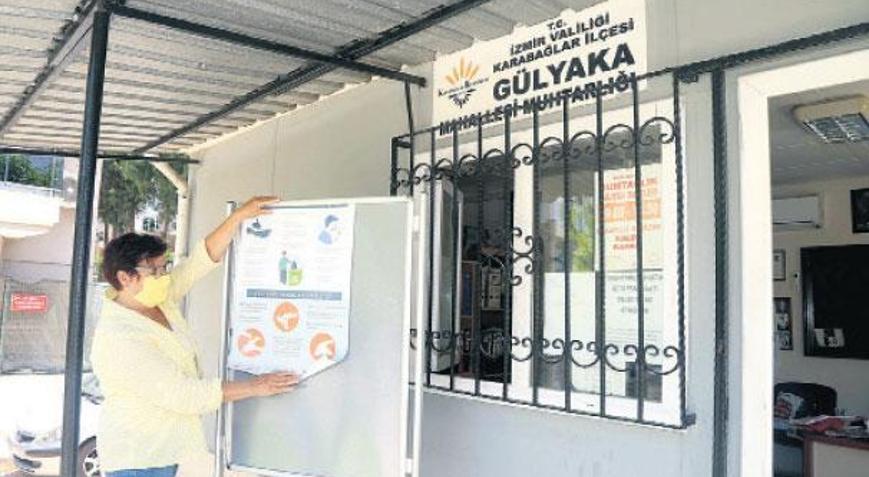
After a risky building is identified, the most critical stage for the owners is the objection period. In accordance with Article 6/A/2 of Law No. 6306, the list of structures deemed risky is posted on the building to serve as notification and announced at the relevant mukhtar’s office for two days. This announcement is considered to have been personally served to the owners.
Owners can object within two days from the date of this announcement. Objections made are decided by a technical committee within three days (Art. 6/A/2). If no objection is made or the objection is rejected, the risky building determination becomes final.
In practice, the answers to questions such as “how many days is the objection period for a risky building?”, “how does the acceptance of a risky building become final?”, and “what does a 2-day objection mean in urban transformation?” are found in this regulation. Due to the very short timeframes, this stage can often lead to loss of rights.
Issuance of Notification by Public Announcement (Article 5/5 and Regulation 8/2)
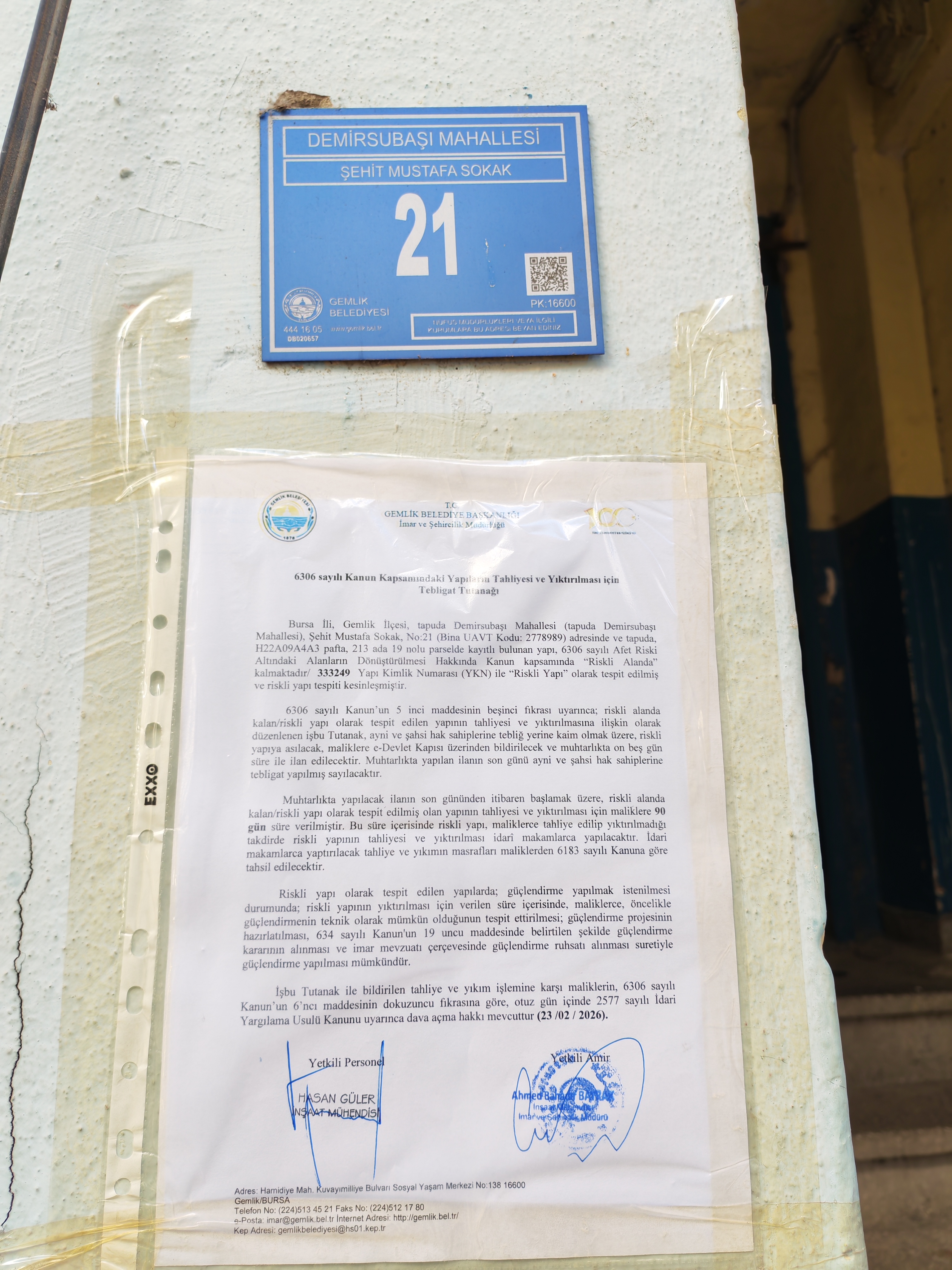
After the determination of a risky building becomes final, the evacuation and demolition process begins. Pursuant to Article 5/5 of Law No. 6306, the notification regarding evacuation and demolition;
Posting the record pertaining to evacuation and demolition on the building,
Notifying the owners via the e-Government Portal,
is carried out by public announcement at the relevant headman’s office (muhtarlık) for a period of 15 days.
The last day of the announcement made at the headman’s office is considered to be the day of notification to the holders of in-rem and personal rights (Art. 5/5). Additionally, buildings requested for evacuation are also announced on the Presidency’s website for a period of 15 days.
Regulation Art. 8/2 mandates the preparation of Annex-7/A for risky buildings; and Annex-7/B for risky areas and reserve building areas. This regulation is the direct answer to questions such as “is notification by headman’s announcement valid?”, “what is the e-Government notification for risky buildings?”, and “what is the notification procedure for urban transformation?”.
Granting a 90-Day Period to Owners (Article 5/3 and Regulation 8/3-a)
For the demolition of risky buildings, owners are given a period not exceeding ninety days (Law No. 6306, Art. 5/3). Within this period, the building must be evacuated and demolished by the owners.
Pursuant to Regulation Art. 8/3-a, if the building is not evacuated and demolished within this period, it is explicitly stated that the building will be evacuated and demolished by administrative authorities.
This provision is the legal basis for searches such as “What is the 90-day period in urban transformation?”, “How many days does it take to demolish a risky building?”, and “What happens if the owner does not demolish it?”.
Demolition by the Administration if Not Demolished Within the Period (Article 5/3-4 and Regulation 8/4)
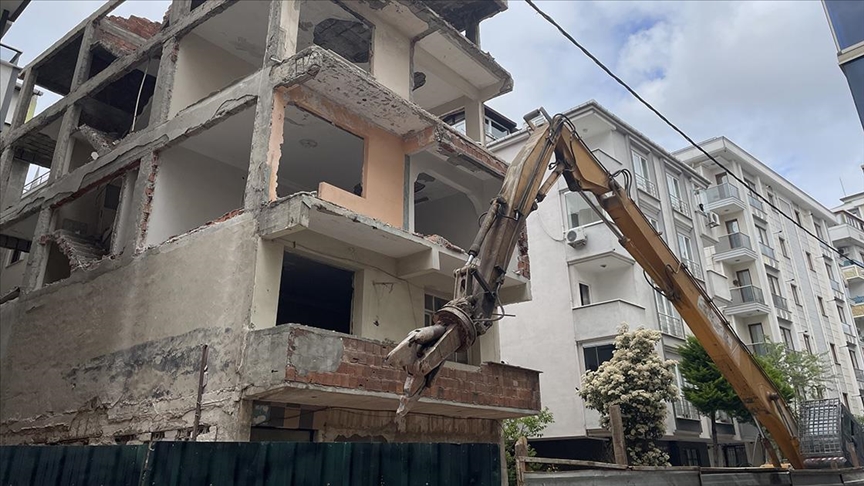
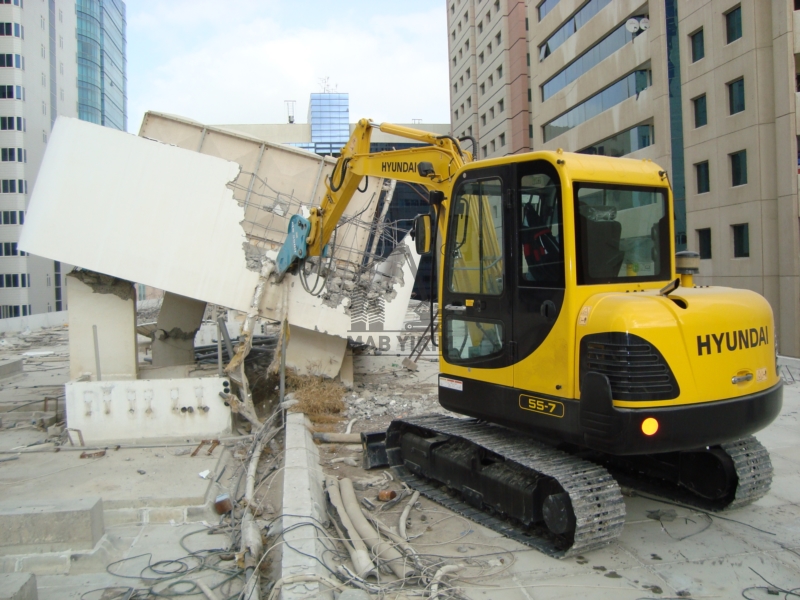
If the owners do not carry out the demolition within the given period, the process passes to the administration. Pursuant to Article 5/3 of Law No. 6306, the evacuation and demolition of structures are carried out or ordered by the administrative authorities. Demolition expenses and necessary aid are primarily covered by the Special Account for Transformation Projects.
Pursuant to Article 5/4, risky structures determined not to have been demolished within the period are reported in writing to the Administration by the Presidency, and are demolished/caused to be demolished by the Administration. If the implementation requires it, the Presidency may carry out the demolition itself.
Regulation Article 8/4 details this process, regulating the direct intervention of the administration.
Evacuation with Law Enforcement Support (Article 5/4 and Regulation 8/5)
In cases such as preventing evacuation, locking doors, or using threats or force, pursuant to Article 5/4 of Law No. 6306, closed doors can be opened by law enforcement with written permission from the administrative authority, and evacuation can be carried out ex officio.
Regulation Article 8/5 details this provision. This stage is particularly important for queries such as “forced evacuation in urban transformation”, “law enforcement support for risky structures”, and “can evacuation be carried out by opening doors?”.
Electricity, Water, and Natural Gas Cut-off (Regulation 8/3-c)
If the owners do not demolish the risky structure within the given period, the relevant institutions and organizations are requested not to provide electricity, water, and natural gas to the risky structure and to stop the services provided (Reg. Art. 8/3-c). It is mandatory for the relevant institutions to fulfill this request.
This regulation ensures that risky structures are effectively put out of use.
Collection of Costs According to Law No. 6183 (Article 5/4 and Regulation 8/8)
The costs of identifying, evacuating, and demolishing risky structures incurred by the Presidency or the Administration are collected from the owners in proportion to their shares (Art. 5/4).
According to Regulation Art. 8/8, costs are paid within one month following the notification. If not paid within the period, they are pursued according to the provisions of Law No. 6183 on the Procedure for the Collection of Public Receivables.
This situation forms the legal basis for questions such as “who pays for urban transformation demolition costs?” and “what happens if a risky structure’s demolition debt is not paid?”.
Relocation Assistance, Rent Assistance, and Construction Assistance (Article 5/1-2)
According to Article 5/1 of Law No. 6306, temporary housing or workplace allocation, or rent assistance and construction assistance, may be provided to building owners, tenants, and limited real right holders residing in the structure who have been evacuated by agreement. With the amendment numbered 7471, it has been stipulated that the procedures and principles of construction assistance will be determined by the President.
According to Article 5/2, assistance may also be provided to the users of the structure if the implementation requires it.
Reinforcement Option (Regulation 8/7)
If the reinforcement of a risky structure is requested instead of its demolition; it is necessary to determine that reinforcement is technically possible, to make a decision in accordance with Article 19/2 of the Condominium Law, to prepare a reinforcement project, and to obtain a license (Reg. Art. 8/7).
If the reinforcement is completed within the specified period, the annotation of a risky structure is removed.
Cancellation of the Risky Structure Annotation (Regulation 8/9)
After demolition, the risky structure annotation in the declarations section of the land registry is cancelled. Subsequently, a note is made indicating that the immovable property falls under Law No. 6306 (Reg. Art. 8/9).
Conclusion
The process of evacuating and demolishing risky structures; from a 2-day objection period to a 15-day public notice, from a 90-day demolition period to police support, and from the collection of public receivables to rental and construction aid, is a multi-stage and technical procedure.
Therefore, the urban transformation evacuation process and the risky structure demolition procedure must be carefully analyzed within the framework of the provisions of Law No. 6306 and its Implementing Regulation. Correct interpretation of legal grounds at every stage of the process is a fundamental condition for eliminating the risk of rights loss.
Why is Expert Legal Support Necessary? (Legal Assurance in the Risky Structure Evacuation and Demolition Process)
The evacuation and demolition process of risky structures, under Article 5 of Law No. 6306 and Article 8 of its Implementing Regulation, involves procedures with severe consequences such as notification, announcement, time limits, police intervention, and collection of public receivables. The slightest procedural error made during this process can result in loss of property rights, debt burden, forced eviction, and irreversible title deed transactions.
In short; the urban transformation evacuation process is not only technical but also a high-risk area of administrative law and real estate law.
Time Management and Notification Errors are of Critical Importance
If the 2-day objection period for a risky building (Art. 6/A/2) is missed, the determination becomes final.
Notification by announcement for 15 days (Art. 5/5, Reg. Art. 8/2) often produces results without actual knowledge.
At the end of the 90-day demolition period (Art. 5/3), eviction by law enforcement is possible.
The most common problem encountered in practice is: Owners realizing the process late and losing the opportunity to file a lawsuit. An expert urban transformation lawyer prevents loss of rights by simultaneously tracking announcement dates, e-Government notifications, and administrative procedures.
Legal Strategy Against Forced Eviction and Law Enforcement Intervention Risk
In accordance with Article 5/4 of the Law and Regulation 8/5, if eviction is obstructed, law enforcement can carry out the eviction by opening closed doors. At this point;
The legality of the eviction decision,
Proper setting of deadlines,
Notification procedure,
Determination of owner status and entitlement
should be examined in detail. Otherwise, irreversible consequences may arise. Professional legal representation takes the process under control and evaluates effective remedies, including a stay of execution if necessary.
Cost Collection and Public Debt Risk According to Law No. 6183
Demolition costs are collected from owners in proportion to their shares, and if not paid, they become a public receivable under Law No. 6183 (Art. 5/4, Reg. Art. 8/8). This situation can lead to;
Seizure,
Blocking of bank accounts,
And annotations on immovable properties.
Expert legal support verifies the legality of expense items and eliminates the risk of unfair collection.
Rent Assistance, Construction Assistance and Entitlement Calculation
Within the scope of Law No. 6306, Article 5/1-2;
Rent assistance,
Relocation assistance,
Construction assistance,
Rights such as temporary housing allocation are available. However, in practice, erroneous assessments, insufficient payments, or incorrect entitlement determinations are frequently observed.
A risky building law consultant reviews entitlement and valuation calculations; ensures the correct determination of land share, independent section value, and indebtedness items.
Reinforcement Option and Alternative Legal Solution
According to Regulation Article 8/7, a reinforcement option is possible. However;
Technical report,
Condominium Law Article 19/2 decision,
If the licensing process is not carried out properly, rights may be lost. Without expert legal guidance, the reinforcement process often fails.
Secure Urban Transformation Process with 2M Hukuk Law Office
2M Hukuk Law Office, based in Istanbul, provides active consultancy services in all districts of Istanbul, especially in Istanbul’s Anatolian Side (Kadıköy, Üsküdar, Ataşehir, Maltepe, Kartal, Pendik, Tuzla, Ümraniye, Çekmeköy, Sancaktepe, Beykoz), and in the Kocaeli (İzmit, Gebze, Darıca, Çayırova, Körfez) region.
Additionally, nationwide in Turkey;
Consultancy for risky building evacuation process
Litigation process for Law No. 6306
Cancellation lawsuits for risky areas and reserve building areas
Termination of flat-for-land construction contracts
Contractor default and notification processes
Title deed annotation and erasure procedures
It provides comprehensive legal support in the areas of entitlement and objections to indebtedness.