Process of Determining Risky Buildings
(Legal Analysis in the Framework of Court Decisions with the Amendment of 21/05/2024, Law No. 6306 Art. 3 and Implementation Regulation Art. 7)
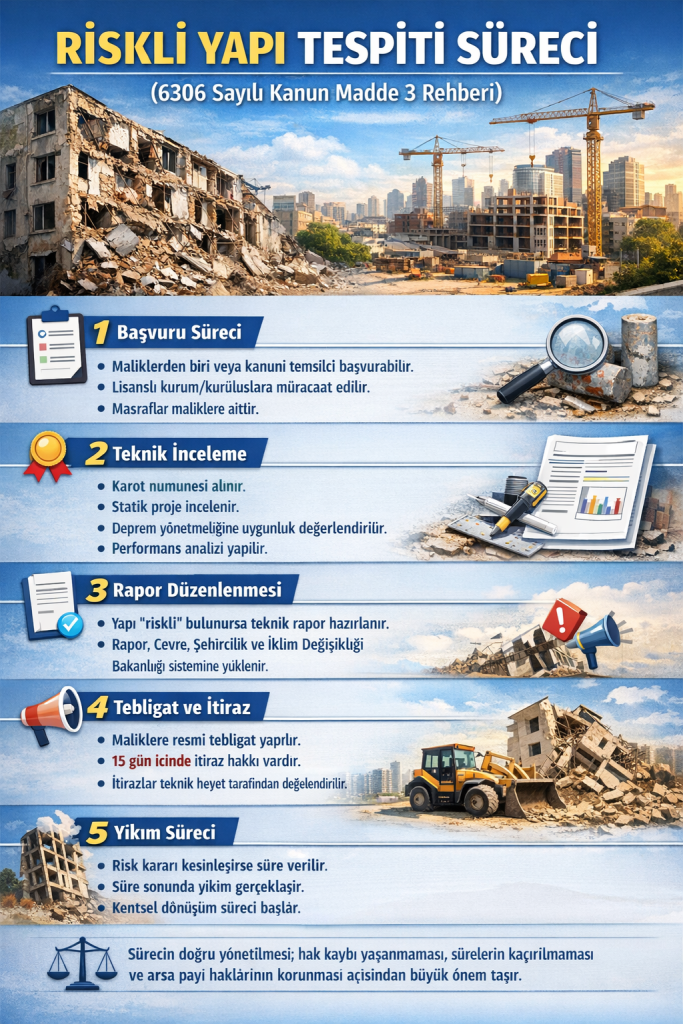
The determination of risky buildings is an administrative procedure regulated within the scope of Article 3 of Law No. 6306 on the Transformation of Areas Under Disaster Risk and Article 7 of the Implementation Regulation, directly affecting property rights. The classification of a building as “risky” leads to serious legal consequences, including an annotation in the land registry, the commencement of the demolition process, owners moving to the decision-making stage with a simple majority, and even extending to the land share sale procedure (Law No. 6306 Art. 3, Art. 6; Imp. Reg. Art. 7).
With the amendment dated 21.05.2024, the process has been made more systematic in terms of electronic software requirement, the single report principle, digitalization of the announcement and notification system, and strengthening of the technical inspection mechanism (Imp. Reg. Art. 7/1, Art. 7/3, Art. 7/4).
Below, the process is explained in detail by evaluating the articles of the law and regulation together.
1. Definition and Scope of Risky Buildings
A risky building is a structure that has completed its economic life, carries the risk of demolition or severe damage, and where this risk is demonstrated with scientific and technical data (Law No. 6306 Art. 3/1).
According to the Regulation, the determination of risky buildings can be made for structures that can be used independently, are covered, and are used by people for purposes such as shelter, work, worship, or recreation, as well as structures used for the protection of animals and goods; buildings under construction or derelict buildings are not included in this scope (Imp. Reg. Art. 7/1).
In the decisions of the Council of State, it is emphasized that a risky building report must necessarily include performance analysis, core samples, static calculations, and technical data; and that reports based solely on observational opinion are grounds for annulment.
2. Electronic Software Requirement
With the amendment of 21/05/2024, the identification of risky buildings has been made possible only through the electronic software system developed by the Presidency (Impl. Reg. Art. 7/1).
Reports prepared outside the electronic system constitute a procedural irregularity. Furthermore, it is mandatory for the report to include the address and building code from the National Address Database (Impl. Reg. Art. 7/3).
In judicial decisions, reports prepared without creating an electronic record are considered unlawful.
3. Identification of Risky Buildings by the Owner
The identification of risky buildings is primarily commissioned by the owner or their legal representatives, and the expenses are borne by them (Law 6306 Art. 3/1; Impl. Reg. Art. 7/2-a).
In title deeds with land shares where condominium ownership has not been established, the actual building owner, who is a land shareholder, can submit an application. If the building is noted in the title deed as belonging to another party, the person in whose favor the annotation is made can commission the identification (Impl. Reg. Art. 7/2-a). In the practice of the Council of State, identifications commissioned by third parties who do not have owner status are annulled.
4. Administration’s Authority for Ex Officio Identification
If the owners fail to commission the identification, the Presidency or the Administration grants a period; if it is not commissioned by the end of this period, an ex officio identification is carried out (Law 6306 Art. 3/1; Impl. Reg. Art. 7/2-b). In this case, the expenses are charged to the owners in proportion to their shares, and if not paid, they are collected as a public receivable in accordance with Law No. 6183 (Impl. Reg. Art. 7/2-b). In Council of State decisions, ex officio identification procedures carried out without granting a period have been found unlawful.
5. Prevention of Assessment and Entry by Law Enforcement
If the assessment is prevented, doors are kept locked, or force is used, forced entry can be made by law enforcement after obtaining written permission from the local administrative authority (6306 m.3/1; Uyg. Yön. m.7/2-c). Forced entry procedures carried out without written permission are considered unlawful.
6. Principle of Single Report
As a rule, only one risky building assessment report can be prepared for each building (Uyg. Yön. m.7/3).
However;
Re-assessment upon objection,
Judicial decision,
Discovery of falsehood/inaccuracy,
In cases of a new concrete event affecting the building’s risk status, a new report is possible (Uyg. Yön. m.7/3). This regulation aims to prevent attempts to “change the outcome by changing the report” in practice.
7. Administrative Review and Annotation on Title Deed
The report is sent to the Provincial Directorate via the electronic system and is technically reviewed (Uyg. Yön. m.7/4). If there are no deficiencies, it is reported to the land registry office within a maximum of 10 business days, and an annotation “Risky Building” is registered in the declarations section (Uyg. Yön. m.7/4). This annotation directly affects sales, loans, building-for-land share agreements, and bank transactions.
8. Notification and Announcement System
The record regarding the identification of a risky building:
Is posted on the building
Is notified via e-Devlet
Is announced at the headman’s office for 15 days
Is published on the Presidency’s website. The last day of the headman’s office announcement is considered the notification date (Uyg. Yön. m.7/4). In Council of State decisions, irregular notification has been considered a reason for annulment.
9. 15-Day Objection Period
Owners or their legal representatives can object within 15 days from the last day of the headman’s announcement (Imp. Reg. Art. 7/5). This period is preclusive. Objections not made within the period are not processed (Imp. Reg. Art. 7/5).
10. Technical Committee Review
Objections are examined by a 7-person technical committee (Law 6306 Art. 3; Imp. Reg. Art. 7/6). The committee evaluates the report from a technical perspective and makes a decision. The process becomes final after the committee’s decision.
11. Cultural Heritage Exception
For structures under Law No. 2863, the determination of a risky structure depends on the owner’s request, and procedures are carried out in accordance with the Protection Board’s decision after finalization (Imp. Reg. Art. 7/8).
12. Ex Officio Risky Determination (Article 6/A Process)
In structures that are dangerously close to collapse, the Presidency can directly decide on a risky determination; the announcement is made for 2 days, objections are filed within 2 days, and the technical committee decides within 3 days (Law 6306 Art. 6/A). This procedure is much faster than the ordinary risky structure process.
13. Legal Consequences of Risky Structure Determination
When the risky structure determination becomes final:
The 90-day demolition process begins (Law 6306 Art. 5)
Electricity, water, and natural gas may be cut off.
Condominium ownership may be cancelled.
The decision-making process by simple majority begins (Law 6306 Art. 6).
The sale of land shares may come on the agenda.
Urgent expropriation may be applied. Procedural errors made at this stage can lead to loss of ownership.
14. Judicial Review and Right to Sue
The determination of a risky building is an administrative act, and an annulment lawsuit can be filed in the administrative court within 30 days from the notification (6306 art.6/9).
The grounds for annulment in the Council of State’s jurisprudence are:
Improper notification
Lack of technical calculation
Failure to perform performance analysis
Error in owner’s capacity
Report outside the electronic system
Violation of the single report principle
Legal Consequences of Risky Building Determination
After the determination of a risky building:
The demolition process begins (90 days).
Electricity, water, natural gas may be cut off.
Condominium ownership is cancelled.
The decision-making process by simple majority begins.
Sale of land share may come on the agenda.
Urgent expropriation can be carried out. An error made at this stage can lead to loss of property.
Conclusion
The risky building determination process is a multi-layered administrative mechanism consisting of technical examination, electronic registration, administrative audit, title deed annotation, notification, objection, technical committee, and judicial review stages (6306 art.3; Impl. Reg. art.7).
Any procedural or technical error made during this process can lead to the cessation of demolition or loss of property. Therefore, the risky building process requires not only engineering but also strong legal oversight.
Why is Expert Lawyer Support Necessary?
The risky building process;
Administrative act
Title deed transaction
Law of notification
Expropriation law
Condominium ownership law
Administrative law
is a multifaceted process with aspects of criminal law.
Legal support is particularly needed in the following areas:
✔ Monitoring of deadlines
✔ Preparation of objection petitions
✔ Monitoring of the technical committee process
✔ Supervision of title deed annotations
✔ Lawsuit against irregular reports
✔ Control of demolition period
✔ Prevention of land share sales
Safe Urban Transformation Process with 2M Law
As 2M Hukuk Law Office; we provide legal consultancy as urban transformation lawyers from the beginning to the end of the risky building process in all districts of Istanbul (Kadıköy, Üsküdar, Ataşehir, Maltepe, Kartal, Pendik, Tuzla, Beşiktaş, Şişli, Bakırköy, Bahçelievler, Küçükçekmece, Başakşehir, Esenyurt, Beylikdüzü and all other districts), as well as in the Gebze, Çayırova, Darıca regions of Kocaeli.
Strategic Legal Management in the Building Process
The validity of the notification is examined.
The 15-day objection period is not missed. The report is technically reviewed. If necessary, an annulment lawsuit is filed. Property rights are protected. Precautions are taken against the sale of land shares.
The identification of a risky building is not merely a technical process. It is an administrative process that directly impacts property rights. An incorrect or unchecked risk report:
Demolition
Sale of land share
Expropriation
can lead to loss of rights. Therefore, the process must be conducted under expert legal supervision from the very first day.