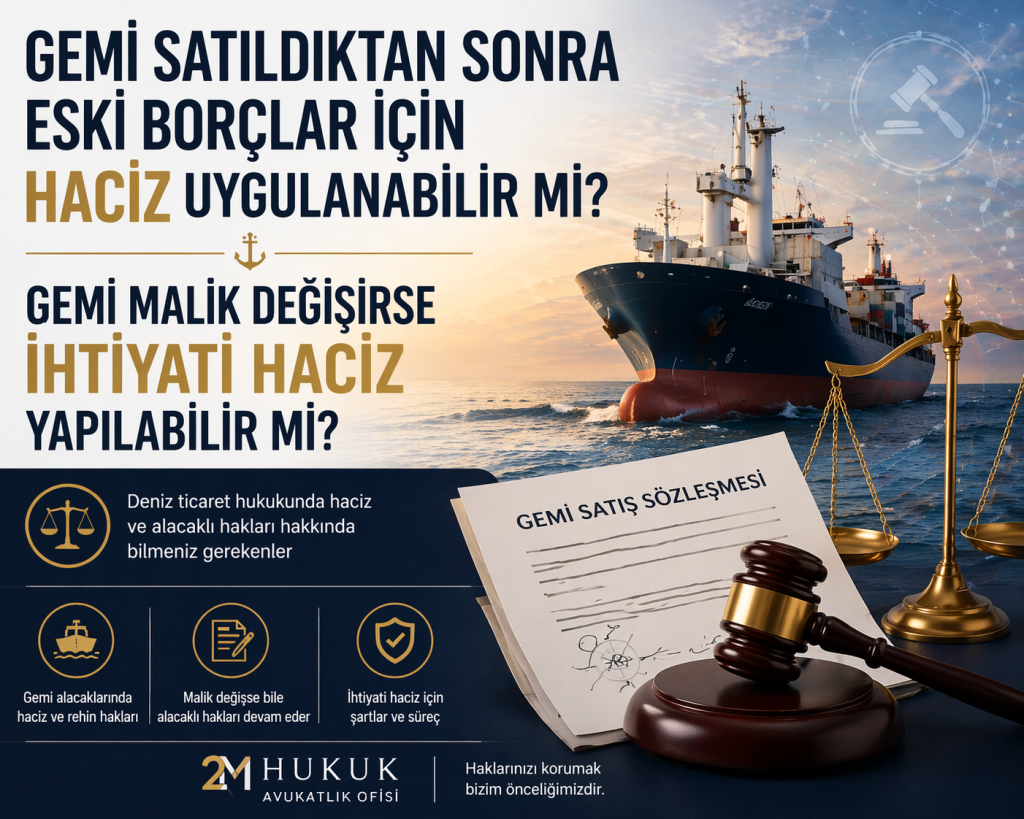
1. The Effect of Change of Ownership on the Application of Provisional Attachment (Turkish Commercial Code, Article 1369/1-a)
According to Article 1369/1-a of the Turkish Commercial Code (Law No. 6102), in order for a ship to be provisionally seized due to a maritime claim, It is a requirement that the person who owned the vessel at the time the debt arose must also be the owner of the vessel and liable for the debt at the time the precautionary attachment is applied. Judicial decisions consider the unity of ownership and responsibility between these two points as a fundamental condition for precautionary attachment.
Adana Regional Court of Appeals, 9th Civil Chamber (26.01.2023, 2022/1530-2023/38): The court ruled that if the vessel is transferred to a third party after the maritime claim arises and ownership changes at the time the provisional attachment is requested, The court ruled that a precautionary attachment order could not be issued against the new owner.
Istanbul Regional Court of Appeals, 43rd Civil Chamber (10.10.2024, 2024/1478-2024/1452): The ruling emphasized that if a provisional attachment order is not yet in effect at the time the ship’s ownership changes, the condition stipulated in Article 1369 of the Turkish Commercial Code is not met, and the ship belonging to the new owner cannot be seized for the debt of the previous owner.
Istanbul Regional Court of Appeals, 4th Civil Chamber (12.02.2020, 2020/11-2020/143): Upon determining that the vessel did not belong to the debtor company at the time of the provisional attachment, the attachment order was lifted as the conditions of Article 1369/1-a of the Turkish Commercial Code were not met, and liability for damages due to wrongful provisional attachment came into question.
Court of Cassation, 11th Civil Chamber (June 15, 2015, 2015/5570-2015/8273): Due to the transfer and registration of ownership that occurred after the debt was incurred, the court upheld the lifting of the provisional attachment order on the grounds that the vessel did not belong to the debtor at the time of the attachment.
2. Change of Ownership in Claims Granting Maritime Creditor Rights (Turkish Commercial Code Articles 1320 and 1321)
Within the scope of Article 1320 of the Turkish Commercial Code “ship creditor’s right” Receivables (seafarers’ wages, salvage fees, port duties, etc.) grant a statutory lien on the vessel, unaffected by changes of ownership. In this case, provisional attachment is possible pursuant to Article 1369/1-e of the Turkish Commercial Code.
Istanbul Regional Court of Appeals, 14th Civil Chamber (02.10.2019, 2018/1255-2019/1246): It is stated that the legal lien right granted by a ship’s debt can be asserted against anyone in possession of the ship, and that this right can also be exercised against the new owner who subsequently acquires the ship.
Izmir Regional Court of Appeals, 17th Civil Chamber (12.10.2022, 2022/1568-2022/1563): It was stated that the right of a ship creditor grants a “right of enforcement” that can be asserted against any owner or possessor regardless of the change of ownership of the ship, and therefore, objections claiming that the new owner is not liable should be rejected.r.
#atfp_close_translate_span#Istanbul Regional Court of Appeals, 12th Civil Chamber (02.12.2021, 2018/1422-2021/1784): It is noted that the statutory right of lien can be asserted even against a good-faith owner if the ownership of the ship changes, however, the creditor shall be deemed to have waived this right if they pursue enforcement through general attachment procedures.
3. The Effect of Compulsory Sale on Change of Ownership and Liability (Turkish Commercial Code Articles 1350 and 1388)
A change of ownership through compulsory execution is a special circumstance that terminates all encumbrances on the vessel. However, the validity of this sale is subject to the laws of the country where the vessel is located at the time of sale, in accordance with Article 1350 of the Turkish Commercial Code.
Court of Cassation, 11th Civil Chamber (30.05.2018, 2018/1631-2018/4112): Since the ship was located in the Port of Izmir during the forced sale conducted by the Lithuanian authorities, it was accepted that the sale was invalid under Turkish law (lex rei sitae) and that ownership did not pass to the buyer without encumbrances.
Istanbul Regional Court of Appeals, 14th Civil Chamber (October 21, 2021, Case No. 2021/1564-2021/1285): It has been ruled that, as a result of a valid forced auction held in Gibraltar, the buyer acquired the vessel free from all real and personal rights, in which case the statutory lien rights on the vessel ceased and the new owner could not be held liable.
4. Proof of Ownership Change and the Importance of Registry Records
Judicial authorities place the burden of proof on the dissenting party in claims of ownership changes and rely on official records.r.
#atfp_close_translate_span#Istanbul Regional Court of Appeals, 43rd Civil Chamber (18.11.2021, 2021/1888-2021/1396): It has been stated that sales documents not bearing the buyer’s signature or provisional registration documents that do not show that the transfer has been recorded in the ship’s register are not sufficient to prove a change of ownership.
Istanbul Regional Court of Appeals, 13th Civil Chamber (17.11.2021, 2021/2073-2021/1650): In determining the ownership status of the ship It was emphasized that the records of “equasis.org” constitute valid evidence, and if these records do not show a change of ownership, the precautionary attachment will remain in effect.
Court of Cassation, 11th Civil Chamber (January 21, 2015, 2014/18925-2015/783): According to Article 1001 of the Turkish Commercial Code, a written agreement and notarized signatures are required for the transfer of a ship, and the change of ownership cannot be accepted unless these documents are presented.
5. Secondary Sources and Additional Context
The following points provide additional context in light of the limited information available in the decision texts:
Secondary Source (Izmir Regional Court of Appeals, 17th Civil Chamber, 25.05.2023, 2023/471-2023/975): According to the strict condition of Article 1369/1 of the Turkish Commercial Code, if the transfer of ownership between the creation of the debt and the request for attachment cannot be proven, it is accepted that the shipowner’s liability continues.
Secondary Source (Istanbul 17th ATM, 08.12.2023, 2023/345-2023/507): Although it is argued that in bareboat charter cases, the registered owner cannot be held personally liable for the crew’s wages, it appears that this situation is evaluated within the framework of Article 1369/1-a and b of the Turkish Commercial Code during the precautionary attachment phase.
Secondary Source (Supreme Court 11th Civil Chamber, 04.03.2020, 2018/3313-2020/2354): When investigating the validity of a change of ownership in foreign-flagged vessels, it is stated that, in accordance with Article 2/1 of the Turkish Private International Law Act, the relevant foreign law must be investigated ex officio; otherwise, Turkish law shall apply.
Secondary Source (Sakarya Regional Court of Appeals, 7th Civil Chamber, 27.03.2024, 2024/638-2024/560): It has been emphasized that in maritime claims such as fuel receivables, the issue of whether the ship owner is indebted at the time of provisional attachment is examined within the framework of approximate rules of evidence, while objections regarding the merits should be discussed during the litigation phase.
Frequently Asked Questions
Gemi satıldıktan sonra eski borçlar için haciz uygulanabilir mi?

Genel kural olarak hayır. TTK m. 1369/1-a gereği, gemi hem alacağın doğduğu anda hem de haciz talep edildiği anda aynı borçluya ait olmalıdır. Malik değişmişse haciz çoğu durumda mümkün değildir.
Gemi alacaklısı hakkı varsa yeni malike rağmen haciz yapılabilir mi?
Evet. Gemi alacaklısı hakkı (örneğin gemi adamı ücretleri gibi) gemiyi takip eden bir haktır. Bu durumda malik değişse bile haciz uygulanabilir.
Malik değişikliği nasıl ispat edilir ve hangi kayıtlar geçerlidir?
Gemi sicil kayıtları ve resmi belgeler esastır. Eksik veya sicile işlenmemiş devirler geçerli sayılmaz. Ayrıca Equasis kayıtları da mahkemelerce delil olarak kabul edilebilmektedir.
Why is Expert Legal Support Necessary?
Maritime commercial law differs from classical debt law. international conventions, ship registration systems, flag state law, and technical commercial practices It is a complex field intertwined with, in particular:
Change of ownership analyzed at the right time and in the right way,
Which receivables determination that it gives rise to a ship creditor’s right,
Request for provisional attachment not directed at the wrong person,
Possible consequences arising from wrongful seizure preventing compensation risks,
On ships flying foreign flags correct determination of the applicable lawCritical issues such as these can lead to serious violations of rights.
An incorrectly submitted seizure request will not only be rejected; it will also result in the opposing party having to comply. you may face an unfair precautionary attachment claim Why might this happen?
Therefore, especially In maritime receivables processes carried out in the ports of Istanbul, Tuzla, Kocaeli and YalovaWorking with a maritime trade law attorney who specializes in this field is critically important for ensuring the process is properly structured, results are obtained quickly, and risks are minimized.
Review Maritime claims#atfp_close_translate_span#