
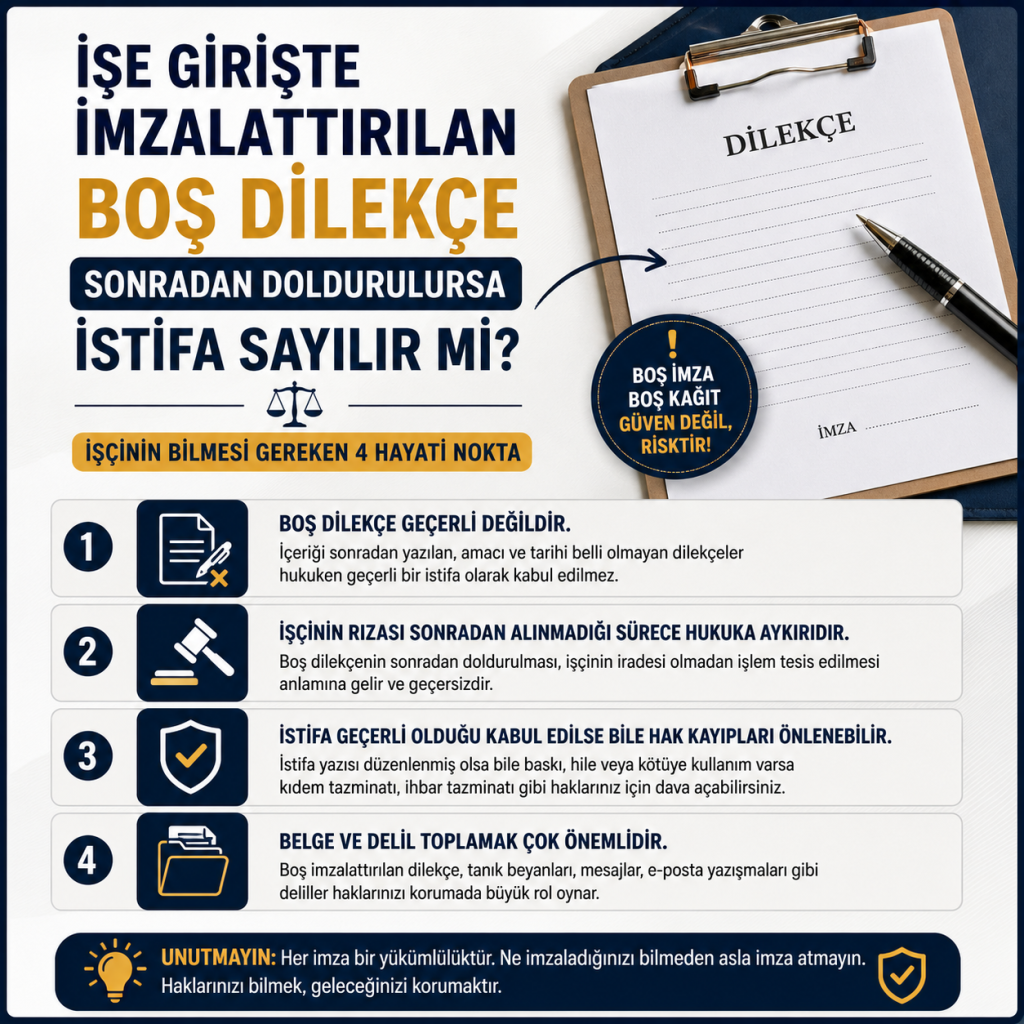
1. Validity of Pre-Printed and Fill-in-the-Blank Documents Obtained During Employment
According to Supreme Court decisions, resignation letters obtained from employees during the commencement of employment or throughout the employment relationship, which are blank in content or prepared as pre-printed forms, are legally deemed invalid. It is emphasized that in cases where the employee’s will was formed under duress or the document was prepared as a pre-printed form and the date was added later, these documents do not reflect a genuine intention to resign.
Supreme Court 9th Civil Chamber-2017/3413-2018/3490 -20.02.2018: “The ‘Resignation’ document dated 02.06.2014, signed by the plaintiff and submitted to the file by the defendant, is a pre-printed document where the date was added later, and it is not correct to accept this document as valid.”
Supreme Court 9th Civil Chamber-2014/32573-2016/4626 -02.03.2016: Even if the signature is accepted as belonging to the employee, if the document was signed while blank and filled in later, it cannot be accepted that the employment contract was terminated by the employee.
Supreme Court 22nd Civil Chamber-2013/13091-2013/13639 -06.06.2013: Resignation letters and release forms prepared as pre-printed documents on a computer and with blanks filled in later cannot be considered valid.
Supreme Court 22nd Civil Chamber-2016/24572-2019/22015 -02.12.2019: In cases where it is a workplace practice for employees to sign blank papers upon employment or during their work processes, even if the signature belongs to the employee, the document is deemed not to be a product of free will.
2. Resignation Letters Obtained Under Duress and Impairment of Will
Resignation documents obtained through employer pressure, promises of compensation payment, or deception are invalid because they do not reflect the employee’s true will. In these situations, the termination is considered to have been carried out by the employer.
Supreme Court 7th Civil Chamber-2013/4035-2013/10617 -06.06.2013: If the employer obtains a written resignation letter from the employee by promising immediate payment of compensations or through similar pressures, a genuine intention to resign cannot be asserted.
Supreme Court 9th Civil Chamber-2014/7682-2014/9411 -24.03.2014: If the employee’s signature is obtained through deception, “by being told it was a leave document” , the document is invalid due to impairment of will.
Supreme Court 9th Civil Chamber-2018/11278-2019/8456 -10.04.2019: If the employee is made to write a resignation letter by hand according to a printed draft provided by the employer, it is accepted that the will has been impaired.
3. Methods of Proof and Technical Examination
In response to claims that the resignation document was filled out later or that the will was impaired, courts rely on technical examination, witness statements, and inconsistencies within the case file.
Technical Examination: Allegations that additions were made later to the text or that dates were subsequently affixed must be absolutely examined from a technical standpoint (Supreme Court 9th Civil Chamber-2017/3413-2018/3490-20.02.2018). The original document should be obtained, and it should be investigated whether the dates were filled in later (Supreme Court 9th Civil Chamber-2014/31047-2015/616 -15.01.2015).
Difference in Writing and Pen: The fact that the date section in the resignation letter was written with a different pen or in a different handwriting is an important presumption that the document was filled in later (Supreme Court 22nd Civil Chamber-2015/20056-2017/24966 -15.11.2017; Supreme Court 7th Civil Chamber-2013/8583-2013/16780 -10.10.2013).
Contradictory Records: The use of different codes (e.g., Code 22) in the termination notice despite the resignation letter, or the statement in the release form that both resignation occurred and compensations were paid, are contradictions that invalidate the document (Supreme Court 9th Civil Chamber-2022/5268-2022/6382 -23.05.2022; Supreme Court 9th Civil Chamber-2012/22270-2014/23310 -03.07.2014).
Burden of Proof: The burden of proving that a handwritten and signed petition was obtained by vitiated consent generally rests with the employee (Supreme Court 9th Civil Chamber-2012/8963-2014/14157 -30.04.2014). However, printed documents and workplace practices can alter this situation in favor of the employee.
4. Special Circumstance Regarding Disabled Employees
In the judicial decisions examined, there is no special regulation specific to disability status or a different method of proof regarding the validity of signed documents obtained from a disabled employee at the start of employment or the subsequent filling out of these documents. Disputes on this matter are evaluated within the framework of general labor law principles and the above-mentioned criteria for vitiated consent/pre-printed documents.
9th Civil Chamber of the Court of Cassation-2022/5268-2022/6382-23.05.2022 and 9th Civil Chamber of the Court of Cassation-2014/21976-2014/36364 -01.12.2014 numbered decisions clearly state that there is no special information or provision for disabled employees.
In conclusion; if blank or pre-printed documents obtained at the time of employment are later filled out as a resignation, and this is proven by technical examination, witness statements, and formal/substantive inconsistencies in the document, it is considered legally invalid, and the termination is deemed to have been made by the employer.

Frequently Asked Questions (FAQ)
1. I signed a blank paper when I started work, and it was later filled out as a resignation letter. Is this document valid?
No. According to Court of Cassation decisions, resignation letters prepared with blank or pre-printed content and subsequently filled out are considered legally invalid because they do not reflect a genuine intention to resign. The fact that the signature belongs to you alone does not make the document valid.
2. If my signature is proven to be mine, will I be considered to have resigned?
No. Even if the signature is accepted as belonging to the employee, if the document was signed while blank and then filled out later, the employment contract is not considered to have been terminated by the employee. What is important is whether the consent was freely given.
3. What happens if the employer obtains a resignation letter by saying “compensation will be paid immediately”?
In this case, a true intent to resign cannot be spoken of. Resignations obtained through employer pressure, promises of payment, or deceptions like “this is just a leave document” are invalid due to vitiated consent, and the termination is deemed to have been made by the employer; your compensation rights arise.
4. How can I prove that the document was filled out later?
Courts consider technical examination (whether the date and text were added later), the date section being written with a different pen/handwriting, witness statements, and contradictory records in the file (e.g., the SGK termination code not matching resignation). Therefore, it is critical to have the original document brought to court for examination.
5. Who bears the burden of proof?
As a rule, the burden of proving that a handwritten and signed petition was obtained under duress lies with the employee. However, if the document is pre-printed or if there is a practice of having blank papers signed at the workplace, this situation may change in favor of the employee. Evaluating this nuance expertise requires.
Why is Expert Lawyer Support Necessary?
The conversion of blank and pre-printed documents obtained during employment into resignation letters later on is one of the most common practices encountered by employees, leading to loss of rights. Success in such cases depends on the correct identification of formal and substantive contradictions in the document, timely request for technical examination (differences in pen/handwriting/date), and presentation of the right witnesses and evidence to the file. A single procedural error can cause a rightful employee to lose their rights to compensation and re-employment.
At this point, working with an experienced employee lawyer is crucial for demonstrating the invalidity of the petition in light of Supreme Court precedents and for establishing the correct evidence strategy from the outset. As 2M Hukuk Law Office, with our expertise in Labor Law, we meticulously protect our clients’ rights in employee-employer disputes.
Our office, serving on the Anatolian Side of Istanbul, offers professional solutions to employees seeking Tuzla lawyer support, or those experiencing issues with severance/notice pay, re-employment lawsuits, or unlawful termination. As an Istanbul lawyer office, we guide our clients in Tuzla, Pendik, Kartal, Maltepe, and surrounding areas through every stage of labor law processes. We strongly recommend seeking expert support at the beginning of the process to ensure your rights are not lost.