
Meta description (suggested): The real cost of establishing a limited and joint-stock company in Turkey in 2026: minimum capital, notary, trade registry/chamber, Competition Authority share, and hidden items — with current TL and USD figures.
Target keywords: 2026 company formation cost, limited company formation cost 2026, joint-stock company formation cost, minimum capital 2026, company formation expenses, company formation lawyer Tuzla, Kocaeli company formation
“How much does it cost to set up a company?” The real answer is not a single figure
Most people who ask about the cost of establishing a company in Turkey expect a single figure. However, the total cost consists of two separate categories: (1) committed capital and (2) formation expenses (notary, fee, chamber, consultant, etc.). Calculations like “we are establishing a company for this much” made without separating these two are often misleading.
As of 2026, official establishment expenses, excluding capital, are roughly in the range of 30,000 TL – 45,000 TL (≈ 670 – 1,000 USD), depending on the city and scope of service. The picture changes when minimum capital, monthly consultancy, and e-transformation costs are added to this.
Below, we have explained each item with current figures, their USD equivalents, and frequently overlooked “hidden” expenses.
Exchange rate note: USD equivalents have been calculated assuming approximately 1 USD ≈ 45 TL as of June 2026. Since exchange rates and official tariffs change throughout the year, please consider the USD amounts as approximate values.
1) Minimum Capital: The largest and most misunderstood item
Since 2024, minimum capital amounts have been increased (Presidential Decree No. 7887, TCC art. 332/580):
| Company type | Minimum capital | USD equivalent (~) | Cash payment at establishment |
|---|---|---|---|
| Limited (Ltd. Co.) | 50,000 TL | ~ 1,110 USD | None — payable within 24 months |
| Joint Stock (JSC) | 250,000 TL | ~ 5,560 USD | 25% of cash capital upfront |
| JSC – registered capital system | 500,000 TL | ~ 11,100 USD | 25% upfront |
Critical difference — capital blocking:
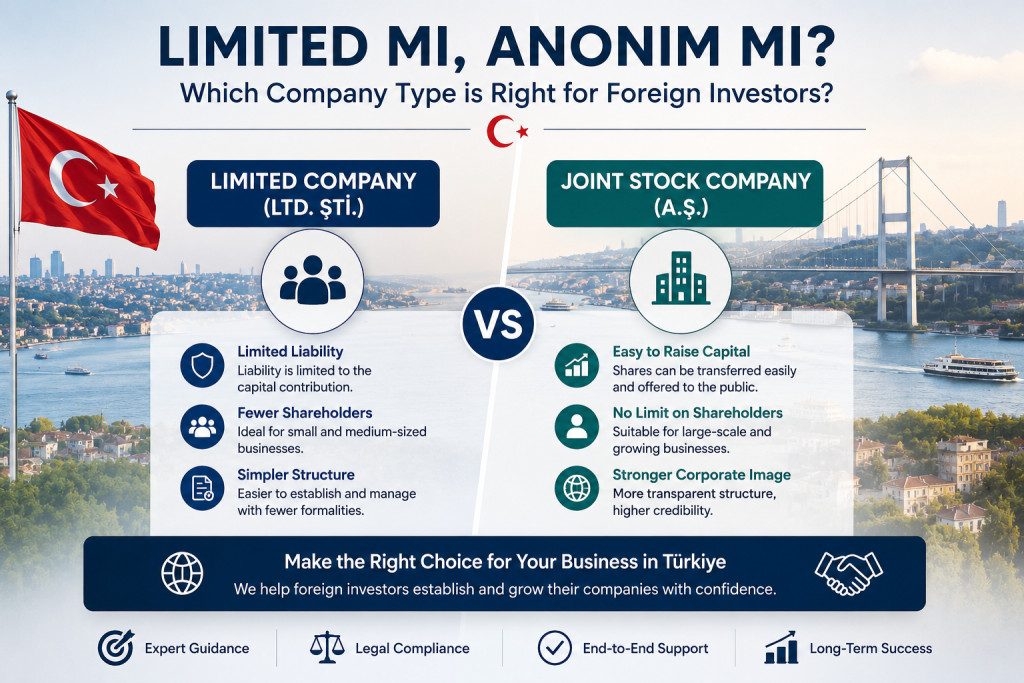
In a limited company, there is no obligation to deposit (block) capital in the bank at the time of establishment. The 50,000 TL capital can be paid within 24 months from registration.
In a joint stock company, however, 25% of the cash capital (62,500 TL for 250,000 TL ≈ 1,390 USD) must be blocked in a temporary account opened in the company’s name at the bank before registration. Once the company is registered in the trade registry, the registration document is submitted to the bank, the block is lifted, and the money can be used in commercial activity. The remaining 75% (187,500 TL) is paid within 24 months.
Therefore, a limited company is initially more convenient for entrepreneurs with tight cash flow.
Warning for existing companies: Old companies whose capital remains below the new minimum amounts will be deemed automatically dissolved (terminated) if they do not increase their capital to these amounts by December 31, 2026. This date is fast approaching; proper compliance procedures are critical for the company’s legal existence.
2) Notary Fees
The approval of the articles of association (which can also be signed at the Chamber of Commerce in some cases), signature declarations/circulars, and powers of attorney are done through a notary. Notary fees are variable as they are updated annually with the revaluation rate.
Estimated notary expense for 2026: approximately 4,000 TL – 12,000 TL (≈ 90 – 270 USD), depending on the number of transactions and documents.
Since the number of books that need to be certified is higher in a joint-stock company, the notary item is slightly higher compared to a limited company.
3) Commercial Registry Registration, Chamber Registration, and Announcement
For a company to acquire legal personality, registration with the commercial registry and with the affiliated chamber of commerce/industry is mandatory. Procedures are carried out via MERSİS and completed in the province where the head office is located; therefore, costs vary by city (Istanbul items are generally the highest).
Commercial registry registration/listing fees (capital companies, 2026): approximately 22,500 TL – 29,500 TL (≈ 500 – 655 USD).
Chamber registration fee: the initial registration fee of the affiliated chamber (varies from province to province).
Trade Registry Gazette publication fee: the cost of publishing the company in the gazette.
These three items together constitute the largest portion of the establishment expenses.
4) Competition Authority Share
In accordance with the Turkish Commercial Code (TTK) and the Trade Registry Regulation, four per ten thousand (0.04%) of the capital is deposited at the chamber’s treasury on behalf of the Competition Authority. It is a relatively small item, proportional to the capital:
| Company | Capital | Competition Authority share |
|---|---|---|
| Limited | 50.000 TL | 20 TL |
| Joint Stock | 250.000 TL | 100 TL |
| JSC (registered capital) | 500.000 TL | 200 TL |
5) Stamp Tax and Book Certifications
Stamp tax: Documents such as company articles of association, financial consultancy agreements, and lease contracts are subject to stamp tax. The amount varies according to the document’s value.
Legal book certifications: Notarization of books such as journal, inventory, and board meeting minute books. In 2026, this item (stamp + certification combined) is approximately 2,500 TL – 4,500 TL (≈ 55 – 100 USD). The amount increases for joint stock companies due to the higher number of books.
6) Financial Advisor Fee and Digital Requirements
Financial consultant establishment (one-time) service fee: On average 8,000 TL – 15,000 TL (≈ 180 – 335 USD) in 2026. Covers document preparation, MERSIS application, and execution of the registration process.
E-Signature (personal): The e-signature of the partner/authorized person is required for the MERSIS application.
Financial seal (corporate): It is mandatory for E-Invoice, E-Archive, and E-Book applications; without a financial seal, it is not possible to be included in the e-transformation system.
7) Hidden/Omitted Costs — Items That Truly Disrupt the Budget
The regular expenses that are usually not shown in establishment announcements but determine the budget are as follows:
Monthly financial consultancy fee: Paid monthly after establishment; varies depending on the company’s size and transaction volume. On an annual basis, it can double the establishment cost.
E-transformation (E-Invoice/E-Book) integrator and credit costs: Generate regular expenses when they fall within the scope of obligation.
Workplace address: Lease agreement and stamp tax; if a virtual office/shared space is preferred, its legal compliance must be researched beforehand (an incorrect address structure causes problems during tax office inspection).
NACE code selection: An incorrect activity code leads to not being able to benefit from incentives and tax exemptions in the future. Correcting it later means additional procedures and costs.
Capital completion obligation: For existing companies, increasing to minimum capital until 31.12.2026; delay carries the risk of dissolution.
2026 Company Establishment Cost — Summary Table (excluding capital, approximate)
| Item | Limited (TL) | USD (≈) |
|---|---|---|
| Notary (contract, circular, power of attorney) | 4.000 – 12.000 | 90 – 270 |
| Trade registry + chamber + announcement | 22.500 – 29.500 | 500 – 655 |
| Competition Authority fee (50,000 TL capital) | 20 | <1 |
| Stamp tax + ledger endorsement | 2.500 – 4.500 | 55 – 100 |
| Financial advisor establishment fee | 8.000 – 15.000 | 180 – 335 |
| Total (excluding capital) | ≈ 30.000 – 45.000 | ≈ 670 – 1.000 |
In a joint-stock company, in addition to these items, 62,500 TL cash capital blockage (temporary, released upon registration) and higher ledger/notary expenses are added.
Beware of “Company in 1 Day, No Documents” Promises
Advertisements promising company formation “without documents”, “in one day”, “all-inclusive at a very low price” are common online. One should approach these promises with caution:
Company formation without documents is not possible. MERSİS application, e-signature, articles of association, chamber registration, and trade registry registration are legally mandatory. Transactions done “without requesting documents” generally mean incomplete or incorrect registration.
An excessively low price often signals hidden costs. A one-time low figure can later be compensated by high monthly consultancy or additional service fees.
A incorrectly structured setup proves costly. An erroneous NACE code, an unsuitable address, the wrong company type, or incomplete main contract provisions can result in tax penalties, loss of incentives, or disputes among partners in the future. The cost of correction is many times higher than setting it up correctly from the start.
A healthy establishment is not the “cheapest,” but one that is suitable for your company’s objective and partnership structure.
Frequently Asked Questions (FAQ)
How much does it cost to establish a limited company in 2026? Excluding capital, official and service expenses average 30,000 – 45,000 TL (≈ 670 – 1,000 USD). To this, a minimum capital of 50,000 TL is added; however, in a limited company, capital is not paid upfront at establishment but can be paid within 24 months.
Is an Inc. (Anonim Şirket) or a Ltd. (Limited Şirket) cheaper? Official fees and notary expenses are similar. The main difference is in cash flow: For an Inc., a cash blockage of 62,500 TL is mandatory at establishment, while there is no such requirement for a Ltd. An Inc. also has more comprehensive bookkeeping and management obligations.
Do I need to deposit 50,000 TL in the bank at establishment? For a limited company, no. The capital can be paid within 24 months from registration. For an Inc., 25% of the cash capital is blocked before registration.
How much is the Competition Authority share? Four per ten thousand (0.04%) of the capital. For a limited company with 50,000 TL capital, it’s 20 TL; for an Inc. with 250,000 TL capital, it’s 100 TL.
Why do company formation costs vary from city to city? Commercial registry fees are relatively standard nationwide; however, they differ according to chamber registration fees, financial consultancy fees and the intensity of notary transactions. Costs in Istanbul are generally the highest.
My existing company is below the minimum capital, what should I do? You must increase the capital to the new minimum amount (JSC 250,000 TL / registered capital 500,000 TL, Ltd. 50,000 TL) by December 31, 2026. Otherwise, the company will be deemed dissolved by law. Capital increase requires a general assembly resolution and registration.
Is the cost of establishing a company with foreign partners different? The basic establishment items are the same; however, additional processes such as obtaining a tax identification number, translation/apostille, and, if necessary, a work permit for the foreign partner increase the cost and duration.
Apart from capital, what will challenge me the most in the first year? Most entrepreneurs focus on the one-time establishment fee; whereas the main burden consists of monthly financial consultancy and e-transformation expenses. The budget should be planned annually.
Why is Expert Lawyer Support Necessary? — 2M Law Office
Although company formation may appear on the surface as a “registration process,” it is in fact a legal process where costly decisions are made regarding company type selection, articles of association provisions, partnership and share structure, capital planning, and scope of activity. A single missing provision in the articles of association — for example, share transfer, non-compete clauses, withdrawal/expulsion from partnership, or management authority regulations — can lead to serious disputes and litigation costs among partners in the future.
Tuzla-based 2M Hukuk Law Firm (Founder: Atty. Meryem Günay) provides legal consultancy to entrepreneurs and businesses in Istanbul’s Anatolian Side (Tuzla, Pendik, Kartal, Maltepe) and Kocaeli region. In this industrially and commercially intensive region, a properly structured company setup prevents future disputes and costs.
Support that 2M Hukuk can offer during the establishment process:
Company type and structure consultancy: Determining the company type (Ltd./JSC) and capital structure suitable for your goals and partnership model.
Meticulous preparation of the articles of association: Regulating provisions regarding share transfer, withdrawal/expulsion from partnership, non-compete clauses, profit distribution, and management in a way that prevents future disputes.
Partnership and shareholders’ agreement: Securing relationships between partners, especially in multi-partner structures, through an agreement.
Capital compliance (31.12.2026): Completing the minimum capital increase process in existing companies without incurring dissolution risk.
Establishment with foreign partners: Integrated management of translation/apostille, tax ID number, and, if necessary, work permit processes.