
Introduction
This study analyzes the procedures and principles regarding administrative detention measures applied to foreigners within the framework of Law No. 6458 on Foreigners and International Protection (YUKK), in light of the presented judicial decisions. The study deeply examines the authority issuing the administrative detention decision, the maximum duration of the measure, the legal remedies that can be appealed against this decision, the judicial authority reviewing the appeals, and the decision-making periods of these authorities. The analysis is based on findings obtained from decisions of the Constitutional Court, the Council of State, the Court of Jurisdictional Disputes, and first-instance courts.
In line with the judicial decisions examined, the main findings regarding the administrative detention measure applied to foreigners are summarized below:
Authority Issuing the Decision: The administrative detention decision is issued in accordance with YUKK by the Governorship (Provincial Directorate of Migration Management).
Administrative Detention Period: The administrative detention period, as a rule, cannot exceed six months. However, if deportation procedures cannot be completed due to reasons such as the foreigner’s lack of cooperation or failure to provide accurate information or documents regarding their country, this period can be extended for a maximum of six more months. The Governorship is obliged to regularly assess each month whether the continuation of administrative detention is necessary.
Legal Remedies Against the Decision: The main legal remedy against the administrative detention decision is to object to the Criminal Judgeship of Peace with a request for the decision to be lifted. Furthermore, after the administrative detention ends, there is an opportunity to file a full remedy lawsuit in administrative courts for damages incurred due to unlawful detention.
Authority Reviewing the Objection: The duty to examine and rule on objections against administrative detention decisions belongs exclusively to the Criminal Judgeship of Peace. Administrative courts have no jurisdiction in this regard.
Objection Resolution Period: The Criminal Judge of Peace must finalize the objection application within five days. The decision rendered by the Criminal Judgeship of Peace in this matter is final.
1. Issuance of Administrative Detention Decision for Foreigners and Its Conditions
According to judicial decisions, an administrative detention decision is an administrative measure established by Governorates for foreigners against whom a deportation decision has been made, in the presence of certain conditions. These conditions are listed as follows, with reference to Article 57 of the YUKK:
“Among those against whom a deportation decision has been made; an administrative detention decision shall be taken by the governorship for those who pose a risk of absconding or disappearing, those who violate Turkey’s entry or exit rules, those who use forged or false documents, those who fail to leave Turkey within the allotted time without an acceptable excuse, or those who pose a threat to public order, public security, or public health.”
This decision reveals that administrative detention is not an arbitrary practice and must be based on concrete grounds specified in the law.
2. Duration and Supervision of Administrative Detention for Foreigners
The duration of administrative detention is primarily limited to six months. However, as emphasized in various decisions, this period, in exceptional circumstances, can be extended by another six months, reaching a total of one year (AYM, 22/11/2022; AYM, 2/6/2020). To prevent the period from exceeding legal limits and to avoid arbitrariness, the legislator has imposed upon the Governorate the obligation to “regularly assess each month whether administrative detention is still necessary” (Council of State 10th Chamber, 2020/5704 E.). These monthly evaluations aim to continuously supervise the continuation of the measure.
3. Appeal Against Administrative Detention Decision: Magistrate Penal Court
In all decisions reviewed, there is full consensus that the judicial authority to appeal administrative detention decisions is the Magistrate Criminal Court. It has been stated that solely Magistrate Criminal Courts are designated as the appeal authority pursuant to Article 57 of Law No. 6458 on Foreigners and International Protection. In this context, administrative courts have no authority to review the legality of administrative detention decisions.”
The appeal process works as follows:
The person placed under administrative detention, their legal representative, or their lawyer can apply to the Magistrate Criminal Court.
This application does not halt the enforcement of the administrative detention measure.
The Magistrate Criminal Judge decides on the application within five days, and this decision is final.
It is possible to reapply to the Magistrate Criminal Court on the grounds that the conditions for administrative detention have ceased to exist or have changed.
4. Effectiveness of Legal Remedies and Compensation Lawsuits
The Constitutional Court, as a rule, accepts the appeal to the Magistrate Criminal Court for reviewing the legality of administrative detention as “an effective remedy” (CC, 17.12.2024). However, the ineffective application of this remedy in a concrete case can lead to a violation of rights. Indeed, in a decision dated 21.01.2025, the High Court deemed the judge’s failure to examine the appeal on its merits, based on the misleading response from the Directorate General of Migration Management, as a violation of the right to personal liberty and security.
After the administrative detention ends, a full remedy lawsuit must be filed for material and non-material compensation claims due to unlawful detention. The Constitutional Court deems individual applications made without exhausting this remedy inadmissible due to “non-exhaustion of application remedies” (AYM, 15/5/2020; AYM, 14/4/2022). However, there is a noticeable uncertainty regarding which branch of the judiciary will hear compensation cases. While the Court of Jurisdictional Disputes ruled that such cases should be heard in the ordinary judiciary (Court of Jurisdictional Disputes, 2022/293 E.), the Constitutional Court, in some of its decisions, pointed to the administrative judiciary (AYM, 9/6/2020).
5. Alternative Obligations to Administrative Detention and Jurisdictional Dispute
Court decisions indicate a discussion regarding the competent jurisdiction for obligations introduced as alternatives to administrative detention, such as “residing at a specific address” or “signing at specific intervals” . The Court of Jurisdictional Disputes ruled that these alternative obligations are a continuation of the administrative detention decision and that lawsuits filed against them should also be heard in the ordinary judiciary (Criminal Peace Court) (Court of Jurisdictional Disputes, 2023/625 E.). However, in dissenting opinions appended to the decision, it was argued that these obligations constitute administrative acts and that the competent jurisdiction should be administrative courts. This situation indicates that legal clarity has not yet been fully established in this area of practice.
Conclusion
The administrative detention measure applied to foreigners is a legal institution regulated in detail by Law No. 6458. Decisions are made by the Governorship (Provincial Directorate of Migration Management), their duration is limited by a 6+6 month formula, and they are reviewed monthly by the administration. The primary and urgent remedy against the measure is the Criminal Judgeship of Peace, which renders a final decision within five days. This remedy is considered an effective oversight mechanism by the Constitutional Court. For compensation claims arising after the end of administrative detention, a full judicial action is available. However, differences in judicial precedents regarding issues such as alternative obligations to administrative detention and the jurisdiction for compensation cases indicate a need to increase legal predictability in these areas. An article suggestion.
Yabancılar için idari gözetim kararını kim verir?
6458 sayılı Yabancılar ve Uluslararası Koruma Kanunu uyarınca, yabancılar hakkında idari gözetim kararı Valilik (İl Göç İdaresi Müdürlüğü) tarafından verilir. Bu karar, ancak kanunda açıkça sayılan koşulların (kaçma riski, sahte belge kullanımı, kamu düzeni tehdidi vb.) varlığı halinde alınabilir. Keyfi idari gözetim hukuka aykırıdır.
İdari gözetim süresi en fazla ne kadar olabilir?
İdari gözetim süresi kural olarak 6 ayı geçemez. Ancak sınır dışı işlemlerinin yabancının iş birliği yapmaması veya bilgi-belge eksikliği nedeniyle tamamlanamaması halinde, bu süre en fazla 6 ay daha uzatılabilir. Toplam süre 12 ayı aşamaz. Valilik, idari gözetimin devamında zorunluluk bulunup bulunmadığını her ay düzenli olarak değerlendirmekle yükümlüdür.
İdari gözetim kararına nereye ve kaç günde itiraz edilir?
İdari gözetim kararına karşı başvuru mercii münhasıran Sulh Ceza Hâkimliğidir. Yabancı, yasal temsilcisi veya avukatı tarafından Sulh Ceza Hâkimliğine başvurulabilir. Hâkim, itirazı 5 gün içinde karara bağlamak zorundadır ve verilen karar kesindir. İdare mahkemeleri bu konuda görevli değildir.

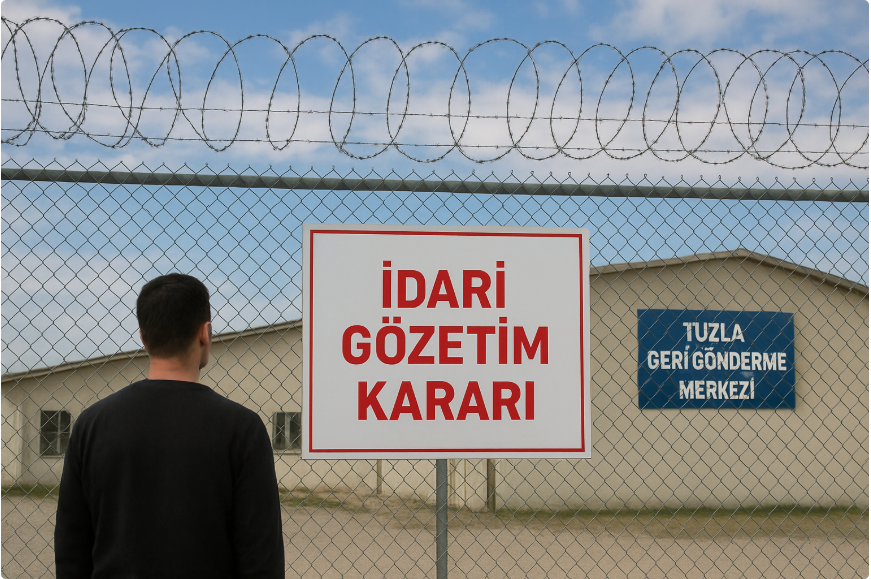
Why is Legal Support from a Tuzla Lawyer Necessary? /Tuzla Removal Centre
Legal support from a lawyer plays a critical role in effectively managing legal processes against administrative detention decisions. Especially, the location of the Tuzla Removal Centre in Tuzla district of Istanbul offers significant advantages for lawyers. Thanks to the extensive transportation opportunities to Istanbul’s city center and surrounding districts, lawyers operating in Tuzla can quickly communicate with foreigners under administrative detention and promptly follow up on applications to the Criminal Judgeships of Peace.
Obtaining legal support in Tuzla helps individuals under administrative detention to file their appeals without experiencing loss of rights and to expedite their legal processes. Furthermore, the practical experience of lawyers familiar with the region regarding the functioning of the Tuzla Removal Center ensures that the process is managed more effectively and securely.
Therefore, in regions such as Istanbul, Tuzla lawyer, Pendik lawyer, Kartal lawyer, Maltepe lawyer, Gebze lawyer, Aydınlı lawyer, Orhanlı lawyer, Tepeören lawyer, Darıca lawyer, Bayramoğlu lawyer or Çayırova lawyer, Şekerpınar lawyer, Güzelyalı lawyer, Postane lawyer and Akfırat lawyer, it is of great importance for foreigners under administrative detention in the Tuzla Removal Center to receive legal support, both for preventing rights violations and for meticulously following the deadlines stipulated by law.