Introduction
This article analyzes the questions of what the concept of “difference in damage cost” is and how this cost can be claimed, in light of the presented first instance court, regional court of justice, and Supreme Court decisions. The analyzed decisions provide a comprehensive framework regarding the definition of the difference in damage cost, its emergence reasons, the claim process, and the points to be considered during the litigation phase. The article aims to create a practical legal resource for lawyers by addressing this concept from different perspectives.
1. Definition and Scope of Damage Difference Cost
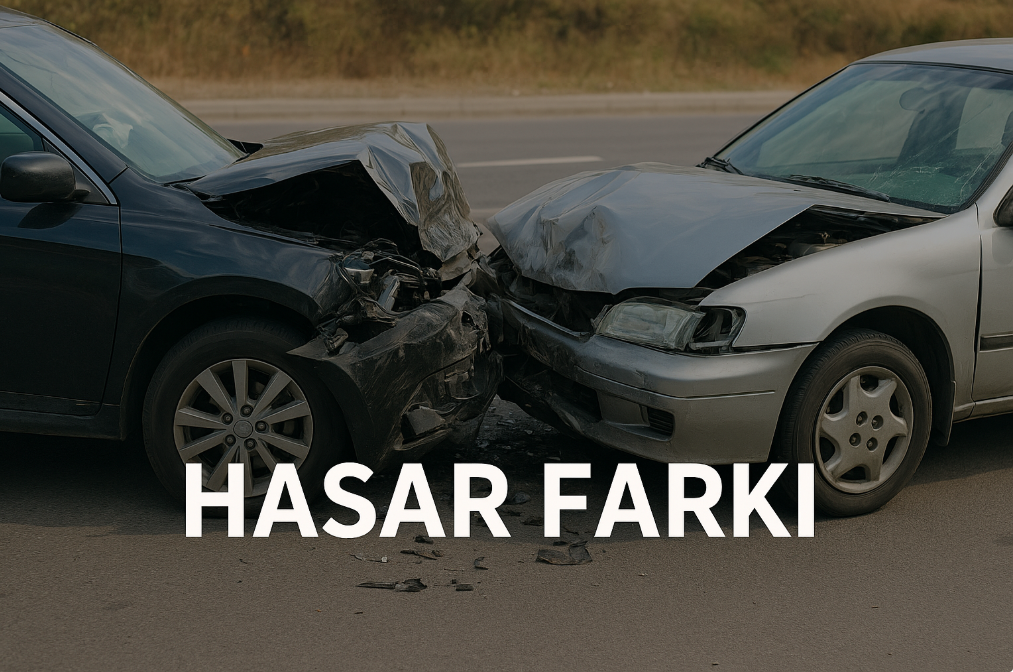
In the examined court decisions, “damage difference cost” (or “residual damage cost”) is defined as the difference between the compensation paid by the insurance company and the actual amount of damage resulting from a traffic accident or a risk covered by an insurance policy. The main reasons for the emergence of this difference are as follows:
Use of Equivalent/Aftermarket Parts Instead of Original Parts: This is the most common subject of dispute. In cases where the insurance company uses cheaper equivalent, compatible, or aftermarket parts instead of original parts for the repair of a damaged vehicle, the price difference between the two parts can be claimed as a damage difference cost. Judicial decisions emphasize that, in accordance with the principle of full compensation, equivalent parts cannot be used without the vehicle owner’s consent. As stated by the Samsun Regional Court of Justice, the burden of proof rests with the insurer to demonstrate that consent was obtained from the rights holder or that the original part could not be supplied: “Within the scope of this paragraph, the burden of proof rests with the insurer to demonstrate that consent was obtained from the rights holder or that it was not possible to replace the damaged part with an original part.” (Samsun Regional Court of Justice, 3rd Civil Chamber, 2023/1606-2024/1941). The established practice of the Supreme Court of Appeals is also in this direction: “…that the actual damage will only be covered by using entirely original parts in the repair of the vehicle, and that the damage cost should be determined according to original parts…” (Izmir 1st Civil Court of Commerce, 2020/403-2021/334).
Unjust Discount Practices: It is common for insurance companies to make payments by applying certain discounts on spare parts and labor costs, especially through contracted services. Courts rule that these discounts cannot be passed on to the insured and that the actual damage should be calculated based on the undiscounted amount. In the decision of Kayseri 2nd Civil Court of Commerce, this situation is stated as, “an unjust and unlawful discount was applied to original spare parts and labor” (2023/15-2024/1040).
Incomplete Damage Assessment and Low Labor Costs: Damage assessments made by insurance adjusters falling below market rates or underestimation of labor costs also lead to claims for differential damage compensation.
2. Claim Process for Differential Damage Compensation
The decisions clearly outline the steps to be followed for the collection of differential damage compensation:
Application to the Insurance Company: The process begins with a written application to the relevant insurance company for compensation of the damage.
Mediation: If the insurance company rejects the claim or makes an incomplete payment, applying for mediation before filing a lawsuit is a prerequisite for litigation.
Initiating a Lawsuit or Applying to the Insurance Arbitration Commission: If an agreement cannot be reached during the mediation process, the rightful party may file a lawsuit in the Civil Court of Commerce or apply to the Insurance Arbitration Commission. However, a final judgment rendered in one of these two avenues is binding on the other. As emphasized in a decision by the Izmir 4th Civil Court of Commerce, a definitive rejection decision by the Insurance Arbitration Commission, “as it will result in a res judicata effect, the injured party cannot make a new claim for the same damage, even through litigation.” (2022/381-2023/162).
Review and Evaluation
The most crucial element determining the outcome of claims for difference in damage amount during the litigation process is the expert report. Courts resort to expert examination in almost all cases to determine the actual damage and largely base their judgments on these reports. For instance, the Izmir 2nd Civil Court of Commerce, by deducting the 7,784.52 TL paid by the insurer from the 20,000.00 TL actual damage determined by the expert report, “ruled for the collection of the 12,215.48 TL damage, determined as the remaining damage amount, from the defendant” (2021/499-2022/246).
For claims to be accepted, it is important for the plaintiff to prove the repair with documents such as invoices. The Istanbul Anadolu 2nd Civil Court of Commerce rejected the case because the plaintiff “could not document that they paid the damage repair cost with an invoice and in accordance with this invoice” (2022/154-2024/328).
On the other hand, there are also cases where claims are rejected. If the expert report indicates that the payment made by the insurance company covered the actual damage, the lawsuit is rejected (Ankara 10th Civil Court of Commerce, 2023/191-2023/856). Similarly, if an agreement or release has been signed between the plaintiff and the insurance company, and there is no “gross disparity” between the amount paid and the actual damage, a subsequent lawsuit for damage difference may be rejected (Ankara 1st Civil Court of Commerce, 2024/460-2025/107).
Conclusion
In light of judicial decisions, the “damage difference amount” is an item of compensation that ensures the completion of the actual damage incurred in the insured’s assets due to the insurance company’s insufficient payment. The main reasons for the emergence of this amount are; the use of equivalent parts instead of original parts, unfair discounts, and insufficient damage assessment.
The successful collection of the damage difference amount depends on the correct adherence to procedural steps including application to the insurance company, mandatory mediation, and ultimately resorting to litigation or arbitration. During the trial phase, the evidence presented to prove the claim, especially an expert report that calculates the actual damage according to market rates and without discounts, and is amenable to scrutiny, is of critical importance. The plaintiff’s ability to prove repair costs with documents such as invoices and not having signed a release form with the insurance company that would extinguish their rights are decisive factors for the course of the lawsuit. A recommended article.
Hasar farkı bedeli talep etmek için fatura şart mı?
Evet, uygulamada hasar farkı bedeli taleplerinin kabulü için onarımın fatura ve ödeme belgeleriyle ispatlanması büyük önem taşır. Mahkemeler, gerçek zararın somut olarak ortaya konulmasını aramakta; fatura sunulamaması halinde davayı reddedebilmektedir. Yargı kararlarında, onarım bedelinin ödendiğinin belgelenememesi davanın reddi için yeterli görülmektedir.
Sigorta şirketi eşdeğer parça kullandıysa hasar farkı alınabilir mi?
Araç sahibinin açık onayı olmaksızın orijinal parça yerine eşdeğer veya yan sanayi parça kullanılması halinde, iki parça arasındaki fiyat farkı hasar farkı bedeli olarak talep edilebilir. Yargıtay ve Bölge Adliye Mahkemeleri, tam tazmin ilkesi gereği sigorta şirketinin bu farktan sorumlu olduğunu kabul etmektedir. Onay alındığını veya orijinal parçanın temin edilemediğini ispat yükü sigorta şirketine aittir.
Hasar farkı bedeli için dava mı açılmalı, tahkime mi gidilmeli?
Sigorta şirketine başvuru ve zorunlu arabuluculuk sürecinden sonra hak sahibi, Asliye Ticaret Mahkemesi’nde dava açabilir veya Sigorta Tahkim Komisyonu’na başvurabilir. Ancak bu yollardan birinde verilen kesin karar, diğer yol bakımından bağlayıcıdır. Bu nedenle stratejik tercih önemlidir; yanlış yol seçimi hak kaybına yol açabilir.

Why is Lawyer Support Necessary in Tuzla?
Damage difference compensation lawsuits are complex processes that require meticulous adherence to both the technical provisions of insurance law and procedural law. In these cases, especially considering that insurance companies operate with strong legal teams, individual applications can often lead to loss of rights.
The importance of obtaining expert legal assistance in Tuzla can be summarized as follows:
Correct Follow-up of the Legal Process: In damage difference compensation claims, it is mandatory to follow the stages such as applying to the insurance company, mediation, and lawsuit/arbitration in the correct order. Legal support ensures that these procedural requirements are fully met.
Objection to Expert Reports: Expert reports are the most critical evidence in litigation. An experienced lawyer in cases heard in local courts in Tuzla can timely identify and object to deficiencies in reports or calculations made in favor of the insurance company.
Prevention of Loss of Rights: Expert legal assistance is necessary for an effective legal struggle against unfair discounts applied by insurance companies, the imposition of equivalent parts, and incomplete damage assessments.
Advantage of Local Experience: Lawyers in Tuzla can directly contribute to the course of the case because they are intimately familiar with the practices of the Civil Courts of Commerce in the region, the pools of expert witnesses, and established litigation practices.
Fast and Strategic Solution: Determining the legal strategy that will provide the highest benefit in the shortest possible time during Insurance Arbitration Commission applications or litigation is possible with professional support.
In conclusion, for claims regarding damage difference cost, the support of an expert lawyer in regions such as Istanbul, a Tuzla lawyer, a Pendik lawyer, a Kartal lawyer, a Maltepe lawyer, an Aydınlı lawyer, an Orhanlı lawyer, a Gebze lawyer, a Çayırova lawyer, a Tepeören lawyer, a Darıca lawyer, a Bayramoğlu lawyer, is a critical necessity both to prevent loss of rights and to ensure the most efficient conclusion of the process.