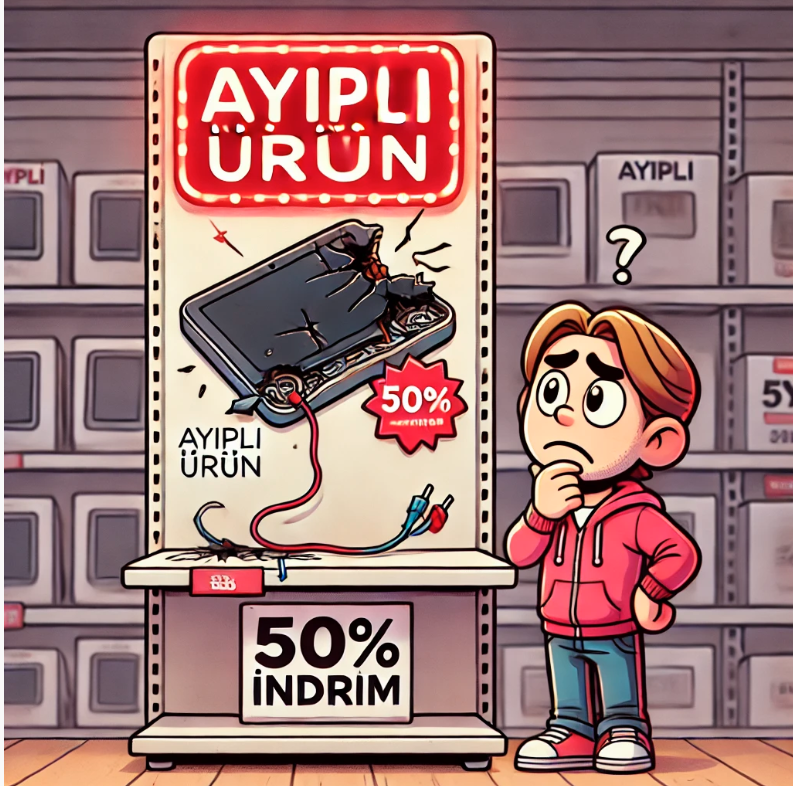
What are the Buyer’s Rights Regarding a Defective Product in Light of Judicial Decisions?
Introduction
This study analyzes the rights of the buyer when a purchased product turns out to be defective (faulty) and the legal remedies that can be pursued if the seller refuses to accept the return of the product, in light of various court decisions. The study aims to offer a holistic perspective by examining the buyer’s optional rights within the framework of the Turkish Code of Obligations (TBK), the Law on Consumer Protection (TKHK), and the Turkish Commercial Code (TTK), the procedural requirements that must be met to exercise these rights, and dispute resolution mechanisms.
1. Buyer’s Optional Rights in Defective Products
Article 227 of the Turkish Code of Obligations, referenced in almost all decisions, grants the buyer four fundamental optional rights when encountering a defective good. These rights allow the buyer to choose the most suitable solution for their situation.
Withdrawal from the Contract: The buyer can terminate the contract by declaring readiness to return the product and demand a refund of the price paid.
Request for a Price Reduction: The buyer can keep the product and demand a reduction in the sale price proportional to the defect in the good.
Request for Free Repair: The buyer can request the product to be repaired free of charge, with all expenses borne by the seller, as long as it does not incur excessive costs.
Replacement with a Non-Defective Equivalent:If possible, the buyer may request that the defective product be replaced with a non-defective new one of the same or similar characteristics.
Regarding the exercise of these rights, a decision by the 13th Civil Chamber of the Supreme Court of Appeals points to an important detail: These rights “are of a constitutive nature and, once exercised, are exhausted, hence cannot be revoked.” This means that a consumer, for instance, cannot arbitrarily withdraw their request for replacement after making it and then demand a refund.
2. Initiation of the Legal Process: Obligation to Notify of a Defect
For the buyer to exercise the aforementioned rights, they must first notify the seller of the defect (give notice). The decisions reviewed indicate that timely and proper notification is of critical importance.
Time Limits in Commercial Sales: If the sale transaction is between merchants, the time limits are stricter according to Article 23/1-c of the TCC (Turkish Commercial Code). As stated in the decision of the 12th Civil Chamber of the Istanbul Regional Court of Justice; “if the defect in the goods is clearly evident at the time of delivery, the buyer must give notice within two days; if it is not clearly evident, the buyer must inspect the goods within eight days after receiving them and notify the seller of the situation within the same period.”Latent defects, on the other hand, must be reported immediately upon discovery.
Notification Procedure in Commercial Sales:A decision by the Istanbul Anadolu 8th Commercial Court of First Instance emphasizes that the notice of rescission from a contract in commercial disputes is subject to a formal requirement. Pursuant to Article 18 of the Turkish Commercial Code (TCC), this notice “must be made via a notary, by registered mail, telegram, or through a registered electronic mail system using a secure electronic signature.” Oral notification may not be deemed sufficient.
3. Legal Remedies to Pursue When the Seller Refuses a Return
If the seller is uncooperative and refuses to accept the return, the buyer may resort to legal remedies to assert their rights.
Consumer Arbitration Committee and Consumer Court:If the buyer is a consumer, they can first apply to the Consumer Arbitration Committee, depending on the monetary limit of the dispute. If the committee’s decisions are not enforced or if the dispute directly warrants a court case, a lawsuit can be filed in the Consumer Court. As in a decision by the 13th Civil Chamber of the Supreme Court of Appeals, the consumer “may file a lawsuit demanding the return of the defective goods and a refund.”
Commercial Court of First Instance or Civil Court of First Instance:If the parties are merchants or if the dispute has a commercial nature, the competent court is the Commercial Court of First Instance. Lawsuits can be filed as a “claim arising from a sales contract” or “Compensation (Return of Goods Subject to Commercial Sale).”
Mediation:As in many commercial cases, applying for mediation before filing a lawsuit is a prerequisite for litigation.
Enforcement Proceedings and Annulment of Objection Lawsuit:The buyer can directly initiate enforcement proceedings for the refund of the amount paid. If the seller objects to these proceedings, the buyer can file an “annulment of objection lawsuit” to ensure the continuation of the proceedings and the collection of their receivable. In such lawsuits, if the buyer is found to be in the right, the court may order the seller to pay “denial compensation.”
4. Burden of Proof and the Role of Expert Reports
As explicitly stated in the decision of the Istanbul 8th Commercial Court of First Instance, “the plaintiff buyer must prove that the purchased products were defective and that the paid amount needs to be refunded.” The most crucial evidence in this proof process is the reports prepared by experts appointed by the courts. It is observed that in almost all decisions, courts base their judgments on expert reports. For example, the statement in one decision, “the expert report indicated that the tires in question were defective,” demonstrates the decisive role of the report.
Court’s Discretion: Even if the buyer rescinds the contract and demands a full refund, the court is not always obliged to accept this demand. As emphasized in the decision of Bakırköy 4th Civil Court of Commerce, “if the buyer exercises their right to rescind the contract, and the circumstances do not justify it, the judge may decide to repair the sold item or reduce the sale price.” This situation indicates that the court may rule for a more appropriate solution, taking equity into consideration.
Joint and Several Liability: An important principle protecting consumers is joint and several (chain) liability. As stated in a decision by the 13th Civil Chamber of the Supreme Court, “the manufacturer, producer, seller, dealer, agent, importer… are jointly and severally liable for defective goods and for the consumer’s elective rights stipulated in this article.” This ensures that consumers, when seeking their rights, can refer not only to the seller from whom they purchased the goods but also to other actors in the production and distribution chain.
Scope of Damages: The buyer’s claim may not be limited solely to the amount paid. In a decision by the 19th Civil Chamber of the Supreme Court, it was stated that in case of rescission of sale, in addition to the seller refunding the amount paid to the buyer with interest, “the seller is also obligated to compensate for the damage directly guaranteed due to the delivery of defective goods.” This means that the buyer can also claim other damages incurred (e.g., notary fees, loss of profit, etc.). An article suggestion.
Conclusion
A holistic analysis of the presented court decisions shows that the buyer is strongly protected by laws in case a purchased product turns out to be defective. The buyer has significant optional rights such as rescinding the contract, price reduction, free repair, or replacement of the product.
However, the effective exercise of these rights depends on fulfilling certain procedural obligations. Especially in commercial sales, a timely and properly made notice of defect forms the basis of the lawsuit. If the seller does not accept the return, the buyer can resort to judicial avenues such as the Consumer Arbitration Committee, Consumer Courts, or Commercial Courts, depending on the nature of the dispute. In this process, proving the existence of the defect with evidence such as an expert report plays a key role in winning the case. Consequently, as long as legal procedures are followed and just cause is proven, effective legal mechanisms are available to remedy the buyer’s grievance against a defective product.
A buyer encountering a defective product must comply with legal deadlines and pay attention to formal requirements to exercise their optional rights. Especially in commercial sales, even a small error in the notice can lead to the loss of a lawsuit.
As seen in local court decisions, the legal path to follow if the seller refuses a return varies according to the nature of the dispute. In this process, it is important which authority the buyer will apply to, how they will fulfill their burden of proof, and with what evidence they will defend their rights.
In cases like these, seen in regions such as Istanbul, Tuzla lawyer, Pendik lawyer, Maltepe lawyer, Kartal lawyer, Gebze lawyer, Aydınlı lawyer, Orhanlı lawyer, Tepeören Lawyer, Darıca Lawyer, Bayramoğlu lawyer, Çayırova lawyer, working with a Tuzla lawyer who is proficient in local judicial practices provides a great advantage in terms of correctly managing the process, avoiding errors, and preventing the loss of rights.