
This study examines the existence of a seafarer’s right to repatriation to their country, the conditions under which this right arises, and who is responsible for covering the costs, in light of the analyses of presented court decisions. The analyses show that this right of the seafarer is secured under both the Maritime Labour Law and the Turkish Commercial Code, but that the exercise of the right is subject to specific procedures and principles.
Main Findings
Existence of the Right to Repatriation: Court decisions clearly confirm the existence of a seafarer’s right to repatriation to their country. This right has been given strong legal protection under the Turkish Commercial Code by being defined as a “maritime lien” and “maritime claim.”
Situations in which the Right Arises: The right typically arises upon the termination of the service contract abroad. According to the examined decisions, these situations include; the seafarer terminating the service contract for just cause (e.g., non-payment of wages), falling ill, being injured, the ship sinking, or the employer unfairly terminating the contract.
Party Responsible for Costs: As a general rule, the employer (shipowner, proprietor, operator, or charterer) is obliged to cover the costs of repatriation (travel, sustenance, etc.).
Procedural Requirement: There is a critical procedural requirement for the right to be exercised. Referring to the Maritime Labor Law, according to Supreme Court decisions, it is mandatory for the seafarer to apply for repatriation within one week from the termination of their employment contract. Failure to comply with this period results in the loss of the right.
Exceptional Cases: Exceptions exist, such as the employer’s right to reclaim expenses paid in cases arising from the seafarer’s fault or in certain termination scenarios (e.g., termination due to non-payment of wages).
1. Legal Basis and Nature
The examined Regional Court of Justice and Supreme Court decisions indicate that the legal basis for a seafarer’s right to repatriation is found in the Turkish Commercial Code. This right is considered a claim arising from the seafarer’s work on board the vessel and is specifically protected by law.
Izmir Regional Court of Justice 17th Civil Chamber (2023/435) and Supreme Court of Appeals 20th Civil Chamber (2016/2758) decisions emphasized that, with reference to Article 1320 of the TCC, this right is a “maritime lien”. The excerpt from the decisions is as follows:“Claims relating to wages and other amounts payable to seafarers due to their employment on board the ship, including their repatriation expenses and social security contributions payable on their behalf…” This characterization means that repatriation expenses are secured by a legal lien on the ship and can be asserted against the new owner even if the ship’s ownership changes. Similarly, Istanbul Regional Court of Justice 43rd Civil Chamber (2024/1636) decision also defined this receivable as a “maritime claim” in accordance with Article 1352 of the TCC.
2. Cases Where the Right to Repatriation Arises and Responsibility for Expenses
Judicial decisions detail various scenarios in which the right arises and who is responsible for the expenses:
Termination for Just Cause: In the consistent decisions of the 9th Civil Chamber of the Supreme Court (e.g.: 2010/51135, 2010/48602, 2010/50021), it has been stated that if the seafarer terminates their employment contract abroad for a just cause (such as non-payment of wages), the employer is obliged to cover the repatriation expenses.“According to Articles 21 and 23 of the Maritime Labor Law, if the employment contract is terminated by the seafarer abroad for a just cause, the employer is obliged to repatriate the seafarer to the vessel’s home port…”
Unjust Termination: In the decision numbered 2015/538 of the Istanbul 17th Civil Court of Commerce, it was ruled that the travel expenses initially deducted from the seafarer’s receivables, whose contract was unjustly terminated by the employer, should be collected from the employer by court order.
Illness, Injury, or Ship Accident: In the decision of the Istanbul 17th Civil Court of Commerce (2022/119), it was stated that repatriation expenses can be claimed if the seafarer falls ill or is injured. The decision of the Istanbul Regional Court of Justice, 13th Civil Chamber (2018/246), on the other hand, reveals that the costs of sending repatriated crew members to their home countries after a ship’s sinking are the responsibility of the shipowner.
Determination of Liability (Bareboat Charter): Istanbul Regional Court of Justice, 43rd Civil Chamber (2020/1498), emphasized, based on Article 1127 of the Turkish Commercial Code (TCC), that in special cases such as a “bareboat charter agreement,” liability belongs not to the shipowner but to the charterer who leases and operates the vessel.
3. Limitations and Exceptions Regarding the Exercise of the Right
This right of the seafarer is not absolute and its exercise is subject to certain conditions and periods.
One-Week Application Period: The most important limitation underlined in multiple decisions of the 9th Civil Chamber of the Supreme Court (2010/51135, 2010/48602, 2010/50021, 2010/50020) is the seafarer’s obligation to apply within one week from the termination of the service contract to exercise their right. Missing this period leads to the rejection of the repatriation compensation claim.“Since the plaintiff seafarer did not apply for repatriation within one week after the termination of the service contract in accordance with Article 25/II of the Maritime Labour Law, the decision to reject the repatriation compensation is also appropriate.”
Employer’s Right to Reclaim Expenses: Decision no. 2013/2307 of the 7th Civil Chamber of the Supreme Court reveals an important exception. If the seafarer has terminated their contract due to unpaid wages (Maritime Labour Law Art. 14/II-a), even though the employer is obliged to pay the repatriation expenses, they subsequently have the right to reclaim these expenses from the seafarer.
Seafarer’s Fault: In the decision numbered 2015/53 of the Istanbul 17th Civil Court of Commerce, the chief engineer’s claim for wages during the period the ship was detained due to his own fault (sea pollution) was rejected on the grounds that “no one in law can claim a right in their own favor due to a situation arising from their own fault.” This principle may also constitute a limitation for repatriation expenses.
Conclusion
In light of judicial decisions, a seafarer’s right to be repatriated to their home country is a fundamental right guaranteed by both the Maritime Labor Law and the Turkish Commercial Code. As a rule, expenses are covered by the employer or the ship operator, and this receivable constitutes a “maritime lien” providing a legal right of pledge on the vessel. However, the exercise of this right is strictly subject to the one-week application period stipulated in the Maritime Labor Law. Furthermore, there are important exceptions, such as the employer’s right to reclaim expenses paid, depending on the reason for termination and the seafarer’s fault. Therefore, in each concrete case, the conditions under which the right arose and compliance with procedural requirements must be carefully evaluated. A paper suggestion.
Frequently Asked Questions
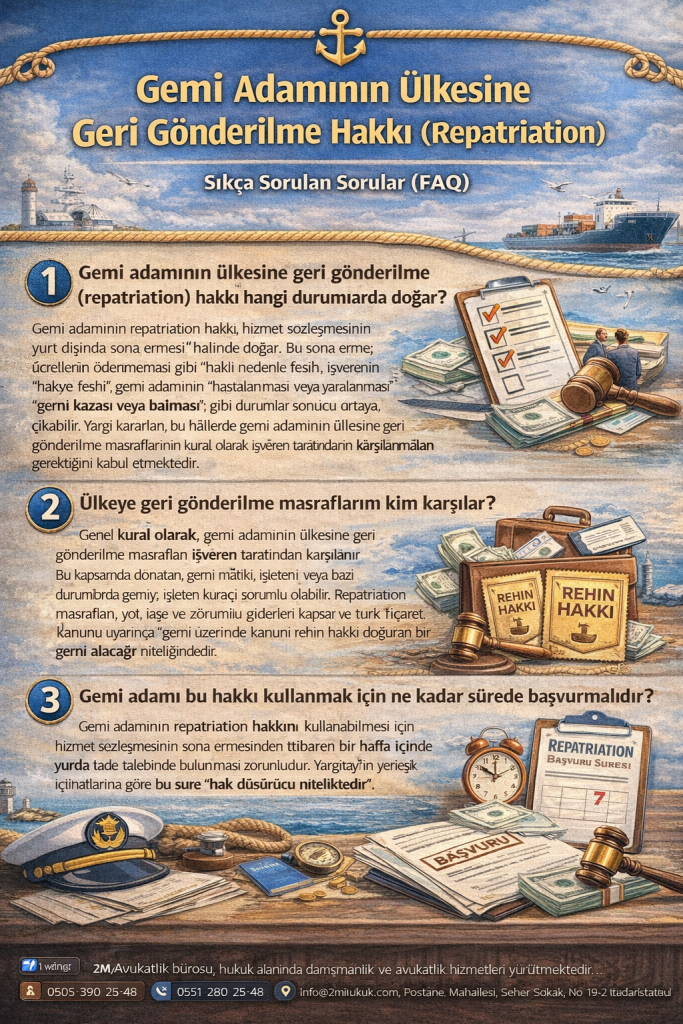
Gemi adamının ülkesine geri gönderilme (repatriation) hakkı hangi durumlarda doğar?
Gemi adamının repatriation hakkı, hizmet sözleşmesinin yurt dışında sona ermesi halinde doğar. Bu sona erme; ücretlerin ödenmemesi gibi haklı nedenle fesih, işverenin haksız feshi, gemi adamının hastalanması veya yaralanması, gemi kazası veya batması gibi durumlar sonucu ortaya çıkabilir. Yargı kararları, bu hallerde gemi adamının ülkesine geri gönderilme masraflarının kural olarak işveren tarafından karşılanması gerektiğini kabul etmektedir.
Ülkeye geri gönderilme masraflarını kim karşılar?
Genel kural olarak, gemi adamının ülkesine geri gönderilme masrafları işveren tarafından karşılanır. Bu kapsamda donatan, gemi maliki, işleteni veya bazı durumlarda gemiyi işleten kiracı sorumlu olabilir. Repatriation masrafları; yol, iaşe ve zorunlu giderleri kapsar ve Türk Ticaret Kanunu uyarınca gemi üzerinde kanuni rehin hakkı doğuran bir gemi alacağı niteliğindedir. Ancak feshin niteliğine göre, işverenin ödediği masrafları gemi adamından geri talep edebildiği istisnai durumlar da bulunmaktadır.
Gemi adamı bu hakkı kullanmak için ne kadar sürede başvurmalıdır?
Gemi adamının repatriation hakkını kullanabilmesi için hizmet sözleşmesinin sona ermesinden itibaren bir hafta içinde yurda iade talebinde bulunması zorunludur. Yargıtay’ın yerleşik içtihatlarına göre bu süre hak düşürücü niteliktedir. Bir haftalık sürenin kaçırılması halinde, gemi adamının ülkeye geri gönderilme masraflarını talep etmesi mümkün olmamakta ve açılan davalar reddedilmektedir.

Why is Expert Legal Support Necessary?
Seafarers’ right to repatriation is guaranteed by the Turkish Commercial Code and the Maritime Labour Law. However, this process, especially in disputes occurring in the ports of Istanbul and the Tuzla region, requires professional support due to complex judicial decisions and strict time limits.
Missing the one-week application period, issues such as who will cover the costs or the employer’s right to reclaim, can lead to the loss of rights for the seafarer with a wrong step. Therefore, in the field of maritime labor law, an experienced lawyer ensures the process is conducted correctly by protecting the rights of both the seafarer and the employer.
Especially in disputes arising in the Tuzla shipyards and other ports in Istanbul, the legal support of an expert lawyer is the most reliable way to achieve a solution in accordance with both national legislation and international rules.