Introduction
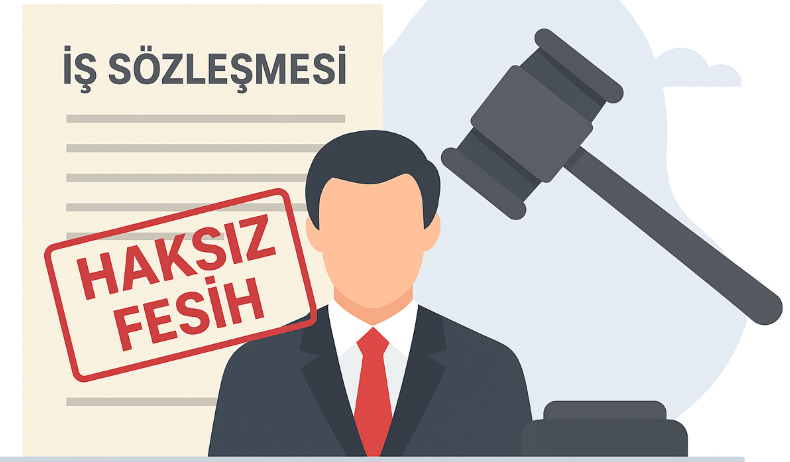
This study has been prepared to analyze the rights of an employee, particularly claims for severance pay and notice pay, in cases where the employment contract is unfairly terminated by the employer, in light of Supreme Court decisions. The study examines the conditions for entitlement to compensation, the burden of proof, just and unjust grounds for termination, procedural requirements during the litigation process, and other important legal details that need attention.
The examined Supreme Court decisions reveal the following key findings regarding claims for severance pay and notice pay in cases of unfair dismissal from work:
Fundamental Right: An employee whose employment contract is terminated by the employer without a just cause is, as a rule, entitled to severance pay and notice pay.
Burden of Proof: The burden of proving that the termination was based on a just cause or that compensation has been paid belongs to the employer. The employee, on the other hand, is obliged to prove claims for additional receivables such as overtime.
Terminating Party: The most important factor determining the right to compensation is who terminated the contract and for what reason. An employee’s termination for a just cause (e.g., non-payment of wages) entitles them to severance pay, but not to notice pay. An employee’s unfair resignation, on the other hand, nullifies both compensation rights.
Procedural Rules: Procedural rules such as preclusive periods, statute of limitations, correct statement of claims in the petition (inability to add new claims through amendment), and the right to be heard legally are as important as the merits of the case and can lead to loss of rights.
Evaluation of Justifiable Reasons: The employer’s grounds for termination (e.g., employee’s conduct contrary to honesty and loyalty) are evaluated by the court based on concrete evidence. Similarly, the employee’s grounds for termination are examined to determine if they fall within the justifiable reasons listed in the law.
Calculation and Judgment: The accurate calculation of compensation and receivables, the absence of contradiction between the grounds for the decision and the operative part of the judgment, and the clear resolution of claims are important elements sought by the Supreme Court.
1. Conditions for Entitlement to Severance and Notice Pay
Supreme Court decisions consistently emphasize that the fundamental condition for entitlement to severance and notice pay is the unjust termination of the employment contract by the employer. As stated in a decision by the 9th Civil Chamber of the Supreme Court, “it is understood that the plaintiff was dismissed without a justifiable reason, thereby becoming entitled to severance and notice pay” (2016/5794 E.) constitutes the basis of this principle.
However, the right to compensation varies according to the terminating party and the reason for termination:
Employer Termination: If the employer terminates the employee’s contract without a justifiable reason (Labor Law Art. 25), the employee is entitled to both severance and notice pay (9th Civil Chamber, 2012/10527 E.; 9th Civil Chamber, 2016/13228 E.).
Employee Termination (For Just Cause): If the employee terminates the contract based on one of the just causes listed in Article 24 of the Labor Law (for example, non-payment of wages in accordance with the law), they are entitled to severance pay. However, in this case, they cannot claim notice pay. The Supreme Court explicitly states this situation as, “the party terminating the employment contract, even for just cause, cannot be entitled to notice pay” (9th Civil Chamber, 2014/4257 E.).
Employee Termination (Without Just Cause – Resignation): If an employee leaves work without a just cause (resignation), they are not entitled to severance and notice pay (9th Civil Chamber, 2017/16807 E.). However, resignation letters obtained under employer pressure are considered invalid, and in such cases, the termination is presumed to have been made by the employer (22nd Civil Chamber, 2017/5615 E.).
2. Burden of Proof and Evaluation of Evidence
During the litigation process, which party bears the burden of proof directly affects the outcome of the case.
Employer’s Burden of Proof: The employer is obliged to prove with written evidence that the termination was based on a just cause or that they paid the employee’s receivables. As stated by the 9th Civil Chamber of the Supreme Court, if the employer “cannot prove that the termination did not require severance and notice pay, and cannot present a document proving that payment was made, the employee’s compensation claims will be accepted.” (2014/35647 E.).
Employee’s Burden of Proof: In matters such as overtime, weekly rest, and public holiday pay, the burden of proof lies with the employee. The employee must prove these claims with evidence such as witness statements and workplace entry-exit records. However, the burden of proving that wages have been paid always belongs to the employer (7th Civil Chamber, 2014/21110 E.).
Nature of Evidence: The SGK termination code alone is not considered sufficient to prove the reason for termination (9th Civil Chamber, 2017/17019 D.). However, payrolls bearing the employee’s signature and whose authenticity is not disputed constitute definitive evidence (22nd Civil Chamber, 2015/419 D.).
3. Justifiable Grounds for Termination and Their Limits
The Supreme Court tends to interpret the justifiable grounds for termination restrictively, both from the employer’s and the employee’s perspective.
Justifiable Grounds for Employers: The employee’s “actions contrary to honesty and loyalty” (e.g., being rude to customers, engaging in acts that would cause harm to the employer) are considered justifiable grounds for termination (9th Civil Chamber, 2016/13418 D.; 9th Civil Chamber, 2016/8451 D.).
Justifiable Grounds for Employees: Failure to pay wages on time and in full is the most fundamental justifiable ground for termination. However, not every demand constitutes a justifiable ground for termination. For example, in one of its decisions, the Supreme Court ruled, by stating, “There is no provision in Article 24 of the Labor Law No. 4857, which regulates the employee’s right to immediate justifiable termination, that cites the employer’s failure to provide an advance to the employee as a reason.” (9th Civil Chamber, 2016/18215 D.), that the failure to provide an advance does not constitute a justifiable ground for termination for the employee.
4. Procedural Rules and Matters to Consider in a Lawsuit
Compliance with procedural rules is as important as the merits of the case.
Forfeiture Periods: The employer must exercise the right to terminate within 6 working days from the date they learn of the employee’s action causing just cause for termination, and in any case, within 1 year from the date the act occurred. Termination made after these periods are exceeded is considered unjust termination, and the employee is entitled to compensation (22. HD, 2017/13667 E.; 7. HD, 2013/9420 E.).
Lawsuit and Amendment: A claim item not requested in the petition (e.g., notice pay) cannot be subsequently included in the lawsuit through amendment. The General Assembly of Civil Chambers has established a clear precedent on this matter, stating:“It is legally not possible to introduce something that was not initially subject to the lawsuit into the lawsuit through amendment and make it the subject of the lawsuit.” (2015/917 E.). Therefore, explicitly stating all claims in the petition is of critical importance.
Statute of Limitations: In employee receivables, the plea of statute of limitations must be raised by the defendant employer within the prescribed period. The court must take this plea into consideration (9. HD, 2017/9895 E.).
Validity of Release Document: Especially for release documents issued after 01.07.2012, their validity is subject to very strict conditions. It is mandatory for the release document to be in writing, to be issued at least one month after termination, to clearly state the type and amount of the claim, and for the payment to be made in full through a bank. Release documents that do not meet these conditions are absolutely null and void (9. HD, 2017/4609 E.).
Prejudicial Question: If there is an ongoing criminal case related to the actions subject to termination, the civil court must await the outcome of this case, as the result of the criminal case may affect compensation claims (22nd Civil Chamber, 2014/13177 File No.).
Conclusion
The examined Supreme Court decisions indicate that receiving severance and notice pay in cases of unfair dismissal from work depends on the simultaneous fulfillment of a series of substantive and procedural conditions. For the right to compensation to arise, it is essential to determine that the termination was carried out by the employer and based on an unfair reason. It should be noted that in cases of termination by the employee with just cause, only severance pay will be entitled. During the litigation process, strict adherence to procedural rules such as the correct distribution of the burden of proof, forfeiture periods, and statutes of limitation, the complete submission of evidence, and the clear articulation of demands in the petition are of vital importance to prevent loss of rights. Lawyers must carefully follow this complex legal framework and the current jurisprudence of the Supreme Court to protect their clients’ rights. Regarding this topic, this article as well can be consulted.

Why is Expert Legal Support Necessary?
Severance and notice pay lawsuits are quite complex processes, both materially and procedurally. Forfeiture periods, statute of limitations, evaluation of evidence, and the proper preparation of the lawsuit petition are critically important to prevent loss of rights. Therefore, in situations such as dismissal from work or compensation claims, obtaining an expert lawyer d support from the beginning of the process is of great importance. Especially working with experienced lawyers in labor law in Istanbul, Pendik, Maltepe, Tepeören, Gebze, Çayırova, Tuzla and its surroundings ensures more effective conduct of cases and protection of rights.