
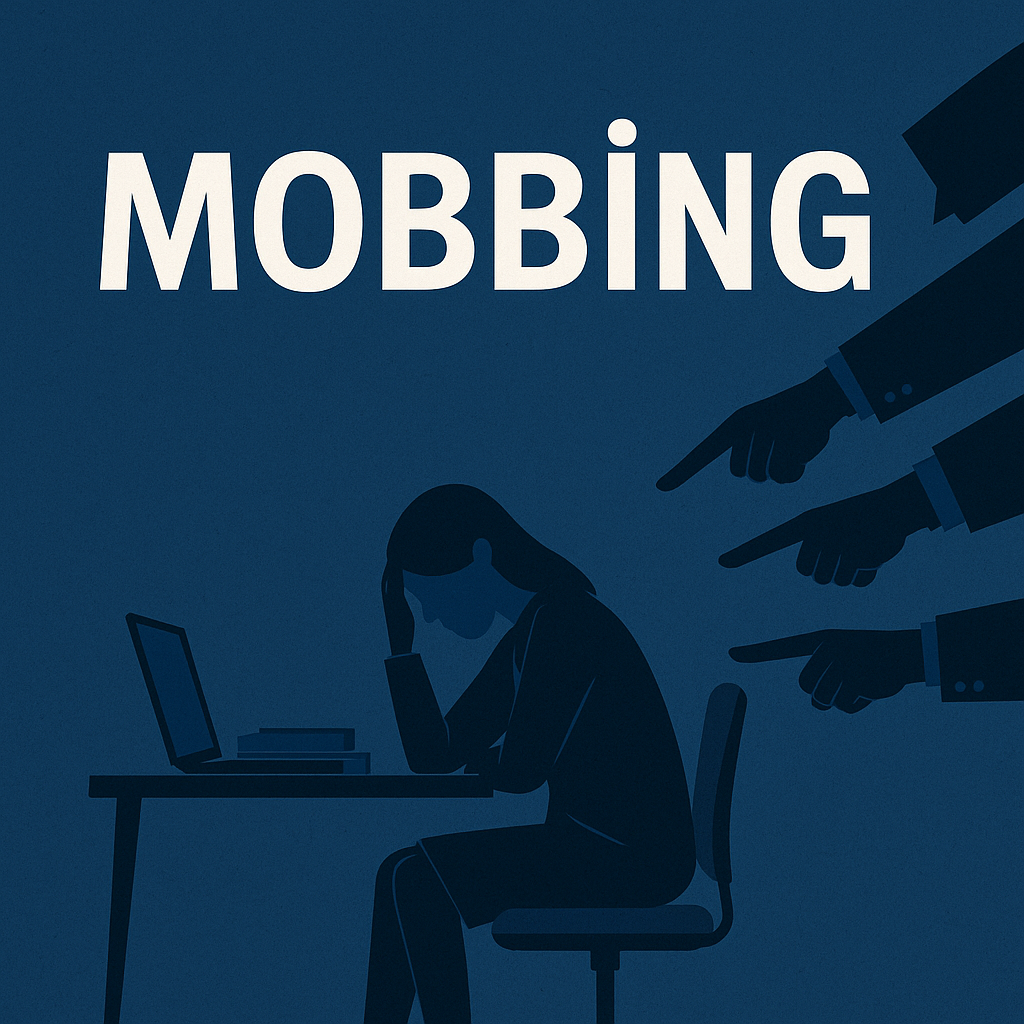
How is Mobbing Proven? What are the Employee’s Rights and What Do Supreme Court Mobbing Decisions Say? When judicial decisions are examined, the fundamental principles and methods adopted by the courts regarding the proof of mobbing (psychological harassment) allegations are summarized below.
A. Definition and Essential Elements of Mobbing
Mobbing, in Supreme Court decisions, is defined as the process of establishing psychological and emotional pressure in the workplace through words, attitudes, and behaviors that create weariness, fear, anxiety, or depression, systematically targeting a specific employee by one or more individuals. The purpose of this process is to neutralize, devalue, humiliate, or force the targeted person to leave their job (Supreme Court 22nd Civil Chamber, 2017/42766).
For an act to be considered mobbing, the following elements must be present together:
Systematic Nature: Behaviors must be purpose-driven and planned.
Continuity: Actions must be spread over a certain period and repeated. Isolated, rude, or impolite behaviors that do not show continuity are not classified as mobbing (Supreme Court 4th Civil Chamber, 2019/4695; Supreme Court 9th Civil Chamber, 2017/10963).
Intent: The presence of the aim to intimidate, coerce, or dismiss from work (9th Civil Chamber of the Court of Cassation, 2013/5390).
Targeting: The acts being directed at a specific employee or group (9th Civil Chamber of the Court of Cassation, 2021/12218).
B. Mobbing Standard of Proof and Ease of Proof
In court decisions, it is frequently emphasized that in proving mobbing allegations, unlike in criminal proceedings, “proof beyond a reasonable doubt” or “one hundred percent proof” is not sought. In labor law proceedings, “proof sufficient to establish a conscientious conviction” is considered enough for the judge (22nd Civil Chamber of the Court of Cassation, 2014/3434; 9th Civil Chamber of the Court of Cassation, 2016/36185).
In this context, courts adopt the method of “preponderance of evidence”. Preponderance of evidence means that proof is considered to have been established when the truthfulness of the alleged event is deemed probable and the likelihood of it being true outweighs the likelihood of it not being true (22nd Civil Chamber of the Court of Cassation, 2014/17345; 4th Civil Chamber of the Court of Cassation, 2019/4695). Furthermore, frequent reference is made to the concept of “circumstantial evidence” (emare), also referred to as “prima facie proof”. Accordingly, it is accepted that proof can be established by the conclusion reached when the typical course of events and rules of life experience are taken into consideration (9th Civil Chamber of the Court of Cassation, 2016/12989; General Assembly of Civil Chambers of the Court of Cassation, 2012/9-1925).
It is also stated that for the existence of mobbing, “there is no need for a severe violation of personal rights; an injustice against personal rights is sufficient” (Court of Cassation 22nd Civil Chamber, 2013/293; Court of Cassation General Assembly of Civil Chambers, 2015/2274).
C. Distribution of the Burden of Proof for Mobbing
As a general rule, the burden of proof rests with the claimant, i.e., the employee (Court of Cassation 9th Civil Chamber, 2013/5390; Council of State 12th Chamber, 2024/3088). However, decisions by the Court of Cassation and the Constitutional Court have introduced an eased burden of proof in favor of the employee. Accordingly, it is sufficient for the plaintiff employee to “put forward facts that raise suspicion that they were subjected to mobbing in the workplace”. When the employee presents these facts to the court, the “burden of proving that mobbing did not occur in the workplace shifts to the defendant employer” (Court of Cassation 22nd Civil Chamber, 2013/293; Court of Cassation General Assembly of Civil Chambers, 2015/2274; Constitutional Court, 10/3/2016). This approach is likened to the rule of the burden of proof in allegations of violation of the equal treatment obligation under Article 5 of the Labor Law No. 4857 (Court of Cassation 9th Civil Chamber, 2021/12218).
D. Evidence That Can Be Used in Proving Mobbing
The evidence that can be used in proving mobbing is as follows:
Witness Statements: This is one of the most frequently resorted to pieces of evidence. However, witness statements must be based on direct observation, be consistent, and contain concrete facts. Statements based solely on hearsay or from hostile witnesses may not be considered sufficient (Court of Cassation 9th Civil Chamber, 2016/16456; Constitutional Court, 15/11/2023).
Health Reports: Doctor and health board reports regarding health problems such as anxiety disorder and digestive system disorders arising from mobbing are important evidence (Court of Cassation 22nd Civil Chamber, 2014/3434; Court of Cassation 22nd Civil Chamber, 2013/293).
Correspondences: Emails, internal company messages, and other written documents can reveal expressions constituting mobbing (e.g., insults, humiliation, improper instructions) (Court of Cassation General Assembly of Civil Chambers, 2015/2274; Court of Cassation 22nd Civil Chamber, 2017/42766).
Administrative and Official Documents: Reports prepared by Ministry Labor Inspectors, complaint petitions submitted to the employer, and disciplinary investigation records can be used as evidence (Court of Cassation 9th Civil Chamber, 2017/15380; Court of Cassation 9th Civil Chamber, 2016/36185).
Other Evidence: All kinds of evidence, such as expert reports, camera recordings, and sudden and unjustified drops in the employee’s performance evaluation records, are taken into consideration (Court of Cassation 22nd Civil Chamber, 2020/230).
E. Employee Rights in Cases of Mobbing
The main rights of an employee if mobbing is proven are as follows:
Right to Terminate the Employment Contract for Just Cause and Severance Pay
An employee subjected to mobbing has the right to immediately terminate their employment contract for just cause, pursuant to Article 24 of Labor Law No. 4857. In this case, the employee is entitled to severance pay (Court of Cassation 9th Civil Chamber, 2020/2304; Court of Cassation 9th Civil Chamber, 2016/36185).
Right to Material and Moral Compensation
Since mobbing constitutes an assault on the employee’s personal rights, the employee may claim moral compensation. This right is based on Article 58 of the Turkish Code of Obligations No. 6098 (Supreme Court 9th Civil Chamber, 2013/5390). Furthermore, it is also possible to claim material compensation for actual damages arising from mobbing practices that are not based on assumption (Supreme Court General Assembly of Civil Chambers, 2012/9-1925).
Right to Reinstatement
If an employee falls ill due to mobbing and the employer terminates the employment contract by citing this situation, it is not considered a valid reason for termination under Article 25/I of the Labor Law No. 4857. In such a case, the termination may be deemed invalid, and the employee may be ordered to be reinstated. If the employee is not reinstated despite applying for reinstatement, the employee shall also be paid compensation for non-reinstatement and wages for the idle period (Supreme Court 22nd Civil Chamber, 2014/3434).
Employer’s Duty of Protection and Care
The fundamental basis of the employee’s rights is the employer’s “duty of care towards the employee”. In accordance with Article 417 of the Turkish Code of Obligations No. 6098, the employer is “obliged to protect and respect the employee’s personality in the service relationship and to ensure an order in the workplace in accordance with the principles of honesty, particularly by taking necessary measures to prevent employees from being subjected to psychological and sexual harassment and to ensure that those who have been subjected to such harassment do not suffer further harm.” Mobbing constitutes a violation of this obligation of the employer (Court of Cassation General Assembly of Civil Chambers, 2015/2274; Constitutional Court, 10/3/2016). In the decisions of the Constitutional Court, this situation is also considered as a requirement of the right to protect and develop one’s material and spiritual existence, guaranteed by Article 17 of the Constitution (Constitutional Court, 15/11/2023). An article suggestion.

Why is Expert Lawyer Support Necessary?
Mobbing lawsuits are legal processes that are extremely technical and delicate, both in terms of the burden of proof and the evidence collection stages. As seen in the decisions of the Court of Cassation and the Constitutional Court, special evaluation criteria such as “approximate proof,” “prima facie evidence,” and “circumstantial evidence” are applied in proving mobbing; witness statements, correspondences, health reports, and workplace records are meticulously examined. Therefore, even a small procedural error can lead to the employee losing their rights.
Especially in regions with intense business life such as Istanbul, Tuzla, Pendik, Kartal, Maltepe, Kadıköy, Ataşehir, Ümraniye, Gebze, Dilovası, Çayırova, and Tepeören, mobbing disputes come up more frequently, and determining the correct legal strategy is of vital importance.
2M Law Office aims to protect the employee’s rights in the most effective way by professionally providing the necessary legal framework, evidence strategy, and litigation process management in proving the allegation of mobbing. Expert legal support is necessary for the following reasons:
Correct analysis of the elements of the mobbing process
Proper selection of witnesses and legally compliant submission of their statements
Processing correspondence and documents in the file in accordance with their evidential quality
Evaluation of the legal validity of medical reports
Correct application of the employer’s duty of care, criteria for non-pecuniary damages, and severance pay rights
Comprehensive management of reinstatement lawsuits and compensation processes
Mobbing is not only psychological but also a serious violation of rights that directly affects the employee’s future. Therefore, working with an expert lawyer from start to finish of the process both prevents loss of rights and increases the chance of success.