

Introduction
This study analyzes the procedures and principles regarding the acquisition of Turkish citizenship through marriage, the main deficiencies leading to the rejection of applications, and the matters on which courts most frequently rule for annulment in cases filed against administrative actions in this regard, in light of the presented literature data. According to Article 16 of the Turkish Citizenship Law No. 5901 (TCL), marrying a Turkish citizen does not directly grant Turkish citizenship to the foreigner; this right is regulated as a status obtainable by fulfilling the conditions specified in the law and by a decision of the Ministry of Interior, the competent authority. Literature shows that this process is based on a balance between the administration’s discretionary power and judicial review, and that court decisions play a critical role in defining the limits of practice.
1. Conditions for Acquiring Turkish Citizenship Through Marriage
Acquisition of Turkish citizenship through marriage requires a series of conditions related to both procedural and substantive matters to be present simultaneously.
a. Substantive Conditions
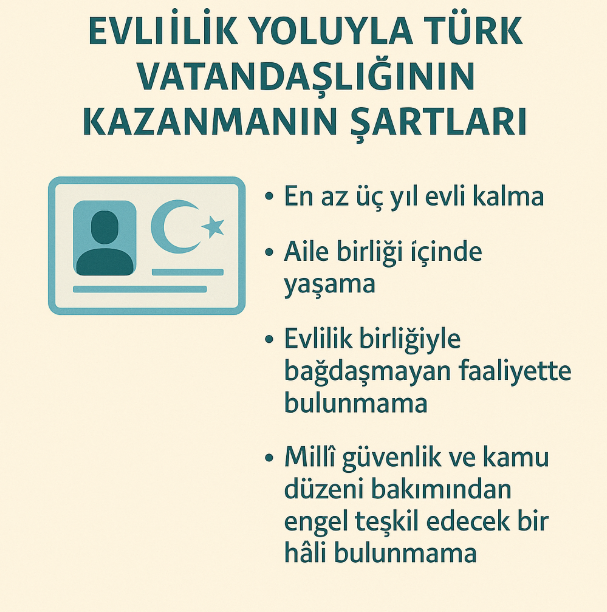
Article 16 of the Turkish Citizenship Law (TVK) explicitly states the fundamental conditions required for a foreigner seeking to acquire citizenship through marriage. These conditions are cumulative, and the absence of any one is sufficient for the application to be rejected. Firstly, for an application to acquire Turkish citizenship through a valid marriage, the marriage established by the foreign applicant with a Turkish citizen must have lasted for at least three years and must still be ongoing. In addition to these conditions, the foreign applicant is also required to meet the following: living within the family unity, not engaging in activities incompatible with the marital union, and not having any situation that poses an obstacle to national security and public order.
These conditions are as follows:
Married for at least Three Years: As of the application date, the foreign national must have been married to a Turkish citizen for at least three years, and the marriage must still be ongoing.
Living within Family Unity: It is essential that the spouses live together physically and that the marriage is not fictitious (collusive). This condition reflects the legislator’s aim to promote genuine marriages.
Not Engaging in Activities Incompatible with the Marital Union: The applicant is expected not to engage in activities that are contrary to general morality, undermine the dignity of the family institution, or render the continuation of the marital union impossible.
Absence of a Condition Constituting an Obstacle to National Security and Public Order: The applicant must not have a situation that would disrupt public order or threaten national security.
b. Procedural Requirements
The application process is subject to a specific procedure. A foreigner wishing to acquire Turkish citizenship through marriage can apply to the governorate of their place of residence within the country, or to foreign missions abroad. In applications for acquiring Turkish citizenship through marriage, the determination of whether foreigners meet the necessary application requirements will be made by the “Citizenship Application Review Commission established in the provinces.”
Applications are made to governorates within the country and to consulates abroad. The application authorities conduct an initial review to check if the file is complete. In case of deficiencies, the application may not be accepted. The final decision is made by the Ministry of Interior.
2. Issues Leading to Rejection of Applications and Judicial Annulment
The rejection of applications is generally based on the failure to meet the substantive conditions listed in Article 16 of the Turkish Citizenship Law (TVK). However, the administration’s discretionary power in this regard is not unlimited and is subject to judicial review by the courts for legality. The issues most frequently subject to annulment in court decisions are:
a. Interpretation of the Condition of Living in Family Unity and Claims of Sham Marriage
One of the most frequent grounds for rejection by the administration is the claim that the marriage is fictitious and that the condition of “living within family unity” is not met. However, courts require this claim to be proven with concrete evidence, not abstract statements. In a Council of State decision, the rejection action taken by the administration on the grounds that the condition of “living within family unity” was not met, was annulled by the court for the following reasons: “…that the legislator’s aim is to prevent sham marriages and establish genuine marriages, that as a result of the investigation carried out by the administration in line with the plaintiff’s request, there was no finding that the plaintiff failed to meet the conditions of not engaging in any activity incompatible with family unity after marriage… that there was no conformity with the law in the administrative action of rejecting the citizenship application on the grounds that the foreign spouse applying for citizenship did not meet the condition of living within family unity…” Courts find rejection decisions unlawful if the investigation conducted by the administration is insufficient or based on assumptions.
b. Activities Incompatible with Marital Union
In interpreting this condition, courts attach particular importance to the timing and nature of the activities in question. Engaging in activities incompatible with marital unity long before the marital union took place was not considered a ground for rejecting the citizenship application solely for this reason; instead, concrete evidence and statements were sought to prove that these activities continued within the marital union. Such activities not carried out within the marital union, not continued or repeated after marriage, have not been considered a ground for rejecting a citizenship application in many court decisions.
This jurisprudence demonstrates that the administration cannot use the applicant’s past actions as an absolute ground for refusal without a current impact on the marital union.
c. Effect of the Turkish Citizen Spouse’s Status on the Application
While conditions for the applicant foreign spouse are enumerated in Article 16 of the Turkish Citizenship Law (TVK), there is no condition regarding the Turkish citizen spouse. Despite this, there are instances where the administration rejects applications, citing the Turkish citizen spouse’s criminal record or conviction status as a reason. Courts annul such rejection decisions, finding them contrary to the principle of “personal culpability”. Considering the principle of personal criminal responsibility in Article 38 of the Constitution, the principle of legality concerning citizenship law in Article 66, and the conditions for acquiring Turkish citizenship through marriage in Article 16 of the TVK, it is seen that the administration’s rejection of a foreign spouse’s application for citizenship through marriage, based on the Turkish citizen spouse’s criminal record, detention, or conviction status, constitutes an unlawfulness. This issue has frequently been brought up in court decisions, and the administration’s decisions to reject citizenship applications have been overturned if no connection is found between the foreign spouse and the crime of the Turkish citizen spouse.
d. National Security and Public Order Justification
This justification is the area that grants the administration the widest discretionary power. However, this power is not absolute. Nevertheless, when reports from intelligence units like the Undersecretariat of MIT (National Intelligence Organization) are involved, courts tend to interpret the administration’s discretion more broadly. This situation indicates that judicial review of national security justifications can be more limited compared to other justifications.
e. Relying on Regulations that have been Repealed or are Contrary to Law
When citizenship applications are rejected, citing conditions that are not in the law but are introduced by regulations constitutes a violation of the “principle of legality”. It is stated that considering “being under investigation” as a reason for rejection, as stipulated in Article 25 of the Regulation on the Implementation of the Turkish Citizenship Law (TVKUY), is contrary to the presumption of innocence and the principle of legality. Similarly, the inclusion of a provision regarding the loss of citizenship in the event of annulment of marriage in the regulation, despite its absence in the law, is unconstitutional. Courts tend to annul administrative actions that violate such a hierarchy of norms.
Conclusion
Literature analysis reveals that acquiring Turkish citizenship through marriage is subject to clear conditions defined by law, but the administration has discretionary power in interpreting these conditions. However, this discretionary power is not unlimited and is subject to judicial review. Court decisions provide a safeguard against arbitrary practices of the administration, especially regarding the following:
Burden of Proof: The absence of abstract conditions such as “living within family unity” must be proven by the administration with concrete and unequivocal evidence.
Principle of Individuality: The status of the Turkish citizen spouse cannot be used as a sole reason for rejection unless a direct connection is established with the status of the applicant foreign spouse.
Time Limitation: It is required that “activities incompatible with the marital union” occurred during the marriage period or are proven to have continued during this period.
Principle of Legality: Administrative actions cannot be based on provisions not explicitly stated in the law or on regulations that have been repealed.
In this context, in lawsuits filed against rejection decisions in citizenship applications through marriage, the focal point of judicial review is whether the justification for the administrative action is based on concrete evidence and complies with the general principles of law (personality, legality, presumption of innocence). An article suggestion.
Why Is Expert Lawyer Support Necessary?
The process of acquiring Turkish citizenship through marriage is not merely a declaration of marriage; it is a multi-layered citizenship procedure with administrative, legal, and judicial stages. A large portion of applications are rejected due to missing documents, misinterpretation of the family unity condition, or incorrect use of the administration’s discretionary power.
Especially in citizenship applications made in regions with a dense foreign population, such as Istanbul, Tuzla, Pendik, Kartal, Gebze, Tepeören, Aydınlı, and Orhanlı, the interview process, the verification of whether the marital union is actually maintained, and public order examinations require special diligence. A small mistake made at this stage can lead to the rejection of the application or litigation processes that can last for years.
For this reason, from the beginning of the process, the support of an expert lawyer in the field of citizenship and foreigners’ law is of critical importance. An expert lawyer:
ensures the complete preparation of the application,
Develops effective defense against arbitrary or erroneous evaluations by the administration,
Professionally manages the administrative litigation process in case of rejection,
Provides guidance on pre-interview preparation, document control, and statement consistency.
An application prepared with the right legal strategy ensures both successful acquisition of citizenship and the completion of the administrative process in the shortest possible time. Therefore, working with an experienced citizenship lawyer operating in Istanbul and its surrounding areas is the most effective way to manage the process securely.